
 = Partner Site
Harold and the Purple Crayon Reading Level: A Complete Guide
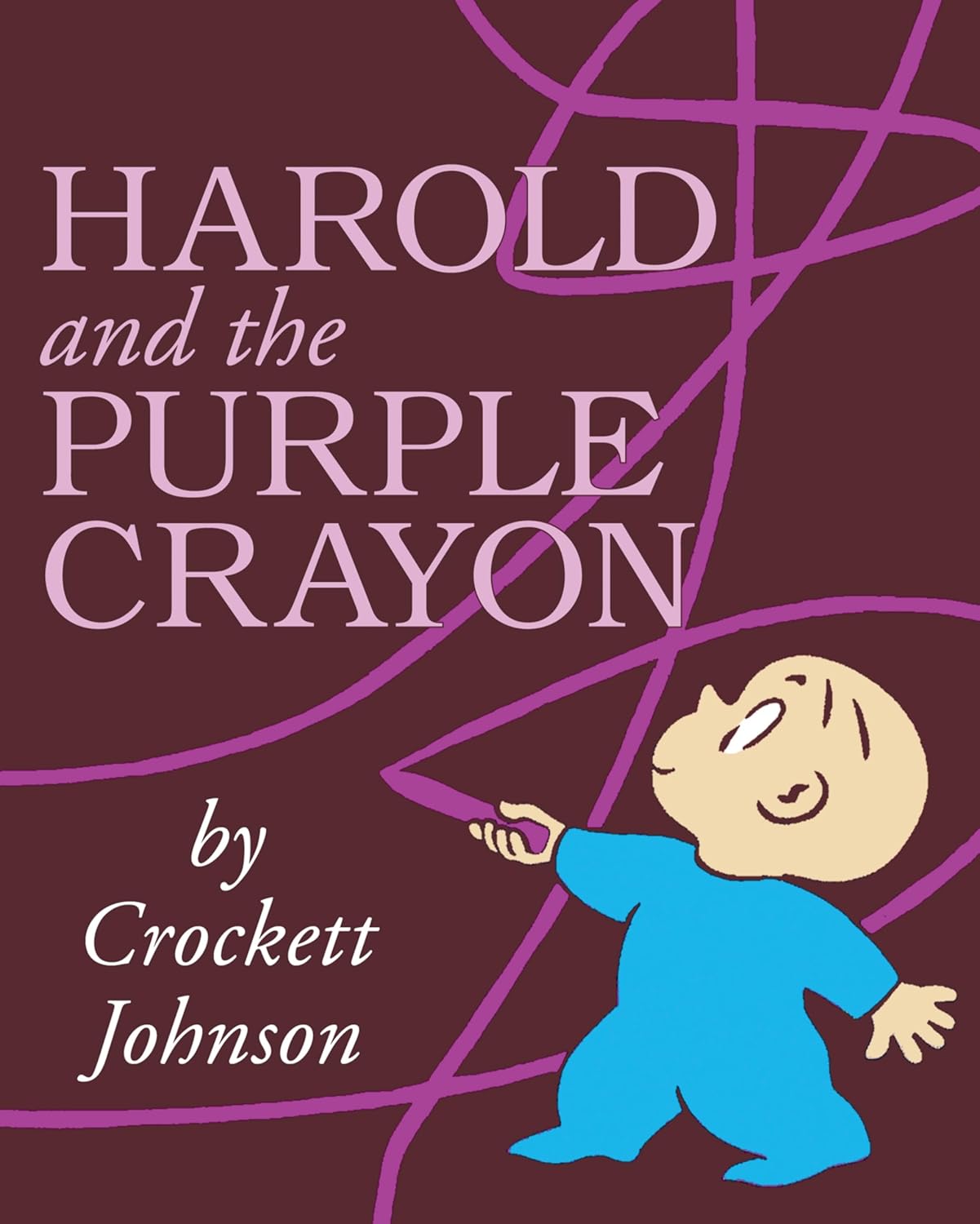
Harold and the Purple Crayon by Crockett Johnson is one of the most quietly radical picture books ever published — a spare, monochromatic story about a small boy who draws his own world into existence and finds his way home again. Published in 1955, it has never gone out of print, and its central idea — that imagination is the most powerful tool a child possesses — is as compelling now as it was seven decades ago. This guide covers the reading level, recommended age, read-aloud vs. independent reading guidance, themes, and everything parents and teachers need to know about sharing this classic with young readers.
For Parents
Find out whether Harold and the Purple Crayon works best as a read-aloud or independent read for your child, what age range it suits, and why this deceptively simple book has inspired readers for nearly seventy years.
For Teachers
Grade-level data, read-aloud timing, key themes, and discussion questions for a cornerstone creative thinking and imagination book. Strong for art integration, writing workshop, discussions of problem-solving and self-reliance, and any unit on the relationship between drawing and storytelling.
Harold and the Purple Crayon at a Glance
Find on Amazon →| Author & Illustrator | Crockett Johnson |
| Published | 1955 |
| Grade Level | K–1 (our assessment) |
| Recommended Age | 3–6 |
| Best For | Read-aloud ages 2–6; independent reading ages 4–6 |
| Flesch-Kincaid Grade | 2.3 |
| Word Count | ~650 |
| Pages | 64 |
| Genre | Picture book / fantasy |
| Setting | A moonlit night; wherever Harold draws |
For official Lexile and AR levels, visit Lexile.com or AR BookFinder. ReadingVine provides independent editorial assessments.
What Reading Level Is Harold and the Purple Crayon?
Harold and the Purple Crayon is a K–1 reading level by our editorial assessment, with a Flesch-Kincaid grade level of approximately 2.3. At around 650 words across 64 pages it has a very low word-per-page ratio — the text is spare and declarative, written in the third person with short, clear sentences that match Harold’s own direct, untroubled logic. The vocabulary is accessible, and the sentence structure rarely extends beyond two clauses.
What makes the book distinctive at this level is not its text alone but the relationship between text and image. Johnson’s illustrations are almost entirely in purple crayon on white — the line Harold draws is the line Johnson draws, so that every illustration is both a picture of what Harold has created and a demonstration of how he created it. This relationship between the words and the pictures carries a significant portion of the book’s comprehension load, and children who read the pictures carefully get more of the book than children who focus only on the text. A close reader of the illustrations will notice, for instance, that Harold’s path is continuous — the line never quite ends — which is itself a subtle piece of storytelling.
For parents who use specific reading level systems: we recommend checking your child’s level on Lexile.com or AR BookFinder for official scores, or asking your child’s teacher for their Guided Reading or DRA level.
Is Harold and the Purple Crayon a Read-Aloud or Independent Read?
Harold and the Purple Crayon works beautifully as both a read-aloud for ages 2–6 and an independent read for ages 4–6. As a read-aloud it is one of the most relaxed and unhurried books at this level — the pace is gentle, the adventures are mild, and Harold’s calm, practical approach to each challenge gives the whole book an atmosphere of serene competence that young children find deeply reassuring. Most adults can read it aloud in about 8–12 minutes.
As a read-aloud, the book rewards a delivery as quiet and unhurried as Harold himself. Johnson’s prose has an almost meditative quality — Harold decides something, Harold draws it, Harold moves through it — and reading it quickly or dramatically works against the book’s particular magic. The illustrations benefit from genuine looking time: the dragon guarding the apple tree, the ocean Harold tumbles into, the forest of trees that becomes so thick Harold gets lost, the window Harold finally draws that turns out to be his bedroom window. Each image is spare but precise, and children who spend time with them find more than a quick look reveals.
For independent reading, a confident kindergartner or early first grader can handle the text. The short, declarative sentences and the clear narrative logic — Harold needs something, Harold draws it — make the book highly accessible to beginning readers. The 64-page length is longer than it sounds, because most pages contain more illustration than text and turn quickly; a child reading independently will finish in far less time than the page count suggests.
There is nothing in this book that requires parental preparation. Harold encounters a dragon — who turns out to be more frightened of Harold than Harold is of it — and briefly falls into the ocean, but neither episode is frightening. The book is, in its entirety, one of the most calm and reassuring picture books in the canon.
After the first reading, give your child a piece of paper and something to draw with and ask: “If you had Harold’s purple crayon, what would you draw first?” The book is one of the best prompts for imaginative drawing and storytelling that exists at this level, and children who have just heard it invariably have something to say. Many will draw themselves into adventures of their own, which is precisely what Johnson intended.
What Is Harold and the Purple Crayon About?
One night, Harold decides to go for a walk in the moonlight. There is no moon, so he draws one. There is no path, so he draws one. Using his purple crayon, he draws himself through a forest, past a dragon guarding an apple tree, into an ocean he tumbles into by mistake, onto a boat he draws to escape the waves, to a picnic of nine kinds of pie, through a city of tall buildings, up in a hot-air balloon, and finally, exhausted and ready for bed, in search of his bedroom window. He draws windows until he remembers that his window always has the moon in the right corner. He draws that window, draws his bed, climbs in, drops the crayon on the floor, and falls asleep.
The story is a single, unbroken adventure drawn into existence by a small boy who solves every problem he encounters with the same tool he used to create it. There is no villain, no conflict beyond the mild inconvenience of getting lost, and no resolution beyond finding home again. What Harold and the Purple Crayon offers instead of plot is something rarer: a completely convincing portrait of how a child’s imagination works — purposeful, practical, endlessly inventive, and always finding its way back to the window with the moon in the corner.
Harold and the Purple Crayon Characters
Harold and the Purple Crayon has one character: Harold, a small, round-headed boy in a onesie who carries a purple crayon and an unshakeable confidence in his own ability to draw whatever he needs. He is not described in detail, and his face rarely changes expression — Johnson renders him with the simplest possible line, a few curves and dots that somehow communicate complete personhood. Harold is not brave in a dramatic sense; he doesn’t slay the dragon or conquer the ocean. He simply draws his way past each obstacle with calm pragmatism and moves on. Children respond to him with immediate recognition, because his approach to problems — just draw what you need — is both fantastical and completely logical from a child’s perspective.
Harold and the Purple Crayon Themes and Lessons
The central theme of Harold and the Purple Crayon is the power of imagination as a practical tool. Harold does not use his crayon to escape reality — he uses it to navigate reality. When he needs a moon, he draws one. When he falls into the ocean, he draws a boat. When he gets lost in a forest of trees, he draws himself out of it. His crayon is not a magic wand that makes things easy; it is the means by which he engages with every problem he encounters. The book argues, quietly and completely, that a child who can imagine something can also do something about it.
This connects directly to the book’s secondary theme of self-reliance. Harold is entirely alone throughout his adventure, and he manages it entirely on his own. He does not ask for help, and he does not need it — not because the world is without challenge but because he has the tools to meet every challenge it presents. For young children who are learning to navigate an increasingly independent world, Harold’s competent solitude is both aspirational and reassuring. He gets lost. He finds his way home. He did it himself.
The book’s final sequence — Harold searching for his bedroom window among all the windows he has drawn, remembering that his window always shows the moon in a particular corner, and drawing that exact window — is one of the most elegant treatments of the idea of home in children’s literature. Home is not just a place; it is a specific, recognizable arrangement of familiar things. Harold can find it because he knows it. Children who hear this book at bedtime often feel the warmth of that recognition without being able to articulate it, which is the best kind of picture book resonance.
Discussion starters for families: What would you draw first if you had Harold’s purple crayon? How did Harold find his way home? Why wasn’t Harold afraid of the dragon? Could you draw yourself out of a problem the way Harold does? What does your bedroom window look like at night?
How Long Is Harold and the Purple Crayon?
Harold and the Purple Crayon has 64 pages and approximately 650 words — a very low word count for 64 pages, because most spreads are dominated by illustration rather than text. Most adults can read it aloud in about 8–12 minutes, though the book rewards a slower pace that gives children time to look at each drawing.
A child reading independently will typically finish in about 8–12 minutes as well, since the pages turn quickly once a child is in the rhythm of Harold’s adventure. The 64-page length should not intimidate parents of young independent readers — it reads significantly shorter than it counts, and the quick page turns feel like momentum rather than length.
Books Similar to Harold and the Purple Crayon
If your child loves Harold and the Purple Crayon, these titles share its imagination-first premise, its adventure arc, or its place in the classic picture book canon:
About the Author and Illustrator
Crockett Johnson was the pen name of David Johnson Leisk (1906–1975), an American cartoonist, illustrator, and children’s book author born in New York City. He took the nickname “Crockett” in childhood after American folk hero Davy Crockett, as a way to distinguish himself from the many other Davids in his neighborhood. He studied art at Cooper Union and New York University, and began his professional career as a commercial illustrator before creating the comic strip Barnaby (1942–1952), which became one of the most popular newspaper comics of the 1940s and attracted admirers from Dorothy Parker to Eleanor Roosevelt.
Harold and the Purple Crayon was published in 1955, the same year the FBI closed his case file — they had been trying to interview him as a potential informant, apparently troubled by his history of left-wing political associations, but Johnson simply stayed home and waited them out until they gave up. The timing is not incidental: Johnson’s politics, his commitment to imagination and self-determination, and his conviction that children deserved books that took their inner lives seriously are all of a piece. The book was an immediate success; Horn Book called it “an ingenious and original little picture story,” and Johnson’s editor, the legendary Ursula Nordstrom, urged him to write a sequel the following year. Seven Harold books in total followed, the last in 1963.
Johnson’s wife was the celebrated children’s book author Ruth Krauss, with whom he collaborated on four books, including The Carrot Seed (1945), illustrated by Johnson and written by Krauss — one of the great picture books about patience and belief. In his final decade, Johnson turned to an entirely different creative pursuit: he painted more than 100 canvases inspired by geometric shapes and mathematical theorems, 80 of which are now in the collections of the National Museum of American History. Among the book’s many admirers over the years was the musician Prince, who has been reported to have loved Harold and the Purple Crayon as a child and to have embraced purple as his emblematic color partly in Harold’s honor.
Harold and the Purple Crayon: Frequently Asked Questions
What reading level is Harold and the Purple Crayon?
Harold and the Purple Crayon is a K–1 reading level by our editorial assessment, with a Flesch-Kincaid grade level of approximately 2.3. The text is spare and declarative — short, clear sentences in the third person — with around 650 words across 64 pages. It works best as a read-aloud for ages 2–6 and as an independent read for ages 4–6. For official Lexile and AR levels, visit Lexile.com or AR BookFinder.
What age is Harold and the Purple Crayon for?
Harold and the Purple Crayon is appropriate for ages 2–6. As a read-aloud it works from age 2 — the gentle pacing, the mild adventures, and Harold’s calm confidence make it well suited to very young children. As an independent read it suits children ages 4–6 who are building early reading skills. It is one of the most relaxed and unhurried picture books at this level, which makes it particularly effective as a bedtime book.
What is Harold and the Purple Crayon about?
Harold and the Purple Crayon is about a small boy who goes for a walk in the moonlight, drawing everything he needs as he goes — a moon, a path, a forest, a dragon, an ocean, a boat, a picnic, a city, a hot-air balloon — and then draws his way home when he gets lost, finding his bedroom window by remembering that the moon always sits in the same corner. It is a story about imagination as a practical tool, and about a child who is completely capable of creating and navigating his own world.
How long does it take to read Harold and the Purple Crayon aloud?
Most adults can read Harold and the Purple Crayon aloud in about 8–12 minutes. Despite its 64-page count, most pages contain more illustration than text, and the pages turn quickly. The book rewards a slow, unhurried pace that gives children time to look at Harold’s drawings — rushing it works against the book’s particular calm and magic.
Are there other Harold books?
Yes — Crockett Johnson wrote seven Harold books in total, all featuring the same small boy with his purple crayon: Harold’s Fairy Tale (1956), Harold’s Trip to the Sky (1957), Harold at the North Pole (1958), Harold’s Circus (1959), A Picture for Harold’s Room (1960), and Harold’s ABC (1963). All are appropriate for the same age range and use the same spare illustration style. Most readers consider the original the strongest, but all seven are genuine Crockett Johnson titles and worth reading.
Why is Harold’s crayon purple?
Crockett Johnson never gave a definitive public explanation for the color, and the choice is generally understood as aesthetic and practical rather than symbolic: purple reproduces clearly in the book’s monochromatic illustrations, it is visually distinctive against the white pages, and it is an unusual enough color to feel slightly magical without being garish. What is documented is that the musician Prince, who cited Harold and the Purple Crayon as a childhood favorite, embraced purple as his emblematic color partly in Harold’s honor — one of the more charming legacies of a children’s book color choice in American cultural history.