
 = Partner Site
Into Thin Air Reading Level: A Complete Guide
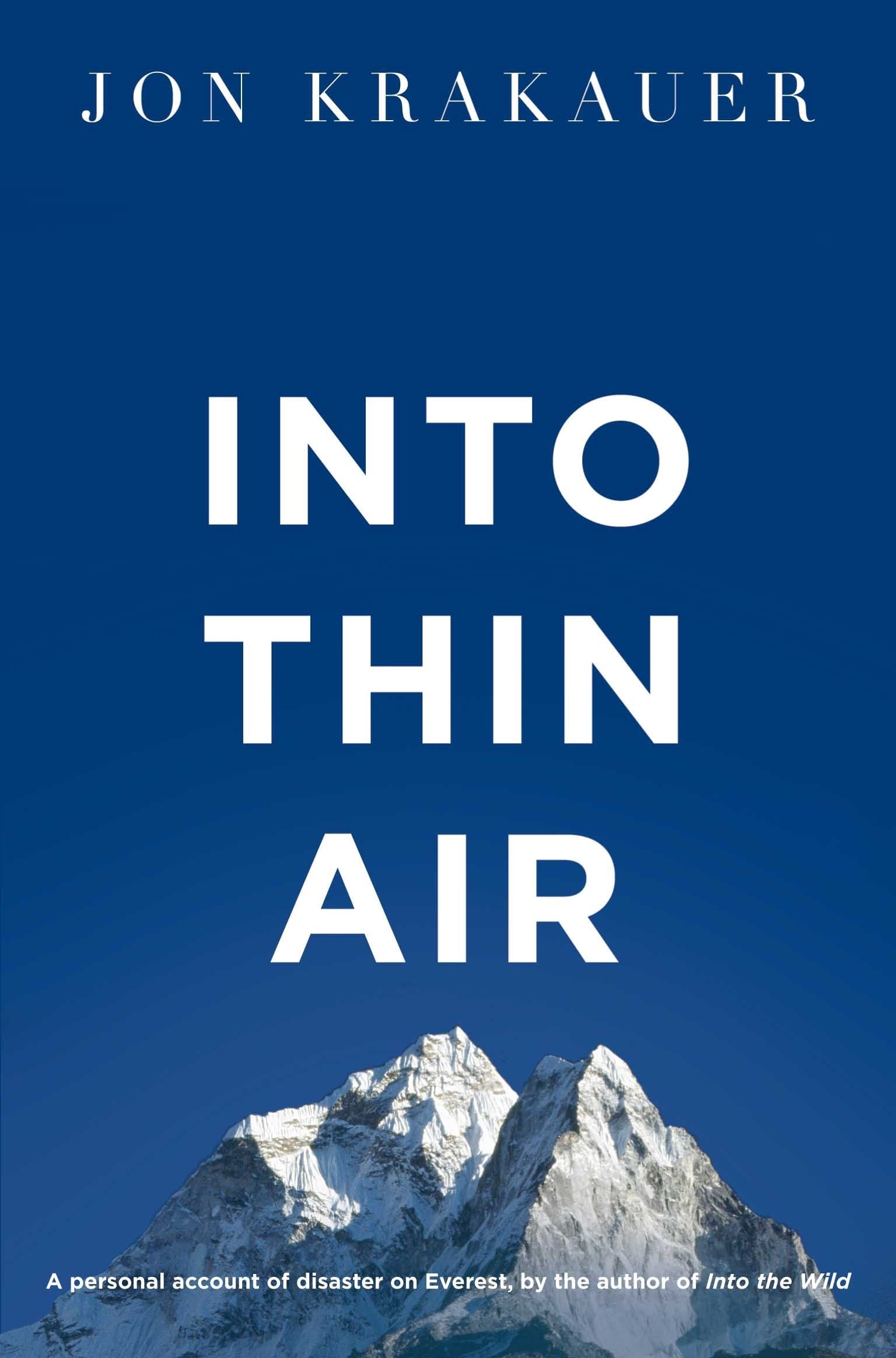
Into Thin Air by Jon Krakauer is the firsthand account of the 1996 Mount Everest disaster — a day in May when eight climbers died on the world’s highest mountain during a catastrophic storm, and Krakauer, who had reached the summit that morning as a journalist for Outside magazine, descended to his tent while his teammates were still dying above him. Published first as a magazine article in September 1996 and expanded into a book in 1997, it became the #1 national bestseller and spent years on school and library reading lists. It is simultaneously a gripping adventure narrative, a work of investigative journalism about the commercialization of Everest, and a sustained act of self-examination by a man who survived something that killed the people around him and who cannot fully reconcile what he knows about his own behavior that day. This complete guide covers Into Thin Air‘s reading level, recommended age, content considerations, key figures, themes, and books similar to Into Thin Air, designed for parents, teachers, and students.
For Parents
Narrative nonfiction — literary journalism about a real disaster with eight real deaths. No content concerns beyond the sustained engagement with death, extreme physical danger, and survivor guilt. Appropriate for ages 14 and up; most commonly assigned in grades 9–12 and college courses on nonfiction writing. The most demanding reading-level text in this catalog.
For Teachers
An exceptional grades 9–12 text for teaching narrative nonfiction, journalistic ethics, and the unreliable eyewitness. Krakauer’s acknowledged limitations as a narrator — oxygen deprivation, trauma, the impossibility of observing everything while surviving — are the text’s most productive teaching resource. The book’s controversy (Krakauer’s disputed account of Boukreev’s actions) is itself an outstanding example of the epistemological challenges of firsthand journalism.
Into Thin Air at a Glance
Find on Amazon →| Author | Jon Krakauer |
| Published | 1997 (Villard / Random House); originally Outside magazine, September 1996 |
| Grade Level | 9–12 (our assessment) |
| Recommended Age | 14+ |
| Lexile | 1320L |
| Word Count | ~92,000 |
| Pages | 368 (paperback) |
| Structure | 16 chapters plus epilogue |
| Genre | Narrative nonfiction / adventure journalism |
| Setting | Mount Everest, Nepal/Tibet; May 1996 |
| Awards | Pulitzer Prize finalist, Nonfiction (1998); Time Magazine Best Nonfiction Book of the Year (1997); Academy Award in Literature, American Academy of Arts and Letters (1999) |
For official Lexile and AR levels, visit Lexile.com or AR BookFinder. ReadingVine provides independent editorial assessments.
What Reading Level Is Into Thin Air?
Into Thin Air has a Lexile of 1320L — the highest in this catalog, and one that accurately reflects the book’s prose demands. Krakauer writes in the tradition of literary journalism: long, complex sentences with embedded technical and mountaineering vocabulary, precise factual layering, and a narrative voice that moves between the immediacy of the summit day and the retrospective analysis of a journalist who spent months investigating what happened. The prose is not ornate, but it is dense with information and requires the kind of sustained attention that extracts meaning from complexity rather than just following plot.
Booksource’s interest level is 9–12; SuperSummary grades it grades 9–12 through college and adult. Our editorial assessment is grades 9–12, ages 14 and up, with the practical note that the book rewards mature readers who are willing to engage with technical mountaineering detail and multiple conflicting accounts of the same events. Students who approach it as a thriller — what happened next? — will find it gripping; students who approach it as journalism — how do we know what happened? — will find it even richer. At approximately 92,000 words and 368 pages across 16 chapters, most classroom readers complete it in two to three weeks; many independent readers finish it in a weekend because the tension does not release. For official Lexile and AR scores, visit Lexile.com or AR BookFinder. ReadingVine’s assessments are independent editorial judgments.
What Age Is Into Thin Air Appropriate For?
We recommend Into Thin Air for readers ages 14 and up. This is the catalog’s most content-uncomplicated recommendation at its grade level: there is no sexual content, no significant profanity, and no content concern beyond the sustained engagement with death and extreme physical danger. Eight people die in the course of the events Krakauer describes — deaths that are depicted with the specific, unglamourized detail of a journalist who was there and who knew many of the people who did not come back. The death of Rob Hall in particular — his last radio conversations with his wife in New Zealand as he lay dying at the South Summit — is one of the most devastating passages in contemporary nonfiction. Parents should know this is a book about real deaths of real people, not fictional danger, and that the weight of that reality is part of the book’s effect.
Krakauer’s own guilt — his account of a mistake he made on the descent that may have contributed to a fellow climber’s death — is the book’s most psychologically demanding element. The book does not resolve this guilt; it lives in the book’s final pages as an open wound. Readers who are sensitive to themes of survivor guilt should know it is a significant undercurrent throughout.
What Is Into Thin Air About?
In 1996, Jon Krakauer was a writer for Outside magazine who had given up serious mountaineering years earlier when he agreed to join a commercial expedition to Mount Everest. His assignment was to report on the growing commercialization of Everest — the practice of guiding paying clients, many without significant mountaineering experience, up the world’s highest peak for fees of $65,000 or more. He had initially planned to go only to Base Camp, but the opportunity to summit was there, and he took it.
His expedition was led by Rob Hall, a celebrated New Zealand guide whose company Adventure Consultants was considered among the best in the business. Also attempting the summit on the same day — May 10, 1996 — were several other expeditions, including one led by Scott Fischer of Mountain Madness and a Taiwanese team and an IMAX film crew. The mountain that spring was, by the standards of commercialized Everest, crowded. Hall and Fischer had a history of professional rivalry. There was an unwritten agreement about summit time — teams were supposed to turn back by 2:00 p.m. regardless of whether they had reached the top, to ensure enough time to descend before dark and the weather that typically builds in the afternoon. On May 10, many climbers ignored or pushed past this deadline.
Krakauer reached the summit at approximately 1:17 p.m. and began his descent. By late afternoon, a massive storm had engulfed the upper mountain. The details of what happened next — who made which decisions, who helped whom, who was where during the storm — are disputed between Krakauer’s account and those of other survivors, and the book itself acknowledges this uncertainty. What is not disputed is the outcome: eight people died, including Rob Hall, Scott Fischer, and several of their clients and Sherpas. Krakauer descended to his tent and survived. He was one of the last people to see several of those who died.
The book is not a simple account of what happened. It is Krakauer’s attempt, written in the months after the disaster while the events were still vivid and before he could fully process them, to reconstruct a day that he experienced partially — oxygen-deprived, exhausted, frightened — and to examine his own role in it. He acknowledges a specific mistake he made on the descent: he misidentified a climber in distress as someone who had already reached safety, and did not raise an alarm. The climber later died. Whether Krakauer’s misidentification contributed to this death is one of the book’s unresolved questions, and Krakauer does not resolve it in his favor.
Into Thin Air: Key Figures
The Controversy Around Into Thin Air
Into Thin Air is not a banned or challenged book, and has no significant challenge history. It does have a substantial controversy — one that is itself one of the most productive things about the book for classroom use. Krakauer’s account of the disaster criticized several people’s decisions, most prominently guide Anatoli Boukreev’s decision to descend ahead of his clients without supplemental oxygen. Boukreev, with his co-author G. Weston DeWalt, responded with The Climb (1997), which disputed Krakauer’s account of multiple events and argued that Krakauer had mischaracterized what happened and omitted events that reflected poorly on Krakauer himself.
The dispute is not simply one person’s word against another’s. Several other survivors offered accounts that corroborated parts of both Krakauer’s and Boukreev’s versions while disagreeing with both on specific points. A key complicating factor is that everyone above 26,000 feet on Everest is operating under conditions of significant cognitive impairment: the brain does not function normally at extreme altitude, memories are distorted, perception is unreliable, and the physiological effects of hypoxia (oxygen deprivation) can produce errors of observation and judgment that the observer cannot identify as errors at the time. Krakauer acknowledges this directly: he makes clear that his account is the account of a severely oxygen-deprived man, that he is not certain of everything he reports, and that other witnesses will have seen different things.
This controversy is not a reason to distrust the book; it is a reason to read it carefully and to understand what journalism in extreme conditions can and cannot reliably tell us. Krakauer’s account is the most thoroughly researched single account of the disaster; it is also the account of a single, limited observer. The book is honest about these limitations in a way that makes it more valuable as a teaching text, not less.
Into Thin Air Themes and Lessons
Krakauer’s central argument — that the commercialization of Everest, by creating pressure on guides to get paying clients to the summit regardless of conditions, contributed directly to the deaths of May 10, 1996 — is the book’s most consequential analytical claim. In 1996, guided Everest expeditions charged $65,000 per client for the experience of reaching the summit. Clients who paid that amount expected to reach the top. Guides whose reputation depended on their summit success rate had commercial incentives to push clients forward in conditions that a less commercially pressured judgment might have identified as prohibitive. Whether those commercial pressures drove Hall and Fischer to make decisions that cost their lives — and whether Krakauer himself was affected by the same dynamics — is the book’s most important open question.
The question of why people climb Everest at all, and what they are looking for there, runs through the book alongside the analysis of decisions. Krakauer is honest about his own motivations: the summit of Everest had been a dream since childhood, the assignment gave him a legitimate professional reason to pursue it, and the experience of standing at 29,028 feet was real and transformative. He is also honest that it was not worth it — that what he gained from the summit was not commensurate with what the day cost him and cost the people who died. This honesty about the inadequacy of the experience to justify its price is one of the book’s most unusual qualities in a genre that tends to celebrate mountaineering as transcendent regardless of outcome.
The journalistic ethics question — what responsibility does a narrator have when their account disputes the actions of people who cannot respond, or who died, or who remember things differently — is the book’s most formally sophisticated concern. Krakauer names his own mistakes. He acknowledges the limitations of his perception. He includes critical accounts of his own behavior from other survivors. He addresses the Boukreev dispute directly in the postscript. All of this is modeling a specific practice of journalistic integrity: the willingness to subject oneself to the same scrutiny applied to others, and to acknowledge uncertainty where uncertainty genuinely exists.
Discussion questions for classrooms and families: What does the book argue about the relationship between commercial pressure and safety judgment on Everest — and do you find this argument persuasive? How does Krakauer handle the limitations of his own perception — and how does knowing he was oxygen-deprived change how you read his account of the summit day? What does the Boukreev dispute illustrate about the challenges of firsthand journalism? Why do people climb Everest — and what does Krakauer’s answer to this question say about his own relationship to risk? What does the book argue about the Sherpa guides’ role in Everest expeditions, and what does it leave out?
How Many Pages and Chapters in Into Thin Air?
The paperback edition is 368 pages across 16 chapters plus an epilogue. The 1999 paperback edition adds an extensive postscript in which Krakauer addresses the controversy with Boukreev and includes his account of their final conversation. Word count is approximately 92,000. Most classroom readers complete it in two to three weeks; most independent readers who engage fully finish it in a weekend because the tension does not release. The book opens at the summit — Krakauer on top of Everest at 1:17 p.m. — and then returns to the beginning of the expedition, creating a structure that puts the reader inside the disaster’s outcome before showing them how it arrived. This flashback structure is worth discussing as a narrative choice: Krakauer begins where the story peaks, not where it starts, and the effect is to make the entire approach to the summit feel weighted with what the reader already knows is coming.
Books Similar to Into Thin Air
About Jon Krakauer
Jon Krakauer was born in 1954 in Brookline, Massachusetts, and grew up in Corvallis, Oregon. His father introduced him to mountaineering at age eight; he summited Mount Rainier at ten. He studied environmental studies at Hampshire College and spent much of his twenties as a serious climber, supporting himself as a fisherman and carpenter while pursuing difficult ascents in Alaska, Patagonia, and elsewhere. By the early 1980s he was contributing articles to Outside magazine, and by the end of the decade he was a full-time writer.
Into the Wild, his account of Christopher McCandless’s death in the Alaskan wilderness, was published in 1996, the same year as the Everest disaster. The two books together established him as one of the defining voices of adventure journalism — a writer whose combination of personal engagement with his subjects, meticulous reporting, and genuine literary skill produces books that are both gripping and morally serious. Into Thin Air was a Pulitzer finalist in 1998 and received the American Academy of Arts and Letters’ Academy Award in Literature in 1999, with a citation that called him “one of the finest journalists and most important writers of our time.” His subsequent books — Under the Banner of Heaven (2003), Where Men Win Glory (2009), Missoula (2015) — have demonstrated that his range extends well beyond adventure journalism into institutional investigation and social criticism. He lives in Boulder, Colorado.
Into Thin Air: Frequently Asked Questions
What reading level is Into Thin Air?
Into Thin Air has a Lexile of 1320L — the highest in this catalog and accurate to the dense, technically complex prose of literary journalism. Booksource’s interest level is 9–12. Our editorial assessment places it at grades 9–12, ages 14 and up. For official Lexile and AR scores, visit Lexile.com or AR BookFinder.
What grade is Into Thin Air appropriate for?
We recommend grades 9–12, ages 14 and up. No content concerns beyond the sustained engagement with the deaths of real people and themes of survivor guilt. This is narrative nonfiction about an actual disaster; the deaths are real and depicted with specificity. The most demanding reading level in this catalog, appropriate for strong high school readers and above.
How many pages are in Into Thin Air?
368 pages across 16 chapters plus an epilogue. The 1999 paperback adds an extensive postscript addressing the Boukreev controversy. Word count approximately 92,000. Most independent readers finish it in a weekend; classrooms typically take two to three weeks.
What is Into Thin Air about?
Jon Krakauer’s firsthand account of the 1996 Mount Everest disaster, in which eight climbers died during a catastrophic storm on May 10, 1996. Krakauer had joined a commercial expedition as a journalist for Outside magazine, reached the summit that morning, and descended to his tent as the storm caught his teammates above him. The book is simultaneously an adventure narrative, an investigation of commercial mountaineering’s risks, and a sustained act of self-examination by a survivor.
Is Into Thin Air accurate?
Disputed in some specifics, but broadly regarded as the most thoroughly reported single account of the disaster. Guide Anatoli Boukreev disputed Krakauer’s characterization of his actions in a competing account, The Climb (1997). Krakauer acknowledges in the book itself that he was severely oxygen-deprived on summit day and that his perception and memory are therefore imperfect. The book is honest about its own limitations in ways that make it a valuable teaching text for journalistic ethics rather than undermining its credibility.
How many people died on Everest in 1996?
Eight people died on May 10, 1996 — the day Krakauer describes in Into Thin Air — making it the deadliest single day in Everest’s history at that time. Those who died include guide Rob Hall, guide Scott Fischer, three of Hall’s clients (Doug Hansen, Yasuko Namba, Andy Harris), and several others. Beck Weathers, left for dead twice, survived. The 1996 season’s overall death toll was higher than the single-day figure, and has since been exceeded by the 2015 earthquake and avalanche.
Is there a movie based on Into Thin Air?
Two. A 1997 TV movie, Into Thin Air: Death on Everest, was made directly from the book with Krakauer’s cooperation; it depicts the same events but differs from the book in its assignment of responsibility. The 2015 film Everest, directed by Baltasar Kormákur and starring Jason Clarke and Josh Brolin, depicts the same events without being based on Krakauer’s account specifically — Krakauer is a character in the film but the movie draws from multiple accounts. Both are rated PG-13 and are appropriate for the same age range as the book.
What is the Boukreev controversy in Into Thin Air?
Anatoli Boukreev, Scott Fischer’s lead guide, descended from the summit ahead of his clients and without supplemental oxygen. Krakauer criticized this decision as a failure of guiding responsibility. Boukreev responded in The Climb, arguing that his early descent was a deliberate strategy to position himself for rescue operations — which he did in fact conduct, saving several lives. Other survivors offered mixed assessments. Boukreev died in an avalanche on Annapurna in 1997. Krakauer’s postscript to the 1999 paperback addresses the dispute and recounts his final conciliatory conversation with Boukreev.