
 = Partner Site
The Things They Carried Reading Level: A Complete Guide
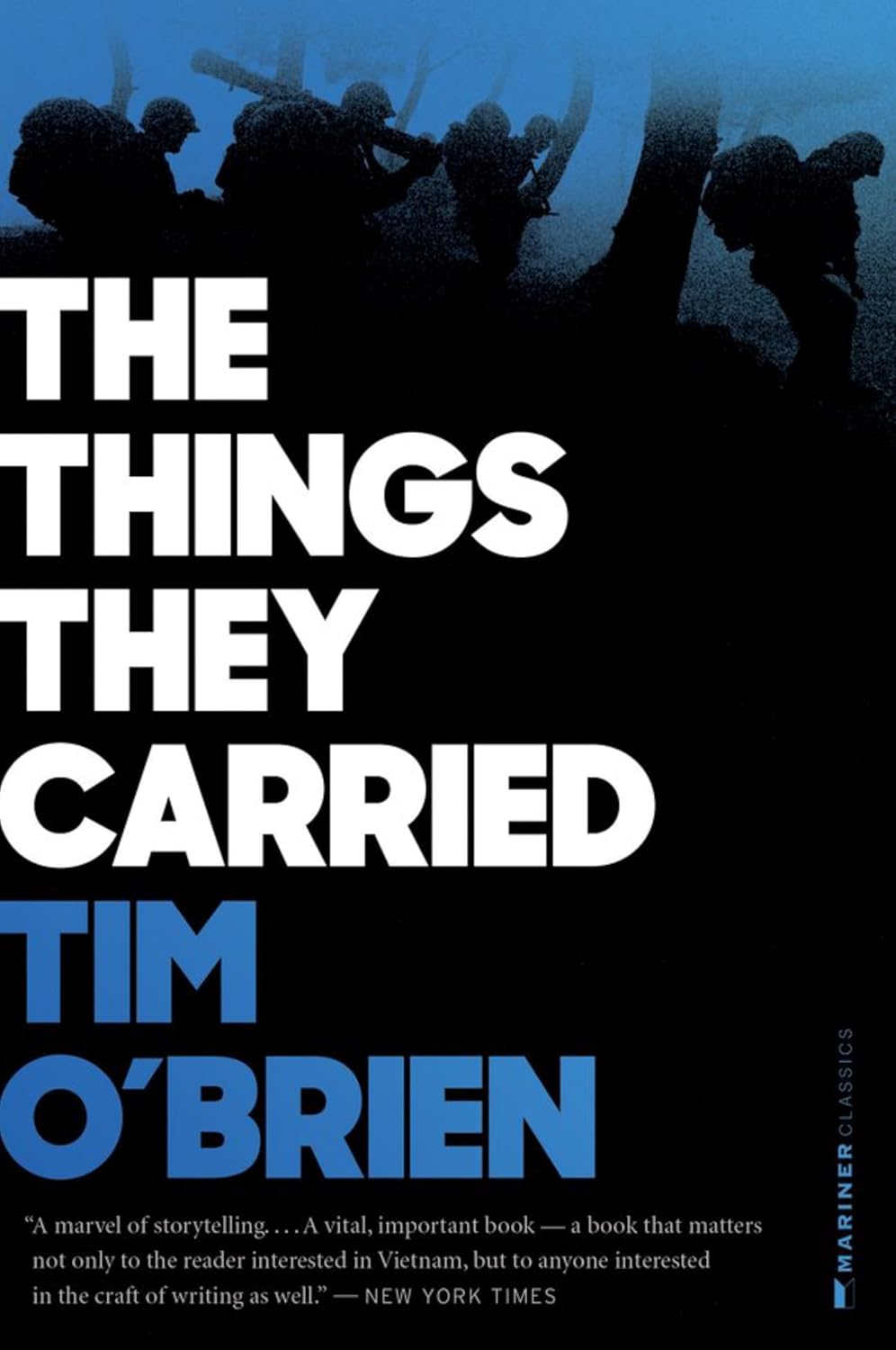
The Things They Carried is a 1990 collection of linked stories by Tim O’Brien, following a platoon of American soldiers—Alpha Company—through the Vietnam War and its aftermath. Published more than fifteen years after the fall of Saigon, it is neither straightforward fiction nor memoir but something O’Brien invented for the occasion: a book that uses his own name for its narrator-character, dedicates itself to the fictional people it depicts, and insists on the philosophical distinction between “story truth” and “happening truth.” It is widely taught in high school and college English courses, considered one of the essential works of American war literature, and one of the most sophisticated explorations of how storytelling functions—what it can do, what it cannot do, and why we need it anyway. This guide covers the book’s reading level, age appropriateness, characters, themes, and teaching resources for students, parents, and educators.
For Parents
The Things They Carried contains graphic depictions of combat death and violence, sustained profanity (the authentic speech of soldiers in combat), drug and alcohol use among soldiers, and some sexual content. These elements are historically grounded and purposeful—O’Brien is documenting the reality of infantry combat in Vietnam with an honesty that has made the book both celebrated and challenged. It is most commonly assigned in grades 10–12, and is appropriate for mature readers ages 15 and up. The book’s emotional and philosophical complexity makes it best suited to students who can engage with its questions about truth, memory, and the ethics of war rather than simply its surface events.
For Teachers
The Things They Carried is one of the most teachable books in the high school canon—not just as war literature, but as a masterclass in metafiction, narrative reliability, and the philosophy of storytelling. O’Brien’s explicit discussions of how and why he tells the stories he tells make the book uniquely self-aware, and the questions he raises about the relationship between fictional and factual truth are some of the most productive and generative in any senior-level English course. The book pairs naturally with All Quiet on the Western Front, Slaughterhouse-Five, primary source accounts of the Vietnam War, and journalism on the ethics of war reporting. Individual stories—particularly “The Things They Carried,” “How to Tell a True War Story,” and “On the Rainy River”—function beautifully as standalone texts for shorter units.
The Things They Carried at a Glance
Find on Amazon →| Author | Tim O’Brien |
| Published | 1990 |
| Grade Level | 10–12 (our assessment) |
| Recommended Age | 15–18 |
| Flesch-Kincaid Grade | 7.2 |
| Word Count | ~68,000 |
| Pages | ~233 (standard paperback) |
| Structure | 22 linked short stories (no traditional chapters) |
| Genre | Linked story collection / war literature / metafiction |
| Setting | Vietnam and the U.S. Midwest, 1968–1970s and beyond |
| Awards | Prix du Meilleur Livre Étranger (France, 1993); Chicago Tribune Heartland Prize |
For official Lexile and AR levels, visit Lexile.com or AR BookFinder. ReadingVine provides independent editorial assessments.
What Reading Level Is The Things They Carried?
ReadingVine places The Things They Carried at a grade 10–12 reading level, with a Flesch-Kincaid score of approximately 7.2. Unlike some high school texts where the gap between readability score and actual complexity is dramatic, O’Brien’s book is genuinely challenging in ways that align with the score: his prose is precise and controlled but also syntactically varied, capable of moving in a single passage from plain, declarative sentences that list what soldiers carry to lyrical, meditative paragraphs about memory and grief. The real difficulty is philosophical rather than linguistic—O’Brien regularly stops the narrative to reflect on its own construction, and these meta-passages require readers who can engage with questions about what truth means in the context of fiction.
The book is structured as 22 linked stories rather than chapters, and individual stories vary widely in length, tone, and approach. Some are brief, almost prose-poem-like; others are extended narratives that function as short stories with their own arc and resolution. The variety means that engagement can shift considerably from story to story, and the book rewards the kind of close, patient reading that high school seniors and advanced tenth- and eleventh-graders bring. For official Lexile and AR scores, visit Lexile.com or AR BookFinder.
What Age Is The Things They Carried Appropriate For?
ReadingVine recommends The Things They Carried for readers ages 15–18. The book contains the full range of content that honest writing about infantry combat in Vietnam requires: men are killed in graphic, sudden, and sometimes absurd ways; the language throughout reflects the authentic speech of soldiers under extreme stress, including sustained and varied profanity; there is drug and alcohol use; and one story, “Sweetheart of the Song Tra Bong,” includes sexual content in the context of a story about a young woman who comes to Vietnam and is consumed by it. None of this material is gratuitous—O’Brien’s commitment to honesty about what war is actually like is precisely the book’s argument—but parents and teachers should be fully aware of what students will encounter.
The Things They Carried contains graphic combat deaths and violence (including a soldier blown apart in a tree and a soldier drowning in a waste-filled field), sustained profanity throughout, references to drug and alcohol use among soldiers, and some sexual content. The book is a frank, historically grounded account of the experience of infantry soldiers in Vietnam, and its honesty about the ugliness of that experience is central to its literary and moral purpose. Most commonly assigned to students ages 15–18 in grades 10–12.
What Is The Things They Carried About?
The book opens with its title story, which establishes the method O’Brien will use throughout: a precise, cataloguing attention to what soldiers carry—the literal weight of weapons, ammunition, food, and letters from home; the figurative weight of fear, guilt, love, and memory. Lieutenant Jimmy Cross carries photographs and letters from a girl named Martha who he knows doesn’t love him. Ted Lavender carries tranquilizers. Kiowa, a devout Baptist and the most warmly drawn character in the book, carries his grandfather’s hunting hatchet and a copy of the New Testament. The story ends with Ted Lavender being shot, and Jimmy Cross burning Martha’s letters, blaming his distracted longing for her for Lavender’s death—a guilt that is both real and unjust, and that O’Brien returns to throughout the collection.
The stories that follow move through time in a non-linear way, revisiting the same events and characters from different angles and distances. Kiowa drowns in a flooded waste field during a night attack—O’Brien tells this story multiple times, from multiple perspectives, each time uncovering a different layer of guilt and responsibility. Norman Bowker, who cannot save Kiowa and who carries that failure home to Iowa, finds it impossible to speak about what happened to anyone who wasn’t there; O’Brien includes a story about receiving a letter from Bowker after the war, asking O’Brien to write the story Norman himself couldn’t tell. One story, “On the Rainy River,” describes O’Brien receiving his draft notice, driving to the Minnesota-Canada border, and spending a week with an old fishing-camp keeper before ultimately boarding a bus to military training—not because he believed in the war, but because he was too afraid of what people at home would think if he ran. He calls this the most cowardly act of his life.
Woven through the combat stories are O’Brien’s extended reflections on the nature of truth and storytelling. In “How to Tell a True War Story,” he argues that a true war story cannot be moral, cannot be believed, and cannot be cleanly told—that the attempt to turn war’s chaos into a redemptive narrative is itself a form of dishonesty. In “Good Form,” he distinguishes between “happening truth” (what literally occurred) and “story truth” (what is emotionally and psychologically real), arguing that story truth can be truer than fact. The book ends with a story about O’Brien’s daughter asking him if he has ever killed anyone, and O’Brien returning to the memory of a girl he knew as a child who died of a brain tumor—and the discovery that stories, by keeping the dead alive in language, are “a kind of love.”
The Things They Carried Characters
Is The Things They Carried Banned?
The Things They Carried has been challenged in multiple school districts across the country, primarily for its language. In George County, Mississippi, the school board voted unanimously to ban it from schools because of its profanity. In Arlington Heights, Illinois, a newly elected school board member raised objections based on excerpts she had found online; the book was retained on the reading list after community review. In Pennridge, Pennsylvania, it was challenged for strong language and retained. In Troup, Texas, parents called it “vulgar,” “complete garbage trash,” and “filled with sexual content and profanity.” In 2021, the Matanuska-Susitna Borough School Board in Alaska voted to remove it from the curriculum alongside I Know Why the Caged Bird Sings, Catch-22, Invisible Man, and The Great Gatsby.
The consistent objection is to the language—the authentic speech of combat soldiers, which includes profanity in heavy and varied use. Critics of censorship have pointed out that the book is most commonly assigned to seniors preparing for college, that the language is historically accurate and morally purposeful rather than gratuitous, and that sanitizing war literature sends a false message about what war actually is. O’Brien has said that the book is honest, and that honesty about what happened in Vietnam is precisely what he was trying to achieve. The American Library Association and PEN America have both supported the book’s retention in curricula where it has been challenged.
The Things They Carried Themes and Lessons
The book’s most original contribution to the literature of war is its extended argument about the relationship between truth and fiction. O’Brien insists, repeatedly and explicitly, that a “true” war story cannot be moral, cannot be believed, and often cannot even be told—that the attempt to impose meaning on the chaos of combat is a form of dishonesty. But he also argues that story truth—the emotional and psychological reality of an experience—can be more accurate than a literal account of what happened. This is not relativism; it is a careful and specific claim about what different kinds of truth can and cannot do. The distinction between “happening truth” and “story truth” is one of the most productive frameworks in the book for classroom discussion, because it forces students to think carefully about what they expect from nonfiction, fiction, and memoir, and why.
The literal things the soldiers carry—the photographs, the letters, the good-luck charms, the weapons—function throughout the book as a catalogue of what it means to be human in an inhuman situation. Every object in the opening inventory is both a weight and a connection: to home, to love, to the person each soldier was before the war and hopes to be again. The figurative things they carry—guilt, fear, grief, the memory of the dead—are heavier and cannot be set down. Discussion questions: What is the difference between “story truth” and “happening truth,” and why does O’Brien insist on it? Why does O’Brien say going to war was the most cowardly thing he ever did? What do the things soldiers carry—literal and figurative—tell us about who they are?
How Many Stories and Pages in The Things They Carried?
The Things They Carried contains 22 linked short stories and runs approximately 233 pages in the standard Mariner Books paperback. At approximately 68,000 words, it is comparable in length to The Great Gatsby and considerably shorter than most full-length novels in the high school canon. The stories vary significantly in length: a few are only a page or two, while others run twenty pages or more. An average high school reader will complete the book in 5–7 hours. Most teachers assign it over two to three weeks, often pairing close reading of individual stories with class discussion before moving on. Because the stories are linked but not strictly sequential, individual pieces—particularly “The Things They Carried,” “On the Rainy River,” and “How to Tell a True War Story”—are frequently taught as standalone texts in courses that cannot assign the full collection.
Books Similar to The Things They Carried
About Tim O’Brien
Tim O’Brien was born on October 1, 1946, in Austin, Minnesota, and grew up in Worthington, Minnesota. He graduated summa cum laude from Macalester College in 1968 with a degree in political science, and was drafted into the U.S. Army shortly after graduation—a development he opposed, having been active in anti-war politics. He served as an infantry soldier with the 23rd Infantry Division in Quảng Ngãi province, Vietnam, from 1969 to 1970, reaching the rank of sergeant. He was awarded the Purple Heart after being wounded twice. After his tour, he entered graduate school in government at Harvard but left to write. His memoir If I Die in a Combat Zone, Box Me Up and Ship Me Home was published in 1973; his novel Going After Cacciato won the National Book Award in 1979. The Things They Carried, published in 1990, is generally regarded as his masterwork—a book that the New York Times named among its “Books of the Century” and that has been continuously in print and continuously taught for more than thirty-five years. O’Brien has described writing about Vietnam not as a choice but as a compulsion: “I’ve been writing the same book my whole life,” he has said, “and it’s always about Vietnam.” He taught creative writing at Texas State University for many years and lives in Texas.
The Things They Carried: Frequently Asked Questions
What reading level is The Things They Carried?
ReadingVine places The Things They Carried at a grade 10–12 reading level, with a Flesch-Kincaid score of approximately 7.2. The prose is precise and controlled but also philosophically demanding—O’Brien regularly stops his stories to reflect on the ethics of storytelling itself, requiring readers capable of engaging with those meta-questions. Most commonly assigned to grades 11–12, and appropriate for advanced tenth-grade readers.
Is The Things They Carried a novel or a short story collection?
The Things They Carried is officially a collection of 22 linked short stories, though O’Brien has called it a “work of fiction” and it is often shelved with novels. The stories share characters, settings, and recurring events; they are not independent of one another in the way standalone stories are, and reading them in sequence builds a cumulative effect that resembles the experience of a novel. The ambiguity is deliberate—the book resists easy genre classification as part of its larger argument about the relationship between fact, fiction, and truth.
Is The Things They Carried a true story?
This is the question O’Brien most wants readers to grapple with. The narrator shares O’Brien’s name, hometown, college, draft history, and Vietnam unit. Several events described in the book appear in O’Brien’s earlier memoir. But O’Brien states explicitly within the text that the narrator is a fictional character, and he has confirmed in interviews that specific events are invented. His distinction between “happening truth” (what literally occurred) and “story truth” (what is emotionally and psychologically real) is the book’s answer to this question: the events may or may not have happened; the truth of what war is like is real.
What does “carrying” mean in The Things They Carried?
The book uses the literal weight of what soldiers carry as a sustained metaphor for the psychological and emotional burdens of war. The opening story catalogs with documentary precision everything the men of Alpha Company carry—weapons, ammunition, food, letters, photographs, good-luck charms—and then extends that list to include grief, guilt, cowardice, and love. Throughout the collection, “carrying” expands to mean everything a person bears across time: the memory of the dead, the knowledge of what they did and failed to do, the stories they need to tell to make the weight livable.
Why does O’Brien say going to war was cowardly?
In “On the Rainy River,” O’Brien describes receiving his draft notice and driving to the Minnesota-Canada border, where he spends a week on the verge of crossing over and avoiding the war he believed was wrong. He ultimately cannot bring himself to do it—not because he changed his mind about the war, but because he was afraid of what his family, his friends, and his hometown would think of him if he fled. He boards the bus to training out of social fear rather than conviction. He calls this cowardice because the decision was driven not by moral reasoning but by shame—he went to war to avoid embarrassment rather than because he believed it was right.
What is “story truth” vs. “happening truth” in The Things They Carried?
In the story “Good Form,” O’Brien draws a distinction between two kinds of truth. “Happening truth” is what literally, factually occurred—the verifiable events that a journalist or historian would document. “Story truth” is the emotional and psychological reality of an experience, which may require invention, compression, or reimagining to convey accurately. O’Brien argues that fiction can achieve a kind of truth that factual reporting cannot, because the felt reality of an experience is sometimes more accurately conveyed through invented details than through a literal account. This distinction is one of the most generative ideas in the book for students thinking about what literature can and cannot do.
Why is The Things They Carried frequently banned or challenged?
The Things They Carried has been banned in George County, Mississippi, and challenged in multiple other school districts, primarily for its sustained profanity—the authentic speech of soldiers in combat, which includes heavy and varied use of offensive language. Other challenges have cited graphic violence and some sexual content. Defenders of the book argue that the language is historically accurate, morally purposeful, and that sanitizing war literature sends a false message about what war actually is. The book is most commonly assigned to high school seniors, and has been consistently supported by the ALA and PEN America when challenged.
How many pages and stories is The Things They Carried?
The Things They Carried contains 22 linked short stories and is approximately 233 pages and 68,000 words in the standard Mariner Books paperback. Individual stories range from a page or two to more than twenty pages. An average high school reader will complete the full book in 5–7 hours. Most teachers assign it over two to three weeks.