
 = Partner Site
Speak Reading Level: A Complete Guide
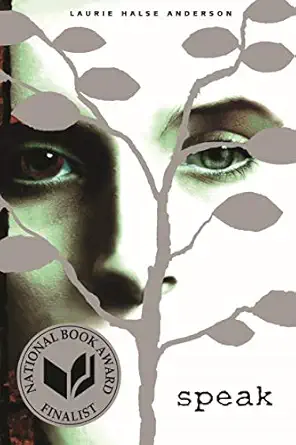
Speak is a 1999 young adult novel by Laurie Halse Anderson, narrated by Melinda Sordino, a high school freshman who arrives at her first day of ninth grade already an outcast—shunned by her former friends for calling the police to break up an end-of-summer party. What her classmates don’t know, and what Melinda can’t bring herself to say, is why she called: she was raped at that party. Told through Melinda’s darkly funny, bitterly observant internal voice across a full school year, Speak has sold more than 3.5 million copies, been translated into 35 languages, and is one of the most widely taught and most frequently challenged books in the high school canon. This guide covers the book’s reading level, age appropriateness, themes, characters, and teaching resources for students, parents, and educators.
For Parents
Speak deals directly with rape and its aftermath—the trauma, isolation, self-harm, and the long, difficult process of finding the courage to speak. The rape itself is not graphically described, but it is clearly depicted and central to the entire novel. The book also contains some profanity and depictions of underage drinking at a party. It is most commonly assigned in grades 8–10, ages 13–16, and is considered by educators and literary organizations to be one of the most important and carefully handled treatments of sexual assault in young adult literature. Many survivors have credited the novel with helping them recognize and name their own experiences.
For Teachers
Speak anchors units on contemporary realism, trauma literature, voice and point of view, and the ethics of silence. Melinda’s narrative voice—sardonic, fragmented, darkly funny, and gradually revealing—is a masterclass in unreliable narration and the way trauma shapes storytelling. The novel’s structure, organized by school marking periods rather than numbered chapters, mirrors Melinda’s psychological state and offers rich opportunities for discussion of how form reinforces content. It pairs productively with The Scarlet Letter (which appears in the novel itself as a parallel text), I Know Why the Caged Bird Sings, and Shout, Anderson’s verse memoir about her own assault.
Speak at a Glance
Find on Amazon →| Author | Laurie Halse Anderson |
| Published | 1999 |
| Grade Level | 8–10 (our assessment) |
| Recommended Age | 13–16 |
| Flesch-Kincaid Grade | 4.5 |
| Word Count | ~47,000 |
| Pages | ~224 (standard paperback) |
| Structure | 4 marking periods, each divided into titled short sections (no numbered chapters) |
| Genre | Young adult realistic fiction / trauma novel |
| Setting | A suburban high school, upstate New York; one school year |
| Awards | National Book Award Finalist (1999); Golden Kite Award for Fiction (2000) |
For official Lexile and AR levels, visit Lexile.com or AR BookFinder. ReadingVine provides independent editorial assessments.
What Reading Level Is Speak?
ReadingVine places Speak at a grade 8–10 reading level, with a Flesch-Kincaid score of approximately 4.5. Like The Color Purple and several other canonical works narrated in a deliberately accessible or vernacular voice, Speak‘s score reflects Melinda’s intentional narrative style rather than the novel’s true complexity. Anderson writes in the clipped, sardonic voice of a traumatized teenager who has stopped trusting language—sentences are often short and declarative, vocabulary is contemporary and accessible, and the prose style is designed to feel immediate rather than elevated. The real difficulty is interpretive: Melinda is an unreliable narrator who withholds the central fact of the novel for most of its length, and understanding what she’s not saying, why she can’t say it, and what it costs her requires active, empathetic reading.
The novel is most commonly assigned in grades 8–10. Its accessibility of language makes it appropriate for younger readers in that range, but the subject matter—rape, trauma, depression, self-harm—is better suited to students who have the emotional maturity to engage with those themes productively. For official Lexile and AR scores, visit Lexile.com or AR BookFinder.
What Age Is Speak Appropriate For?
ReadingVine recommends Speak for readers ages 13–16. The novel’s central subject is rape and its aftermath—the trauma, the silence, the depression, and the slow, painful process of recovery. The assault itself is depicted rather than described in graphic detail: Anderson shows us what happened through Melinda’s fragmented, avoidant memories rather than a direct scene, which is both a stylistic choice and a psychologically accurate representation of how trauma is actually experienced and recalled. The novel also depicts depression, social isolation, self-harm (a brief scene of cutting), and underage drinking.
Speak depicts the aftermath of rape experienced by a ninth-grade girl. The assault itself is shown through fragmented, indirect memory rather than explicit description, but it is clearly depicted and is the subject of the entire novel. The book also includes a scene of self-harm (cutting), sustained depictions of depression and social isolation, some profanity, and references to underage drinking at a party. Anderson’s handling of all these elements is careful and purposeful—the novel is widely used in school counseling contexts as well as English classrooms—but parents should be aware of the content before assigning it to younger or more sensitive readers.
What Is Speak About?
Melinda Sordino begins her freshman year at Merryweather High School as an outcast. Her former friends won’t speak to her, her new acquaintances quickly distance themselves, and she moves through the school’s social landscape like a ghost. The reason, which her classmates resent her for and which she cannot bring herself to explain, is that she called the police to an end-of-summer party—and her call broke it up. What no one knows is that she called because she was raped at that party by Andy Evans, a popular older student who still walks the halls of Merryweather every day.
The novel follows Melinda through the four marking periods of her freshman year, told in her own voice—a voice that is funny, observant, and deeply self-protective. She develops an elaborate inner life of dry commentary on the absurdities of high school while functionally withdrawing from everything around her. Her grades collapse. Her relationships with her parents deteriorate into a series of misunderstood silences. The one thread she holds onto is her art class, where her teacher Mr. Freeman assigns her a semester-long project: a tree. Melinda’s struggle with the tree—how to draw life, how to draw something real—becomes the novel’s central metaphor for her psychological recovery.
The story moves toward two convergences: Melinda’s eventual confrontation with what happened to her, and a second encounter with Andy Evans that forces the confrontation she has been unable to make on her own terms. Anderson structures the novel so that the reader gradually pieces together what happened before Melinda can bring herself to say it directly—a narrative strategy that puts readers in the position of understanding more than the other characters do while watching Melinda remain trapped in her silence. The ending offers genuine, hard-won recovery rather than a tidy resolution: Melinda speaks, and the speaking begins—rather than completes—her healing.
Speak Characters
Is Speak Banned?
Speak has been one of the most consistently and extensively challenged books in American schools since its publication. It appears on the ALA’s list of the Top 100 Banned/Challenged Books for 2000–2009 and climbed to number 25 on the list for 2010–2019. In 2020, it reached number 4 on the ALA’s annual most-challenged books list. In the 2022–2023 school year alone, according to PEN America’s Index of Banned Books, Speak and its adaptations were removed or restricted in 14 public school districts.
The challenges have been strikingly contradictory in their reasoning. In 2010, an associate professor at Missouri State University wrote a widely circulated opinion piece calling the novel’s depiction of rape “soft pornography” and demanding its removal from school curricula. In 2013, a group of parents in Sarasota, Florida, similarly described the novel as pornographic. Other challengers have claimed the book contains a “political viewpoint” or is “biased against male students.” Anderson—who has spoken publicly about her own rape at age 13, which she revealed was the inspiration for the novel—has been an outspoken advocate against these challenges, arguing that censoring books about difficult adolescent experiences leaves young readers without the language and framework to understand and name their own. The novel remains widely taught in grades 8–10 across the country and is actively defended by the American Library Association, PEN America, and the National Council of Teachers of English.
Speak Themes and Lessons
The novel’s title is its central metaphor and its central imperative. Melinda cannot speak—not because she literally lacks the ability, but because the experience she needs to speak about is so dangerous, so shameful in the way her culture has shaped her to feel about it, and so likely to be misunderstood or disbelieved that speaking feels more threatening than silence. Her withdrawal into a nearly mute state is Anderson’s precise depiction of how sexual trauma actually operates: it does not just cause pain, it attacks the survivor’s capacity for connection and communication. The novel’s arc is the recovery of that capacity—not the instant catharsis of a single confession, but the slow, difficult work of finding language for what happened and the courage to use it.
Art, in Speak, is the medium through which Melinda can begin to express what she cannot yet say in words. Her semester-long project—drawing a tree in all its forms—tracks her psychological recovery in parallel with the narrative. Trees appear throughout the novel as symbols of life that survives damage, grows through adversity, and shows its history in its form. Mr. Freeman’s instruction to “find the soul of your subject” is advice that applies as much to Melinda’s inner work as to her artwork. Discussion questions: Why does Anderson structure the novel in marking periods rather than numbered chapters? What role does humor play in Melinda’s narration—what does it protect her from, and what does it reveal? What do you think it means to truly “speak” in this novel?
How Many Pages and Chapters in Speak?
Speak is approximately 224 pages in the standard Farrar, Straus and Giroux paperback and approximately 47,000 words. The novel has no numbered chapters. Instead, it is organized into four “marking periods”—First, Second, Third, and Fourth—each of which mirrors a grading period of Melinda’s freshman year. Within each marking period, the story is divided into short, titled sections (often just a page or two long) with wry, deadpan titles that reflect Melinda’s sardonic inner voice, such as “Welcome to Merryweather High,” “Fizz Ed,” and “Naming the Monster.” This structure—fragmentary, organized by institutional time rather than narrative momentum—formally mirrors Melinda’s fractured psychological state. An average reader will complete the novel in 3–4 hours. Most teachers assign it over one to two weeks.
Books Similar to Speak
About Laurie Halse Anderson
Laurie Halse Anderson was born in Potsdam, New York. She studied foreign languages and linguistics at Georgetown University and worked as a reporter for the Philadelphia Inquirer before turning to writing books. Speak was her first novel, published in 1999, and its immediate success—a National Book Award finalist, a Michael L. Printz Honor book, a New York Times bestseller—established her as one of the most important voices in young adult literature. More than twenty years after its publication, Anderson revealed publicly that she was raped at the age of thirteen, and that Melinda’s story grew in part from her own experience—something she had not been able to say until she wrote Shout, a 2019 verse memoir. She has described the writing of Speak as a way of giving voice to an experience she had carried in silence for decades, and the response from readers—particularly from survivors who said the novel helped them name and understand their own experiences—as one of the most meaningful outcomes of her career. She has been a prominent advocate against book banning, has won the Astrid Lindgren Memorial Award (2023), widely regarded as the most prestigious international prize for children’s and young adult literature, and is the author of more than thirty books including the historical Chains, Forge, and Ashes trilogy.
Speak: Frequently Asked Questions
What reading level is Speak?
ReadingVine places Speak at a grade 8–10 reading level, with a Flesch-Kincaid score of approximately 4.5. Like many novels narrated in an accessible, contemporary teenage voice, the score reflects language rather than complexity—Melinda’s fragmented, withholding narration is deliberately designed to make readers piece together what she cannot say directly, which requires careful, active reading. It is most commonly assigned in grades 8–10, to readers ages 13–16.
What is Speak about?
Speak is about a ninth-grade girl named Melinda Sordino who arrives at her first day of high school already ostracized by her peers, because she called the police to break up an end-of-summer party. What no one knows—and what Melinda cannot bring herself to say—is that she called because she was raped at that party. The novel follows her through a full school year as she withdraws into near-total silence, finds a partial lifeline in her art class, and eventually works toward the courage to speak about what happened to her.
Is Speak based on a true story?
Speak is fiction, but Anderson has publicly stated that it is rooted in her own experience of being raped at age thirteen—something she did not speak about publicly for more than twenty years after the novel’s publication. She revealed it in her 2019 verse memoir Shout. Anderson has said that writing Melinda’s story was a way of finding language for an experience she had long carried in silence, and that the response from survivors who recognized themselves in the novel has been among the most meaningful parts of her career as a writer.
Why is Speak frequently banned or challenged?
Speak is one of the most challenged books in American schools. It has appeared on the ALA’s list of the 100 Most Banned/Challenged Books consistently since its publication, reaching number 4 on the annual list in 2020. Challengers have called its depiction of rape “soft pornography,” claimed it has a “political viewpoint,” and argued it is “biased against male students.” Anderson has responded that books like Speak give survivors language to understand and name their own experiences, and that removing them from schools sends the message that these experiences should not be talked about. The novel is actively defended by the ALA, PEN America, and the National Council of Teachers of English.
Why doesn’t Speak have numbered chapters?
Anderson structures the novel in four “marking periods”—the grading periods of a school year—each divided into short, titled sections rather than numbered chapters. This structure mirrors Melinda’s psychological state: her world is fragmented, time is organized around institutional rhythms she barely participates in, and she processes experience in discrete, disconnected episodes rather than a coherent narrative. The titles of the sections—often sardonic, brief, and deadpan—also reflect Melinda’s interior voice and her way of keeping a small, ironic distance from the world around her as a survival mechanism.
What does the tree symbolize in Speak?
The tree is Melinda’s semester-long art project and the novel’s central symbol. Mr. Freeman assigns it at the beginning of the year, and Melinda’s struggle to draw it—her repeated failures and discarded attempts—tracks her psychological recovery in parallel with the narrative. Trees grow, survive damage, show their history in their scars, and produce new growth even after they have been cut back or broken. The tree represents the possibility that Melinda—who has been, in many ways, cut down—can also survive and eventually grow again. Her final, successful tree appears at the end of the novel, alongside her ability to speak.
Does Speak have a happy ending?
Speak ends with genuine hope rather than a tidy resolution. Melinda confronts Andy Evans a second time and, when he attacks her, she fights back and calls for help—and is heard. She begins to tell Mr. Freeman what happened. The novel ends before recovery is complete, because Anderson’s point is not that speaking heals everything instantly, but that speaking is how healing can begin. It is a hard-won, earned ending rather than a comforting one, and most readers find it deeply satisfying for exactly that reason.
How many pages and words is Speak?
Speak is approximately 224 pages in the standard paperback and approximately 47,000 words. It is organized into four marking periods with short, titled sections rather than numbered chapters. An average reader will complete it in 3–4 hours. Most teachers assign it over one to two weeks.