
 = Partner Site
The Fault in Our Stars Reading Level: A Complete Guide
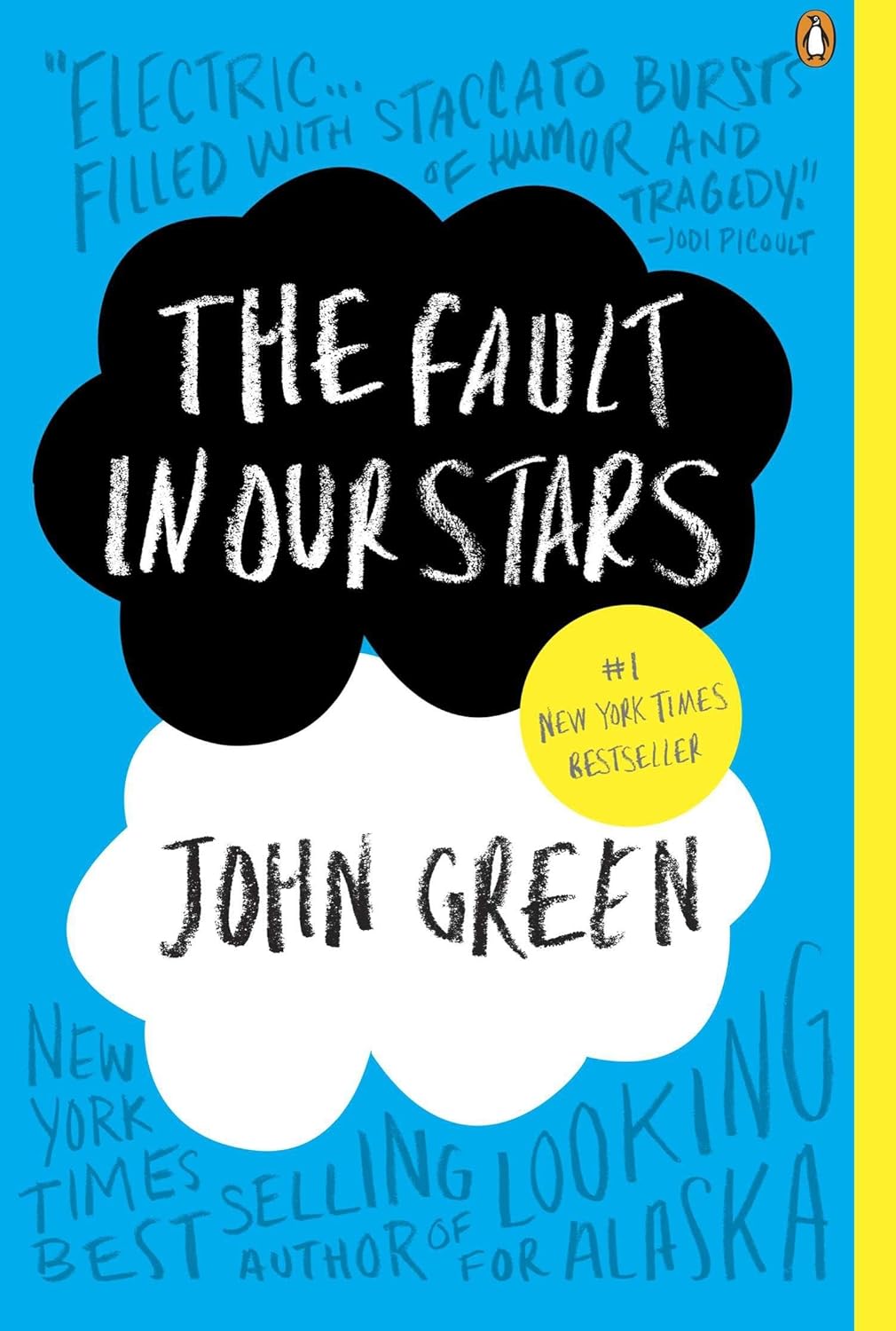
This complete guide to The Fault in Our Stars by John Green covers everything parents, teachers, and students need to know — from reading level and age appropriateness to characters, themes, and similar books. Published on January 10, 2012, the novel tells the story of Hazel Grace Lancaster, a sixteen-year-old with terminal thyroid cancer, and Augustus Waters, a seventeen-year-old cancer survivor she meets at a support group. It became a #1 New York Times bestseller within weeks of publication, was named TIME Magazine’s #1 Fiction Book of 2012, and was adapted into a widely seen 2014 film. More than a decade later it remains one of the most read and most emotionally impactful YA novels of its era — a love story about two teenagers navigating mortality with wit, intelligence, and open eyes. This guide is designed to help parents, teachers, and readers approach it with clear expectations about its content, reading level, and what makes it endure.
For Parents
The Fault in Our Stars is a realistic YA romance centered on two teenagers with cancer who fall in love. Its primary content considerations are: a brief, non-graphic sexual encounter between the two main characters (described in a few sentences without explicit detail); mild to moderate language; depictions of cancer’s physical realities — oxygen tanks, medical ports, seizures, and deterioration — that are honest rather than sensationalized; and a significant death that is emotionally devastating for characters and readers alike. The book deals directly and unflinchingly with mortality, grief, and the fear of being forgotten. There is no violence. Common Sense Media rates it for ages 14 and up, though many readers encounter it at 12 or 13 and engage with it meaningfully at that age. The best guide is your own knowledge of your reader’s emotional maturity and readiness to sit with grief.
For Teachers
The Fault in Our Stars is a sophisticated literary novel in the guise of a teen romance, and it rewards serious classroom attention. Hazel is one of the most distinctive narrative voices in contemporary YA fiction — sardonic, self-aware, intellectually serious, and genuinely funny — and the novel’s engagement with questions of legacy, oblivion, and what a life means invites substantive philosophical discussion. The title itself comes from Shakespeare’s Julius Caesar, and the novel’s embedded fictional novel (An Imperial Affliction by the fictional Peter Van Houten) functions as a layered meditation on how stories about dying people work and what they owe their subjects. It is most commonly assigned in grades 8–10, though it appears on some 7th grade lists. It pairs well with poetry units (Hazel reads poetry throughout), with non-fiction writing about illness, and with broader discussions of how fiction represents suffering.
The Fault in Our Stars at a Glance
Find on Amazon →| Author | John Green |
| Published | January 10, 2012 |
| Grade Level | 7–10 (our assessment) |
| Recommended Age | 13–17 |
| Flesch-Kincaid Grade | 5.5 |
| Word Count | 65,752 |
| Pages | 318 (standard paperback) |
| Chapters | 25 |
| Genre | YA realistic fiction / Contemporary romance |
| Setting | Indianapolis, Indiana; Amsterdam, Netherlands |
| Awards | #1 New York Times Bestseller; TIME Magazine #1 Fiction Book of 2012; Goodreads Choice Award for Best YA Fiction (2012) |
For official Lexile and AR levels, visit Lexile.com or AR BookFinder. ReadingVine provides independent editorial assessments.
What Reading Level Is The Fault in Our Stars?
The Fault in Our Stars has a Lexile score of 850L and an ATOS level of 5.5, worth 10 AR points. Our Flesch-Kincaid calculation is consistent with the ATOS at grade 5.5. These numbers describe the prose mechanics — sentence length, vocabulary complexity, and word familiarity — and by those measures the book reads at a late-elementary level. The sentences are clear, the vocabulary is accessible (with the notable exception of medical terminology that Hazel explains as she uses it), and there are no archaic constructions or difficult syntax to navigate.
What these metrics don’t capture is why The Fault in Our Stars is not a fifth-grade book. This is the core challenge in communicating about it to parents. The reading level gap here is wider than almost any other title on our list — a 5.5 ATOS score assigned to grades 7–10 — because the novel’s complexity is entirely emotional and philosophical rather than linguistic. Hazel and Augustus are teenagers confronting their own deaths and doing so with unusual intellectual seriousness: they argue about whether the universe is indifferent, they debate the purpose of human memory and legacy, they read poetry as a genuine source of meaning, and they grapple with the ethics of loving someone you know you will lose. A ten-year-old who can decode every sentence in this book may have nothing in her experience to help her process those questions. The grade-level assignment reflects emotional readiness, not decoding ability. Our editorial assessment is grades 7–10, with grade 8 being the most common classroom placement.
For official Lexile and AR scores, visit Lexile.com or AR BookFinder. ReadingVine’s assessments are independent editorial evaluations.
What Age Is The Fault in Our Stars Appropriate For?
We recommend The Fault in Our Stars for readers ages 13–17. Common Sense Media rates it 14 and up for the book. Many readers encounter it at 12 or 13, and for readers with emotional maturity and some experience processing grief or serious topics, that can be an entirely appropriate age. The publisher lists grades 7–12. The question of age appropriateness here is genuinely individual in a way it isn’t for most titles — a thoughtful 12-year-old may be better equipped for this book than a less reflective 15-year-old, and a reader who has personally experienced illness or loss in the family may connect with it differently than one who hasn’t.
The most significant content considerations: Hazel and Augustus have sex during their trip to Amsterdam. The scene is brief — described in a few sentences without explicit detail — and is presented as a meaningful, consensual expression of their relationship rather than as titillation. It is the most commonly cited reason for parental concern and library challenges. Language throughout the novel includes profanity used naturally in the voice of a sardonic sixteen-year-old narrator; the language is realistic rather than gratuitous. The novel depicts cancer’s physical realities with honesty and specificity: Hazel carries an oxygen tank, Augustus experiences a late-night medical crisis involving his chemotherapy port that is described in vivid and distressing detail, and the physical deterioration of a character in the novel’s final third is rendered without softening. A main character dies. The death is not depicted graphically, but its emotional impact on the surviving characters and the reader is the emotional center of the book’s final chapters. An adult character is an alcoholic who is depicted drinking throughout his scenes. There is no violence. There is no substance use by the teen characters beyond drinking champagne on a special occasion.
For families raising children in traditions that emphasize abstinence, the brief sexual encounter between the protagonists — portrayed by the novel as a natural and positive part of their relationship — may be a consideration worth discussing with your teen before or alongside reading. The novel does not moralize about the characters’ choice, which some families will appreciate and others will find worth contextualizing in conversation.
What Is The Fault in Our Stars About?
Hazel Grace Lancaster has been living with terminal thyroid cancer since she was thirteen. Now sixteen, she is technically in a stable period — a miracle drug has slowed the spread of the cancer to her lungs — but “stable” is not “cured,” and Hazel has made her peace with being, as she describes it, a grenade: someone who will one day explode and wound everyone who loves her. To keep her depression at bay, her parents insist she attend a weekly cancer support group at a church in Indianapolis, which she finds mostly useless. Then Augustus Waters shows up: seventeen, tall, in remission from osteosarcoma (which cost him a leg below the knee), devastatingly charming, and immediately and bafflingly fixated on Hazel.
What unfolds between them is a love story, but not a conventional one. Hazel’s awareness of her own mortality shapes everything — her resistance to letting Gus get close, her obsession with a novel called An Imperial Affliction whose abrupt ending mirrors what she fears about her own life, her ongoing negotiation between wanting to live fully and wanting to minimize the damage she’ll leave behind. Gus, who has been in remission and who approaches life with an outsized need to matter and be remembered, is drawn to Hazel precisely because she has thought through the same questions he is only beginning to ask. Through a Wish foundation, they travel to Amsterdam to meet the reclusive and deeply disappointing author of Hazel’s favorite book — a trip that becomes one of the novel’s most important narrative turns — and what they find there, in the author’s response to their questions about the ending, shifts the ground beneath both of them.
The novel’s central preoccupations are legacy and oblivion: whether a life, however short, can matter; what we owe the people we love; and whether the universe cares about any of it. Green wrote these characters as deliberately unsentimental — Hazel and Gus are funny and occasionally cruel and fully human — and the result is a portrait of illness and love that readers who have lost someone, or who are facing illness themselves, have consistently described as the most honest they’ve encountered in fiction. The book is dedicated to Esther Earl, a teenager who developed a bond with Green through the Nerdfighter community before she died of thyroid cancer in 2010 at age sixteen. Green has said that knowing Esther made it possible for him to write about a dying teenager with honesty and hope rather than sentimentality.
The Fault in Our Stars Characters
Is The Fault in Our Stars Banned?
The Fault in Our Stars has been formally challenged and temporarily removed from school libraries in several documented cases. The ALA’s Office for Intellectual Freedom includes it on its list of frequently challenged YA books. The two most prominent documented incidents both occurred in California in 2014: the book was pulled from the Frank Augustus Miller Middle School library in Rancho Cucamonga after a parent complained that its subject matter — teens dying of cancer who use crude language and have sex — was inappropriate for middle schoolers. Around the same time, it was removed from all middle school libraries in the Riverside Unified School District by a reconsideration committee vote of 6 to 1. In both cases, the book remained available in the districts’ high school libraries. In the Riverside case, the National Coalition Against Censorship and the ACLU of Southern California sent letters urging reinstatement; the school board subsequently voted 3 to 2 to return the book to middle school shelves. The ban was reversed approximately two months after the initial removal.
The reasons cited across challenges are consistent: sexual content (the Amsterdam scene), language, and age-appropriateness concerns about middle schoolers reading about mortality and teen sex. The book has never been banned from high school libraries in any documented case, and remains widely stocked and assigned at the high school level. The challenge history is concentrated at the middle school level, which is broadly consistent with the publisher’s stated grade range of 7–12 and most educators’ recommendation of grade 8 and up for classroom use.
The Fault in Our Stars Themes and Lessons
The novel’s central philosophical question — whether a short life can matter, and to whom, and how — animates everything in it. Gus is consumed by a fear of oblivion, by the need to leave a mark that the universe will notice. Hazel has arrived, through her years of illness, at a more resigned position: she believes oblivion is inevitable and that what matters is the love we share with the people immediately around us, not the impression we make on history. Their relationship is in many ways an argument between these two positions, and by the end of the novel, each has shifted closer to the other’s view through what they experience together. Neither position is endorsed as simply right; the novel respects both and shows both as genuine responses to an impossible situation.
The way the novel handles grief is one of its most distinctive and honest qualities. It does not suggest that grief is resolved or transcended or that suffering produces wisdom in any neat way. It suggests that the people we love leave marks on us, and that those marks are the opposite of oblivion — that being changed by someone is a form of their continuing existence in the world. Discussion questions worth exploring: Is Hazel right that she is a grenade, or is Gus right that she should allow herself to be loved anyway? What does the novel say about what a story about a dying person owes that person — should it offer a neat ending? What does it mean to matter?
How Many Pages and Chapters in The Fault in Our Stars?
The Fault in Our Stars is 318 pages in the standard paperback edition, with 25 chapters. At approximately 65,750 words, it is significantly shorter than most YA novels — closer in length to a novella than to a typical 90,000-word YA title. This is one reason readers often describe finishing it in a single sitting despite its emotional density. The chapters are moderate length, averaging around 12–15 pages, and each one tends to move the central relationship forward meaningfully rather than treading water.
At a comfortable pace for a reader in the 13–17 target range, expect roughly 4–6 hours of total reading time. Many readers finish in two sittings. Classroom use typically spans two to three weeks, with ample time for discussion between chapters. The relatively short length makes it well-suited to close reading assignments — there is enough space and precision in Green’s prose to reward careful attention, and the novel’s limited page count means students can revisit specific passages without the logistical difficulty of navigating a long book.
Books Similar to The Fault in Our Stars
About John Green
John Michael Green was born on August 24, 1977, in Indianapolis, Indiana, and grew up in Orlando, Florida. At fifteen he enrolled at Indian Springs School, a boarding school outside of Birmingham, Alabama, which became the basis for the fictional Culver Creek Preparatory School in his first novel. He graduated from Kenyon College in 2000 with a double major in English and religious studies, then spent several months as a student chaplain at a children’s hospital in Chicago, counseling dying children and their families. That experience, he has said, was the seed of The Fault in Our Stars, though he could not write the book until years later. Rather than continue toward ordination as an Episcopal priest, he took a job at the book review magazine Booklist in Chicago, where an editor encouraged him to write his own fiction. His debut novel, Looking for Alaska (2005), won the 2006 Michael L. Printz Award, the American Library Association’s highest honor for YA literature. An Abundance of Katherines (2006) was a Printz Honor book; Paper Towns (2008) won the 2009 Edgar Award for Best Young Adult Novel. In 2007, Green and his brother Hank launched the VlogBrothers YouTube channel, which grew into Nerdfighteria — an international fan community organized around intellectual curiosity and charitable action. A prominent early Nerdfighter was Esther Earl, a teenager with thyroid cancer who formed a close friendship with Green before she died in 2010 at age sixteen. Green has said that knowing Esther made it possible for him to write about a dying teenager honestly rather than sentimentally. The Fault in Our Stars, dedicated to Esther, was published in January 2012 and sold more than 150,000 pre-orders alone — all of which Green signed by hand over the course of a month. It reached #1 on the New York Times bestseller list within weeks. A 2014 film adaptation starred Shailene Woodley and Ansel Elgort and grossed over $307 million worldwide. Green lives in Indianapolis with his wife, Sarah Urist Green, and their two children. He has been included in Time magazine’s 100 Most Influential People in the World (2014).
The Fault in Our Stars: Frequently Asked Questions
What reading level is The Fault in Our Stars?
The Fault in Our Stars has a Lexile score of 850L and an ATOS level of 5.5, worth 10 AR points. Our editorial assessment is grades 7–10. The prose is accessible — clear sentences, explained medical terminology, a fluid narrative voice — but the content is calibrated for a teen audience emotionally ready to engage with mortality, grief, love, and loss. The reading-level metrics describe the prose difficulty; the grade assignment reflects the emotional and thematic complexity.
What age is The Fault in Our Stars appropriate for?
We recommend ages 13–17. Common Sense Media rates it 14 and up. The primary content considerations are a brief, non-graphic sexual scene, mild to moderate language, honest depictions of cancer’s physical realities, and a significant death that is the emotional center of the novel’s final act. Age appropriateness is genuinely individual here — emotional maturity and readiness to process grief matter more than chronological age. Many readers encounter it at 12 or 13 and engage with it meaningfully.
What does the title The Fault in Our Stars mean?
The title is drawn from Shakespeare’s Julius Caesar, Act I, Scene 2: “The fault, dear Brutus, is not in our stars, / But in ourselves, that we are underlings.” In Shakespeare, Cassius is arguing that human beings, not fate, are responsible for their circumstances. Green inverts the quotation’s logic for his title: Hazel and Gus did not choose their cancer, and the fault — in the sense of the flaw, the damage, the thing that marks their lives — is written in the stars, in forces beyond their control, not in anything they have done or failed to do. The title is also a wry acknowledgment that the stars (fate, the universe, whatever one calls it) are genuinely indifferent to whether teenagers with cancer live or die.
Is The Fault in Our Stars based on a true story?
The novel is not directly autobiographical, but it was inspired in significant part by John Green’s friendship with Esther Earl, a teenager from Massachusetts who was diagnosed with thyroid cancer at age twelve and died in 2010 at age sixteen. Earl was a prominent member of the Nerdfighter community, and Green has said that knowing her — her humor, her refusal to be reduced to her illness, her engagement with life and literature even while dying — made it possible for him to write Hazel with honesty rather than sentimentality. The book is dedicated to Earl, and her family’s non-profit, This Star Won’t Go Out, continues to support families of children with cancer. Hazel is not Esther, and the novel’s plot is entirely fictional, but Esther’s spirit is what Green has described as the book’s moral center.
Is there a Fault in Our Stars movie?
Yes. A 2014 film adaptation directed by Josh Boone starred Shailene Woodley as Hazel and Ansel Elgort as Augustus. It was rated PG-13 and grossed over $307 million worldwide on a budget of approximately $12 million, making it one of the most commercially successful YA adaptations of its era. John Green was closely involved in the production and has said he was pleased with the result. The film follows the novel closely, though some scenes from the Amsterdam section are condensed. Green makes a brief uncredited cameo appearance at the airport. A stage play adaptation was authorized by Green in 2017.
Why was The Fault in Our Stars banned?
The book has been challenged and temporarily removed from school libraries in several documented cases, most prominently in two California districts in 2014. The reasons cited were sexual content (the Amsterdam scene between Hazel and Gus), language, and age-appropriateness concerns about middle schoolers reading about teen mortality and sex. In both documented California cases, the removals were reversed within months — in Riverside Unified after the school board voted 3 to 2 to reinstate the book following advocacy from free speech organizations. The book has never been banned from high school libraries in any documented case and remains widely stocked and assigned at the high school level.
Is An Imperial Affliction a real book?
An Imperial Affliction — the novel that Hazel reads obsessively and that drives the plot’s Amsterdam arc — is a fictional book invented by John Green for The Fault in Our Stars. Its fictional author, Peter Van Houten, is also invented. The title is an allusion to Emily Dickinson’s poem that begins “After great pain, a formal feeling comes,” which refers to pain as an “imperial affliction.” Green chose to keep the book fictional because he wanted it to do specific narrative work — particularly its abrupt, unresolved ending — that no existing novel could do in quite the same way. Readers who want to pursue the Dickinson connection will find the poem well worth reading alongside the novel.
What other books has John Green written?
Green’s novels include Looking for Alaska (2005, Printz Award winner), An Abundance of Katherines (2006, Printz Honor), Paper Towns (2008, Edgar Award for Best YA Novel), Will Grayson, Will Grayson (2010, co-written with David Levithan), The Fault in Our Stars (2012), Turtles All the Way Down (2017), and The Anthropocene Reviewed (2021, essays). Looking for Alaska was adapted as a Hulu series in 2019; Paper Towns was adapted as a 2015 film. Turtles All the Way Down, which draws on Green’s personal experience with OCD and anxiety, is often considered his most autobiographical work.
