
 = Partner Site
The Outsiders Reading Level: A Complete Guide
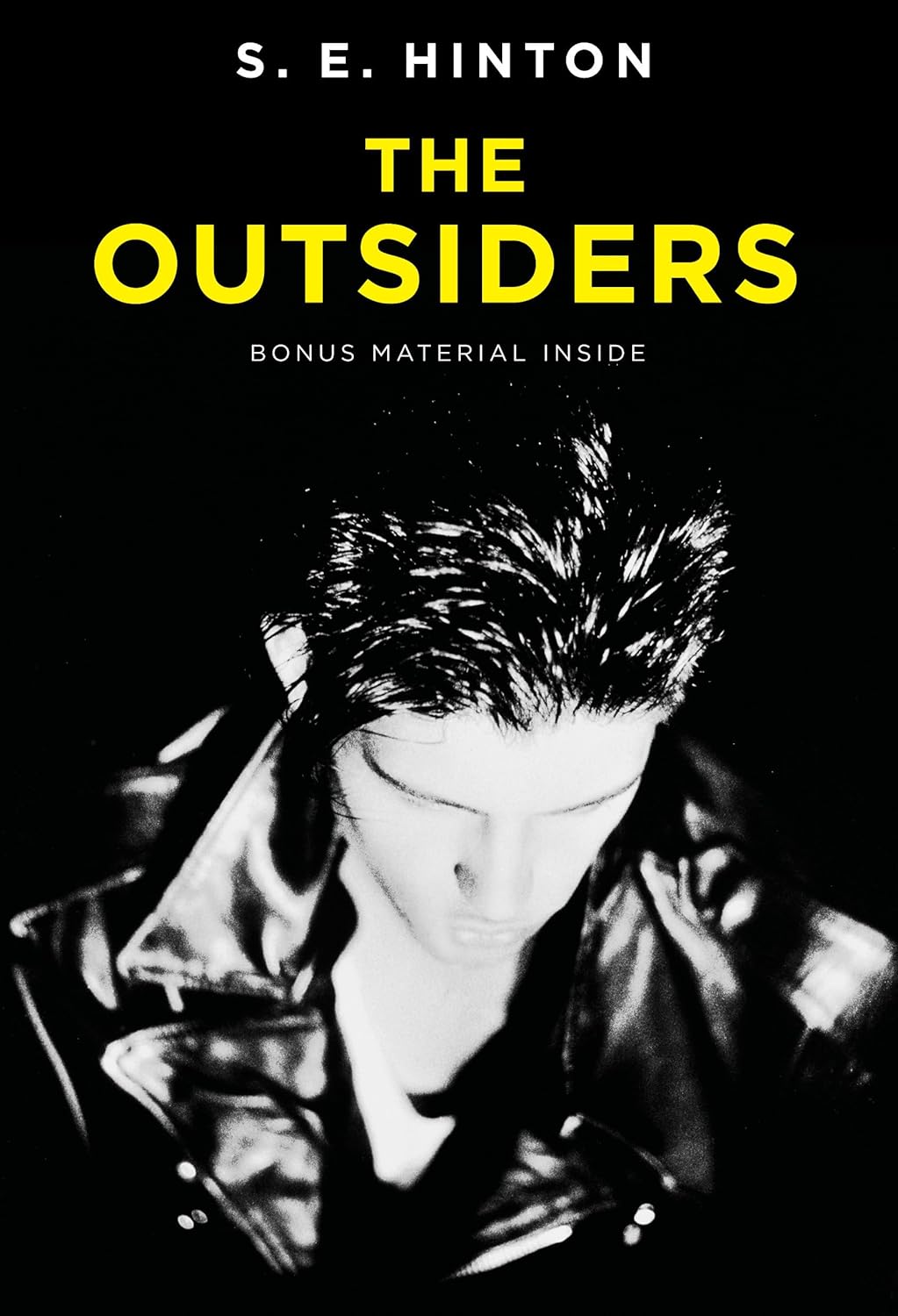
This complete guide to The Outsiders by S.E. Hinton covers everything parents, teachers, and students need to know — from reading level and recommended age to a full character list, key themes, and similar books. Published in 1967 when its author was just seventeen years old, The Outsiders is widely credited with helping shape the modern young adult novel, transforming a genre of prom queens and football heroes into one capable of honest, unflinching stories about class, loyalty, violence, and what it costs to grow up on the wrong side of everything. It still sells roughly 500,000 copies a year and remains required reading in schools across the country. Whether you’re a parent deciding if it’s right for your child’s age and temperament, or a teacher planning a unit around it, you’ll find honest, practical guidance here.
For Parents
The Outsiders is a first-person novel narrated by fourteen-year-old Ponyboy Curtis — a greaser, the youngest of three orphaned brothers, a reader of poetry and watcher of sunsets who does not quite fit the tough-kid mold that his world assigns him. The book deals with gang violence, underage drinking and smoking, the death of sympathetic characters, and a character’s death at the hands of police. None of this is gratuitous; Hinton wrote it at fifteen because she was frustrated by how little fiction spoke honestly to teenagers about the lives they were actually living. Common Sense Media rates it for ages 12 and up, and most schools assign it in grades 7–8. Parents who read it alongside their child will find it prompts genuine conversation about class, belonging, and what it means to be seen.
For Teachers
The Outsiders is one of the most reliably engaging novels in the middle and high school canon — teachers consistently report that it reaches reluctant readers in a way that very few assigned books do. Its themes of class conflict, social identity, empathy across divides, and chosen family are perennially teachable, and the novel’s tight first-person voice offers strong material for studying narrative perspective and character interiority. Hinton drew directly on the real gang dynamics at her Tulsa high school, making it a rich text for discussions of social context and authorial purpose. It appears on the SpringBoard Grade 8 curriculum and is widely taught in grades 6–9. The 1983 Francis Ford Coppola film and the 2024 Tony Award–winning Broadway musical provide productive companion texts for adaptation units.
The Outsiders at a Glance
Find on Amazon →| Author | S.E. Hinton |
| Published | 1967 |
| Grade Level | 6–9 (our assessment) |
| Recommended Age | 12–15 |
| Flesch-Kincaid Grade | 4.7 |
| Word Count | 48,523 |
| Pages | 224 (standard paperback) |
| Chapters | 12 |
| Genre | Realistic fiction / Coming-of-age / YA |
| Setting | Tulsa, Oklahoma; mid-1960s |
| Awards | New York Herald Tribune Best Teenage Book (1967); Chicago Tribune Book World Spring Book Festival Honor Book; ALA Best Book for Young Adults; Massachusetts Children’s Book Award; Margaret A. Edwards Award (1988, for S.E. Hinton’s body of work) |
For official Lexile and AR levels, visit Lexile.com or AR BookFinder. ReadingVine provides independent editorial assessments.
What Reading Level Is The Outsiders?
The Outsiders carries a Lexile score of 750L and an ATOS (Accelerated Reader) level of 4.7, worth 7 AR points. Our Flesch-Kincaid calculation is consistent with the ATOS at approximately grade 4.7. By the word and sentence level metrics, this is a book accessible to confident readers in grades 4 or 5 — Hinton’s prose is direct, colloquial, and fast-moving, written in the authentic voice of a fourteen-year-old boy who reads widely but does not write like a scholar. There are no ornate sentences, no elaborate vocabulary, no structural complexity to slow a reader down.
Those metrics, however, are a significant understatement of the book’s actual demands. The Outsiders is assigned in grades 6 through 9 — not grades 4 and 5 — because the emotional and thematic content is calibrated for early adolescence in a very specific way. The novel deals with class resentment, gang violence, the deaths of characters the reader has grown close to, grief, and a character who is shot and killed by police in a reckless confrontation he seems to have sought out. Ponyboy’s internal life is also more psychologically complex than a surface reading of the prose would suggest: his narration circles back on itself, his rationalizations are not always reliable, and the ending reveals that what you have been reading is itself an act of literary processing. That layer rewards an older reader who can sit with ambiguity.
Our editorial assessment is grades 6–9, with grades 7–8 being the typical assignment range and the sweet spot for most readers. The book is particularly effective for reluctant readers in this range: Common Sense Media notes that many teens describe it as the first book they ever genuinely enjoyed reading. For official Lexile and AR scores, visit Lexile.com or AR BookFinder. ReadingVine’s assessments are independent editorial evaluations.
What Age Is The Outsiders Appropriate For?
We recommend The Outsiders for readers ages 12–15, consistent with Common Sense Media’s recommendation of age 12 and up and the publisher’s interest level of grades 7–12. Hinton wrote it specifically because she felt that teenagers were being underserved by fiction that ignored the harder realities of adolescent life, and the novel’s authenticity is a large part of why it continues to resonate across generations. Readers in this age range — particularly those who feel like outsiders themselves, or who have experienced the particular loneliness of not fitting neatly into a social category — tend to connect with it deeply and immediately.
The novel contains gang violence, including a rumble between rival groups described in vivid detail and a fatal stabbing that is central to the plot. Several sympathetic characters die over the course of the story, including one character who is shot and killed by police after a reckless, self-destructive confrontation. Characters smoke and drink, and the text does not frame these habits as particularly remarkable — they are presented as part of the world these teenagers inhabit. There is some mild profanity and period-appropriate slang. A few brief, casual references to sex appear but are not explicit. There is no sexual content of substance. Parents of younger or more sensitive readers, or of readers not ready to encounter death and violence depicted without softening, should preview the book before sharing it.
It is worth noting that several of the book’s documented challenges have cited “family dysfunction” as an objection — specifically, the fact that the Greasers function as a chosen family of boys without stable adult supervision rather than a conventional nuclear family. Educators and librarians have consistently pushed back on this framing, arguing that the novel is, at its core, a story about the extraordinary value of loyalty and care between people who have little else. The three Curtis brothers — Darry, Sodapop, and Ponyboy — are orphans holding each other together. The novel does not present this as ideal; it presents it as hard-won and deeply human.
What Is The Outsiders About?
Fourteen-year-old Ponyboy Curtis lives on the East Side of Tulsa, Oklahoma, in the 1960s. He is a Greaser — not by temperament, exactly, but by circumstance and loyalty. Greasers are the working-class kids, the ones with long greased hair and leather jackets, the ones who get jumped by the Socs (Socials) when they’re walking home from the movies. The Socs are the wealthy West Side kids, and their idea of a good time sometimes involves finding a Greaser alone and doing serious damage. Ponyboy’s parents are dead. His oldest brother Darry, twenty years old, works two jobs to keep the three brothers together and out of state custody. His middle brother Sodapop dropped out of school to work at a gas station. Ponyboy, the youngest and most bookish, is the one who has to figure out what kind of person he is.
The novel’s central crisis begins one night when Ponyboy and his best friend Johnny — small, scared, the most damaged of the Greasers — are jumped by a group of Socs after a confrontation over two girls. When the Socs try to drown Ponyboy, Johnny kills one of them to stop it. The two boys flee, hide out in an abandoned church in the country, and spend days reading Gone with the Wind and watching sunsets while waiting to find out what to do. The church catches fire. Children are trapped inside. What Johnny and Ponyboy do next — and what it costs them — sets the novel’s final third in motion, building toward a rumble between the Greasers and Socs and a series of losses that Ponyboy will spend the rest of the novel trying to understand.
The book is framed as something Ponyboy has written — a school essay that turned into something larger, an attempt to make sense of what happened by putting it into words. That framing is revealed only at the end, and it casts everything the reader has just experienced in a new light: this is not just a story about what happened, but a story about what it means to survive what happened and to find that the only way through is to write it down. The closing line of the novel is the opening line of the novel — a detail that many readers notice only on a reread, and that many teachers use as an entry point for discussions of narrative form.
The Outsiders Characters
Is The Outsiders Banned?
The Outsiders has been challenged repeatedly since its publication and ranked No. 38 on the ALA’s list of the 100 most frequently challenged books of the 1990s. It has appeared on the ALA’s challenged and banned books lists across multiple decades and continues to receive periodic challenges. It is not banned in any widespread or systemic sense — it remains one of the most commonly assigned novels in American middle and high school curricula — but it has a genuine and ongoing challenge history.
Documented challenges include a 1986 challenge in South Milwaukee, Wisconsin, where it was cited for drug and alcohol use and for featuring characters from “broken homes”; a 1992 challenge in the Boone, Iowa School District; a 2001 challenge at George Washington Middle School in Eleanor, West Virginia for its focus on gang violence; and a 2016 challenge in which a parent argued the book’s violence, death, and criminal activity were unsuitable for the age group — a challenge the school’s reconsideration committee rejected, citing student engagement with the text. According to the ALA, the book has been challenged for gang violence, underage smoking and drinking, strong language, slang, and its portrayal of family dysfunction. Several Christian schools have challenged it for what some have described as “ungodly themes.”
S.E. Hinton has said that the letters she treasures most from readers are those in which young people — particularly those who considered themselves non-readers — say that The Outsiders was the first book they ever loved. That testimony has been a consistent part of the argument for retaining it, and it has been retained in most documented challenges where the outcome was recorded.
The Outsiders Themes and Lessons
The novel’s most insistent theme is the arbitrariness and cruelty of social division. Ponyboy is a greaser not because of who he is but because of where he was born and who raised him; the Socs are Socs for the same reason. Cherry Valance tells Ponyboy that the Socs are too cool to feel anything, that there’s something about having too much that leaves you more lost than having too little — and this insight, that privilege has its own emptiness, runs through the novel as a counterweight to the straightforward class resentment the Greasers carry. Hinton is not interested in making the Socs simple villains. She is interested in what it would look like if a Greaser and a Soc actually looked at each other.
Running alongside this is the novel’s treatment of literature as a form of survival. Ponyboy reads Gone with the Wind to Johnny in the abandoned church; he recites Robert Frost’s “Nothing Gold Can Stay” watching the sunrise; the novel itself ends with the revelation that everything we’ve read is Ponyboy’s own writing. The book argues, quietly but persistently, that the ability to feel things and name them — to read a poem and have it mean something, to write down what happened because it’s the only way to bear it — is not weakness. It is the thing that might save you. Discussion questions worth exploring: What does “nothing gold can stay” mean, and why does the poem matter to the novel? How does Hinton use the structure of the novel’s ending to change the meaning of what came before? What separates a Greaser from a Soc, really — and is that line as fixed as the characters believe?
How Many Pages and Chapters in The Outsiders?
The Outsiders is 224 pages in the standard paperback edition and contains 12 chapters. At approximately 48,523 words, it is a relatively short novel by YA standards — shorter than most assigned books at this grade level — and its fast pace and compelling voice make it one of the more readable required texts in the middle and high school canon. An average reader in the 12–15 target range, reading at a comfortable pace, would typically finish it in 2–4 days of independent reading.
At roughly 200 words per minute for a middle school reader, the book requires approximately 4–5 hours of total reading time. For classroom use, the novel divides naturally into three informal sections: chapters 1–4 (the setup and the central crisis), chapters 5–8 (hiding out, the fire, and its aftermath), and chapters 9–12 (the rumble and its consequences). The 12-chapter structure makes it easy to assign 3–4 chapters per class period for a two-week unit. The novel’s relative brevity is part of what makes it so effective with reluctant readers — it does not ask for a weeks-long sustained commitment, and most readers find they’ve finished it before they expected to.
Books Similar to The Outsiders
About S.E. Hinton
Susan Eloise Hinton was born in 1948 in Tulsa, Oklahoma, and grew up in a working-class neighborhood not unlike the one Ponyboy inhabits. She attended Will Rogers High School, where the real social division between greasers and socs was a daily fact of life, and she began writing The Outsiders at fifteen — frustrated, by her own account, with the absence of realistic fiction for teenagers and with a fight a greaser friend of hers had gotten into that she felt no existing book could adequately describe. She finished the novel at sixteen and published it at seventeen, and her publisher suggested she use her initials rather than her full name so that male reviewers would not dismiss a novel about teenage boys written by a teenage girl. She has used S.E. Hinton ever since. The book was immediately successful — it won the New York Herald Tribune’s Best Teenage Book award the year it was published and has never gone out of print — and its success enabled Hinton to attend the University of Tulsa, where she earned a degree in education in 1970. In 1988, the American Library Association presented her with the inaugural Margaret A. Edwards Award for her lifetime contribution to writing for young adults, recognizing her first four novels — The Outsiders, That Was Then, This Is Now (1971), Rumble Fish (1975), and Tex (1979) — all of which were later adapted as films, three of them directed by Francis Ford Coppola. Hinton has described herself as a private person and an introvert who no longer does public appearances, and she continues to live in Tulsa.
The Outsiders: Frequently Asked Questions
What reading level is The Outsiders?
The Outsiders has a Lexile score of 750L and an ATOS level of 4.7. Our editorial assessment places it at grades 6–9, with grades 7–8 being the typical assignment range. The prose is accessible and fast-paced — Hinton writes in the direct, colloquial voice of a fourteen-year-old narrator — but the emotional and thematic content is calibrated for early adolescence and is more demanding than the word-level metrics suggest. It is one of the most effective texts for reaching reluctant readers in this grade range.
Did S.E. Hinton really write The Outsiders as a teenager?
Yes. Hinton began writing the novel when she was fifteen years old, inspired by her frustration with the social divisions at her Tulsa high school and the lack of realistic fiction for teenagers. She finished it at sixteen and it was published in 1967 when she was seventeen. Her publisher recommended she use her initials S.E. rather than her first name Susan Eloise so that male reviewers would not dismiss a novel about teenage boys because it was written by a girl. The book has since sold over 14 million copies and still sells approximately 500,000 copies annually.
What is the significance of “Nothing Gold Can Stay” in The Outsiders?
Robert Frost’s poem, which Ponyboy recites to Johnny watching the sunrise from the church hideout, becomes one of the novel’s central images. The poem argues that the most beautiful and innocent things cannot last — that gold, dawn, Eden, and youth all fade. Johnny’s dying message to Ponyboy, “Stay gold, Ponyboy,” is an instruction to hold onto his sensitivity and his capacity to see the world with wonder, even as everything around him has gotten harder. It is both a farewell and a charge, and it is the emotional hinge on which the novel’s final chapters turn.
Is there a movie version of The Outsiders?
Yes. Francis Ford Coppola — director of The Godfather — adapted the novel in 1983, starring C. Thomas Howell as Ponyboy alongside a cast that included Patrick Swayze, Rob Lowe, Emilio Estevez, Matt Dillon, Ralph Macchio, and a young Tom Cruise. S.E. Hinton served as a consultant and appears in a small cameo role. The film grossed over $33 million and is widely considered a faithful and atmospheric adaptation. Coppola also directed a film adaptation of Hinton’s Rumble Fish the same year, with many of the same actors. In 1990, The Outsiders was also adapted as a television series on Fox, whose pilot episode was the highest-rated show in Fox’s history at the time.
Is there a Broadway musical of The Outsiders?
Yes. A stage musical adaptation of The Outsiders had its Broadway premiere in 2024 and won the Tony Award for Best Musical that year, becoming one of the higher-profile Broadway debuts of the decade. The show was directed by Danya Taymor, with music and lyrics by Jamestown Revival. S.E. Hinton was involved in the production. The musical’s success introduced the story to a new generation of theatergoers and prompted renewed interest in the novel in schools.
What is the significance of the ending of The Outsiders?
The novel ends with the same sentence it begins with: “When I stepped out into the bright sunlight from the darkness of the movie house, I had only two things on my mind: Paul Newman and a ride home.” This reveals that everything the reader has just experienced is a piece of writing that Ponyboy himself produced — the school essay that became something larger, the attempt to make sense of what happened by putting it into words. The circular structure suggests that writing is not just how Ponyboy tells the story but how he survives it. Many readers only notice the callback on a reread, and many teachers use the ending as an entry point for discussing how form and meaning relate in fiction.
Is The Outsiders appropriate for 6th grade?
For many sixth graders, yes — particularly those who are mature, engaged readers. The reading level (Lexile 750L, ATOS 4.7) is fully within reach for sixth grade, and the novel is a famously powerful book for reaching students who have not yet found fiction they care about. The content to be aware of includes gang violence, the deaths of sympathetic characters, underage smoking and drinking, and a character who is shot and killed by police after a reckless confrontation. Most sixth-grade teachers who assign it treat it as a discussion-rich text rather than pure independent reading, and conversations about the book’s themes tend to be among the more memorable classroom discussions students have at that age.
What does “Stay gold” mean in The Outsiders?
“Stay gold” is the message Johnny leaves for Ponyboy in the letter Ponyboy reads after Johnny dies — a reference to the Robert Frost poem “Nothing Gold Can Stay” that Ponyboy had recited to Johnny at the church hideout. It is Johnny’s way of telling Ponyboy not to let the hardness of their world extinguish the sensitivity and wonder that make Ponyboy different from the other Greasers. It is among the most quoted lines in the novel and has become a cultural shorthand for holding onto what is best and most innocent in yourself against circumstances that push in the other direction.
