
 = Partner Site
Night Reading Level: A Complete Guide
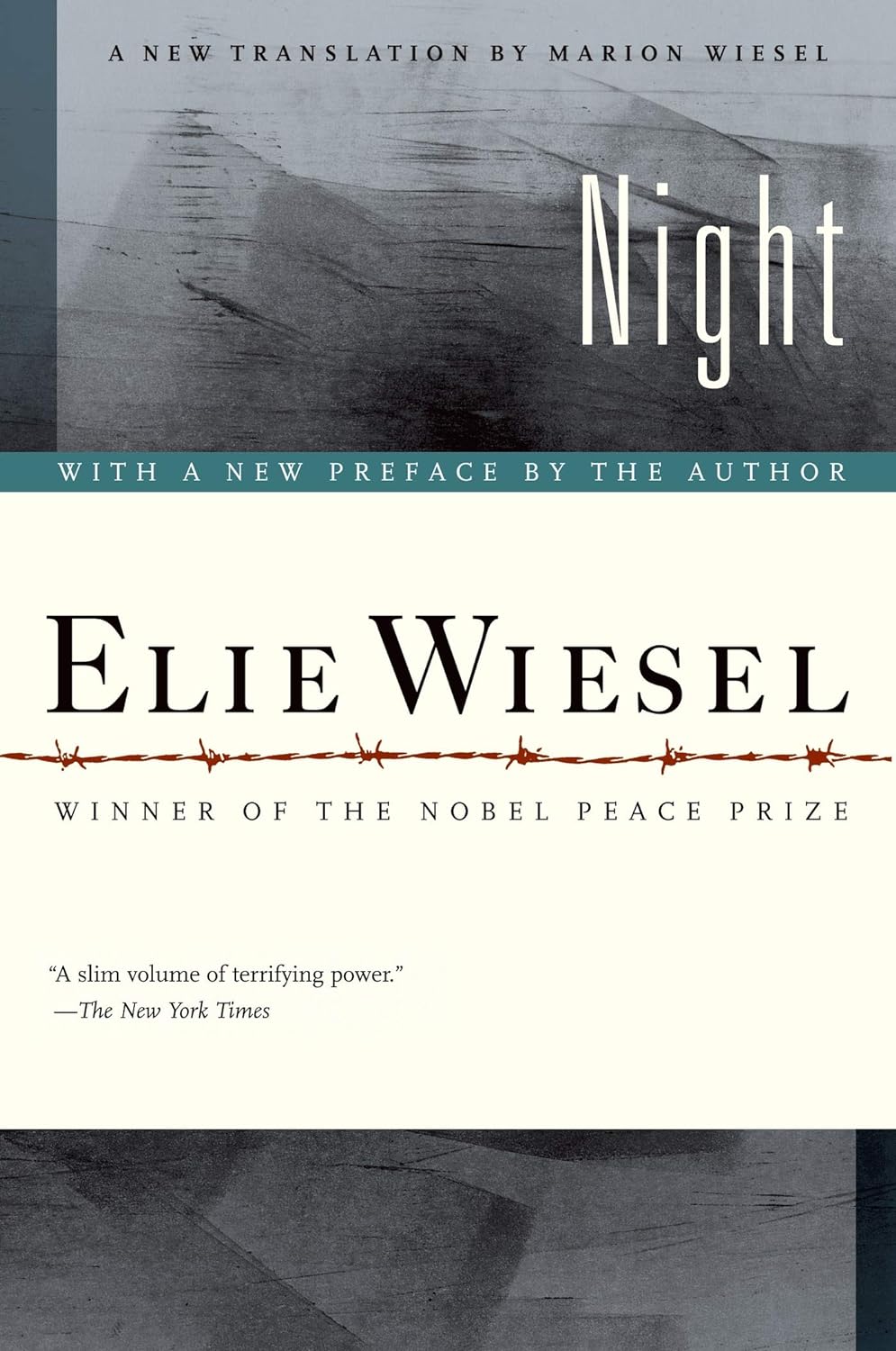
Night is a 1960 memoir by Elie Wiesel, first published in French in 1958 as La Nuit, recounting his experiences as a fifteen-year-old Jewish boy deported from his hometown of Sighet, Romania, to the Nazi concentration and death camps of Auschwitz and Buchenwald in 1944–1945. Spare, fragmentary, and devastating, it is one of the most important works of Holocaust literature ever written and one of the most widely assigned books in American middle and high schools. This guide covers the book’s reading level, age appropriateness, themes, characters, and teaching resources for students, parents, and educators.
For Parents
Night is a first-person account of survival in the Nazi death camps, and its content reflects that reality. It contains descriptions of mass murder, starvation, beatings, forced death marches, and the death of Wiesel’s father—handled with restraint but with unflinching honesty. It is most commonly assigned in grades 8–10 and is appropriate for most readers ages 13 and older. The emotional weight is significant and should not be underestimated; the book is most valuable when assigned in a classroom context where students can process what they read with teacher guidance.
For Teachers
Night is a foundational text for Holocaust education and one of the most assigned books in American secondary schools. Its brevity makes it possible to read carefully in one to two weeks; its moral and philosophical depth—Wiesel’s crisis of faith, the inversion of the parent-child relationship, the question of what it means to bear witness—rewards sustained analysis. It pairs naturally with historical primary sources on the Holocaust, with Wiesel’s Nobel Peace Prize acceptance speech, and with works like Anne Frank’s diary and Art Spiegelman’s Maus. It is also a remarkable model of spare, controlled literary prose that rewards close reading instruction.
Night at a Glance
Find on Amazon →| Author | Elie Wiesel |
| Published | 1958 (French); 1960 (English); 2006 (new translation) |
| Grade Level | 8–10 (our assessment) |
| Recommended Age | 13–18 |
| Flesch-Kincaid Grade | 4.8 |
| Word Count | ~28,000 (memoir) |
| Pages | ~116 (standard paperback) |
| Sections | 9 |
| Genre | Memoir / Holocaust literature |
| Setting | Sighet, Romania; Auschwitz; Buchenwald; 1941–1945 |
| Awards | Author awarded Nobel Peace Prize (1986) |
For official Lexile and AR levels, visit Lexile.com or AR BookFinder. ReadingVine provides independent editorial assessments.
What Reading Level Is Night?
ReadingVine places Night at a grade 8–10 reading level, with a Flesch-Kincaid score of approximately 4.8. Wiesel’s prose—particularly in Marion Wiesel’s 2006 retranslation, the standard school edition—is spare and direct, built from short sentences and plain declarative statements that read quickly at the word level. A confident middle school reader can follow the language without difficulty.
The emotional and moral weight of what the language describes is another matter entirely. Night is not a difficult book to read; it is a very difficult book to absorb. The restraint of the prose is itself a literary and ethical choice—Wiesel packs an almost unbearable amount of suffering into sentences that barely seem to tremble—and students benefit enormously from classroom support to process what they are reading. The memoir is most commonly and most productively assigned in grades 8–10, with teachers carefully considering their students’ readiness before assigning it and creating space in the classroom for the emotional responses the book reliably generates.
For official Lexile and AR scores, visit Lexile.com or AR BookFinder.
What Age Is Night Appropriate For?
ReadingVine recommends Night for readers ages 13–18. The memoir’s content is historically accurate and intentionally unflinching—it describes the systematic murder of millions of people, and Wiesel does not soften what he witnessed. The question of age-appropriateness for Night is not primarily about content in the conventional sense: there is no sexual content, and while violence is present throughout, it is not described with gratuitous detail. The question is whether a reader has the emotional and historical context to engage with Holocaust testimony responsibly. Most educators and parents find ages 13–14 to be the threshold, with strong classroom support essential.
Night contains descriptions of mass murder, including the killing of babies and children at Birkenau, which Wiesel witnesses on his first night in the camp. There are scenes of beatings, starvation, public hangings (including the hanging of a young child that is one of the memoir’s most devastating passages), and the death march from Auschwitz to Buchenwald in the dead of winter. Wiesel’s father dies of dysentery and beatings near the end of the memoir while Wiesel lies on the bunk above him, too exhausted and fearful to intervene. The memoir also engages deeply with Wiesel’s crisis of faith—his loss of belief in a just God in the face of what he witnesses—which some families may wish to discuss in religious context. There is mild profanity. These elements are not incidental; they are the substance of historical testimony that Wiesel chose to record so the world would not forget.
What Is Night About?
Eliezer Wiesel is a deeply religious fifteen-year-old boy living in the small Hungarian town of Sighet in Transylvania when the memoir opens. He studies the Talmud by day and weeps over the destruction of the Temple by night; his faith is the organizing principle of his young life. His neighbors largely ignore the warnings of Moché the Beadle—a Jewish exile who has escaped the mass murder of deported Jews and returned to warn Sighet—and when the Germans occupy Hungary in 1944, the Jews of Sighet find themselves in a ghetto, then on cattle cars, then in a place they have never heard of: Birkenau, the reception center for Auschwitz.
On the first night in camp, Eliezer and his father Shlomo are separated forever from Eliezer’s mother Sarah and his younger sister Tzipora, who are sent directly to the gas chamber. Eliezer and his father are tattooed—Eliezer becomes A-7713—and enter a world organized entirely around survival and the systematic dehumanization of its prisoners. They are transferred to the Buna labor camp within Auschwitz, where Eliezer works in a warehouse and witnesses beatings, selections, and hangings. His faith—in God, in human goodness, in the world—is stripped away methodically, replaced by a single imperative: stay alive, and keep his father alive with him.
As Soviet forces advance in January 1945, the SS evacuates Auschwitz in a death march through the snow toward Buchenwald. Eliezer’s foot is injured; his father is increasingly weakened. They arrive at Buchenwald, where Shlomo deteriorates rapidly from dysentery and the beatings of an SS guard. He dies in the night, taken to the crematory before Eliezer wakes. Eliezer is liberated from Buchenwald in April 1945 by American soldiers. When he looks at himself in a mirror for the first time since Sighet, he sees—and the memoir ends—”a corpse.” Wiesel observed a ten-year vow of silence about his experiences before publishing the original Yiddish memoir in 1956. He distilled and refined it into the French La Nuit in 1958, and the English translation appeared in 1960. It sold fewer than 1,100 copies in its first year and a half; it has since sold millions.
Night Characters
Is Night Banned?
Night has been challenged in schools in Texas, Iowa, Pennsylvania, and other states, primarily for its descriptions of violence, horror, and profanity—objections that many educators and scholars have found particularly painful given that the book is a survivor’s first-person account of historical atrocity rather than fiction. In Iowa, a federal judge specifically cited Night when blocking an overly broad book ban law in 2024, noting that the law as written would prevent public schools from stocking nonfiction history books about the Holocaust. The judge called the law “one of the most bizarre laws I’ve ever read” and pointed to Wiesel’s memoir as a clear example of what would be caught in its dragnet.
In Pennsylvania, a school district required a librarian to remove a poster displaying Wiesel’s quote “Silence encourages the tormentor, never the tormented” under a policy requiring classroom neutrality on contested issues—an episode that drew widespread condemnation. Night remains one of the most widely assigned books in American secondary education and is universally available in school and public libraries. The challenges it has faced are a testament to the book’s power rather than a reason to withhold it.
Night Themes and Lessons
The memoir’s central spiritual crisis is Wiesel’s loss of faith. He arrives at Auschwitz as a boy whose entire life is organized around God and religious observance; he leaves as someone who has watched babies thrown into fire and cannot reconcile that with any conception of a just or present divinity. The famous passage where Wiesel describes God hanging on the gallows alongside the hanged child—”Where is God? Here He is—He is hanging here on this gallows”—is one of the most discussed passages in Holocaust literature, an expression of a theological rupture so total that it becomes its own form of testimony. Wiesel spent the rest of his life in dialogue with that rupture, never fully resolving it, and arguing that the refusal to resolve it is itself a form of moral honesty.
Equally central is Wiesel’s argument—made in this memoir and throughout his career—that the greatest moral danger is not hatred but indifference. The Jews of Sighet ignored Moché’s warnings. The world largely ignored what was happening in the camps while it was happening. Wiesel’s insistence, after the war, that silence is complicity—”The opposite of love is not hate, it is indifference”—grew directly from his experience of watching the world look away. Discussion questions: Why do you think the Jews of Sighet didn’t leave when Moché warned them? What does Wiesel mean when he says he saw God hanging on the gallows? How does the relationship between Eliezer and his father change over the course of the memoir, and what does Wiesel seem to feel about those changes?
How Long Is Night?
Night is divided into 9 sections and runs approximately 116 pages in the standard Hill & Wang/Farrar, Straus and Giroux paperback—the edition most widely used in American schools. The 2006 edition with Marion Wiesel’s retranslation and Wiesel’s new preface runs slightly longer. At approximately 28,000 words, it is one of the shortest books assigned in high school—shorter even than Of Mice and Men or The Pearl. An average reader will complete the memoir text itself in 2–3 hours. Most teachers nonetheless spread it over one to two weeks, reading slowly and deliberately, with substantial time for discussion after each section. The memoir rewards rereading—passages that seemed spare on first reading reveal more with each return.
Books Similar to Night
About Elie Wiesel
Eliezer “Elie” Wiesel (1928–2016) was born in Sighet, in the Carpathian Mountains of what is now Romania, into a deeply religious Hasidic Jewish family. In May 1944, when he was fifteen, he and his family were among 131,641 Jews deported from northern Transylvania to Auschwitz. His mother Sarah and younger sister Tzipora were killed on arrival. He and his father survived together through Auschwitz-Buna and the death march to Buchenwald; his father Shlomo died at Buchenwald in January 1945, three months before American soldiers liberated the camp. Wiesel was liberated in April 1945 at age sixteen. After the war he settled in France, studied at the Sorbonne, and became a journalist, working for French and Israeli newspapers. He observed a ten-year vow of silence about his experiences before writing the original 862-page Yiddish memoir Un di velt hot geshvign (“And the World Remained Silent”) in 1956. Working with the novelist François Mauriac, he distilled it into the 178-page French La Nuit in 1958; the English translation appeared in 1960. He moved to the United States in 1956, became a U.S. citizen in 1963, and eventually joined the faculty of Boston University, where he taught for decades. He was a driving force behind the creation of the United States Holocaust Memorial Museum and was awarded the Nobel Peace Prize in 1986—which the Nobel Committee described as a prize for being “a messenger to mankind” whose “message is one of peace, atonement and human dignity.” He died in New York City on July 2, 2016, at age 87.
Night: Frequently Asked Questions
What is the reading level of Night?
ReadingVine places Night at a grade 8–10 reading level, with a Flesch-Kincaid score of approximately 4.8. Wiesel’s prose is spare and accessible at the word level—the challenge is not linguistic but emotional and historical. The memoir is most commonly and appropriately assigned in grades 8–10, with strong classroom support to help students process what they read.
Did Night win any awards?
Night did not win a standalone literary prize. Elie Wiesel was awarded the Nobel Peace Prize in 1986 for his humanitarian work—his decades of activism, testimony, and advocacy against violence and oppression around the world. The Nobel Committee cited Night as central to his legacy, calling him “a messenger to mankind.” He also received the U.S. Congressional Gold Medal (1984), the Presidential Medal of Freedom, and the French Legion of Honor, among many other honors.
Is Night a novel or a memoir?
Night is a memoir—a first-person account of Wiesel’s actual experiences in the Nazi concentration camps. It is not fiction. Wiesel uses a slightly fictionalized narrator named Eliezer (his given name), and literary critics have noted that the process of compressing his original 862-page Yiddish account into the spare, 116-page memoir involved choices that gave it the formal qualities of literature as well as testimony. But it is grounded in historical experience: the events described happened, the people named were real, and Shlomo Wiesel died at Buchenwald in January 1945 as his son lay silently above him.
What does the title Night mean?
Night functions as both a literal and symbolic title. Literally, the memoir begins with “that first night” in the camps—an experience Wiesel describes as transforming his life into “one long night seven times sealed.” Symbolically, night represents the darkness of the Holocaust itself: the moral darkness of a world in which such events were possible, the spiritual darkness of Wiesel’s loss of faith, and the darkness of a world that largely looked away while the camps operated. Night is also the first of a trilogy—Night, Dawn, Day—which Wiesel described as tracing his movement from darkness toward light, following the Jewish tradition of beginning a new day at nightfall.
What happens to Elie Wiesel’s family in Night?
On arrival at Birkenau, Wiesel’s mother Sarah and his younger sister Tzipora are separated from him and his father and sent directly to the gas chamber. He never sees them again. His two older sisters survive, having been separated from the family at a different point. Wiesel and his father Shlomo survive together through Auschwitz-Buna, the death march to Buchenwald in January 1945, and the weeks that follow—until Shlomo dies at Buchenwald, beaten by an SS guard and destroyed by dysentery, on a night when Wiesel lies silently above him. Wiesel carries the guilt of that silence for the rest of his life.
Why does Wiesel say “God is hanging on the gallows”?
The passage comes during the hanging of a young child at Buna, watched by thousands of prisoners. Unlike adults, the child is too light and dies slowly, lingering on the gallows for more than half an hour. When someone in the crowd asks “Where is God now?”, Wiesel hears a voice inside himself answer: “He is hanging here on this gallows.” This is one of the most discussed passages in Holocaust literature—an expression of the complete destruction of Wiesel’s faith that he does not resolve or retract. It is not a triumphant atheism but a grief-struck theological rupture: the God he believed in is gone, executed along with the child. The image haunts the rest of the memoir and the rest of Wiesel’s life.
How is Night different from The Diary of Anne Frank?
Anne Frank’s diary ends in August 1944, when she is arrested and deported—at the threshold of the camps. Wiesel’s Night begins at that threshold and takes the reader inside. Frank’s diary is a document of hope, creativity, and adolescent life under persecution; Wiesel’s memoir is a document of what awaited at the end of that persecution. Together they offer a complete arc of the Jewish experience under the Nazis—the hiding, the arrest, and the camps—that neither alone fully conveys. Many teachers assign both, with Frank’s diary first.
How many pages is Night?
Night is approximately 116 pages in the standard Hill & Wang/Farrar, Straus and Giroux paperback edition, divided into 9 sections, with a word count of approximately 28,000 words. An average reader will complete the memoir text itself in 2–3 hours, but most teachers spread it over one to two weeks to allow for the slow, careful reading and discussion the material demands.