
 = Partner Site
Junie B. Jones and the Stupid Smelly Bus Reading Level: A Complete Guide
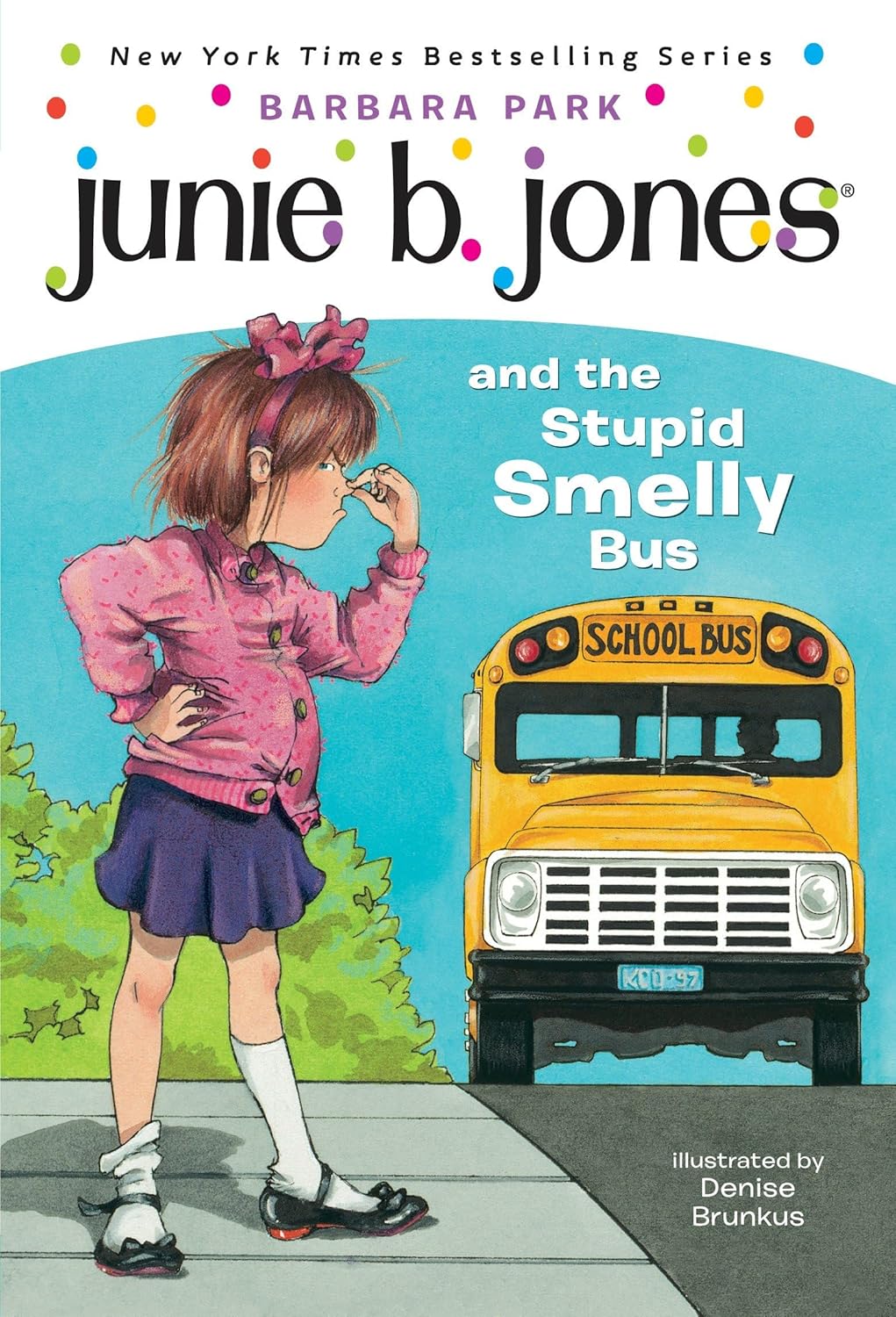
Junie B. Jones and the Stupid Smelly Bus by Barbara Park, illustrated by Denise Brunkus, is the first book in a wildly popular, joyfully chaotic early chapter book series — the story of Junie B. Jones, a kindergartner of irrepressible personality and imperfect grammar, who faces her first day of school with the same combination of confidence and cluelessness that has made her a beloved character in children’s literature for more than thirty years. Published in 1992, the series has sold over 80 million copies and spent more than 180 weeks on the New York Times bestseller list. This guide covers the reading level, recommended age, read-aloud vs. independent reading guidance, themes, and everything parents and teachers need to know about sharing this book with young readers — including a note on the title’s language.
For Parents
Find out whether Junie B. Jones and the Stupid Smelly Bus works best as a read-aloud or independent read for your child, what age range it suits, and why this laugh-out-loud first chapter book works so well for children who are just beginning to read independently and need to be convinced that reading is actually fun.
For Teachers
Grade-level data, read-aloud timing, key themes, and discussion questions for a widely read early chapter book in American classrooms. Strong for discussions of school anxiety, first-person voice, and the comedy of a character who says exactly what she thinks — including the ongoing classroom conversation about Junie B.’s unconventional grammar.
Junie B. Jones and the Stupid Smelly Bus at a Glance
Find on Amazon →| Author | Barbara Park |
| Illustrator | Denise Brunkus |
| Published | 1992 |
| Grade Level | 1–2 (our assessment) |
| Recommended Age | 5–8 |
| Best For | Read-aloud ages 5–8; independent reading ages 6–8 |
| Flesch-Kincaid Grade | 2.9 |
| Word Count | ~5,800 |
| Pages | 80 |
| Chapters | 9 |
| Genre | Early chapter book / realistic fiction / humor |
| Setting | Home; a school bus; kindergarten classroom |
| Awards | #1 New York Times Bestselling Series; NH Great Stone Face Award (1995); WI Golden Archer Award (1998); 80 million copies sold |
For official Lexile and AR levels, visit Lexile.com or AR BookFinder. ReadingVine provides independent editorial assessments.
What Reading Level Is Junie B. Jones and the Stupid Smelly Bus?
Junie B. Jones and the Stupid Smelly Bus is a grade 1–2 reading level by our editorial assessment, with a Flesch-Kincaid grade level of approximately 2.9. At around 5,800 words across nine chapters it is comparable in length to Magic Tree House #1: Dinosaurs Before Dark by Mary Pope Osborne and is a genuine early chapter book. The chapters average about 640 words each, with short paragraphs and a first-person narration that moves quickly and conversationally.
The FK score of 2.9 is somewhat misleading as a guide to comprehension demand, because Junie B.’s narration is deliberately written in a child’s grammar rather than an adult’s: she uses sentence fragments, unconventional constructions, informal vocabulary, and the occasional malapropism. This gives the text a lively, spoken quality that beginning readers often find easier and more engaging than more formally written early chapter books — the voice sounds like someone they know — while also generating ongoing classroom discussion about grammar and word choice. The book is a grade 1–2 independent read; as a read-aloud, it works for children as young as five who enjoy humor and the company of a protagonist they recognize. For parents who use specific reading level systems: we recommend checking your child’s level on Lexile.com or AR BookFinder for official scores, or asking your child’s teacher for their Guided Reading or DRA level.
Is Junie B. Jones and the Stupid Smelly Bus a Read-Aloud or Independent Read?
Junie B. Jones and the Stupid Smelly Bus works brilliantly as both a read-aloud for ages 5–8 and an independent read for ages 6–8. As a read-aloud, it is a reliable laugh-generator in the early chapter book library — Junie B.’s voice is inherently comedic when read aloud because her observations are always sincere and always slightly, magnificently wrong. Kirkus Reviews called it “a hilarious, first-rate read-aloud” and that is accurate: the nine chapters can be read in two or three sittings, each running about 10–15 minutes, and the full book takes about 40–50 minutes to read aloud.
As a read-aloud, Junie B.’s voice is the performance. She narrates with complete conviction, complete sincerity, and a vocabulary that is perpetually one step behind the situation she is describing. Reading her lines with her exact earnestness — not winking at the audience, not signaling that you know she’s wrong — produces the comedy most effectively. Children who identify with Junie B.’s experience (the bus is scary, the other kids are mean, school is confusing and you don’t know the rules yet) find her validation and her defiance genuinely moving, not just funny.
For independent reading, a confident first or second grader can handle the text. The short chapters and brisk pacing make it feel faster than the word count suggests, and Junie B.’s voice — chatty, breathless, full of exclamation points — creates a reading energy that pushes children forward. It is a book that adults frequently credit for “making me a reader” in childhood, and for good reason: the combination of recognizable school anxiety, genuine comedy, and a protagonist who never stops talking makes it almost impossible to put down once you’ve started.
One note for parents: Junie B.’s grammar is deliberately imperfect — she says “runned” instead of “ran,” “goed” instead of “went,” and uses other non-standard constructions throughout the series. This has generated some parental concern and even occasional library challenges over the years. The academic consensus is that children who read widely, including books with non-standard grammar, develop strong language skills and do not adopt the grammatical errors of characters they enjoy. Most teachers use the grammar as a teaching opportunity rather than a concern, asking children to identify what Junie B. “should have said” — which turns her mistakes into a productive language lesson.
When Junie B. makes a grammatical slip — “I runned all the way” or “she goed home” — resist the urge to correct it while you’re reading. Let it land. Then, after you’ve finished the chapter, ask your child: “Did you notice anything funny about the way Junie B. talks?” Children who identify the error themselves, rather than being told about it, are doing real language work. And children who have never noticed anything funny about Junie B.’s grammar are getting something equally valuable: a protagonist who sounds exactly like them, which is its own form of literacy magic.
What Is Junie B. Jones and the Stupid Smelly Bus About?
It is Junie B. Jones’s first day of kindergarten. She is almost six years old, and she does not want to ride the school bus. It is big, and it smells funny, and there is a mean girl who will not let her sit down, and she has to sit in the middle between two people she doesn’t know, and it is generally terrible. At school, things are marginally better: she loves Room Nine, she loves her teacher Mrs. (whose last name she keeps almost-but-not-quite-remembering), she loves the pencil sharpener and the clay. But at the end of the day, when everyone lines up to go home, Junie B. cannot bring herself to get back on the stupid smelly bus.
So she doesn’t. She hides in the school instead. She finds the supply closet and the media center and the office and various other rooms, she has some adventures, and eventually the principal finds her and her parents are called. The crisis is resolved. Tomorrow, Junie B. will have to figure out the bus all over again. But she did it today — she got through the first day — and that counts for something. The book ends with Junie B. at home, in her bed, being hugged by her parents, which is exactly where she needs to be.
Junie B. Jones and the Stupid Smelly Bus Characters
Junie B. Jones and the Stupid Smelly Bus Themes and Lessons
The central theme of Junie B. Jones and the Stupid Smelly Bus is the real difficulty of starting something new — specifically, the particular fear and disorientation of the first day of school, rendered from inside a child’s experience rather than from outside it. Junie B. is not being silly about the bus; she is genuinely frightened and genuinely overwhelmed, and the book takes that experience seriously while making it funny. Children who have felt the first-day fear recognize themselves in Junie B. completely, and recognition is a powerful thing a book can provide: it says, your feelings are real, they are large, and you are not alone in having them.
The book is equally a study in child-sized courage. Junie B. does not conquer her fear of the bus. She hides instead of riding it, and she is found and returned home, and tomorrow the bus will still be there. But she got through the day. She found the supply closet and the media center and the office, and she navigated the school on her own, and she was eventually okay. Park does not moralize about this or turn it into a lesson about facing your fears. She simply shows a child getting through a hard thing in the way children actually get through hard things — imperfectly, noisily, and ultimately fine — which is more honest and more useful than a tidier resolution.
For teachers, Junie B. Jones and the Stupid Smelly Bus is a valuable text for the September classroom conversation about school anxiety and new beginnings. Most children in a first-grade classroom in September are having some version of Junie B.’s first-day experience, and reading it together creates both a shared vocabulary (the bus is scary; new things are hard; being brave doesn’t mean not being scared) and a sense of community — we are all in Room Nine together, and even the funniest, boldest kid in the room is figuring it out too.
Discussion starters for families: Have you ever been scared of something new at school? What did Junie B. do when she was scared? Was hiding a good idea? What would you have done? Why do you think the bus felt so scary to Junie B.? What is one thing about school that you love, like Junie B. loves the pencil sharpener?
How Long Is Junie B. Jones and the Stupid Smelly Bus?
Junie B. Jones and the Stupid Smelly Bus has 80 pages, 9 chapters, and approximately 5,800 words. Each chapter averages about 640 words and takes about 10–15 minutes to read aloud; the full book takes about 40–50 minutes across two or three sittings. The brisk, chatty narration makes the pages turn quickly, and most families find themselves at the end of a chapter before they intended to stop.
A child reading independently at a confident first- or second-grade level will typically finish in about 45–60 minutes across multiple sessions. Like Magic Tree House #1: Dinosaurs Before Dark, the book’s chapter structure makes progress visible and satisfying. Unlike that book, Junie B.’s voice creates a sense of velocity — the text feels faster than it is because she never, ever stops talking.
Books Similar to Junie B. Jones and the Stupid Smelly Bus
If your child loves Junie B. Jones and the Stupid Smelly Bus, these titles share its humor, its chapter book format, or its emotional honesty about childhood:
About the Author and Illustrator
Barbara Park (1947–2013) was an American children’s author who grew up in Mount Holly, New Jersey, and spent most of her adult life in Arizona. She had been writing children’s books since 1981 — including award-winning middle-grade novels like Skinnybones and Mick Harte Was Here — before creating Junie B. Jones in 1992. Park has said that Junie B.’s voice came from her own memories of being a small child who felt things very strongly and said them very honestly, and from watching her own children navigate the social complexity of early school years. She wrote 28 books in the series between 1992 and 2013, the year of her death from ovarian cancer; the final book was published posthumously. She once wrote: “I’ve never been sure whether Junie B.’s fans love her in spite of her imperfections — or because of them. But either way, she’s gone out into the world and made more friends than I ever dreamed possible.” She won more than 40 children’s book awards across her career, and the Junie B. Jones series spent over 180 weeks on the New York Times bestseller list.
Denise Brunkus is an American illustrator who has illustrated more than 60 children’s books, including all 28 books in the Junie B. Jones series. Her black-and-white pencil illustrations give Junie B. her visual identity — the wild hair, the expressive face, the perpetual sense that she is in the middle of something — and they are inseparable from the character’s personality. Brunkus’s illustrations do not merely accompany the text; they extend it, capturing the expressions and body language that Junie B.’s words gesture toward but never quite land on. She continues to illustrate children’s books.
The title Junie B. Jones and the Stupid Smelly Bus uses the word “stupid,” which some parents, schools, and libraries have found objectionable. The series appeared on the American Library Association’s list of frequently challenged books from 2000–2009, with concerns about both title language and Junie B.’s non-standard grammar. These are decisions each family and school community makes for itself. What the research shows is that children who read widely — including books whose characters use informal, imperfect, or occasionally forbidden language — develop strong reading habits and do not adopt the linguistic patterns of characters they enjoy. The word “stupid” is used by Junie B. the way a five-year-old would actually use it: to describe something she finds frightening and overwhelming. Whether that is an appropriate use for a title is a reasonable question; whether the book itself is valuable for early readers is not much in dispute.
Junie B. Jones and the Stupid Smelly Bus: Frequently Asked Questions
What reading level is Junie B. Jones and the Stupid Smelly Bus?
Junie B. Jones and the Stupid Smelly Bus is a grade 1–2 reading level by our editorial assessment, with a Flesch-Kincaid grade level of approximately 2.9. At around 5,800 words across nine chapters, it is a genuine early chapter book. The first-person narration in Junie B.’s deliberately imperfect grammar gives it a chatty, accessible quality that many beginning readers find engaging. It works best as a read-aloud for ages 5–8 and as an independent read for ages 6–8. For official Lexile and AR levels, visit Lexile.com or AR BookFinder.
What age is Junie B. Jones and the Stupid Smelly Bus for?
Junie B. Jones and the Stupid Smelly Bus is appropriate for ages 5–8. As a read-aloud it works from age 5 — the humor and the school-anxiety themes engage children immediately. As an independent read it suits confident first and second graders ages 6–8. It is frequently cited by parents and teachers as a reliable book for children who have been reluctant to engage with chapter books, and it has the well-earned reputation of being able to “make a reader” out of a child who didn’t think they liked reading.
Is the word “stupid” in the title appropriate for young children?
This is a question each family and school community answers for itself, and both positions are reasonable. The series appeared on the ALA’s list of frequently challenged books partly for this reason. The word is used by Junie B. the way a frightened five-year-old would use it — to describe something overwhelming and unpleasant — and the book is widely used in classrooms precisely because it reflects how children actually think and talk. Parents who prefer to avoid the word in their household are the best judges of whether this book is right for their child; parents who have no objection to it will find the book enormously popular with the age group it is designed for.
Does Junie B.’s grammar teach children bad English?
The research does not support this concern. Children who read widely — including books whose characters use non-standard grammar — develop strong language skills and do not adopt the grammatical patterns of fictional characters. Many teachers use Junie B.’s grammar as a productive classroom tool, asking students to identify what she “should have said” and why. This approach turns an apparent concern into one of the more engaging grammar lessons available. Barbara Park wrote Junie B.’s voice deliberately and precisely; it is an accurate rendering of how a not-quite-six-year-old processes the world, and children recognize it as such.
What is Junie B. Jones and the Stupid Smelly Bus about?
Junie B. Jones and the Stupid Smelly Bus is about Junie B. Jones’s first day of kindergarten, which begins badly because she has to ride the school bus and the school bus is big and smelly and full of strangers. School itself is better — she loves her classroom and her teacher — but at the end of the day she cannot bring herself to get back on the bus. So she hides in the school instead. Eventually she is found, her parents are called, and she goes home. The book ends warmly, with Junie B. in her bed, surrounded by her family, knowing she got through the first day. Tomorrow the bus will still be there. But today she survived.
Are there other Junie B. Jones books?
Yes — Barbara Park wrote 28 books in the Junie B. Jones series between 1992 and 2013. The first 17 follow Junie B. through kindergarten; Books 18–28 follow her into first grade. All are written in the same first-person voice and illustrated by Denise Brunkus. The series is complete — Park died in 2013 and no books have been added since. For children who love the first book, the rest of the series offers the same humor, the same voice, and the same emotional honesty in a new situation every time.