
 = Partner Site
M. C. Higgins the Great Reading Level: A Complete Guide
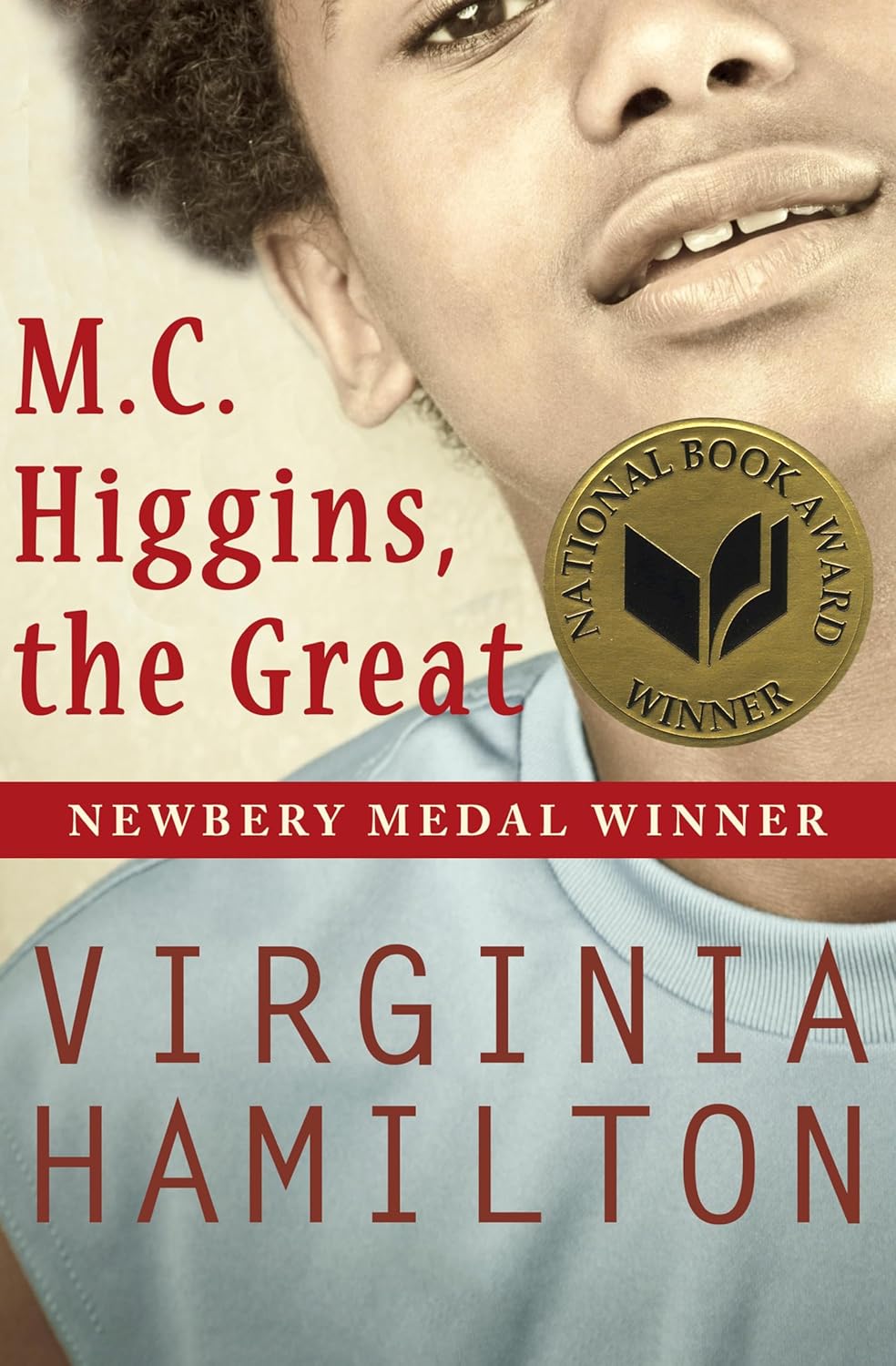
This complete guide to M.C. Higgins, the Great by Virginia Hamilton covers everything parents, teachers, and students need to know — from reading level and recommended age to a full character breakdown, key themes, and the best books to read next. Published in 1974 by Macmillan, M.C. Higgins, the Great won the 1975 Newbery Medal, the National Book Award for Young People’s Literature, and the Boston Globe–Horn Book Award — the first book in history to claim all three. It is narrated by thirteen-year-old Mayo Cornelius Higgins, a boy who spends his days perched atop a forty-foot steel pole on a mountain his family has called home for generations, watching a strip-mining spoil heap inch closer and trying to figure out how to save the people he loves. This guide gives parents, teachers, and students the information they need before, during, and after reading.
For Parents
M.C. Higgins, the Great is a literary novel — richer and more interior than most middle grade fiction, and deliberately paced. It rewards patient readers with one of children’s literature’s most vivid portraits of place, family, and the particular tension of a young person caught between the world they were raised in and a future they can almost see. The novel covers three days in M.C.’s life; the drama is emotional and environmental rather than action-driven. There is no sexual content, no profanity, and no graphic violence. Common Sense Media recommends it for ages 10 and up. The content that warrants attention is thematic: a family facing displacement, a father who holds his family back through fear and pride, and an undercurrent of danger from the unstable spoil heap. The novel is ideal for families who want to read and discuss together — it raises questions that don’t have tidy answers.
For Teachers
M.C. Higgins, the Great is among the most formally ambitious novels to hold the Newbery Medal, and its classroom value goes well beyond its awards. Hamilton’s prose — lyrical, rhythmic, deeply grounded in the speech patterns and landscape of Appalachian life — is excellent material for teaching voice, setting, and the relationship between place and identity. The novel’s Lexile score of 560L places it below the typical grade 5–7 difficulty range, but its emotional and thematic complexity push it firmly into upper elementary and middle school territory. It pairs naturally with units on Appalachian history, environmental justice, the legacy of the Great Migration, and the tension between tradition and change. A full Scholastic Teaching Guide is available.
M.C. Higgins, the Great at a Glance
Find on Amazon →| Author | Virginia Hamilton |
| Published | 1974 (Macmillan; current edition: Simon & Schuster) |
| Grade Level | 5–7 (our assessment) |
| Recommended Age | 10–13 |
| Flesch-Kincaid Grade | ~4.4 |
| Word Count | ~69,500 |
| Pages | 278 (original hardcover); 288 (current paperback) |
| Genre | Realistic fiction / Coming-of-age |
| Setting | Sarah’s Mountain, Appalachian Kentucky, near the Ohio River; contemporary to the novel’s 1974 publication |
| Awards | Newbery Medal (1975); National Book Award for Young People’s Literature (1975); Boston Globe–Horn Book Award; ALA Notable Book; NYT Outstanding Children’s Book of the Year; Lewis Carroll Shelf Award |
For official Lexile and AR levels, visit Lexile.com or AR BookFinder. ReadingVine provides independent editorial assessments.
What Reading Level Is M.C. Higgins, the Great?
M.C. Higgins, the Great has a Lexile score of 560L and an ATOS level of 4.4, placing it at approximately a fourth-grade text complexity by those measures. Our editorial assessment is grades 5–7, with a recommended age of 10–13. The gap between the metrics and our assessment reflects something important about this novel: the prose is not technically difficult, but it is dense with imagery, interior experience, and the kind of deliberate pacing that rewards readers who know how to sit with a book rather than race through it. A fourth grader who is technically capable of reading the sentences may not yet have the patience or emotional toolkit for what Hamilton is doing here.
The novel covers three days in M.C.’s life, which means the action is compressed and the story moves through feeling and reflection more than event. Hamilton’s narrative style draws on the oral traditions of Appalachian storytelling — her sentences have rhythm and music, and her descriptions of landscape are among the most sustained and beautiful in American children’s literature. Strong readers in grades 5–7 who have some tolerance for lyrical prose will find it rewarding. Readers who prefer plot-driven books may struggle to connect. It works exceptionally well as a teacher read-aloud, particularly when paired with discussion of setting and voice.
For official Lexile and AR scores, visit Lexile.com or AR BookFinder.
What Age Is M.C. Higgins, the Great Appropriate For?
We recommend M.C. Higgins, the Great for readers ages 10–13. Common Sense Media recommends it for ages 10 and up. The novel is largely free of the content that typically concerns parents — no sexual content, no profanity, and no graphic violence. What the book contains is emotional and thematic weight that rewards older readers more than younger ones.
The novel’s central tension is environmental: a mining company’s spoil heap — a mountain of unstable mining waste — is slowly sliding toward the Higgins family home, and M.C. is not sure whether or how it can be stopped. The danger is real but never erupts into action during the story’s three-day span; instead it hangs over everything as a source of dread. M.C.’s father Jones is a complicated figure — a man whose love for his family is genuine but whose pride and fear make him resistant to change, and whose decisions keep the family in a precarious position. A subplot involves a girl named Lurhetta, and their relationship has the tentative, searching quality of early adolescent connection. There is one scene of M.C. and Lurhetta swimming that some parents flag, though it is brief and not explicit. The Killburn family — neighbors whom Jones has forbidden M.C. to associate with due to an old superstition — are thought by some in the community to practice witchcraft; this subplot is handled thoughtfully and the novel ultimately treats superstition as something to be examined and moved past. No significant violence. No graphic content.
For classroom use: the novel’s thematic complexity — tradition vs. change, loyalty vs. self-determination, environmental threat vs. family attachment — makes it particularly strong for grades 6–7, where students have the life experience to engage with M.C.’s specific dilemma. For independent readers, a mature ten-year-old will manage it, but it is most alive in the hands of eleven- and twelve-year-olds.
What Is M.C. Higgins, the Great About?
Thirteen-year-old Mayo Cornelius Higgins lives with his family on Sarah’s Mountain in the Appalachian hills near the Ohio River — land his great-grandmother Killburn claimed after escaping slavery, land that has defined the Higgins family across generations. M.C.’s favorite place is the top of a forty-foot steel pole his father Jones erected in the yard: a reward for swimming the Ohio River, a throne from which M.C. can survey his entire world. From up there he can see the rolling hills and valleys spread before him. He can also see, directly behind the house, a spoil heap — a massive mound of unstable mining waste left by strip-mining operations — that is slowly, certainly, moving toward everything his family calls home.
The novel takes place over three days. In that compressed span, two strangers arrive on Sarah’s Mountain and change M.C.’s sense of what might be possible. The first is James Lewis, a young man traveling the country with a tape recorder, collecting folk songs — M.C.’s mother Banina has a voice of extraordinary beauty, and M.C. has allowed himself to hope that Lewis might be the ticket to fame and escape. The second is Lurhetta Outlaw, a girl M.C.’s age traveling alone with a pack on her back, whose easy self-possession and freedom of movement show M.C. a kind of life he has never imagined for himself. Through these encounters — and through his friendship with Ben Killburn, a boy from a family his father has forbidden him to know — M.C. begins to reckon with the central question the novel has been building toward all along: whether it is possible to love a place deeply and still choose to leave it, or whether the mountain demands that its people stay.
The resolution is small by conventional standards — not an escape, not a rescue, but a beginning. M.C. starts to build a wall. It is, the novel suggests, the first act of someone who has stopped waiting for someone else to save him and decided to act in the world himself.
M.C. Higgins, the Great Characters
Is M.C. Higgins, the Great Banned?
M.C. Higgins, the Great has not been banned or formally challenged in any documented way. It does not appear on the American Library Association’s lists of challenged or banned books. A 1975 Newbery Medal winner with the National Book Award and Boston Globe–Horn Book Award also on its shelf, the novel is firmly within the mainstream of recognized literary achievement for children, and its portrait of a Black Appalachian family is treated with dignity and depth throughout. If your child’s school has assigned it, the book is consistent with the most honored tradition of middle grade literature.
M.C. Higgins, the Great Themes and Lessons
The novel’s deepest argument is about what it means to love a place — and what happens when that love becomes a trap. Sarah’s Mountain is not just scenery. It is the Higgins family’s inheritance from a woman who escaped slavery and chose this ground as the place where her people would be free. That history is present in every scene: in Jones’s refusal to leave, in M.C.’s ambivalence, in the weight that the mountain carries as both home and obligation. Hamilton is not sentimental about it. She shows how the same love of place that sustains a family can also hold it in danger, and how hard it is to separate genuine attachment from fear of change.
The environmental thread is one of the novel’s most prescient elements — the spoil heap as an emblem of what extraction economies do to the communities they pass through. Hamilton was writing in 1974, but the dynamic she describes remains recognizable: a family with deep roots to land that larger economic forces have decided to use and discard. The novel also quietly interrogates superstition and community prejudice through the Killburn subplot — the webbed fingers that mark the Killburns as different, Jones’s prohibition, and M.C.’s eventual recognition that what his father has taught him to fear is simply a family with an unusual trait and a generous spirit. For family and classroom discussion: What does it mean to protect something you love? When does loyalty become stubbornness? What is M.C. actually building when he starts to build his wall — and is it enough?
How Many Pages and Chapters in M.C. Higgins, the Great?
The original 1974 Macmillan hardcover edition of M.C. Higgins, the Great runs 278 pages; the current Simon & Schuster paperback is 288 pages. The novel is organized into chapters rather than numbered sections, with approximately 14–15 chapters across its span. Word count is approximately 69,500 words. For the target age group reading independently, most readers complete it in one to two weeks, though readers who engage deeply with Hamilton’s prose may take longer. The novel works well as a read-aloud; Hamilton’s rhythmic sentences reward being heard, and the descriptions of the mountain landscape are particularly effective when read expressively. A 1986 film adaptation was produced by Random House Video; it is primarily of historical interest rather than wide classroom use.
Books Similar to M.C. Higgins, the Great
About Virginia Hamilton
Virginia Esther Hamilton was born on March 12, 1936, in Yellow Springs, Ohio — the youngest of five children in a family whose roots in southwestern Ohio stretched back to the 1850s, when her great-grandfather Levi Perry arrived as an infant via the Underground Railroad. That family history — of a people who claimed a piece of Ohio soil and held it across generations — flows directly into M.C. Higgins, the Great, and into Hamilton’s understanding of what land means to people whose right to it was never guaranteed. She attended Antioch College on a full scholarship, transferred to Ohio State University, and later studied at the New School for Social Research in New York City, where she met poet Arnold Adoff, whom she married in 1960. In 1969 the couple returned to Yellow Springs and built their home on the last remaining acres of the original Hamilton family farm, where Hamilton did her most significant writing. Her debut novel, Zeely, was published in 1967; over the next thirty-five years she published 41 books across virtually every genre available to children’s literature — picture books, folklore collections, science fiction, biography, mystery, and realistic fiction. She described her body of work as “Liberation Literature” — stories that centered the African American experience as fully human, fully complex, and fully worthy of the imagination’s best effort. M.C. Higgins, the Great (1974) made her the first Black author to win the Newbery Medal and the first book to simultaneously hold the Newbery Medal, the National Book Award, and the Boston Globe–Horn Book Award. In 1995 she became the first children’s writer to receive a MacArthur Fellowship — the so-called “Genius Grant.” Her other major honors include the Hans Christian Andersen Award (1992), the Laura Ingalls Wilder Award (1995), and multiple Coretta Scott King Awards. After her death from breast cancer on February 19, 2002, the American Library Association established the Coretta Scott King–Virginia Hamilton Award for Lifetime Achievement in her name. She was 65. The Virginia Hamilton Conference on Multicultural Literature for Youth has been held annually at Kent State University since 1984.
M.C. Higgins, the Great: Frequently Asked Questions
What reading level is M.C. Higgins, the Great?
M.C. Higgins, the Great has a Lexile score of 560L and an ATOS level of 4.4. Our editorial assessment is grades 5–7, ages 10–13. The metrics reflect the accessibility of the prose, but they understate the novel’s emotional and thematic complexity — Hamilton’s sentences are not long or difficult, but her narrative is interior, lyrical, and deliberately paced in ways that reward older readers. Strong readers in upper elementary can access it; it is most rewarding in middle school. For official scores, visit Lexile.com or AR BookFinder.
What age is M.C. Higgins, the Great appropriate for?
We recommend M.C. Higgins, the Great for ages 10–13. Common Sense Media recommends it for ages 10+. There is no sexual content, no profanity, and no graphic violence. The content parents most often flag: a scene where M.C. and a girl named Lurhetta swim together (brief and not explicit); a subplot involving a family believed by some neighbors to practice witchcraft (handled thoughtfully, ultimately sympathetic to the accused family); and an underlying sense of environmental danger that never resolves into dramatic action but is present throughout. The novel’s emotional weight is its primary challenge for younger readers — it rewards patience and a capacity to sit with ambiguity.
What awards did M.C. Higgins, the Great win?
M.C. Higgins, the Great won the 1975 Newbery Medal, the National Book Award for Young People’s Literature, and the Boston Globe–Horn Book Award — making it the first book in history to hold all three simultaneously. (The only other book to have done so is Holes by Louis Sachar, in 1998.) It was also named an ALA Notable Book and an NYT Outstanding Children’s Book of the Year, and won the Lewis Carroll Shelf Award. In winning the Newbery, Virginia Hamilton became the first Black author to receive the honor.
What is the spoil heap in M.C. Higgins, the Great?
The spoil heap — also called a slag heap — is a massive mound of waste rock and debris left behind by strip-mining operations on the mountain above the Higgins family home. Strip mining removes the surface of the earth to access the coal or minerals below, and the discarded material is piled nearby. In the novel, the spoil heap is slowly sliding toward the house, destabilized by rain and the ongoing degradation of the land. It is both a literal threat — M.C. worries it will one day bury the house — and a symbol of what extractive industries do to the communities they pass through. The novel was prescient; the environmental dynamics it describes were very real in Appalachian communities in the 1970s and remain so today.
Why does M.C. have a forty-foot pole?
M.C.’s father Jones erected the pole as a reward after M.C. swam the Ohio River — a feat of endurance and courage that Jones treated as a rite of passage. The pole has a bicycle seat at the top, and M.C. spends much of his time up there, using it as both lookout post and private refuge. It is the one place where he is above everything and, in a sense, free from the competing obligations that pull at him on the ground. The pole is also one of the novel’s richest symbols: a son’s gift from his father, a throne above a home under threat, and an emblem of a boy who has learned to rise above his circumstances but hasn’t yet figured out how to change them.
Why is Virginia Hamilton historically significant?
Virginia Hamilton was the first Black author to win the Newbery Medal, which she received for M.C. Higgins, the Great in 1975. She was also the first children’s writer to receive a MacArthur Fellowship (the “Genius Grant”), which she was awarded in 1995. Her 41 books span nearly every genre in children’s literature, and she is widely credited with helping establish the modern tradition of African American children’s literature — stories that centered Black life and experience not as exceptional or exceptional-to-be-explained, but as fully realized and fully worthy of literary attention. The American Library Association honored her legacy by establishing the Coretta Scott King–Virginia Hamilton Award for Lifetime Achievement in her name after her death in 2002.
Is M.C. Higgins, the Great part of a series?
No. M.C. Higgins, the Great is a standalone novel. Virginia Hamilton wrote 41 books over her career, several of which are loosely connected by theme or setting, but M.C. and his family do not appear in any other work. Readers who want to continue with Hamilton after this novel often turn to The House of Dies Drear (1968), a mystery set in an Underground Railroad safe house that similarly weaves African American history into a present-day story, or Sweet Whispers, Brother Rush (1982), another interior, lyrical novel about a teenager navigating a complicated family legacy.
What is the ending of M.C. Higgins, the Great?
The novel ends not with escape or rescue but with M.C. beginning to build a wall — a physical barrier he hopes will divert or slow the spoil heap’s slide toward the house. It is a modest act measured against the scale of the problem, and Hamilton is honest about that. But it is also the first thing M.C. does that is wholly his own: not dreaming about someone else saving his family, not waiting for the stranger with the tape recorder to carry his mother to fame, but acting. The ending is open and quiet. It has frustrated readers who wanted resolution and moved readers who recognize what it actually costs to begin.