
 = Partner Site
Julie of the Wolves Reading Level: A Complete Guide
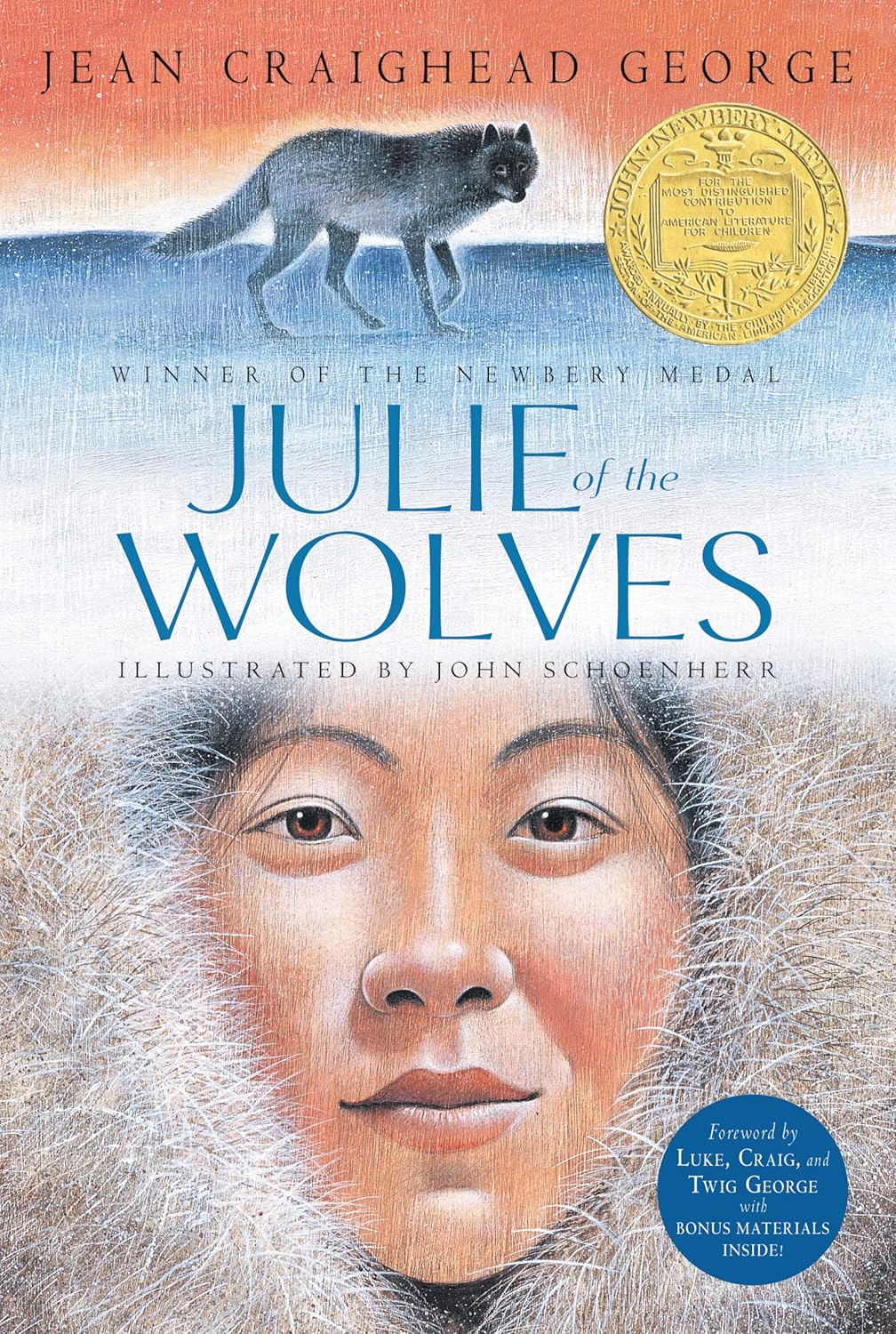
Julie of the Wolves by Jean Craighead George follows a thirteen-year-old Inupiat girl who survives alone on the Alaskan tundra by befriending a wolf pack, caught between her traditional Inupiat heritage and modern American culture. This guide provides parents and teachers with reading level information, age recommendations, content insights, and discussion questions for this Newbery Medal winner about survival, identity, and the clash between tradition and modernity.
For Parents
Find the right reading level for your child, understand the book’s themes about cultural identity and survival, and get conversation starters to help your child explore ideas about finding yourself, respecting nature, and navigating between two worlds.
For Teachers
Access grade-level guidance, reading metrics, character analysis support, and thematic discussion questions. This George classic offers rich opportunities for exploring Inupiat culture, Arctic ecology, survival narratives, and themes about cultural identity.
Julie of the Wolves at a Glance
Find on Amazon →| Author | Jean Craighead George |
| Published | 1972 |
| Grade Level | 5–7 (our assessment) |
| Recommended Age | 10–13 |
| Flesch-Kincaid Grade | 5.9 |
| Word Count | ~44,000 |
| Pages | ~170 (standard paperback) |
| Chapters | 3 parts |
| Genre | Survival fiction / coming-of-age |
| Setting | Alaska tundra, 1970s |
| Awards | Newbery Medal (1973) |
For official Lexile and AR levels, visit Lexile.com or AR BookFinder. ReadingVine provides independent editorial assessments.
What Reading Level Is Julie of the Wolves?
Julie of the Wolves is appropriate for grades 5–7, with a Flesch-Kincaid grade level of 5.9. The vocabulary includes Inupiat words and Arctic wildlife terms, but George’s prose is clear and precise. Her detailed descriptions of wolf behavior and tundra survival are accessible while being scientifically accurate. The straightforward narrative structure makes the survival story easy to follow despite complex themes about cultural identity.
Jean Craighead George’s writing style is observational and rich with natural detail. She describes wolf behavior with scientific precision—how they communicate through body language, establish pack hierarchy, and hunt—making readers feel like naturalists studying the pack alongside Julie. The prose balances action (survival challenges) with contemplation (Julie’s internal struggle about her identity). The three-part structure moves between present survival, flashbacks to Julie’s past, and her journey’s resolution.
The story resonates most deeply with readers ages 10–13 who can appreciate both the survival adventure and the deeper themes about cultural loss and finding your place between two worlds. Strong fifth graders can read it; sixth and seventh graders engage more fully with Julie’s identity struggles and the book’s environmental themes.
What Age Is Julie of the Wolves Appropriate For?
Julie of the Wolves is most appropriate for readers ages 10–13. The book deals with difficult content including attempted sexual assault and cultural displacement, but handles these themes with appropriate restraint for middle-grade readers. The survival story is compelling but honest about the dangers of Arctic wilderness.
Attempted sexual assault: Daniel, Julie’s husband in an arranged child marriage, attempts to force himself on her while drunk. Julie fights him off and escapes. The scene is not graphic but is frightening and clearly traumatic. This is the reason Julie runs away into the wilderness.
Death of Amaroq: The wolf pack leader who befriends Julie is shot and killed by hunters from a plane. His death is sad and represents the destruction of the wild world Julie loves.
Cultural loss and displacement: The book honestly portrays the painful erosion of traditional Inupiat culture and Julie’s grief over what’s being lost.
Survival challenges: Julie faces real dangers—starvation, freezing, getting lost—but survives through knowledge and resourcefulness.
What’s NOT in the book: The attempted assault is not graphic. The ending is bittersweet rather than tragic—Julie survives and finds a path forward, though not the one she hoped for. The book treats Inupiat culture with respect and celebrates traditional knowledge while honestly showing the challenges of cultural survival in the modern world.
What Is Julie of the Wolves About?
The book opens with thirteen-year-old Miyax (her Inupiat name; Julie is her English name) lost on the North Slope of Alaska, many miles from civilization. She’s been wandering for days and is desperately hungry. She knows she’s in danger of starving or freezing before she can reach safety. Her only hope is a nearby wolf pack—if she can communicate with them using the wolf language her father taught her, maybe they’ll share their kill and help her survive.
Miyax observes the wolves carefully, learning their personalities and pack hierarchy. There’s Amaroq, the magnificent black leader; his mate Silver; Nails, the beta male; and several others including a playful pup Miyax names Kapu. Using what her father taught her about wolf behavior, Miyax signals submission and friendship. She whimpers, averts her eyes, and makes herself small and unthreatening. Slowly, incredibly, the wolves accept her. Amaroq brings her meat. The wolves let her observe their hunts and share their kills. Miyax becomes, in a way, part of the pack.
As Miyax survives on the tundra through the brief Arctic summer, the book flashes back to explain how she got here. She was born Miyax, daughter of Kapugen, a respected Inupiat hunter who taught her the old ways—how to survive on the tundra, read animal signs, and respect the natural world. When Miyax was young, her mother died and her father disappeared, presumed lost at sea. Miyax was sent to live with her aunt in Mekoryuk, where she attended school and became “Julie,” trying to fit into the white American world.
At thirteen, facing an uncertain future, Miyax agreed to marry Daniel, the son of Kapugen’s friend Naka. It was understood the marriage would be in name only until both were older—a practical arrangement to give Miyax a home and Daniel a companion. For a while, this worked. Miyax went to school and Daniel left her alone. But one night, drunk and influenced by his friends, Daniel attempted to assault her. Miyax fought him off and ran.
Rather than return to a life she couldn’t bear, Miyax decided to run away. She had corresponded with a pen pal named Amy in San Francisco who had written enthusiastically about American life—a distant dream that seemed to promise escape. Miyax set out across the tundra toward Point Hope, where she might work and eventually save money to travel farther. But she got lost in the vast, featureless landscape. That’s where the book begins—with Miyax starving, alone, and turning to the wolves for help.
Living with the wolves through the summer, Miyax rediscovers her Inupiat identity. She finds joy in the traditional skills her father taught her. She hunts, makes warm clothes from caribou hide, builds a cozy sod house, and thrives using the old knowledge. She begins to reconsider her earlier dream of San Francisco and questions whether that distant, modern life is truly what she wants, instead feeling drawn toward reconnecting with her father and the traditional ways he taught her. When the wolves migrate, she decides to follow them to their winter territory, where she hopes to find her way back to a traditional Inupiat life.
But tragedy strikes. Hunters in a plane spot the wolves and shoot them. Amaroq is killed. Miyax is devastated—Amaroq represented everything noble and wild, everything worth preserving. His death shows her that the old ways are dying, that even the wilderness isn’t safe from modernity’s intrusion.
Miyax continues traveling and eventually reaches a hunting camp. To her shock, she discovers her father Kapugen is alive. He didn’t drown at sea—he’s living in a modern house with a white wife, flying a plane, and living a modern life. The father she remembered, the traditional hunter who taught her the old ways, is gone. He’s become someone else. Miyax realizes there’s no going back to the world she imagined.
The book ends with Miyax accepting that she must find a way to live in the modern world while honoring what she’s learned. She can’t live with the wolves, and the traditional life is vanishing. But she carries within her the knowledge and values her father taught her and the lessons the wolves showed her. She’ll find her own path between two worlds, keeping the best of both. She heads toward her father’s house, no longer Miyax of the tundra or Julie of the American dream, but herself—changed by her journey and ready to forge a new identity.
Julie of the Wolves Characters
Julie of the Wolves Themes and Lessons
At its heart, Julie of the Wolves is about finding your identity when caught between two worlds. Miyax loves her traditional Inupiat heritage and the survival skills her father taught her, but the traditional life is vanishing. American culture offers opportunity but feels hollow and alien to her. Through her time with the wolves, Miyax discovers that she can’t fully return to the old ways (the traditional world is dying) and doesn’t want to fully embrace modern American life (it doesn’t honor what she values). She must forge her own path, keeping the wisdom and values of her heritage while living in the modern world.
The book also explores humans’ relationship with nature and the cost of environmental destruction. The wolves teach Miyax about living in harmony with the natural world—taking only what you need, respecting the balance of life, understanding you’re part of the ecosystem rather than above it. Amaroq’s death—shot from a plane by hunters—represents humanity’s destruction of what’s wild and beautiful. George wrote during the early environmental movement and the book celebrates indigenous knowledge about sustainable living while mourning what’s being lost. The book teaches that traditional cultures often understand truths about living with nature that modern society has forgotten.
Discussion questions for families:
- How does Miyax’s time with the wolves change her understanding of who she is?
- What does Amaroq’s death represent? Why is it so devastating to Miyax?
- Why can’t Miyax go back to the traditional life she imagined? What has changed?
- What does the book teach about indigenous knowledge and respecting nature?
How Many Pages and Chapters in Julie of the Wolves?
Julie of the Wolves is approximately 170 pages in standard paperback editions and is divided into 3 parts rather than traditional chapters. Part One covers Miyax’s survival with the wolves in the present. Part Two flashes back to her childhood and explains how she came to be lost on the tundra. Part Three follows her journey after leaving the wolves and her discovery of her father’s new life. The word count is about 44,000 words.
For independent readers ages 10–13, the book typically takes 3–4 hours to read. The clear prose and compelling survival narrative make it engaging and accessible. As a read-aloud, it takes approximately 2.5–3 hours. The book pairs well with units on Arctic ecosystems, Native American cultures, or survival literature. George’s scientific accuracy makes it valuable for discussing animal behavior and Arctic ecology.
Books Similar to Julie of the Wolves
About Jean Craighead George
Jean Craighead George (1919–2013) was a naturalist and author who wrote over 100 books about the natural world. She grew up in a family of naturalists and spent her childhood camping, hiking, and studying wildlife. Julie of the Wolves, published in 1972, won the Newbery Medal in 1973 and became her most famous work. George spent time in Alaska researching Arctic wolves, observing their behavior firsthand to ensure scientific accuracy. The wolf behavior in the book—their communication through body language, pack hierarchy, hunting techniques—is based on careful observation and research. George also consulted with Inupiat people to portray their culture respectfully and accurately. The book was groundbreaking in its sympathetic portrayal of indigenous knowledge and its environmental message at a time when both were underrepresented in children’s literature. George wrote two sequels: Julie (1994), which follows Miyax as she navigates life between traditional and modern worlds, and Julie’s Wolf Pack (1997), told from the wolves’ perspective. Her other famous work, My Side of the Mountain, also features wilderness survival and was a Newbery Honor book. George’s books are celebrated for their scientific accuracy, environmental awareness, and celebration of self-reliance and connection with nature. Julie of the Wolves remains a classic of survival literature and one of the most powerful books about cultural identity and environmental destruction in children’s literature. The book has been praised for its respectful treatment of Inupiat culture while honestly showing the challenges of cultural survival in the modern world.
Julie of the Wolves: Frequently Asked Questions
What grade level is Julie of the Wolves?
Julie of the Wolves is appropriate for grades 5–7 (ages 10–13). The Flesch-Kincaid level of 5.9 reflects clear prose with some Inupiat vocabulary and Arctic terms. The survival narrative is accessible but the themes about cultural identity, attempted assault, and environmental destruction require maturity. Strong fifth graders can read it; sixth and seventh graders engage most fully with Julie’s identity struggles. It won the Newbery Medal in 1973 and is widely taught in middle school. The book rewards readers interested in survival stories, animal behavior, and themes about finding yourself between two cultures.
What happens at the end of Julie of the Wolves?
At the end of Julie of the Wolves, Miyax discovers that her father, Kapugen, is alive but has adapted to aspects of modern life—living in a house, flying a plane, and participating in a changing world that blends traditional and contemporary ways. The father she remembered is gone. Amaroq, the wolf pack leader, has been killed by hunters, representing the destruction of the wild world Miyax loves. Miyax realizes she can’t return to the traditional life she imagined—it’s vanishing—and she doesn’t fully want the modern American life either. The ending is bittersweet: Miyax must find her own path between two worlds, keeping the wisdom and values of her heritage while living in the modern world. She heads toward her father’s house, no longer purely Miyax of the tundra or Julie of America, but herself—changed by her journey and ready to forge her own identity that honors both worlds.
Is Julie of the Wolves appropriate for kids?
Julie of the Wolves is appropriate for children ages 10 and up, but parents should be aware of its content. The book includes an attempted sexual assault scene where Daniel tries to force himself on Julie—it’s not graphic but is clearly traumatic and frightening. This is handled with restraint appropriate for middle-grade readers but requires maturity. The book also includes Amaroq’s death, which is sad, and themes about cultural loss and displacement. However, these difficult elements are handled thoughtfully and serve important purposes in the story. Many educators consider the book valuable precisely because it addresses real challenges young people face and celebrates indigenous knowledge and environmental awareness. Parents should be prepared to discuss the attempted assault and cultural themes with their children.
What is the main message of Julie of the Wolves?
The main message of Julie of the Wolves is about finding your identity when caught between two worlds and learning to forge your own path that honors your heritage while living in the modern world. Miyax loves her traditional Inupiat culture but can’t fully return to it because that world is vanishing. Modern American culture feels alien and doesn’t honor what she values. Through her time with the wolves, she learns that she must create her own identity, keeping the wisdom and values of her traditional heritage while finding a way to live in the contemporary world. The book also teaches about humanity’s relationship with nature, celebrating indigenous knowledge about living sustainably and mourning environmental destruction. Amaroq’s death represents the cost of treating nature as something to dominate rather than respect. The book honors traditional cultures’ understanding of living in harmony with the natural world.
How does Julie survive in Julie of the Wolves?
Julie (Miyax) survives by befriending a wolf pack and using traditional Inupiat survival skills her father taught her. She observes the wolves carefully and uses wolf language—body postures, sounds, submission signals—to communicate that she’s not a threat. The alpha wolf Amaroq accepts her and brings her meat from their kills. She learns to hunt small game, builds a warm sod house, makes clothing from caribou hide using traditional methods, finds edible tundra plants, and navigates by reading natural signs. Her survival depends on both the wolves’ help and her deep knowledge of traditional Inupiat ways of living on the tundra. The book’s survival details are scientifically accurate—George researched Arctic wolves and consulted with Inupiat people to ensure authenticity.
What happens to Amaroq in Julie of the Wolves?
Amaroq, the magnificent black wolf who leads the pack and befriends Miyax, is shot and killed by hunters flying in a plane. Amaroq’s death devastates Miyax emotionally and symbolically represents the destruction of the wild, natural world she loves and the traditional ways that honored it. His death shows her that even the wilderness isn’t safe from modernity’s intrusion and that the old ways are dying. It’s one of the book’s most powerful and sad moments, teaching about the environmental cost of treating nature as something to exploit rather than respect. Amaroq’s death is a turning point that forces Miyax to accept she can’t escape into the wild world she imagined.
Does Julie of the Wolves have sequels?
Yes, Jean Craighead George wrote two sequels. Julie (1994) continues Miyax’s story as she navigates life in her father’s modern household while trying to honor her traditional heritage and maintain her connection to the wolves. Julie’s Wolf Pack (1997) tells the story from the wolves’ perspective, following Kapu (the pup from the original book) as he leads the pack and occasionally encounters Julie. While the sequels extend the story, neither achieved the classic status of the original Julie of the Wolves. Most readers find the first book to be the most powerful, with its tight focus on Miyax’s survival and identity journey. The original stands beautifully on its own with its bittersweet but complete ending.
Why is it called Julie of the Wolves?
The title refers to the protagonist’s dual identity and her deep connection with the wolf pack that saves her life. “Julie” is the English name given to Miyax when she attended school and tried to fit into American culture, while her Inupiat name is Miyax. The title “Julie of the Wolves” suggests she belongs with the wolves—they’re her pack, her family, her teachers during her time on the tundra. It also captures the book’s central tension: she’s Julie (modern/American) but also of the wolves (traditional/wild/Inupiat). The title reflects her identity struggle—caught between two names, two cultures, two worlds. By the end, she’s neither purely “Julie” nor purely “Miyax” but her own person who must find a way to honor both identities.