
 = Partner Site
Momo Reading Level: A Complete Guide
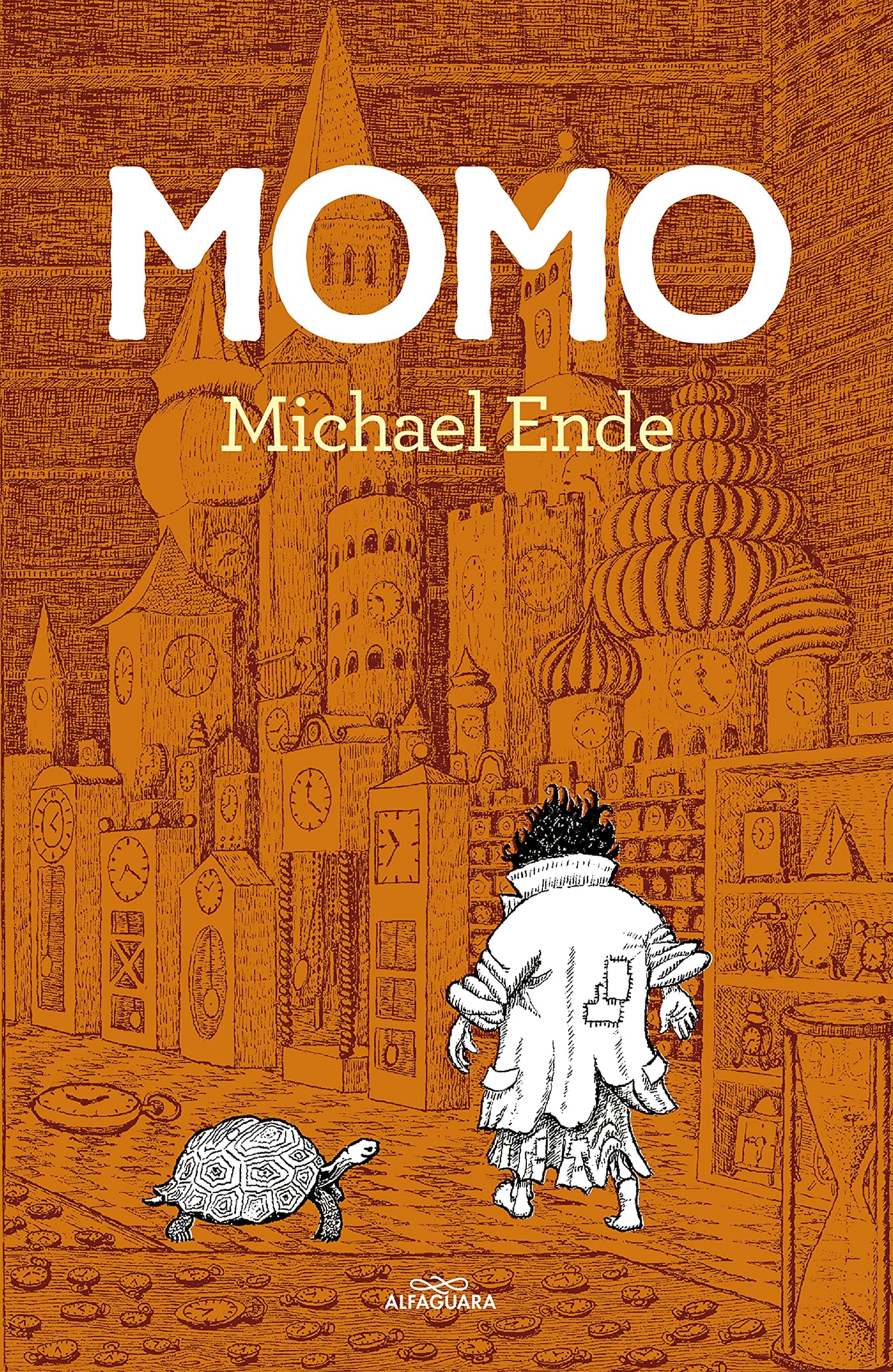
Momo by Michael Ende is a philosophical fantasy novel about a mysterious girl who lives in a ruined amphitheater on the outskirts of an unnamed city and possesses an extraordinary gift: she listens. When sinister grey men begin stealing time from the city’s inhabitants — leaving them hurried, joyless, and unable to remember what they used to love — only Momo can stop them. First published in German in 1973 and translated into English in 1984, Momo is a fable about attention, presence, and what is lost when a society trades away the things that make life worth living in exchange for efficiency. This complete guide covers Momo‘s reading level, recommended age, content considerations, characters, themes, and books similar to Momo, designed for parents, teachers, and students.
For Parents
Momo is a gentle, strange, and deeply humane book — less frightening than The Neverending Story and more emotionally accessible, though no less philosophically serious. Its villain is not a monster but a concept: the theft of time through busyness, efficiency, and the compulsion to save and accumulate. Best for ages 9–13, it is one of the rare children’s books that speaks just as directly to the adults reading it, and often more uncomfortably so.
For Teachers
An outstanding grades 5–7 text for exploring allegory, the nature of time, and the social critique embedded in fantasy. Ende’s grey men are one of the most elegant allegorical villains in children’s literature — a perfect vehicle for discussing consumerism, busyness culture, and the difference between being productive and living well. Pairs naturally with The Neverending Story for a Michael Ende unit, and with The Phantom Tollbooth for a broader unit on philosophical fantasy.
Momo at a Glance
Find on Amazon →| Author | Michael Ende |
| Translator | J. Maxwell Brownjohn (English edition) |
| Published | 1973 (German); 1984 (English) |
| Grade Level | 5–7 (our assessment) |
| Recommended Age | 9–13 |
| Flesch-Kincaid Grade | ~5.4 |
| Word Count | ~80,000 |
| Pages | ~240 (Puffin paperback) |
| Chapters | 22 (across 3 parts) |
| Genre | Fantasy / philosophical fable |
| Setting | An unnamed Mediterranean city, contemporary (1970s) |
| Awards | Deutscher Jugendliteraturpreis (1974) |
For official Lexile and AR levels, visit Lexile.com or AR BookFinder. ReadingVine provides independent editorial assessments.
What Reading Level Is Momo?
By our editorial assessment, Momo reads at a grade 5–7 level. The Flesch-Kincaid formula places the English translation at approximately grade 5.4 — accessible to a confident fifth-grade reader, and somewhat easier to read sentence-by-sentence than The Neverending Story. Ende’s prose in Momo is warmer and more intimate in register, less given to the philosophical asides and descriptive density that characterize his later novel. The story moves clearly and the central concept — time being stolen by grey men in grey suits — is immediately graspable by a wide age range.
The challenge, as with Ende’s work generally, is not linguistic but conceptual. Momo is a sustained allegorical argument about what happens to human beings when they are convinced their time is a resource to be saved and invested rather than a medium to be lived in. Younger readers (9–10) will enjoy it as a fantasy adventure about a girl fighting mysterious villains; older readers (12–13) will begin to understand that Ende is describing something that is happening around them right now, and to whom. Both readings are valid and both are in the book.
For official Lexile and Accelerated Reader scores, visit Lexile.com or AR BookFinder. ReadingVine’s assessments are independent editorial judgments.
What Age Is Momo Appropriate For?
We recommend Momo for readers ages 9–13. The novel contains no sexual content, no profanity, and no significant violence. Its tone is gentler than The Neverending Story — this is a more consistently warm book, and its darkness is the slow, creeping darkness of a world growing colder and emptier rather than the existential menace of the Nothing or the identity-erasure of Bastian’s story.
There are a handful of elements parents of younger or more sensitive readers should be aware of. The grey men are genuinely unsettling — not frightening in a visceral way, but deeply strange, and their interactions with adults have a hypnotic, coercive quality that some children find disturbing. The novel’s most affecting sequences involve watching the adults in Momo’s life — her friends Beppo and Gigi, the people of the neighborhood — slowly change under the grey men’s influence, becoming harried, distracted, and indifferent to the things they used to love. For children who are sensitive to themes of adults losing their warmth or becoming emotionally unavailable, these passages carry real weight.
The novel also contains a long, surreal sequence in which Momo travels through a realm outside ordinary time — beautiful and strange rather than frightening, but genuinely dreamlike in a way that younger readers may find disorienting. Overall, however, Momo is among the more accessible and emotionally safe of Ende’s longer works, and the presence throughout of Momo herself — steady, unhurried, utterly certain of what matters — gives the book a quality of reassurance that The Neverending Story‘s second half notably lacks.
What Is Momo About?
Momo is a small, ragged girl of indeterminate age and origin who appears one day in the ruins of an old amphitheater on the edge of an unnamed city and simply stays. No one knows where she came from. She has no family, no possessions, and no particular plans. What she has is an extraordinary capacity to listen — not just to hear, but to attend fully, to be so completely present with another person that they find, in talking to her, thoughts and feelings they didn’t know they had. Children come to her with their quarrels and leave reconciled. Adults come with their troubles and leave knowing what to do. Momo doesn’t solve anything; she simply listens, and in her listening something opens up.
The city Momo lives in is prosperous and busy in the way that modern cities are busy — full of people who are always in a hurry, always behind, always vaguely dissatisfied despite having more than enough. Then the grey men arrive. They are agents of the Timesaving Bank, and their pitch is seductive: you are wasting time, they tell people, and time is your most precious possession. Every minute you spend on things that don’t produce results — talking with friends, playing with children, sitting quietly — is a minute stolen from your future. They offer to help people save time, to be more efficient, to stop squandering. The people agree, and the grey men collect what they’ve saved.
But saved time, it turns out, does not accumulate. The people of the city work harder and harder, rush faster and faster, and feel increasingly poor in exactly the resource they are supposedly accumulating. Their relationships wither. Their laughter disappears. The neighborhood around Momo’s amphitheater — once full of informal life, storytelling, children playing, old men sitting in the sun — empties out and goes cold. Momo watches her friends change and doesn’t understand what’s happening, only that it is wrong.
The grey men know about Momo and fear her, because her gift — genuine, unhurried attention — is the one thing their system cannot accommodate. A person in her presence is fully alive in the present moment, and the grey men’s power depends on people being elsewhere: in the future they’re saving for, in the efficiency they’re optimizing toward, in anywhere but here. When Momo is brought into contact with the enigmatic master of time, Professor Hora, and shown the true nature of what the grey men are doing, the novel moves toward a confrontation that is less a battle than an act of witness — of seeing clearly and refusing to look away.
Momo Characters
Is Momo Banned?
Momo has not been banned or formally challenged in American schools or libraries and does not appear on any lists of frequently challenged books. It is less widely known in the English-speaking world than The Neverending Story — Ende’s 1973 novel did not receive an English translation until 1984 and has never benefited from a major film adaptation — but where it is taught, it is considered a distinguished and age-appropriate work of philosophical children’s fiction with no documented history of challenge or concern.
Momo Themes and Lessons
Ende’s central argument in Momo is that time is not a resource. It cannot be saved, accumulated, invested, or optimized — it can only be lived in, and the quality of that living depends entirely on whether you are actually present for it. The grey men’s deception is not that they take time away; it is that they convince people to give it away voluntarily, in exchange for the promise of having more later. The people of the city become measurably more productive and measurably less alive, and the exchange feels like a reasonable deal right up until the moment it doesn’t.
The novel is a precise diagnosis of what we would now call productivity culture or hustle culture — the compulsion to optimize every moment, eliminate waste, convert all activity into usefulness. Ende was writing this in 1973, before personal computers, before smartphones, before the attention economy, and the accuracy of his observation has only improved with time. Parents and teachers reading Momo with children in the 2020s will find that almost nothing requires updating. The grey men have simply gotten better at their work.
Momo’s gift — listening — is Ende’s answer to everything the grey men represent. She does not produce anything. She does not optimize anything. She simply gives another person her complete, unhurried attention, and in doing so she gives them the experience of being fully real to someone else. This is, Ende suggests, not a minor or decorative thing but the foundation of human life. Everything that makes existence meaningful — friendship, love, creativity, play, the sense that one’s own inner life matters — depends on being genuinely attended to at some point.
Gigi’s trajectory is the novel’s most pointed illustration of this. His transformation from free storyteller to successful but empty professional is not a story about selling out; it is a story about what happens when imagination is put entirely in service of productivity. The stories he tells at the end of the novel are technically more polished and reach many more people than the ones he told to the children in the amphitheater, and they mean nothing at all.
Discussion questions for classrooms and families: What does Momo do when she listens to someone — what actually happens? Why are the grey men afraid of her specifically? What does Gigi lose when he becomes successful, and when does he lose it? Do the grey men’s arguments make sense? Have you ever felt like you were saving time but ending up with less of it? What does Beppo’s way of sweeping streets have to do with the novel’s larger argument?
How Many Pages and Chapters in Momo?
The standard Puffin paperback edition of Momo runs approximately 240 pages, organized into 22 chapters across three named parts. The three-part structure follows Momo’s arc cleanly: the first part establishes her world and the grey men’s encroachment; the second traces the city’s transformation and Momo’s awakening to what is happening; the third follows her journey to Professor Hora and the confrontation with the grey men. Word count is approximately 80,000 words.
For readers in the recommended age range of 9–13, expect a reading time of roughly 5–8 hours, or about one to two weeks of steady reading at 30–45 minutes per session. The novel’s pacing is even and relatively brisk for Ende — the grey men’s gradual takeover of the city is rendered with quiet urgency, and the final section has genuine momentum. For classroom use, the three-part structure lends itself naturally to a three-week unit with one part per week, with the middle section offering the richest material for discussion about the novel’s social critique.
Books Similar to Momo
About Michael Ende
Michael Ende was born in 1929 in Garmisch, Germany, the son of the Surrealist painter Edgar Ende. He grew up during the rise of National Socialism — his father’s work was declared “degenerate art” and suppressed — and Ende later said that his childhood understanding of how a society could hollow itself out of meaning shaped everything he would eventually write. He worked as an actor and theater critic before publishing his first children’s book, Jim Button and Luke the Engine Driver, in 1960.
Momo, published in 1973, won the German Youth Literature Prize the following year and established Ende as a major voice in European children’s literature. It preceded The Neverending Story by six years and, while less internationally famous than that novel, is considered by many readers — and by Ende himself in some accounts — to be the more personally urgent of the two books. Where The Neverending Story is a defense of imagination, Momo is a defense of time itself: of the unscheduled, unproductive, unhurried hours that constitute most of what a human life actually is. Ende was deeply influenced by Rudolf Steiner’s anthroposophical philosophy, by Romantic German literature, and by his own observations of a European culture he felt was accelerating toward something it wouldn’t be able to reverse. He died in 1995 in Munich. Momo has been translated into more than thirty languages and remains continuously in print.
Momo: Frequently Asked Questions
What reading level is Momo?
Momo has a Flesch-Kincaid grade level of approximately 5.4. Our editorial assessment places it at grades 5–7 (ages 9–13). The prose is warm and accessible — somewhat easier sentence-by-sentence than The Neverending Story — though the allegorical depth of Ende’s argument rewards older and more experienced readers. For official Lexile and AR scores, visit Lexile.com or AR BookFinder.
What grade is Momo appropriate for?
We recommend grades 5–7 as the primary range. Strong 4th-grade readers will enjoy the fantasy adventure; 6th- and 7th-grade readers will begin to grasp the social critique Ende is making. The novel’s themes — busyness, efficiency, the commodification of time — become more resonant the older a reader is, which makes Momo an unusually rich text for mixed-age classroom discussion.
How many pages are in Momo?
The standard Puffin paperback edition is approximately 240 pages across 22 chapters in three parts. Word count is approximately 80,000 words. Readers in the target age range should expect one to two weeks of steady reading.
What is Momo about?
A mysterious girl with an extraordinary gift for listening discovers that grey men are stealing time from the people around her — convincing them to save every moment for the future until the present is entirely empty. It is a fable about attention, presence, and what is lost when a society is persuaded to treat time as a resource to be optimized rather than a life to be lived.
Is Momo good for a 10-year-old?
Yes — Momo is one of Ende’s more accessible works and is well suited to readers ages 9–10 who enjoy fantasy with a gentle, warm tone. The grey men are unsettling rather than frightening, and the book’s darkness is the slow, creeping kind rather than anything visceral or abrupt. A 10-year-old will enjoy it as a fantasy adventure; the deeper allegorical argument will become clearer on a reread a few years later.
How is Momo different from The Neverending Story?
Momo is gentler, more intimate, and more consistently warm in tone. Where The Neverending Story is a sweeping meta-fantasy about the nature of stories and imagination, Momo is a tighter, more allegorical fable about time and attention. It is also somewhat shorter and easier to read, and contains none of the identity-erasure darkness of The Neverending Story‘s second half. Many readers find Momo the more emotionally immediate of the two books, and Ende himself reportedly considered it the more personally felt.
What do the grey men represent in Momo?
The grey men are Ende’s allegorical representation of the forces that convince people to trade genuine living for productivity and efficiency — what we might now call hustle culture, the attention economy, or the compulsion to optimize every moment. They are not evil in a conventional fantasy sense; their arguments are plausible and their promises attractive. They represent the entirely real phenomenon of a society that has been persuaded its time is an asset to be managed rather than a life to be inhabited.
Is Momo part of a series?
No. Momo is a standalone novel with a complete, self-contained story. Michael Ende’s other novels — including The Neverending Story — are separate works. Ende wrote numerous shorter pieces and picture books, but Momo has no sequel and is not part of any series.