
 = Partner Site
One Hundred Years of Solitude Reading Level: A Complete Guide
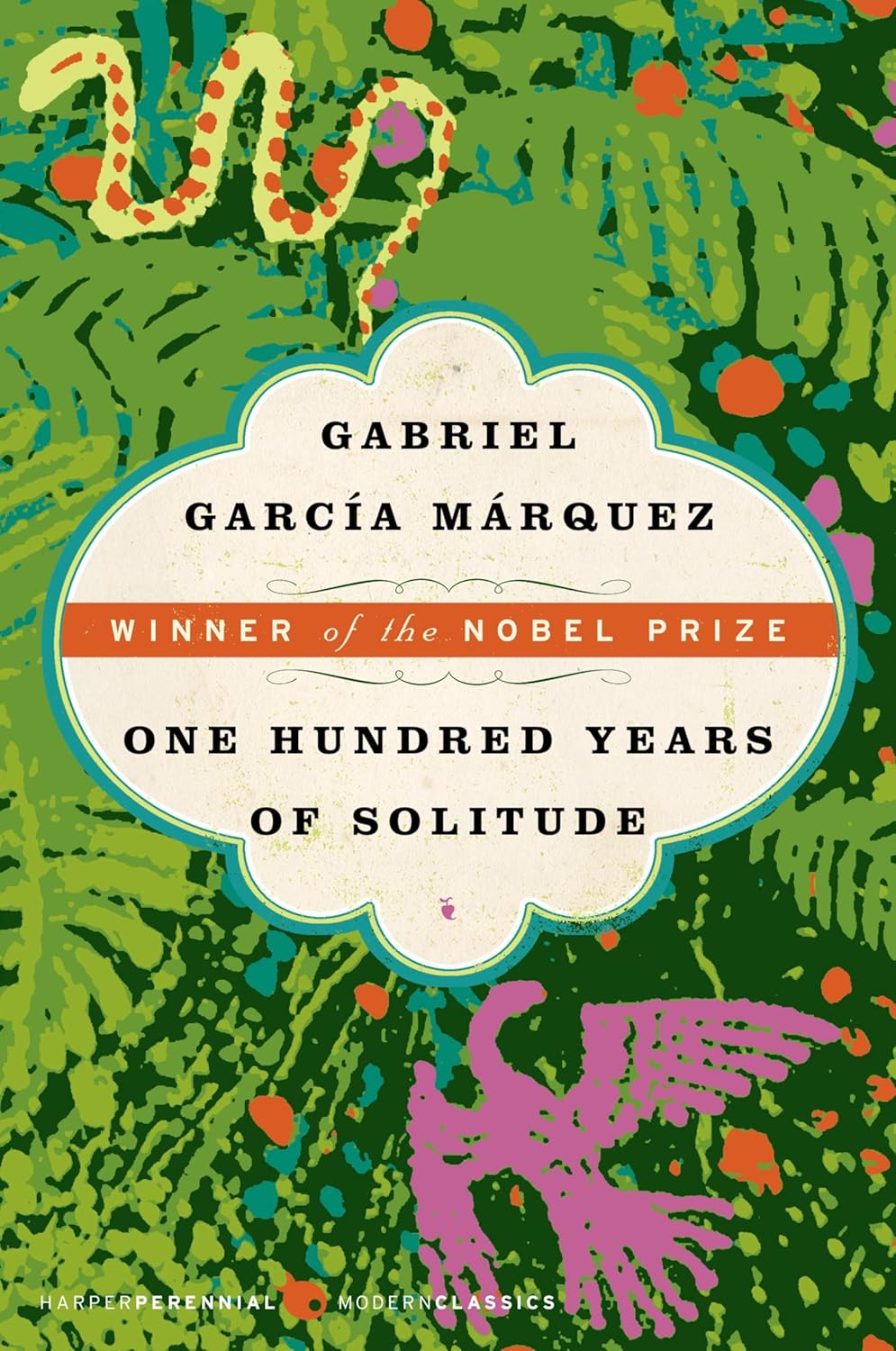
One Hundred Years of Solitude by Gabriel García Márquez is a novel about seven generations of the Buendía family in the fictional Colombian town of Macondo — from the town’s founding in a primordial jungle to its apocalyptic erasure in the final pages. Published in 1967 and translated into English by Gregory Rabassa in 1970, it is the defining work of magical realism: a mode of fiction in which extraordinary events are described in the same matter-of-fact prose as ordinary ones, and the boundary between the real and the miraculous is treated as a social and political construction rather than a fixed ontological line. García Márquez received the Nobel Prize in Literature in 1982; Pablo Neruda called the novel “the greatest revelation in the Spanish language since Don Quixote.” This complete guide covers One Hundred Years of Solitude‘s reading level, recommended age, content considerations, characters, themes, and books similar to One Hundred Years of Solitude, designed for parents, teachers, and students.
For Parents
A long, formally demanding novel that requires patience with non-linear time, recurring character names, and a narrative style that treats magic as fact. Contains sexual content (including incest), political violence, and the massacre of striking workers. Appropriate for ages 15 and up; assigned primarily in grades 11–12 and college.
For Teachers
A grades 10–12 text best suited to AP English or IB courses — the novel’s density, its demands on the reader’s tolerance for deliberate disorientation, and the Colombian historical context it requires make it more appropriate for advanced secondary readers than standard curricula. The magical realism mode and the novel’s treatment of circular time are the richest material for discussing how narrative form embodies thematic argument.
One Hundred Years of Solitude at a Glance
Find on Amazon →| Author | Gabriel García Márquez |
| Published | 1967 (Editorial Sudamericana); English translation 1970 (Harper & Row) |
| Translator | Gregory Rabassa (English) |
| Grade Level | 10–12 (our assessment) |
| Recommended Age | 15+ |
| Lexile / ATOS | Not published for standard editions |
| Word Count | ~114,500 |
| Pages | 448 (HarperCollins paperback) |
| Chapters | 20 (unnumbered in original) |
| Genre | Literary fiction / magical realism |
| Setting | Macondo, Colombia; mid-19th to early 20th century |
| Awards | Nobel Prize in Literature (1982) |
For official Lexile and AR levels, visit Lexile.com or AR BookFinder. ReadingVine provides independent editorial assessments.
What Reading Level Is One Hundred Years of Solitude?
Standard Lexile and ATOS scores are not widely published for One Hundred Years of Solitude — a fact that is itself informative. The novel does not fit neatly into the framework those tools were designed for. The English prose of Gregory Rabassa’s translation is rich, long-sentenced, and periodically dense, but the primary difficulty is not vocabulary or sentence structure. It is architectural. The novel requires readers to navigate seven generations of a family whose members share a small number of names — there are multiple Aurelianos and multiple José Arcadios across the generations — and to track events across a timeline that occasionally circles back on itself, and to maintain their footing as the narrative treats the miraculous with the same flat descriptive tone it applies to the mundane.
Booksource’s interest level for the novel is grades 10 through adult. Our editorial assessment places it at grades 10–12, with the practical caveat that it is best approached in courses that can give it the classroom time and context it requires — AP English, IB Literature, or college introductory literature. Students reading it without preparation frequently find the first fifty pages bewildering and the character name repetition maddening; students who understand the magical realism mode and the novel’s approach to time before they begin find it immersive and, eventually, overwhelming in the way it intends to be. At approximately 114,500 words and 448 pages, the novel typically takes four to six weeks in a classroom with close reading. For official Lexile and AR scores, visit Lexile.com or AR BookFinder. ReadingVine’s assessments are independent editorial judgments.
What Age Is One Hundred Years of Solitude Appropriate For?
We recommend One Hundred Years of Solitude for readers ages 15 and up. The novel contains explicit sexual content throughout — presented with García Márquez’s characteristic matter-of-factness rather than graphic intent, but present and substantial. It also contains incest (the final generation’s relationship between Amaranta Úrsula and Aureliano), political violence, the massacre of striking banana workers by the Colombian army, and the novel’s overall sustained engagement with death, decay, and the passage of generations in ways that ask for emotional and intellectual maturity.
Sexual content appears throughout the novel as part of García Márquez’s portrait of several generations of Buendía family life — including the founding patriarch’s wife Úrsula’s long marriage, the sexual adventures of multiple José Arcadio characters, and the relationship between Rebeca and José Arcadio. The Buendía family’s recurring anxiety about producing a child with a pig’s tail (the result of incest, which haunts the family across generations) culminates in the final chapter when the last Aureliano and Amaranta Úrsula — who do not realize they are related — have a child together who is born with a pig’s tail. The novel also depicts the Banana Massacre of 1928, in which Colombian army soldiers fire on striking United Fruit Company workers at a railway station; García Márquez describes the massacre and its aftermath — the company and government jointly denying it ever happened — with specificity and political anger. Parents should be aware that this novel is adult literary fiction assigned in secondary school rather than a YA novel assigned to secondary students, and its content reflects that category.
What Is One Hundred Years of Solitude About?
José Arcadio Buendía founds the town of Macondo with his wife Úrsula after killing a man in a dispute over a cockfight and being haunted by the dead man’s ghost. He establishes the town in a pristine jungle, organizes it according to his own utopian vision, and gradually loses his mind to an obsessive pursuit of alchemical and scientific knowledge. Úrsula holds the family and the town together across a century with fierce practical intelligence. Their children, grandchildren, and subsequent descendants — many of them named Aureliano or José Arcadio in a pattern that begins to feel like a curse rather than a naming convention — repeat variations on the same patterns of pride, solitude, love, war, and decay.
The world of Macondo is one in which the extraordinary is ordinary: a woman ascends into heaven while folding sheets in the garden; a man returns from the dead because he cannot bear the solitude; yellow butterflies attend a man wherever he goes; a priest levitates after drinking hot chocolate; a beautiful girl’s presence drives men to self-destruction; a man makes and melts down and remakes the same seventeen golden fishes for the rest of his life. These events are reported in the same flat, historically-styled prose as births and deaths and market days, which is the novel’s fundamental formal argument: that the distinction between the real and the miraculous is not natural but imposed, and that the cultures of Latin America have always existed in a different relationship to that distinction than European literary realism assumes.
The Buendía family’s history is also Colombia’s history. The civil wars between Liberals and Conservatives that devastated Colombia in the nineteenth century run through the novel in the person of Colonel Aureliano Buendía, who fights thirty-two armed uprisings and loses them all. The arrival of the banana company — clearly the United Fruit Company, the American corporation that dominated Colombian agriculture in the early twentieth century — brings a period of apparent prosperity followed by a workers’ strike and a massacre that the company and the government subsequently deny ever occurred. After years of rain, Macondo decays into ruin. In the final chapter, the last Aureliano deciphers a manuscript left by the gypsy Melquíades, who has been present since the novel’s first pages, and discovers that it contains the entire history of the Buendía family — including the moment he is reading it — written in Sanskrit a century before it happened. As he reads the last line, Macondo is erased by a biblical wind.
One Hundred Years of Solitude Characters
Is One Hundred Years of Solitude Banned?
One Hundred Years of Solitude was challenged frequently throughout the 1980s and 1990s for coarse language and sexual content. In 1986, it was removed from required reading lists at Wasco Union High School in California, an act that triggered a lawsuit from English teacher Lee McCarthy. School officials described the novel as “garbage being passed off as literature.” The novel was eventually reinstated. The challenges have generally focused on sexual content and language; the novel’s political content — its unflinching portrayal of American corporate exploitation in Colombia and the massacre of workers by a government protecting that exploitation — has generated less formal challenge activity but is worth naming as part of what the book contains.
The Wasco Union case is among the cleaner illustrations of the challenge dynamic in this catalog: a Nobel Prize-winning novel, endorsed by critics and scholars across fifty-plus countries, described as “garbage” by a school board that removed it for sexual content. McCarthy’s lawsuit was not ultimately successful in the way it was framed, but the novel remained in use at the school and has been continuously taught in American high schools and universities since.
One Hundred Years of Solitude Themes and Lessons
Magical realism is not a decoration on top of the novel’s content — it is the novel’s argument about how to represent Latin American reality. García Márquez has said that the narrative voice of One Hundred Years of Solitude is the voice of his grandmother, who would tell him the most extraordinary things as if they were entirely ordinary. The mode in which the extraordinary is narrated without exclamation or explanation is not surrealism — it is not dreamlike or irrational — but rather a different epistemology: a way of knowing and representing the world in which the boundaries European rationalism drew between the natural and the supernatural are themselves constructions, products of a specific cultural history that Latin America does not share. The flying carpet and the massacre are both described in the same voice because both are part of the same world.
The novel’s treatment of time is its most formally demanding feature. The Buendía family does not progress through history — it circles through it. Each generation reproduces the patterns of the previous one: the same solitudes, the same loves, the same obsessions, the same failures. The recurring names — Aureliano and José Arcadio down the generations — are not laziness but argument: these are not distinct individuals so much as variations on the same type, and the type is the type of the Latin American man who cannot break the cycle he was born into. The novel’s last line — “races condemned to one hundred years of solitude did not have a second opportunity on earth” — is its most explicit statement of this argument, and it is devastating rather than resigned.
The Banana Massacre — based on the real 1928 massacre of striking United Fruit Company workers by the Colombian army, with the death toll suppressed and the event officially denied — is the novel’s most politically direct passage. García Márquez was a journalist before he was a novelist, and his account of the massacre and its cover-up has the specificity of a reporter’s work. The novel’s argument that the erasure of Macondo in the final pages is not only mythological but historical — that the mechanism by which empires erase what they have done is the same mechanism by which a wind can erase a town from human memory — connects the magical to the political in a way that rewards careful reading.
Discussion questions for classrooms and families: What does it mean that the narrative treats Remedios’s ascension and the banana massacre with the same narrative tone — and what argument does that equivalence make? Why does García Márquez give multiple generations the same names — what does the repetition say about the relationship between individuals and history? What is Melquíades’s manuscript, and what does it mean that it contains the family’s entire history before it has happened? What does the novel argue about the relationship between memory and political power — why does it matter that the massacre is officially denied? What does the final line — “races condemned to one hundred years of solitude did not have a second opportunity on earth” — mean?
How Many Pages and Chapters in One Hundred Years of Solitude?
The HarperCollins paperback is 448 pages across twenty sections. The sections are unnumbered in the original — García Márquez did not give them chapter numbers or titles, just white space between them — and different editions have handled this differently; many reader guides number them 1 through 20 for reference. Word count is approximately 114,500. Most classrooms working closely through the novel take four to six weeks; independent readers typically take longer than the word count suggests because the density and the character-tracking demands slow the pace considerably.
The novel’s structure does not divide as cleanly as most three-part or four-part novels in this catalog. It is better understood as a continuous chronicle in which time occasionally folds back on itself — a paragraph that covers fifty years of Úrsula’s life, followed by a scene that takes place in a single afternoon, followed by a return to the long view — than as a plot with discrete narrative phases. First-time readers benefit from keeping a family tree close at hand, which most editions provide and which several independent resources make available online.
Books Similar to One Hundred Years of Solitude
About Gabriel García Márquez
Gabriel García Márquez was born in 1927 in Aracataca, a small town in the Colombian Caribbean coast that was the model for Macondo. He was raised primarily by his maternal grandparents — his grandfather a decorated Liberal veteran of the Thousand Days’ War, his grandmother a teller of impossible stories in a matter-of-fact voice — and the combination of that family history and that narrative method became the DNA of his fiction. He trained as a journalist and worked for Colombian and Venezuelan newspapers through the 1950s before his fiction began to receive international attention.
The novel came to him, by his own account, during a drive to Acapulco in 1965: he saw the first sentence fully formed, turned his car around, and drove home to write. He spent the next eighteen months writing it — his wife managing the household finances by borrowing from neighbors and keeping creditors at bay — and mailed the manuscript to Editorial Sudamericana in Buenos Aires in 1966. It was published in 1967 to immediate and sustained acclaim across Latin America, and Rabassa’s English translation in 1970 spread that recognition to the rest of the world. García Márquez received the Nobel Prize in Literature in 1982, with the committee citing his novels and short stories in which the fantastic and the realistic are combined in a richly composed world of imagination. He died in Mexico City in 2014 at the age of eighty-seven.
In 2024 — fifty-seven years after publication — an authorized Netflix series adaptation appeared, produced by García Márquez’s sons, who had long refused adaptation offers. García Márquez himself had refused for decades, saying the novel could only be filmed in Spanish and would require an enormous budget; the Netflix series met both conditions and was filmed entirely in Colombia with a Colombian cast.
One Hundred Years of Solitude: Frequently Asked Questions
What reading level is One Hundred Years of Solitude?
Standard Lexile and ATOS scores are not widely published for this novel. The prose of Rabassa’s English translation is rich and long-sentenced but not technically difficult; the primary challenge is architectural — navigating seven generations of a family with recurring names across a non-linear timeline, within a narrative mode that treats the miraculous as ordinary. Our editorial assessment places it at grades 10–12, ages 15 and up; Booksource’s interest level is grade 10 through adult.
What grade is One Hundred Years of Solitude appropriate for?
We recommend grades 10–12, ages 15 and up. The novel contains explicit sexual content throughout, political violence, and the incestuous relationship in the final generation. It is best suited to AP English, IB Literature, or college courses that can provide the classroom time and Colombian historical context the novel requires. Booksource rates the interest level as grade 10 through adult.
How many pages are in One Hundred Years of Solitude?
The HarperCollins paperback is 448 pages across twenty unnumbered sections. Word count is approximately 114,500. Most classrooms take four to six weeks; independent readers often take longer due to the density and character-tracking demands.
What is One Hundred Years of Solitude about?
Seven generations of the Buendía family in the fictional Colombian town of Macondo — from the town’s founding to its apocalyptic erasure. The novel traces the family’s repeated cycles of pride, solitude, war, love, and decay against the backdrop of Colombian history, including the civil wars of the nineteenth century and the United Fruit Company’s exploitation of Colombian workers in the early twentieth. In the final chapter the last Aureliano deciphers a gypsy’s manuscript and discovers it contains the entire family history, including the moment he is reading it, as the wind erases the town.
Why are so many characters named Aureliano or José Arcadio?
García Márquez deliberately repeats the names across generations as a formal argument rather than a continuity error. The Buendía family does not progress — it circles through the same patterns generation after generation. By giving multiple characters the same names, García Márquez makes the repetition visible: these are not distinct individuals so much as variations on a recurring type. Most editions include a family tree, which most readers find essential for the first half of the novel. The confusion eventually resolves once the pattern is understood.
What is magical realism?
A narrative mode in which extraordinary events are presented in the same matter-of-fact prose as ordinary ones — without editorial comment, without marking them as dreams or visions, without signaling to the reader that the usual rules of reality have been suspended. In One Hundred Years of Solitude, a woman folds sheets and ascends into heaven; this is reported the same way a woman baking bread would be reported. Magical realism is not surrealism (which emphasizes the dreamlike and irrational) but rather a different epistemology: a way of writing about cultures in which the boundaries between the natural and the supernatural are socially and historically constructed rather than fixed by European rationalist convention.
Is One Hundred Years of Solitude based on real events?
The fictional town of Macondo is based on Aracataca, García Márquez’s birthplace. The civil wars between Liberals and Conservatives in the novel are based on the real Thousand Days’ War (1899–1902). The banana company massacre is based on the real 1928 massacre of striking United Fruit Company workers by the Colombian army — an event the government subsequently denied. García Márquez’s grandfather, a Liberal veteran of the Thousand Days’ War, is a direct model for Colonel Aureliano Buendía.
Is there a One Hundred Years of Solitude Netflix series?
Yes — a Netflix series adaptation was released in 2024, produced by García Márquez’s sons, who had long refused previous adaptation offers. The series is filmed entirely in Spanish with a Colombian cast, fulfilling conditions García Márquez had set for any adaptation during his lifetime. It covers the full span of the novel across two seasons.