
 = Partner Site
Sisters Reading Level: A Complete Guide
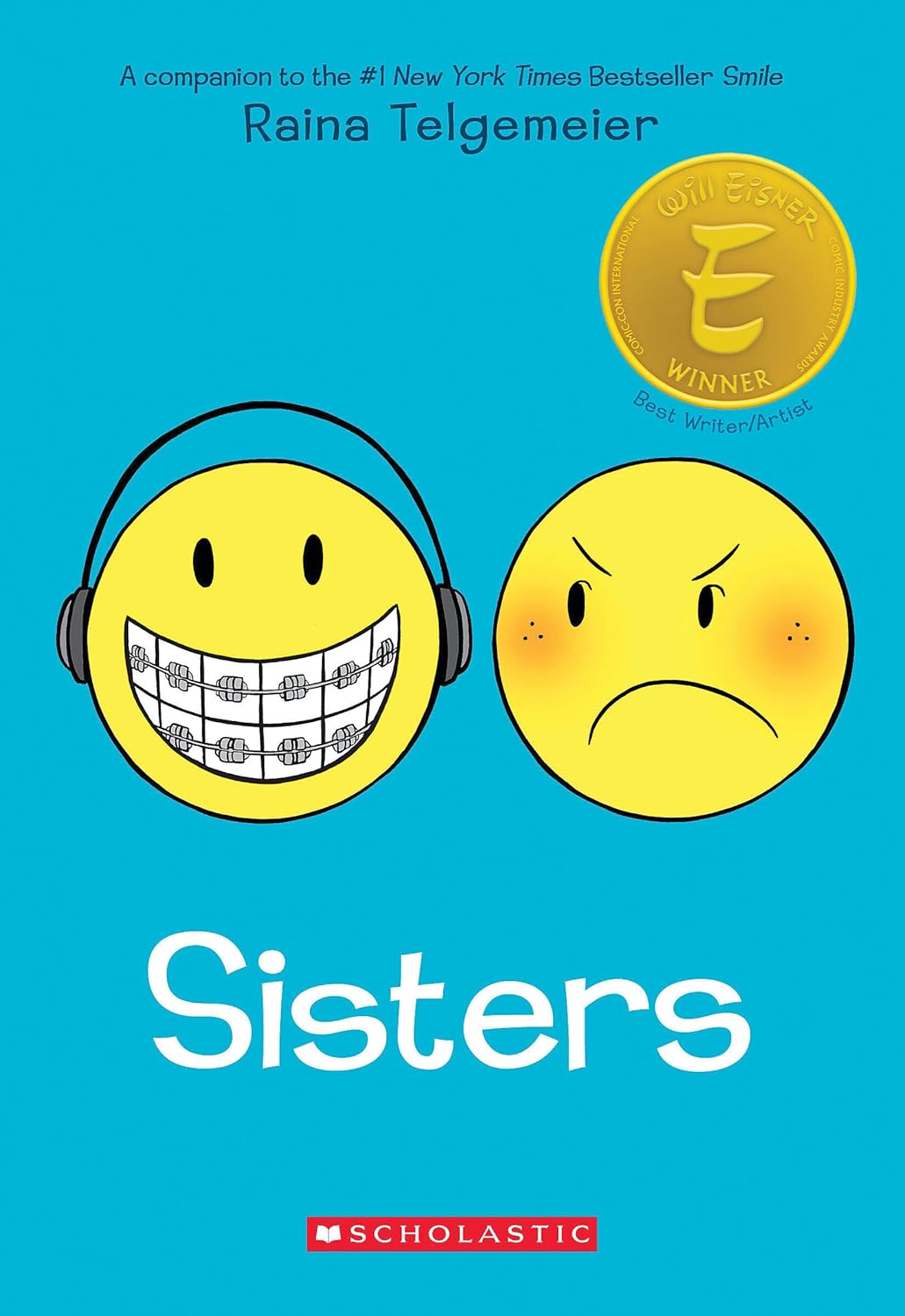
Sisters, written and illustrated by Raina Telgemeier and colored by Braden Lamb, is a 208-page autobiographical graphic novel about the road trip Raina and her family took from San Francisco to a family reunion in Colorado the summer before seventh grade — told in a non-linear structure that weaves the present-day trip with flashbacks to Raina and her younger sister Amara growing up together from the day Amara was born. Raina wanted a sister. She got one. Amara turned out to be a grouchy, independent baby who preferred to play alone, and the relationship between them has never been quite what Raina imagined. Trapped in a minivan for a week with Amara, their little brother Will, and their mother — while something unspoken and serious seems to be happening between their parents — Raina and Amara begin, slowly, to figure each other out. A #1 New York Times bestseller and winner of the Eisner Award for Best Writer/Artist in 2015, Sisters is the warmest and the most structurally sophisticated of Telgemeier’s three autobiographical graphic novels. This guide covers reading level, age appropriateness, content, themes, and similar books.
For Parents
A warm, funny, honestly told autobiographical graphic novel about sibling rivalry, family road trips, and the slow work of actually getting to know your sister. Ages 8–13, grades 3–6. Content note: the parents’ marriage is under strain throughout the book; divorce is implied and eventually confirmed. Handled with restraint and from a child’s perspective. A deeply relatable book for any family with siblings.
For Teachers
A grades 3–6 library staple — the non-linear structure (present-day road trip interwoven with flashbacks) makes it one of the most teachable of Telgemeier’s books for discussions of narrative structure and time. The sibling relationship is universal enough to generate immediate personal connection from almost any student. Natural companion to Smile and Guts for a Telgemeier unit.
Sisters at a Glance
Find on Amazon →| Author & Illustrator | Raina Telgemeier (author & illustrator); Braden Lamb (colors) |
| Published | 2014 (Scholastic/Graphix) |
| Grade Level | 3–6 (our assessment) |
| Recommended Age | 8–13 |
| Lexile | 290L (prose text only — see below) |
| ATOS Level | 2.4 |
| Pages | 208 |
| Format | Autobiographical graphic novel (full color) |
| Genre | Graphic memoir / autobiography |
| Setting | San Francisco to Colorado road trip; summer 1993 and flashbacks |
| Awards | Eisner Award – Best Writer/Artist (2015); #1 New York Times bestseller |
For official Lexile and AR levels, visit Lexile.com or AR BookFinder. ReadingVine provides independent editorial assessments.
What Reading Level Is Sisters?
Lexile 290L, ATOS 2.4, interest level grades 5–12 — the lowest formula scores of any Telgemeier book in this catalog, reflecting a word count of just 5,068. As with all Telgemeier graphic novels, these scores capture only the prose text in dialogue and captions, not the visual narrative across 208 pages. The non-linear structure — present-day scenes alternating with flashbacks across years of the sisters’ childhood — adds narrative complexity that is entirely invisible to the formula scores but very much present for the reader. Our assessment: grades 3–6, ages 8–13. For official scores, visit Lexile.com or AR BookFinder.
What Age Is Sisters Appropriate For?
Ages 8–13, grades 3–6. The primary content note is the family situation: the parents’ marriage is under strain throughout the book, and the possibility of divorce hangs over the road trip as something Raina is aware of but can’t fully name. By the book’s end, the divorce is more clearly implied. This is handled from a child’s perspective — Raina observes, worries, and doesn’t entirely understand — and with enough restraint that it is not distressing, but parents who want to prepare children for this content before sharing the book can do so. No other content concerns.
What Is Sisters About?
The summer before seventh grade, Raina’s family packs into a minivan for a week-long road trip from San Francisco to a family reunion in Colorado. Raina sits in the middle seat with her little brother Will beside her and her younger sister Amara behind — Amara, who has always been grouchy and independent and not quite the sister Raina imagined when she desperately wanted one. Their father will meet them in Colorado; for the drive, it is just Raina, Amara, Will, and their mother, who seems to be carrying something she’s not quite saying.
Woven through the road trip in flashbacks: Raina wanting a sister so badly it hurt. Amara arriving — cute, immediately irritating, completely her own person from the beginning. The years of the sisters not quite getting along, not quite connecting, not quite understanding each other. Raina hiding her colored pencils from Amara before the trip, out of spite, and then feeling bad about it. The small accumulation of sibling history that neither of them fully understands.
By the time the family reaches Colorado, something has shifted — not fixed, not fully resolved, but shifted. Raina and Amara know each other a little better. The thing between their parents is named, if quietly. The road trip ends with less of what was unspoken at the start.
The Non-Linear Structure — The Book’s Most Distinctive Feature
Sisters uses a non-linear structure more deliberately than any of Telgemeier’s other books: the present-day road trip and the flashbacks to the sisters’ childhood are woven together throughout, with the flashbacks triggered by things that happen or are remembered during the drive. This structure allows Telgemeier to show both the present state of the relationship and its full history simultaneously — the reader understands why the sisters are where they are because they’ve seen how they got there, even as the present-day story unfolds.
Kirkus called it “laugh-out-loud funny and quietly serious all at once” — which captures the structural achievement accurately. The comedy of the road trip (Amara’s independence, Will’s obliviousness, the indignities of a week in a minivan) and the seriousness of what Raina is observing about her parents coexist in the same panels without either undermining the other. This is genuinely difficult to do and is worth noting with older students as a specific craft achievement.
Sisters Themes and Lessons
The book’s warmest argument is about the gap between the sibling you imagined and the sibling you got — and how the one you got can turn out to be exactly right in ways you couldn’t have imagined. Raina wanted a sister who would be her best friend, share her interests, play what she wanted to play. She got Amara, who is none of those things. What she actually got, the book argues through its structure and its ending, is something more interesting: a specific person with her own specific personality who will eventually become someone Raina genuinely knows. The relationship isn’t fixed at the end of the book; it is begun.
The collaboration with Amara in the book’s creation — Telgemeier submitted the storyboard to her sister three years before publication, seeking permission and incorporating Amara’s insights into a second draft — is itself part of the book’s argument. The sister who seemed least interested in sharing Raina’s creative life turned out to be a genuine collaborator when asked. This is worth sharing with readers who ask about the book’s origins.
Talking with your child: Was there ever a time you got something you really wanted and it wasn’t what you expected? What do you think Raina’s mom was thinking during the road trip? How are Raina and Amara different from each other — and what does each one need from the other? What does the title mean — is it about what it means to be sisters, or just about the two of them specifically?
Books Similar to Sisters
About Raina Telgemeier
See our Smile guide for a full biography. Sisters was published in 2014, four years after Smile, and is the book Telgemeier has described as requiring the most courage — not because of what it depicts, but because she had to ask her sister’s permission to tell it. She submitted the full storyboard to Amara three years before publication; Amara contributed insights and helped develop the final draft. The collaboration is one of the most meaningful parts of the book’s creation and is part of what gives it its specific warmth: this is not a story told about someone but a story told with them.
Sisters: Frequently Asked Questions
What reading level is Sisters?
Lexile 290L (prose text only), ATOS 2.4 — the lowest formula scores of any Telgemeier book, reflecting only 5,068 words of dialogue and captions. The full graphic novel reading experience, including the non-linear structure, is considerably more demanding. Our assessment: grades 3–6, ages 8–13. For official scores, visit Lexile.com or AR BookFinder.
What is Sisters about?
A summer road trip from San Francisco to a family reunion in Colorado, intercut with flashbacks to Raina and her younger sister Amara growing up together. Raina wanted a sister. Amara turned out to be grouchy, independent, and nothing like she imagined. Trapped in a minivan for a week with their parents’ unspoken problems hanging over everything, Raina and Amara begin to actually know each other.
Is there a divorce in Sisters?
The parents’ marriage is under strain throughout and a divorce is implied by the book’s end — handled from Raina’s child perspective, with restraint, as something she senses but can’t fully name. It is present but not the book’s primary focus. Parents who want to prepare children for this content before sharing the book can do so.
Do I need to read Smile before Sisters?
Not strictly — Sisters stands alone. But the siblings and family dynamics of Sisters are also present in Smile, and reading both gives a fuller picture of Raina’s childhood. Most readers enjoy starting with Smile (which is the more emotionally complete standalone) and then reading Sisters as the companion that fills in the family story.
Did Amara help write Sisters?
Yes — Telgemeier submitted the full storyboard to Amara three years before publication, seeking her permission and incorporating her insights into the final draft. Sisters is genuinely a collaborative memoir rather than a story told about Amara without her knowledge or consent. This is part of what gives the book its specific warmth and honesty.