
 = Partner Site
The Book With No Pictures Reading Level: A Complete Guide
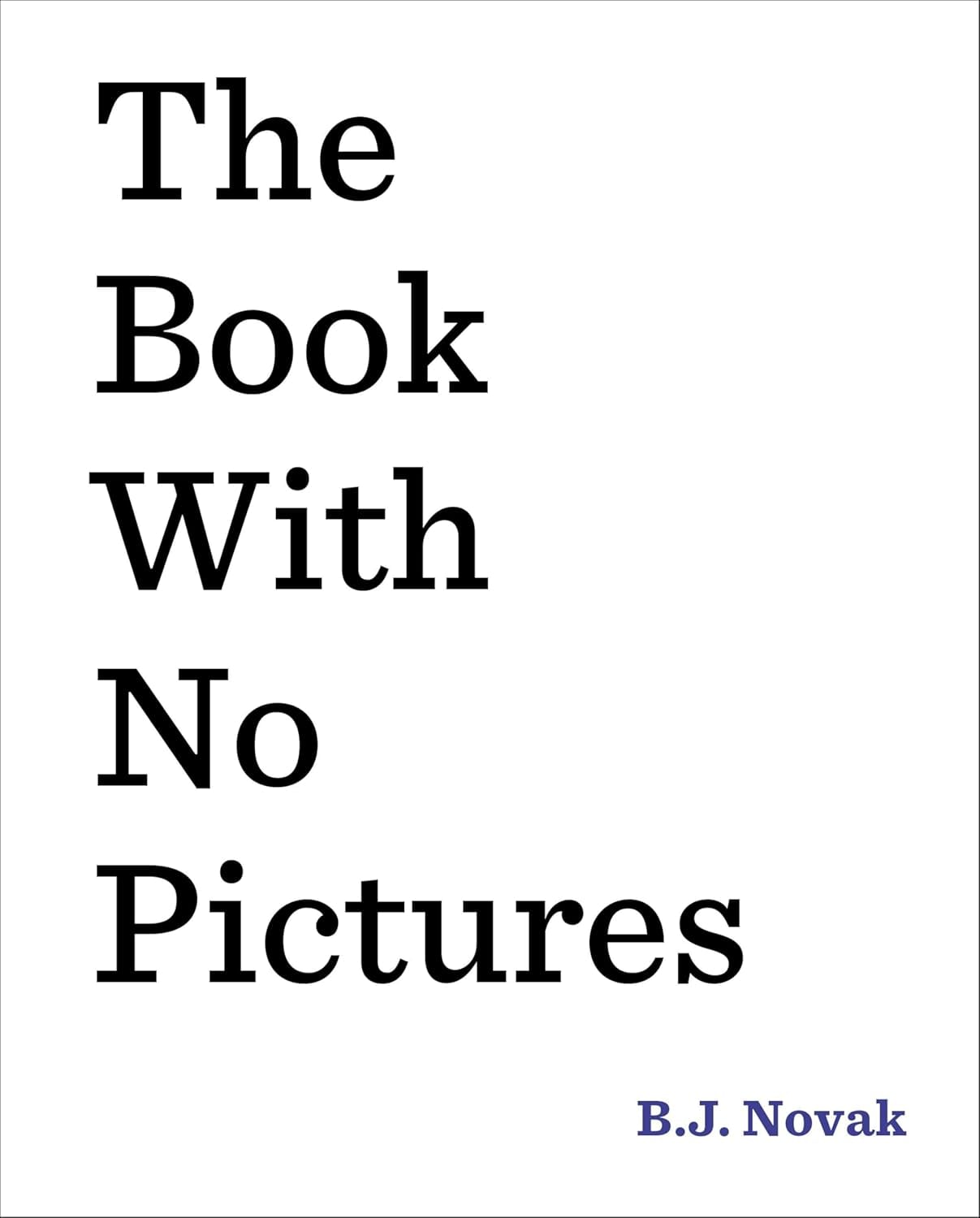
The Book With No Pictures by B.J. Novak is one of the most conceptually audacious and immediately funny picture books of the past decade — a book that has no pictures and uses that absence as its entire premise, trapping the adult reader into saying increasingly ridiculous things by invoking the fundamental rule that everything written in a book must be read aloud. A #1 New York Times bestseller published in 2014, The Book With No Pictures has become a modern classic of the read-aloud canon and one of the most reliably effective books for children who are skeptical that a book can be entertaining without illustrations. This guide covers the reading level, recommended age, read-aloud vs. independent reading guidance, themes, and everything parents and teachers need to know about sharing The Book With No Pictures with young readers.
For Parents
Find out whether The Book With No Pictures works best as a read-aloud or independent read for your child, what age range it suits, and why this unusual book — which has no pictures and no illustrator — is one of the funniest read-alouds in the K–2 library and a genuinely useful tool for children who are reluctant to engage with text alone.
For Teachers
Grade-level data, read-aloud timing, key themes, and discussion questions for a modern classroom classic. Exceptional for teaching children about how books work, the relationship between reader and text, the power of written words, and — most practically — for getting an entire room of children laughing at the same time.
The Book With No Pictures at a Glance
Find on Amazon →| Author | B.J. Novak |
| Illustrator | None |
| Published | 2014 |
| Grade Level | K–2 (our assessment) |
| Recommended Age | 4–8 |
| Best For | Read-aloud ages 4–8; independent reading ages 6–8 |
| Flesch-Kincaid Grade | 2.8 |
| Word Count | ~500 |
| Pages | 48 |
| Genre | Picture book / interactive / humor |
| Setting | The pages of the book itself |
| Awards | #1 New York Times Bestseller; Kirkus starred review; Publishers Weekly starred review |
For official Lexile and AR levels, visit Lexile.com or AR BookFinder. ReadingVine provides independent editorial assessments.
What Reading Level Is The Book With No Pictures?
The Book With No Pictures is a K–2 reading level by our editorial assessment, with a Flesch-Kincaid grade level of approximately 2.8. At around 500 words it is short by picture book standards, though the pages are spacious and the text is designed for maximum vocal performance rather than dense content. The vocabulary oscillates between simple sight words and invented nonsense — BLORK, BLUURF, BLAGGITY BLAGGITY, GLIBBITY GLOBBITY — plus a handful of longer real words that appear for comic effect.
The FK score is a somewhat awkward fit for this book because The Book With No Pictures doesn’t function like other texts at this level. It is not primarily a reading comprehension exercise; it is a performance script that happens to be formatted as a book. The book’s central mechanism — the rule that everything written must be said aloud — means that the reader’s experience of the text is entirely different from a child’s experience of listening to it. A child listening to The Book With No Pictures is not following a narrative or accumulating information; they are watching an adult be compelled by rules to say increasingly ridiculous things, and finding this hilarious. The FK score does not measure hilarity, which is the book’s primary achievement.
For parents who use specific reading level systems: we recommend checking your child’s level on Lexile.com or AR BookFinder for official scores, or asking your child’s teacher for their Guided Reading or DRA level.
Is The Book With No Pictures a Read-Aloud or Independent Read?
The Book With No Pictures is, more than almost any other book on this list, a read-aloud for ages 4–8 first and everything else second. Its premise requires a reader — specifically an adult reader who can be watched saying ridiculous things — and the comedy depends entirely on the dynamic between the reader who is trapped by the rules of books and the child who is watching them be trapped. It can work as an independent read for ages 6–8, but reading it alone misses the entire point. Most adults can read it aloud in about 8–12 minutes, though the participatory energy usually extends it.
As a read-aloud, The Book With No Pictures requires exactly one thing from the reader: complete commitment. The book opens by explaining its own rules — everything written must be said aloud, no matter what — and then immediately tests them. BLORK. The reader must say BLORK. BLUURF. The reader must say BLUURF. “My head is made of blueberry pizza.” The reader must say this with a straight face, or as close to a straight face as they can manage. Children find the adult’s compliance with these rules deliriously funny; they find the adult’s attempts to resist or comment on them even funnier. The book is constructed with the timing of a stand-up comedy routine, and the laughs are earned by pacing — Novak knows exactly when to escalate and when to pause.
For independent reading, a confident first or second grader can handle most of the text. The nonsense words are decodable (they follow phonetic patterns) and the real words are generally accessible, though a few appear specifically because they are funny in context rather than because they are simple. The experience of reading The Book With No Pictures silently is considerably less satisfying than reading it aloud, and children who have heard it read aloud will understand better than children approaching it cold. It is worth a read-aloud first.
There is nothing in this book that requires parental preparation. The silliest thing in it is a hippo named Boo Boo Butt. This is as prepared as you need to be.
Read it with complete seriousness. The book is funniest when the adult treats the rules as genuinely binding and says BLORK with the gravity of someone who had no choice. Children who see that the reader is not playing around — that the rules really do force you to say these things — find the escalating absurdity significantly funnier than if the reader telegraphs the jokes. Commit to “my head is made of blueberry pizza” as a statement of fact. The laughs will come.
What Is The Book With No Pictures About?
The Book With No Pictures opens by establishing its central rule: this book has no pictures, but here is how books work — everything the words say, the person reading the book has to say. No matter what. The book then immediately exploits this rule. The reader must say BLORK. The reader must say BLUURF. The reader must announce that they are a robot monkey. The reader must say that their best friend is a silly old rhinoceros. The reader must perform a preposterous song about eating ants for breakfast. The reader must say “BLAGGITY BLAGGITY.” The reader must say “GLIBBITY GLOBBITY.” The reader must say that their head is made of blueberry pizza. The reader must admit that a hippopotamus named Boo Boo Butt is their friend. The book ends with the acknowledgment that the child made the adult say all these things — because that, it turns out, is what books can do.
There is no plot in the conventional sense, no characters who have adventures, no problem that is resolved. What The Book With No Pictures has instead is a perfectly constructed comedic mechanism: a premise, a rule, and an escalating series of increasingly ridiculous obligations that the rule creates. It is a comedy routine about the power of written words, and it delivers its thesis — that text alone can be as rich and surprising and delightful as any illustration — by making the text itself the source of the comedy.
The Book With No Pictures Characters
The Book With No Pictures has two characters: the Reader and the Child. The Reader — whoever is reading the book aloud — is the one the book is doing things to: compelling, trapping, forcing into increasingly ridiculous statements, occasionally allowing to object, then overriding the objection with the rules. The Child — whoever is listening — is the one the book is performing for: the audience whose laughter the whole mechanism is engineered to produce, and whose delight in the Reader’s predicament is the emotional payoff of every page. Neither character is named. Both are essential. The book does not work without both of them in the room.
The Book With No Pictures Themes and Lessons
The central theme of The Book With No Pictures is the power of written words — specifically, the idea that written text has authority that transcends the person reading it. The book’s premise is that the rules of books are real and binding: if it’s written down, it has to be said. This is, in a literal sense, true. Children who have grown up understanding books as things that are done to them — that adults choose, read from, and put away — discover something through this book that genuinely surprises them: that a book can also do things to the adults. That the child who hands this book to a parent has, in some meaningful sense, gained power over that parent for the duration of the reading. This discovery — that text is active, not passive; that it does things rather than merely containing things — is one of the most important insights a young reader can have, and The Book With No Pictures delivers it through comedy so that no child notices they’re having it.
The book also teaches something important about how rules create comedy. Novak’s genius is that he doesn’t just write funny things — he writes a system in which the reader is obligated to say funny things. The humor is not random; it is generated by the structure. BLORK is funny not because it’s an especially funny word but because the rule that forces the reader to say BLORK with complete seriousness is funny. Children who laugh at The Book With No Pictures are laughing at a mechanism, and children who understand that a mechanism can be funny have understood something fundamental about how comedy works.
For teachers, The Book With No Pictures opens one of the most productive conversations available at the K–2 level about what books are and how they work. Most young children have a vague, functional relationship with books: books are things you read to find out what happens. The Book With No Pictures makes the book itself the subject — asks children to think about what a book is, what the rules of reading are, where those rules come from, and who benefits from them. These are sophisticated questions, and the book asks them with sufficient hilarity that children engage with them genuinely rather than academically.
Discussion starters for families: Did you know books had rules? Were the rules fair? Why did the reader have to say everything? Could you make a book that made someone say silly things? What would you make them say? Who really controls a book — the person who wrote it, the person reading it, or the person listening?
How Long Is The Book With No Pictures?
The Book With No Pictures has 48 pages and approximately 500 words. Most adults can read it aloud in about 8–12 minutes, though this varies considerably based on how long children laugh between pages — which is not a variable that can be controlled or estimated. A first reading typically runs longer than subsequent ones as children encounter the jokes for the first time; subsequent readings are often faster because children anticipate the escalations and laugh before you get there, which is its own form of comedy.
A child reading independently at a first- or second-grade level will typically finish in about 8–10 minutes, though as noted, reading The Book With No Pictures independently is considerably less satisfying than being read to — it is a book designed to be performed, and performance takes time.
Books Similar to The Book With No Pictures
If your child loves The Book With No Pictures, these titles share its interactive energy, its fourth-wall-breaking premise, or its place in the Humor and Read-Aloud cluster:
About the Author
B.J. Novak is an American writer, actor, director, and comedian best known for his work on the NBC comedy series The Office, where he served as a writer, actor, director, and executive producer and won Emmy Awards as part of the writing team. He is a graduate of Harvard University with a degree in English and Spanish literature, and his other books include a New York Times bestselling collection of short stories for adults, One More Thing: Stories and Other Stories (2014), published the same year as The Book With No Pictures.
The Book With No Pictures was Novak’s first children’s book and was developed from a simple observation he made while reading to children: that the funniest moments in read-alouds often come from the adult being forced by the text to say something undignified, and that this dynamic could be made the entire subject of a book. The premise — a book that weaponizes the rules of reading against the reader — is deceptively simple and extraordinarily effective. Novak’s background as a comedy writer is visible in every page: the book is structured with the discipline of a tight stand-up set, each element placed for maximum effect, the escalations precisely timed. It became a #1 New York Times bestseller and received starred reviews from Kirkus, Publishers Weekly, School Library Journal, and The Horn Book — an unusual degree of critical consensus for a book that is, at its core, about a robot monkey and a hippo named Boo Boo Butt.
The Book With No Pictures has no illustrator because it has no illustrations — the visual design of the book, which uses varied typefaces, colors, and sizes to give the text the expressiveness that illustrations would normally provide, was developed by Novak and the book’s designers at Dial Books for Young Readers. The cover, with its bold yellow and the unadorned title, is itself a kind of joke: it looks like a very serious book about something important. It is not.
The Book With No Pictures: Frequently Asked Questions
What reading level is The Book With No Pictures?
The Book With No Pictures is a K–2 reading level by our editorial assessment, with a Flesch-Kincaid grade level of approximately 2.8. The vocabulary ranges from simple sight words to invented nonsense to a few longer real words chosen for comic effect. It works best as a read-aloud for ages 4–8 and as an independent read for ages 6–8 — though reading it independently misses most of what makes it work. For official Lexile and AR levels, visit Lexile.com or AR BookFinder.
What age is The Book With No Pictures for?
The Book With No Pictures is appropriate for ages 4–8. As a read-aloud it works from age 4 — the premise is immediately grasped and the comedy lands across the full age range. As an independent read it suits first and second graders ages 6–8, though the full experience requires an adult reader. It is one of those books that works equally well in a one-on-one bedtime reading and in a classroom of thirty children, which is a rare combination.
Why does The Book With No Pictures have no pictures?
The absence of pictures is the entire premise and the entire joke. The book opens by acknowledging that you might expect pictures, then explains the rule: everything written must be said aloud. Without pictures to carry the story, all the work falls to the text — and since the text has to be performed by an adult, the book can make that adult say anything it wants. The no-pictures constraint is not a limitation; it is the mechanism. The book could not work with illustrations, because the comedy depends on text alone having the power to make someone say “my head is made of blueberry pizza.”
How long does it take to read The Book With No Pictures aloud?
Most adults can read The Book With No Pictures aloud in about 8–12 minutes, though children laughing between pages extends this considerably. A first reading typically runs longer as children encounter the escalations for the first time; subsequent readings are often faster because children anticipate the jokes, which generates its own comedy. Either way, the time spent is significantly longer than a typical picture book of the same word count, because The Book With No Pictures is a performance, not a text.
What is The Book With No Pictures about?
The Book With No Pictures is about the rule that everything written in a book must be said aloud by the reader — and about what happens when a book uses that rule to make the reader say increasingly ridiculous things. BLORK. BLUURF. “I am a robot monkey.” “My best friend is a silly old rhinoceros.” “My head is made of blueberry pizza.” The book escalates through a series of increasingly absurd obligations until the reader has said everything the book wanted them to say — because books have rules, and the rules apply no matter what. It is a comedy about the power of written words, delivered by making written words do something funny.
Does The Book With No Pictures really have no pictures at all?
Correct — The Book With No Pictures contains no illustrations whatsoever. The visual interest of its pages comes entirely from typography: varied typefaces, bold colors, different sizes of text, and the strategic use of white space. Some words appear in enormous block letters across an entire spread; others whisper in small type. The design does the work that illustrations would normally do, giving the text emotional tone and emphasis without drawing anything. This typographic approach is itself unusual and worth pointing out to children who may be noticing it — the book is making an argument that text design is its own kind of visual art.