
 = Partner Site
The Invention of Hugo Cabret Reading Level: A Complete Guide
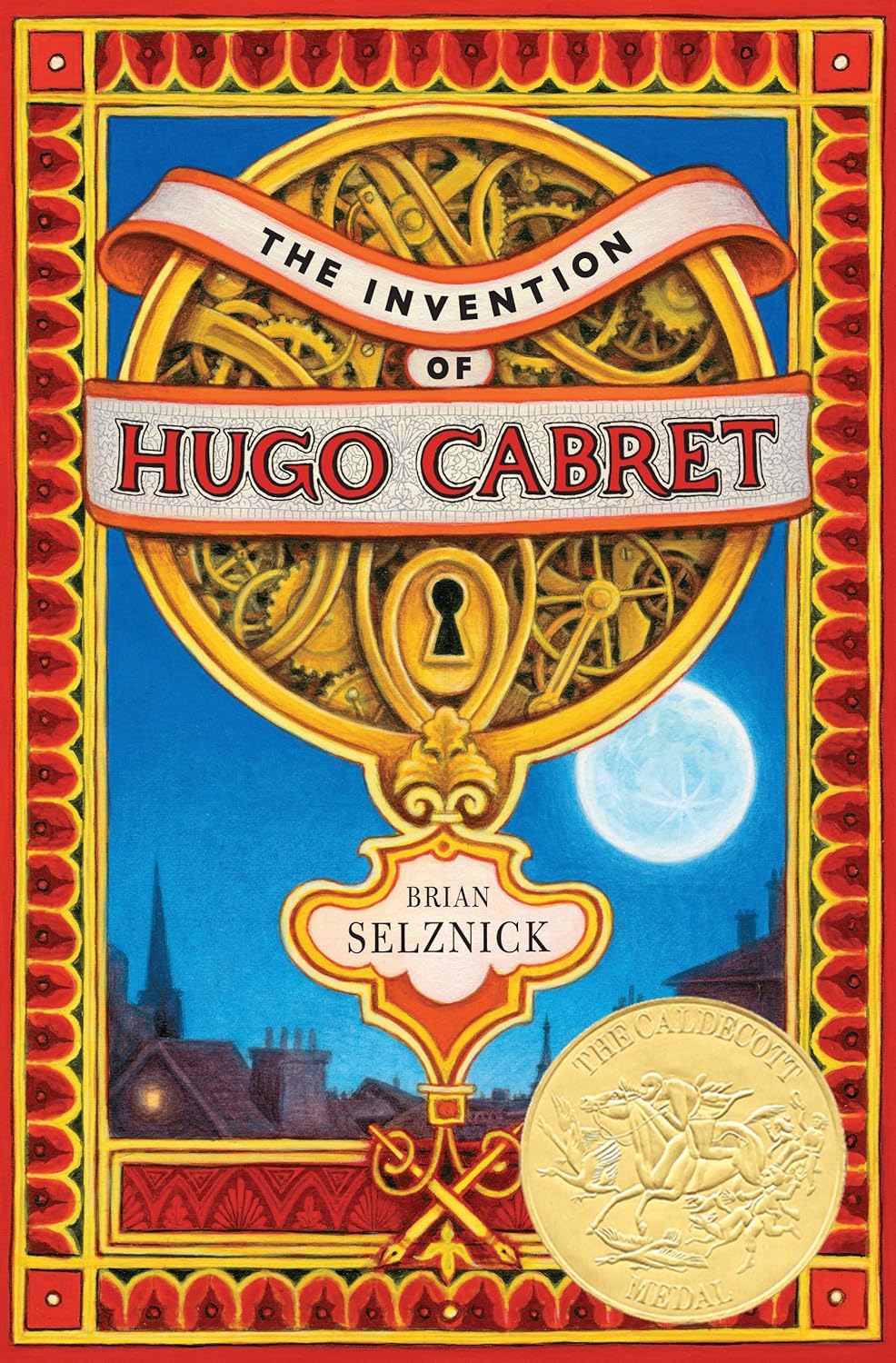
The Invention of Hugo Cabret by Brian Selznick is a groundbreaking illustrated novel about a secretive orphan boy who lives inside the walls of a Paris train station and tends its clocks — and whose search for the key to a broken automaton leads him to an unexpected discovery about cinema history. This complete guide covers the book’s reading level, recommended age, content considerations, characters, themes, and books similar to The Invention of Hugo Cabret, designed for parents, teachers, and students.
For Parents
The Invention of Hugo Cabret is a uniquely immersive reading experience — roughly half of its 533 pages are full-page illustrations that advance the story without words, making it far more accessible than its size suggests. The story is warm-hearted and largely gentle, with themes of loss, belonging, and purpose that are emotionally meaningful without being distressing. Appropriate for most readers ages 8 and up, and a strong choice for children who love art, history, or movies.
For Teachers
Hugo Cabret is an outstanding classroom text for grades 4–7 that opens up rich discussions about visual storytelling, the history of cinema, and how words and images work together to create meaning. The book is rooted in real history — Georges Méliès was a real filmmaker, and Selznick’s depiction of early cinema is historically grounded — making it an excellent bridge between language arts and history or media literacy units. It also works beautifully as a read-aloud, where the illustrations can be projected for the class.
The Invention of Hugo Cabret at a Glance
Find on Amazon →| Author | Brian Selznick |
| Published | 2007 |
| Grade Level | 4–6 (our assessment) |
| Recommended Age | 8–12 |
| Flesch-Kincaid Grade | 5.1 |
| Word Count | ~26,000 (text only) |
| Pages | 533 (approximately half illustrations) |
| Chapters | 2 parts, 22 chapters total |
| Genre | Illustrated novel / historical fiction / mystery |
| Setting | Paris, France; 1931 |
| Awards | Caldecott Medal (2008) |
For official Lexile and AR levels, visit Lexile.com or AR BookFinder. ReadingVine provides independent editorial assessments.
What Reading Level Is The Invention of Hugo Cabret?
The Invention of Hugo Cabret reads at approximately a 5th-grade word level by standard readability measures (Flesch-Kincaid grade 5.1), placing it squarely in the middle-grade range. Our editorial assessment is grades 4–6 for independent reading. However, the book’s 533-page count is genuinely misleading — roughly half of those pages are full-page or double-page pencil illustrations that carry the story forward without any text at all. The actual prose is closer to a short novel in length, and most readers move through the book much faster than the page count implies.
What makes Hugo Cabret distinctive from a reading-level standpoint is that it demands a different kind of literacy than most novels: readers must be able to interpret sequential visual narratives — essentially reading the illustrations the way one reads a film or a wordless picture book, panel by panel and page by page. This visual literacy component means the book works well for reluctant readers who are strong visual thinkers, even if their prose reading level is still developing. At the same time, Selznick’s prose sections are genuinely literary and reward careful attention. For official Lexile and AR scores, visit Lexile.com or AR BookFinder.
What Age Is The Invention of Hugo Cabret Appropriate For?
We recommend The Invention of Hugo Cabret for readers ages 8–12, with the strongest fit at ages 9–11. The combination of accessible prose, captivating illustrations, and a compelling mystery makes it broadly appealing across a wide age range. Younger readers who are strong readers can engage with it meaningfully, and many adults who encounter it for the first time as parents or teachers find it genuinely absorbing. The book has particular appeal for children who love art, drawing, old movies, or mechanical objects.
The Invention of Hugo Cabret contains themes of orphanhood, loss, and poverty — Hugo’s father has died, and Hugo lives secretly and precariously inside the train station, stealing food and parts to survive. There is some menace from the Station Inspector, who threatens to send unclaimed children to an orphanage. A significant subplot involves a character dealing with depression and the loss of purpose following a profound disappointment. None of this content is graphic or traumatic, but families should be prepared to discuss themes of grief, hardship, and what it means to find purpose after loss. There is no profanity, violence, or sexual content.
The book is also an excellent conversation starter about film history and the history of art. Selznick includes an extensive author’s note explaining what is real and what is fictional — particularly regarding Georges Méliès — which adds significant educational value and is worth reading together with younger children.
What Is The Invention of Hugo Cabret About?
Twelve-year-old Hugo Cabret lives secretly inside the walls of a busy Paris train station in 1931, maintaining its many clocks in place of his uncle, who has disappeared. Hugo is largely alone in the world — his father, a clockmaker, died in a museum fire — and his only connection to his father is a broken mechanical automaton they had been working to restore together. Hugo believes the automaton, when repaired, will write him a message from his father. To fix it, he steals mechanical parts from a toy booth in the station run by a bitter old man named Papa Georges.
When Papa Georges catches Hugo stealing and confiscates his notebook — which contains his father’s drawings of the automaton — Hugo is desperate to get it back. He befriends Isabelle, Papa Georges’s goddaughter, and together they begin to unravel the mystery of who Papa Georges really is and why he seems so determined to bury his past. The trail leads them into the early history of cinema and to a discovery that changes everything they thought they knew about the old man at the toy booth.
Brian Selznick based significant portions of the novel on the real life of Georges Méliès (1861–1938), a French magician-turned-filmmaker who pioneered special effects and narrative cinema in the late 19th and early 20th centuries. Méliès’s story — his extraordinary creative achievements, his financial ruin, and his rediscovery later in life — is largely accurate, and Selznick’s detailed author’s note separates the historical record from his fictional additions. The book is at once an adventure story, a love letter to early cinema, and a meditation on what it means to be forgotten and then remembered.
The Invention of Hugo Cabret Characters
The Invention of Hugo Cabret Themes and Lessons
The Invention of Hugo Cabret is ultimately a book about broken things being fixed — not just the automaton at the center of the plot, but people. Hugo is broken by grief and isolation. Papa Georges is broken by loss and disappointment. The novel argues that what repairs us is not time alone, but connection: the act of being seen and remembered by another person. This is expressed through both the personal story of Hugo and his father and the larger historical story of Georges Méliès, whose life’s work was nearly lost to time before being rediscovered. Selznick treats the preservation of stories and art as a moral act — the world is diminished when we forget what has been made and who made it.
The book also makes a sustained argument for the importance of having a purpose. Hugo’s observation that the world is like a machine — that every part has a role, and a person without a purpose is like a broken part — is one of the novel’s most quoted passages and a rich starting point for classroom discussion. Discussion questions worth exploring: What does the automaton represent for Hugo? Why does Papa Georges want to forget his past, and what changes his mind? How do words and pictures work together differently than either does alone? What does the novel suggest about what happens when art or history is forgotten?
How Many Pages and Chapters Are in The Invention of Hugo Cabret?
The Invention of Hugo Cabret is 533 pages long and divided into two parts containing 22 chapters total, plus a prologue and epilogue. The page count is the most misleading thing about the book: approximately 284 of those pages are full-page or double-page pencil illustrations, meaning the prose text is closer to 26,000 words — roughly the length of a short middle-grade novel. Most readers in the target age range finish the book in 4–6 hours of total reading time, considerably faster than the page count suggests. For classroom use, the book reads beautifully aloud, and the illustrations can be projected so the whole class experiences them together. Selznick also includes an extensive author’s note at the back, approximately 10 pages, which places the fictional story in its historical context and is highly recommended reading.
Books Similar to The Invention of Hugo Cabret
About Brian Selznick
Brian Selznick was born in 1966 in East Brunswick, New Jersey, and studied illustration at the Rhode Island School of Design. He worked for years as a children’s book illustrator before creating The Invention of Hugo Cabret, which represented a radical expansion of what a children’s book could be — a 533-page illustrated novel that blurred the line between picture book, graphic novel, and prose fiction. The book was awarded the Caldecott Medal in 2008, the most prestigious American award for children’s book illustration, making it one of the longest books ever to receive that honor. Selznick followed Hugo Cabret with Wonderstruck (2011) and The Marvels (2015), both using the same innovative word-and-illustration format. He has spoken extensively about his deep love of early cinema and his desire to give Georges Méliès — whose work had been largely forgotten for much of the 20th century — a new generation of admirers. Martin Scorsese adapted The Invention of Hugo Cabret into the film Hugo in 2011, which won five Academy Awards.
The Invention of Hugo Cabret: Frequently Asked Questions
What grade level is The Invention of Hugo Cabret?
By standard readability measures, The Invention of Hugo Cabret reads at approximately a 5th-grade word level (Flesch-Kincaid grade 5.1). Our editorial assessment is grades 4–6 for independent reading. The 533-page count is misleading — roughly half the pages are illustrations, making the actual prose closer to a short novel in length. Most readers move through it much faster than the size implies.
Is The Invention of Hugo Cabret a graphic novel?
Not exactly — Brian Selznick created a genuinely new form with this book. It is not a traditional graphic novel (which typically uses panels with speech bubbles and minimal prose), nor is it a standard illustrated novel. Instead, it alternates between extended sequences of full-page pencil illustrations that advance the plot without words and more traditional prose chapters. Selznick has described the illustration sequences as similar to watching a silent film. The result is its own distinct form, sometimes called a “visual novel” or an “illustrated novel.”
Is Georges Méliès a real person?
Yes. Georges Méliès (1861–1938) was a real French filmmaker and magician who is considered one of the founding pioneers of cinema. He was among the first filmmakers to use narrative storytelling, special effects, and hand-painted color in film. His most famous work, A Trip to the Moon (1902), is still widely watched today. Méliès did fall into financial ruin and obscurity in his later years and was eventually rediscovered — much as the novel depicts. Brian Selznick’s author’s note carefully explains what is historically accurate and what he invented for the story.
Is there a movie based on The Invention of Hugo Cabret?
Yes. Director Martin Scorsese adapted the book into the film Hugo, released in 2011. The film won five Academy Awards, including Best Cinematography and Best Visual Effects, and is widely praised as a faithful and visually stunning adaptation. It is rated PG and appropriate for roughly the same age range as the book. Watching the film after reading the book — or before, as an introduction — makes for a rich comparison of how the same story works in different media.
Why is the book so long if it’s for younger readers?
The 533-page count is the most common source of hesitation about The Invention of Hugo Cabret, but it is genuinely misleading. Approximately 284 of those pages are full-page illustrations with no text. The prose portions add up to roughly 26,000 words — comparable to a short middle-grade chapter book. Most readers in the target age range finish it in a single weekend. The illustrations are not decorative; they are essential to the story and carry narrative scenes entirely on their own.
What is an automaton, and why is it important to the story?
An automaton is a self-operating mechanical figure — essentially a very sophisticated wind-up machine built to perform a specific action, often writing or drawing. Automatons were considered engineering marvels in the 18th and 19th centuries, and examples from that era still exist in museums. In the novel, the automaton Hugo and his father were restoring is the central mystery and the key to the story’s resolution. It represents Hugo’s connection to his father and, ultimately, leads him to the discovery that gives the book its emotional payoff.
What award did The Invention of Hugo Cabret win?
The Invention of Hugo Cabret was awarded the Caldecott Medal in 2008. The Caldecott Medal is the most prestigious American award for children’s book illustration, given annually by the American Library Association to the most distinguished illustrator of an American picture book for children. Hugo Cabret is one of the longest books ever to receive the award and helped expand the definition of what illustrated children’s literature can look like.
Does The Invention of Hugo Cabret have a sequel?
Not a direct sequel, but Brian Selznick followed it with two books using the same innovative format: Wonderstruck (2011), which tells two parallel stories across different time periods using the same alternating word-and-illustration structure, and The Marvels (2015). Both are standalone stories rather than continuations of Hugo’s story, but readers who loved Hugo Cabret’s format and emotional tone consistently love both.