
 = Partner Site
The Magic School Bus: Inside the Human Body Reading Level: A Complete Guide
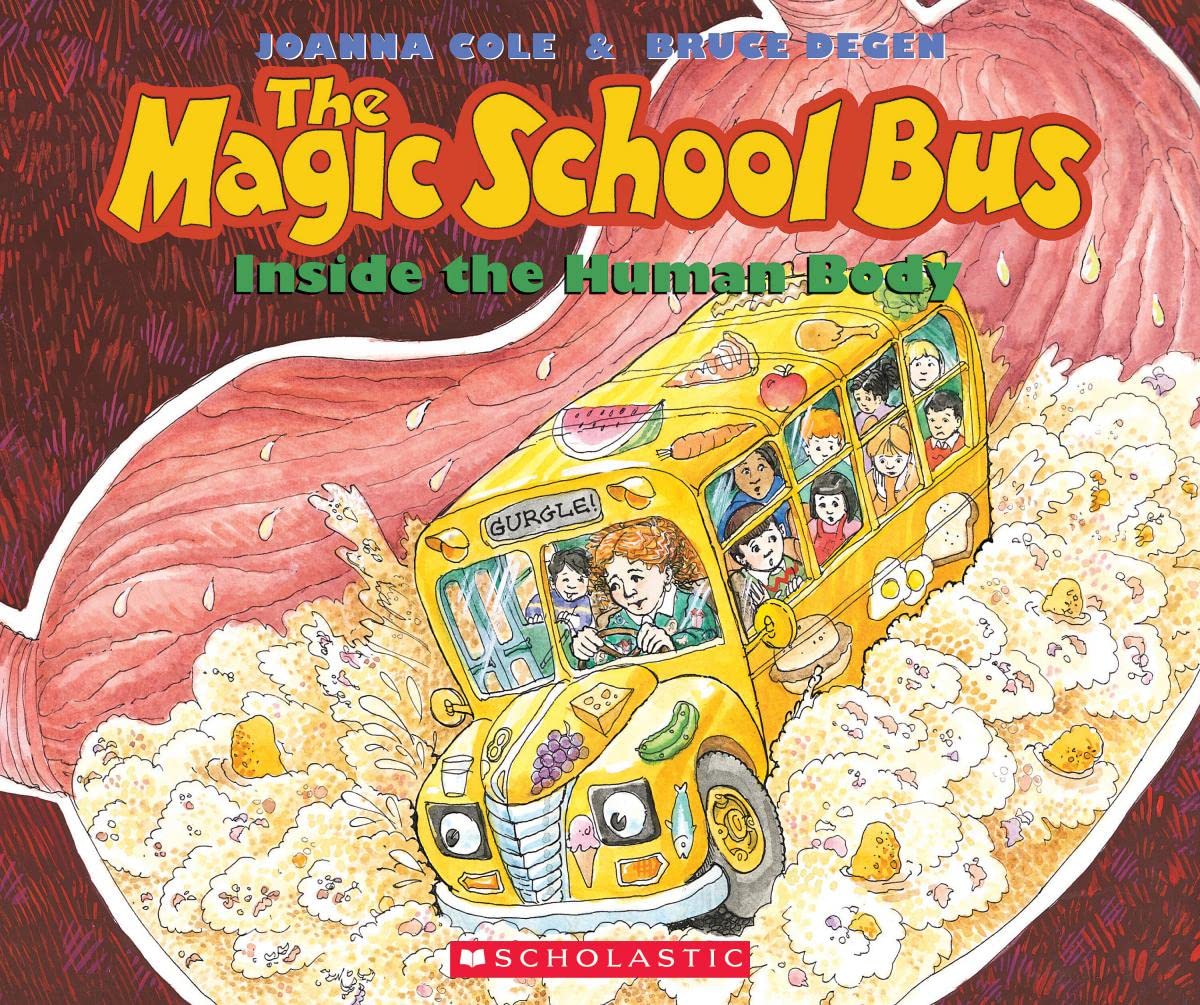
The Magic School Bus: Inside the Human Body by Joanna Cole, illustrated by Bruce Degen, is the third book in the beloved Magic School Bus series — a science picture book in which Ms. Frizzle’s class boards a school bus that shrinks to microscopic size, gets swallowed by Arnold, and travels through the human digestive system, bloodstream, and lungs before being expelled in an enormous sneeze. Published in 1989 by Scholastic, the Magic School Bus series has sold more than 93 million copies and is one of the bestselling science series for children ever published. This guide covers the reading level, recommended age, read-aloud vs. independent reading guidance, themes, and everything parents and teachers need to know about sharing The Magic School Bus: Inside the Human Body with young readers.
For Parents
Find out whether The Magic School Bus: Inside the Human Body works best as a read-aloud or independent read for your child, what age range it suits, and how to navigate this book’s unusually layered page design — which combines a main narrative, student reports, sidebars, and diagrams into a single spread — in a way that feels like an adventure rather than a lesson.
For Teachers
Grade-level data, read-aloud timing, key themes, and science content notes for a curriculum staple in grades 1–4. The Magic School Bus: Inside the Human Body covers digestion, the circulatory system, red and white blood cells, lungs, and the immune system — all within an adventure narrative that makes the content memorable rather than abstract.
The Magic School Bus: Inside the Human Body at a Glance
Find on Amazon →| Author | Joanna Cole |
| Illustrator | Bruce Degen |
| Published | 1989 |
| Grade Level | 1–4 (our assessment) |
| Recommended Age | 5–9 |
| Best For | Read-aloud ages 5–8; independent reading ages 6–9 |
| Flesch-Kincaid Grade | 4.2 |
| Word Count | ~3,200 |
| Pages | 40 |
| Genre | Science picture book / narrative nonfiction / adventure |
| Setting | A classroom; inside the human body |
| Awards | ALA Notable; NSTA/CBC Outstanding Science Trade Book |
For official Lexile and AR levels, visit Lexile.com or AR BookFinder. ReadingVine provides independent editorial assessments.
What Reading Level Is The Magic School Bus: Inside the Human Body?
The Magic School Bus: Inside the Human Body is a grade 1–4 reading level by our editorial assessment, with a Flesch-Kincaid grade level of approximately 4.2 — one of the highest on the K–2 list, driven largely by the science vocabulary embedded throughout. Words like esophagus, intestine, bloodstream, plasma, and capillary appear in context, supported by illustrations and sidebars that define and explain them, but they represent a genuine vocabulary challenge for younger independent readers.
The book’s unusual page structure is worth understanding before a first reading. Each spread combines multiple layers of text and visual information: a main narrative telling the adventure story of the class inside Arnold’s body, student-written “reports” on notebook paper in the margins, word balloons from the characters, scientific diagrams with labels, and Ms. Frizzle’s running commentary. A child reading independently at a first-grade level can follow the main narrative text without difficulty; the sidebar material is more demanding and is often best appreciated in a second or third reading, or when a parent or teacher reads it together with the child. Grades 1–2 children typically engage primarily with the adventure story on a first read; the full scientific content becomes more accessible as they move into grades 2–4. For parents who use specific reading level systems: we recommend checking your child’s level on Lexile.com or AR BookFinder for official scores.
Is The Magic School Bus: Inside the Human Body a Read-Aloud or Independent Read?
The Magic School Bus: Inside the Human Body works well as both a read-aloud for ages 5–8 and an independent read for ages 6–9, though the layered page design requires a slightly different approach than a simpler picture book. As a read-aloud, most adults can cover the main narrative in about 12–18 minutes; including all sidebars, student reports, and diagram labels extends this to 20–25 minutes. Many families and teachers read the book across two sittings or choose to read the adventure narrative first and return to the science sidebars separately — both approaches work well.
As a read-aloud, the key is deciding in advance how much of the layered content to include in each reading. The main narrative — Ms. Frizzle’s class adventures inside Arnold — is linear, fast-moving, and funny on its own, and younger children (ages 5–6) often absorb more by following the adventure story cleanly than by stopping every spread for the sidebar material. The student reports and diagrams reward children who are already curious about how the body works — they extend and deepen the narrative content rather than advancing it, and children who find them interesting will pore over them independently after the read-aloud. Degen’s illustrations are so dense with information that even children who do not read the sidebars absorb a great deal of science content from looking at the pictures.
For independent reading, a confident second or third grader can manage the full text, though the science vocabulary will require occasional support. The adventure narrative is accessible to strong first graders; the complete page content — including all sidebars and the true-false test at the end — suits grades 2–4 independently. One of the most effective classroom approaches is to read the book aloud first for the story, then have students explore individual spreads independently or in pairs, identifying one new science fact per page.
On a first read-aloud, follow just the main story text and the character word balloons — you’ll cover the adventure cleanly in about 12 minutes and children will be fully engaged. Then go back to a spread or two that generated questions and explore the student reports and diagrams together. This two-pass approach respects the book’s layered design: the adventure earns the science lesson, rather than the science lesson interrupting the adventure.
What Is The Magic School Bus: Inside the Human Body About?
Ms. Frizzle’s class is studying the human body. They visit a science museum exhibit, and Ms. Frizzle teaches them about digestion. Then — as always happens with Ms. Frizzle — the field trip takes a turn. She pushes a button on the bus, it shrinks to the size of a cheesy snack, and Arnold (who was not on the bus) accidentally swallows it. Now the class is inside Arnold, traveling through his digestive system.
The bus is pushed through Arnold’s esophagus, swirled through his stomach, absorbed through his small intestine into his bloodstream. The students don surgical gowns and float out to ride red blood cells. They travel through the heart, into the lungs, and back again. Meanwhile, Arnold — outside his own body, bewildered and alone — retraces his steps to the school. When he finally sneezes, the bus is expelled into the parking lot. The class reassembles and charts everything they learned from the inside. The book ends with a true-false test that helps readers distinguish the book’s fantasy elements from the accurate science — a structural choice that is both honest about what is real and effective as a comprehension tool.
The Magic School Bus: Inside the Human Body Characters
The Magic School Bus: Inside the Human Body Themes and Lessons
The central theme of The Magic School Bus: Inside the Human Body — and of the Magic School Bus series as a whole — is science experienced rather than memorized. The adventure format places children inside the phenomenon they are studying: they do not learn that blood travels through blood vessels, they travel through blood vessels. They do not learn that the stomach churns food, they get churned. This approach exploits the same imaginative mechanism that all good narrative nonfiction uses — the reader is emotionally inside the experience — but it takes that mechanism further than most science books dare, making the body itself an adventure setting rather than a diagram to be labeled.
Cole and Degen were meticulous about scientific accuracy, spending over a year on each of the first ten Magic School Bus books. The true-false test at the end of The Magic School Bus: Inside the Human Body explicitly addresses the fantasy elements (the bus cannot really shrink; you cannot really travel inside a body) versus the science elements (the digestive and circulatory systems described in the book are real and accurate). This intellectual honesty — the book knows the difference between the adventure it is telling and the science it is teaching, and tells you — is one of the series’s most valuable qualities. Children who understand that the magic is fictional but the biology is real get more from the book than children who treat it as pure fantasy.
The book’s page design is itself a kind of theme. The student reports, diagrams, and sidebars alongside the main narrative enact the kind of parallel research and documentation that real scientists do: they observe (the adventure), they record (the student reports), they diagram (the labeled illustrations). Children who engage with the full page content are practicing a form of scientific literacy — reading across multiple types of visual and textual information simultaneously — that is increasingly important and rarely taught this enjoyably.
Discussion starters for families: What surprised you most about how the body works? Which part of the trip would you least want to take? Why does the book have a true-false test at the end? What did the students learn that they couldn’t have learned from a textbook? What body system would you most like to explore in a shrunk school bus?
How Long Is The Magic School Bus: Inside the Human Body?
The Magic School Bus: Inside the Human Body has 40 pages and approximately 3,200 words across all text elements — main narrative, sidebars, student reports, diagram labels, and the true-false section at the end. The main narrative alone runs about 1,500 words. Most adults can read the main narrative aloud in about 12–18 minutes; the full page content, including all sidebars and student reports, takes about 20–25 minutes.
A child reading independently at a strong second- or third-grade level will typically finish the main narrative in about 15–20 minutes and may spend considerably more time exploring the sidebars and illustrations. The book rewards slow, exploratory reading of the page details — Degen packs genuine science content into every corner of every spread, and children who look closely at the illustrations consistently find things they missed on previous readings. It is one of the most re-readable books on the K–2 list, not because the story changes but because the page always has more in it than a single reading can absorb.
Books Similar to The Magic School Bus: Inside the Human Body
If your child loves The Magic School Bus: Inside the Human Body, these titles share its science content, its adventure format, or its place in the science picture book category:
About the Author and Illustrator
Joanna Cole (1944–2020) was an American author who wrote more than 250 children’s books over a career spanning nearly fifty years, of which the Magic School Bus series is by far the most widely read. She grew up in East Orange, New Jersey, with an early love of science — she had a teacher who, she said, acted a little like Ms. Frizzle, letting students check out science books weekly and treating reading about science as something done for pleasure. Cole worked as a librarian and elementary school teacher before becoming a full-time writer, and she brought both a teacher’s instinct for what children need to know and a librarian’s commitment to accuracy to every book she wrote. The first Magic School Bus book was published in 1986; the series eventually ran to ten original titles and spawned an animated television series, sequel series, and companion nonfiction books. Cole and Bruce Degen spent over a year on each of the first ten books, a production pace that reflected their shared commitment to getting the science right. Cole died in July 2020; the series has continued with new titles by other authors. She received the Washington Post/Children’s Book Guild Award for her nonfiction children’s books and the National Endowment for the Arts Foundation Award for Outstanding Service to Public Education, among many other honors.
Bruce Degen is an American illustrator and author who has illustrated the entire Magic School Bus series as well as more than 100 other children’s books, including the Jesse Bear series and Jane Yolen’s Commander Toad series. His own picture book Jamberry (1983) is a perennial favorite. For the Magic School Bus books, Degen developed the visual system that makes the series instantly recognizable: a main narrative illustration that fills the page, with student reports on notebook paper in the margins, diagrams with scientific labels, and character word balloons that carry additional humor and information. This layered design — which packs far more content into a 40-page picture book than any conventional format would allow — was Degen’s solution to the challenge of making science genuinely visible rather than merely described. He continues to illustrate books from his home in Connecticut.
The Magic School Bus: Inside the Human Body: Frequently Asked Questions
What reading level is The Magic School Bus: Inside the Human Body?
The Magic School Bus: Inside the Human Body is a grade 1–4 reading level by our editorial assessment, with a Flesch-Kincaid grade level of approximately 4.2 — one of the higher levels on the K–2 list, driven by science vocabulary like esophagus, intestine, and capillary. The main adventure narrative is accessible to strong first graders; the full page content including sidebars and student reports suits grades 2–4. As a read-aloud it works well from age 5. For official Lexile and AR levels, visit Lexile.com or AR BookFinder.
What age is The Magic School Bus: Inside the Human Body for?
The Magic School Bus: Inside the Human Body is appropriate for ages 5–9. As a read-aloud the adventure narrative engages children from age 5; as an independent read the full content suits children ages 6–9. It is one of the most widely used science picture books in grades 1–4 classrooms, and the science content — digestion, the circulatory system, blood cells, and lungs — is accurate and appropriately detailed for that range.
Is The Magic School Bus: Inside the Human Body science accurate?
Yes — Joanna Cole and Bruce Degen spent over a year on each of the original Magic School Bus books, working with scientific consultants to ensure accuracy. The book itself addresses the question directly through a true-false test at the end, which explicitly distinguishes the fantasy elements (a bus cannot really shrink; you cannot travel inside a human body) from the science elements (the digestive and circulatory systems described are real and accurate). The digestive journey from mouth through stomach and small intestine to the bloodstream, the description of red and white blood cells, the explanation of how the heart pumps blood to the lungs — all of this reflects genuine biology at an appropriate level for elementary students.
How long does it take to read The Magic School Bus: Inside the Human Body aloud?
The main adventure narrative takes about 12–18 minutes to read aloud. Including all sidebars, student reports, and diagram labels extends this to 20–25 minutes. Many teachers and parents read the adventure story first in one sitting, then return to explore specific spreads and sidebars in a second pass. Both approaches work well — the layered page design is designed to reward multiple readings at different levels of depth.
What body systems are covered in The Magic School Bus: Inside the Human Body?
The Magic School Bus: Inside the Human Body covers the digestive system (mouth, esophagus, stomach, small intestine), the circulatory system (bloodstream, heart, blood vessels, red and white blood cells, plasma), and the respiratory system (lungs, breathing). The book follows the path of food through the body — from being chewed and swallowed through digestion, absorption into the bloodstream, travel through the heart, oxygenation in the lungs, and return to circulation — which gives the journey a logical narrative structure that mirrors the body’s actual sequence.
Are there other Magic School Bus books about the human body?
Yes — the expanded Magic School Bus series includes several other titles related to human biology, including The Magic School Bus: Inside the Earth (geology), The Magic School Bus: At the Waterworks (the water cycle), and later titles covering the brain, germs, and other body systems. The original ten books written by Joanna Cole with illustrations by Bruce Degen are considered the core series; later books by other authors continue in the same format. For the classroom, the series also has companion Fact Reader nonfiction books and an animated TV series that covered many of the same topics.