
 = Partner Site
The Monster at the End of This Book Reading Level: A Complete Guide
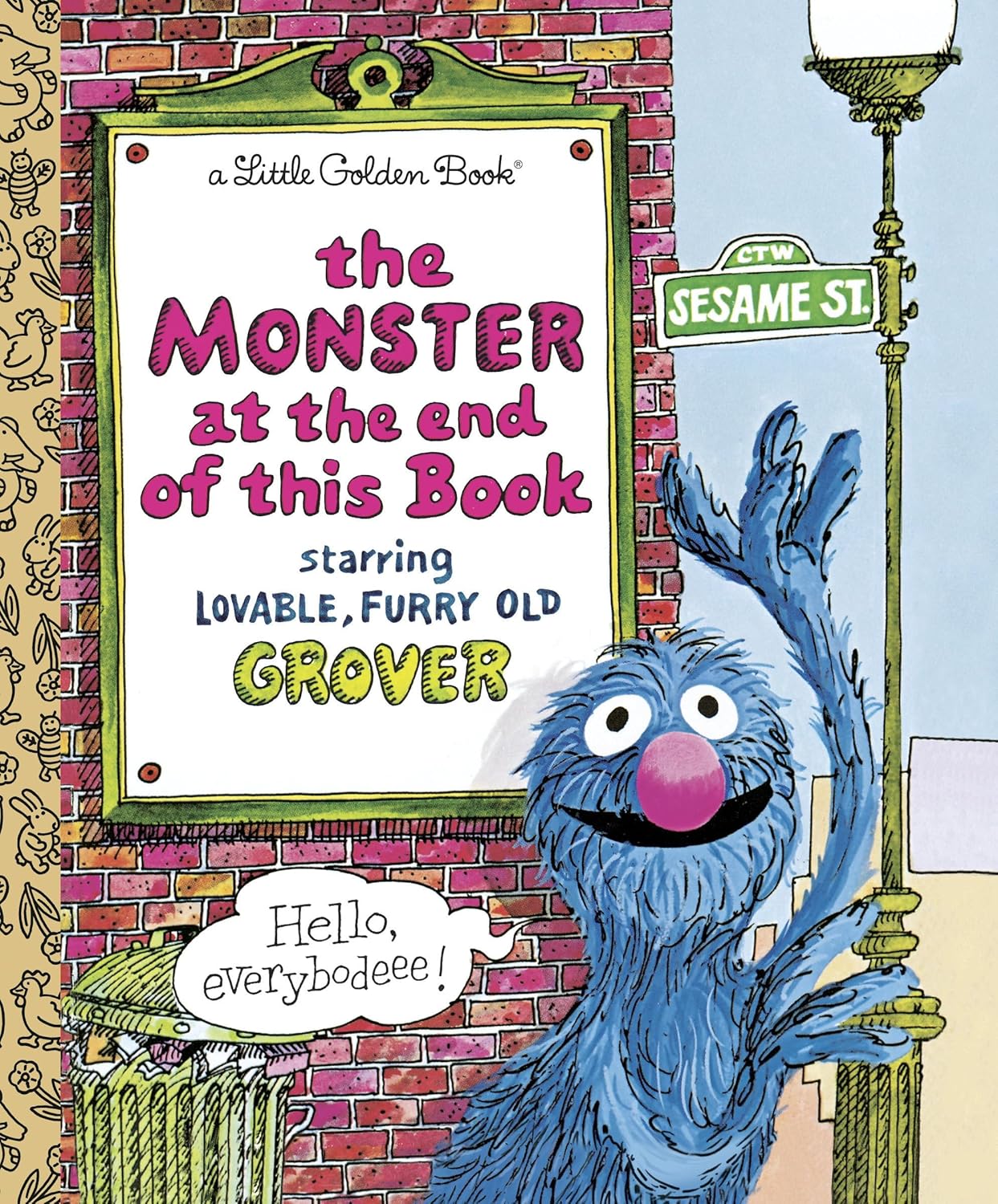
The Monster at the End of This Book, written by Jon Stone and illustrated by Michael Smollin, is a 24-page picture book in which Grover — lovable, furry, terrified — reads the title of the book he is in, realizes there is a monster at the end of it, and spends every subsequent page begging the reader not to turn to the next one. He ties the pages together with rope. He nails them shut. He builds a brick wall. None of it works, because it never does when you are made of illustrations. At the very end, the monster turns out to be Grover himself. “Oh, I am so embarrassed,” he says. First published in 1971 as a Little Golden Book and now the all-time bestselling Sesame Street book title, it is one of the earliest and most celebrated examples of a metafictional picture book — a book that knows it is a book, that has a character who talks directly to the reader, and that makes the act of turning the page into the story’s central dramatic event. Jon Stone wrote it on a flight across the United States in early 1971, reportedly finishing the manuscript in one sitting. It sold two million copies in its first year. This guide covers The Monster at the End of This Book‘s reading level, whether it’s a read-aloud or independent read, what it’s about, its themes, how long it takes to read, and similar books — designed for parents and teachers of K–2 readers.
For Parents
A hilarious, participatory picture book in which Grover begs you not to turn the page — and children feel the irresistible pull to do it anyway. Best as a read-aloud for ages 2–6, with independent reading accessible for ages 5–7. No content concerns. One of the most reliably delightful read-aloud experiences in children’s literature, for child and adult alike.
For Teachers
A PreK–1 classroom staple that introduces children to the concept of a book as an object with a reader — the metafictional structure makes print concepts and reader agency concrete and funny. Grover’s fourth-wall-breaking is one of the most accessible entry points to discussions of how books work. Pairs naturally with other metafictional picture books in the published catalog.
The Monster at the End of This Book at a Glance
Find on Amazon →| Author | Jon Stone |
| Illustrator | Michael Smollin |
| Published | 1971 (Little Golden Books / Golden Press) |
| Grade Level | PreK–K read-aloud; K–1 independent (our assessment) |
| Recommended Age | Read-aloud ages 2–6; independent reading ages 5–7 |
| Best For | Read-aloud ages 2–6; independent reading ages 5–7 |
| Lexile | AD450L |
| Word Count | ~400–500 (varies; interactive format) |
| Pages | 24 |
| Genre | Picture book / metafiction / humor / Sesame Street |
For official Lexile and AR levels, visit Lexile.com or AR BookFinder. ReadingVine provides independent editorial assessments.
What Reading Level Is The Monster at the End of This Book?
The Monster at the End of This Book has a Lexile of AD450L — Adult Directed, indicating it is designed as a read-aloud. The prose is conversational and direct; Grover speaks in the voice he uses on Sesame Street, with exclamation points, capital letters for emphasis, and the specific cadence of someone who is increasingly desperate. A confident kindergartner or first-grader can work through the text independently, but the experience of reading it aloud — with someone to react to Grover’s pleas and respond when he asks you to stop — is what makes the book what it is.
The word count is difficult to standardize precisely because the book’s interactive format — Grover’s instructions to the reader, his reactions after each page turn — means the “text” and the “reader’s participation” blur in ways that formula scoring does not account for. What the Lexile captures accurately is that this is a text for young readers, appropriate for PreK through early primary, and that its reading demands are entirely accessible. For official Lexile and AR scores, visit Lexile.com or AR BookFinder. ReadingVine’s assessments are independent editorial judgments.
Is The Monster at the End of This Book a Read-Aloud or Independent Read?
This is first and most powerfully a read-aloud for ages 2–6 — and one of the great performative read-aloud experiences in children’s literature. The book requires a reader who is willing to play the part: to beg, in Grover’s voice, for the child not to turn the page; to build the dramatic pause before the brick wall spread; to perform Grover’s embarrassed collapse at the end with full commitment. The more theatrical the reading, the better the book works. Children who have heard it read aloud with energy want to hear it again immediately.
For independent reading, a confident K–1 reader can work through the text on their own. Many children who love the book return to it independently — including children who find delight in being in the position of power, turning the pages while Grover begs them not to. The book specifically designed to make the child feel powerful as a reader, and that experience is available whether an adult is present or not.
Give Grover everything he asks for: really beg not to turn the page. Really try to hold the page shut. Really gasp when the brick wall comes down. The more you commit to Grover’s panic, the more your child will delight in overruling you. Pause before the last page and ask: “What do you think the monster looks like?” Then turn it — and give Grover his “Oh, I am so embarrassed” its full, defeated weight. The book works in direct proportion to how seriously you take it.
What Is The Monster at the End of This Book About?
Grover opens the book, reads the title — The Monster at the End of This Book — and is immediately horrified. There is a monster at the end of this book! He begs the reader, directly and urgently, not to turn the page. The reader turns the page. Grover is distressed. He ties the pages together with rope. The reader turns the page. The rope is broken. Grover nails the pages shut. The reader turns the page. The nails come out. Grover builds a wall of bricks and mortar. The reader turns the page. The wall is rubble. With each failed attempt, Grover’s desperation escalates, his pleas grow more elaborate, and the reader grows more gleefully determined to keep going.
At the very last page — the end of the book — Grover reaches the monster. He opens his eyes. The monster is him. “Oh, I am so embarrassed,” he says. “I have been so SCARED, and you have been turning pages, and all the time the monster was me.” He pauses. “Well. That is the end of the book. Good bye.” The book is over. Everything is fine. It was never not fine.
The book was originally conceived, Stone has said, to introduce young children to the concept of reading a book from beginning to end — specifically to counter the tendency of young children to flip immediately to the last page. By making the end the source of both danger and resolution, it gives children a reason to stay in sequence. It works almost too well: children who know the book still want to turn each page in order, even on the hundredth reading.
The Monster at the End of This Book Characters
Grover is the book’s only character — and its narrator, its protagonist, its villain (by reputation), and its comic victim simultaneously. The Grover of this book is the Sesame Street Grover precisely: self-important, easily frightened, physically expressive, and ultimately endearing in his embarrassment. The reader is the book’s other character — present only through the turning of pages, which is enough. The dynamic between Grover’s desperate resistance and the reader’s cheerful transgression is the entire book, and it is one of the most perfectly calibrated dynamics in picture book history. The monster — present in the title, dreaded throughout, revealed on the last page — is Grover himself, which is both the punchline and the point.
The Monster at the End of This Book Themes and Lessons
The book is one of the earliest examples in American picture book publishing of a text that is explicitly aware of its own form — what literary scholars call metafiction. Grover does not just tell a story; he inhabits the book as a physical object and attempts to use it as a physical object, tying pages together, building walls between them. This makes the book’s structure part of its content: turning the page is not just how you read, it is what the story is about. Every page turn is both a narrative event and an act of reader agency — the child deciding to continue despite Grover’s pleas is making a choice, and the book validates that choice by rewarding it with Grover’s escalating panic and ultimate discovery.
The book’s deeper argument — legible to children on re-reading, and to adults immediately — is about the relationship between fear and its object. Grover is terrified of the monster at the end of the book. The monster turns out to be himself. His fear was always self-directed, always about himself, always more about the anticipation than the reality. This is not a didactic point in the text; it is simply what happens. But it is what Grover articulates on the final page — he has been scared of himself — and children who have experienced their own fears as larger than what caused them will recognize something true in it.
Talking with your child: Why did Grover not want you to turn the page? What did you think the monster was going to look like? Were you surprised that it was Grover? Why do you think Grover was so scared — and why did it turn out to be okay? Have you ever been really scared of something that turned out to be not scary at all?
How Long Is The Monster at the End of This Book?
The Monster at the End of This Book is 24 pages — the shortest book in this catalog by page count. Most adults can read it aloud in about five to seven minutes, though sessions with young children typically run longer because children demand Grover’s pleas be performed properly and because the ending requires at least two re-readings. The book has been in print continuously since 1971 and is available in multiple formats including a standard Little Golden Book paperback, hardcover editions, board book versions for very young children, and an animated special on HBO Max (The Monster at the End of This Story, 2020). The sequel Another Monster at the End of This Book (1996) features both Grover and Elmo and is a natural next read for children who love the original.
Books Similar to The Monster at the End of This Book
About Jon Stone and Michael Smollin
Jon Stone was born on April 13, 1931, in New Haven, Connecticut. He was a founding member of the Sesame Street creative team, serving as its first head writer and one of its principal directors and producers for more than two decades. He is credited with helping develop some of the show’s most iconic characters, including Cookie Monster, Oscar the Grouch, and Big Bird, and is widely regarded as one of the finest writers in the history of American children’s television. He wrote The Monster at the End of This Book in early 1971 on a transcontinental flight, completing the manuscript in a single sitting. The musician Christopher Cerf, who later wrote songs for Sesame Street, has said that reading the manuscript for the first time he thought: “Oh my god, this is wonderful.” Stone died on March 30, 1997.
Michael Smollin was a former advertising executive who became a children’s book illustrator. His illustrations for The Monster at the End of This Book — Grover’s increasingly desperate facial expressions, the elaborate physical barriers he constructs, the ruins of each failed attempt after each page turn — are inseparable from the book’s comedy. He also illustrated the sequel, Another Monster at the End of This Book (1996).
The Monster at the End of This Book: Frequently Asked Questions
What reading level is The Monster at the End of This Book?
The Monster at the End of This Book has a Lexile of AD450L — Adult Directed, designed as a read-aloud. The prose is conversational and direct, accessible to young children. Our assessment: read-aloud for ages 2–6; independent reading for ages 5–7. For official Lexile and AR scores, visit Lexile.com or AR BookFinder.
What is The Monster at the End of This Book about?
Grover reads the title of the book he is in, discovers there is a monster at the end, and spends every page begging the reader not to turn to the next one. He ties pages with rope, nails them shut, and builds a brick wall — none of which works. At the very last page, the monster turns out to be Grover himself. “Oh, I am so embarrassed,” he says.
Who is the monster at the end of the book?
Grover. He has spent the entire book terrified of the monster at the end, and the monster is himself. This is both the punchline and the point: Grover’s fear was always self-directed, always larger than its actual object, and entirely resolved by the simple act of getting to the end and seeing what was actually there.
Why did Jon Stone write The Monster at the End of This Book?
Stone originally conceived the book to introduce young children to the concept of reading from beginning to end — countering the tendency of young children to flip immediately to the last page. By making the ending simultaneously dangerous (a monster!) and the source of resolution (just Grover!), he gave children a reason to stay in sequence. He wrote the manuscript in a single sitting on a flight across the United States in early 1971.
Is there a sequel to The Monster at the End of This Book?
Yes — Another Monster at the End of This Book (1996), also written by Stone and illustrated by Smollin, features both Grover and Elmo. In this version, Elmo actively encourages the reader to turn the pages while Grover panics. A new sequel, The Momster at the End of This Book, is scheduled for 2026. An animated special, The Monster at the End of This Story, was released on HBO Max in 2020.
How long does it take to read The Monster at the End of This Book aloud?
About five to seven minutes for the text — but sessions with young children almost always run longer because the ending requires re-reading and because Grover’s pleas deserve full theatrical performance. Budget ten to fifteen minutes if this is a first encounter, because immediate re-reading is essentially guaranteed.