
 = Partner Site
The Road Reading Level: A Complete Guide
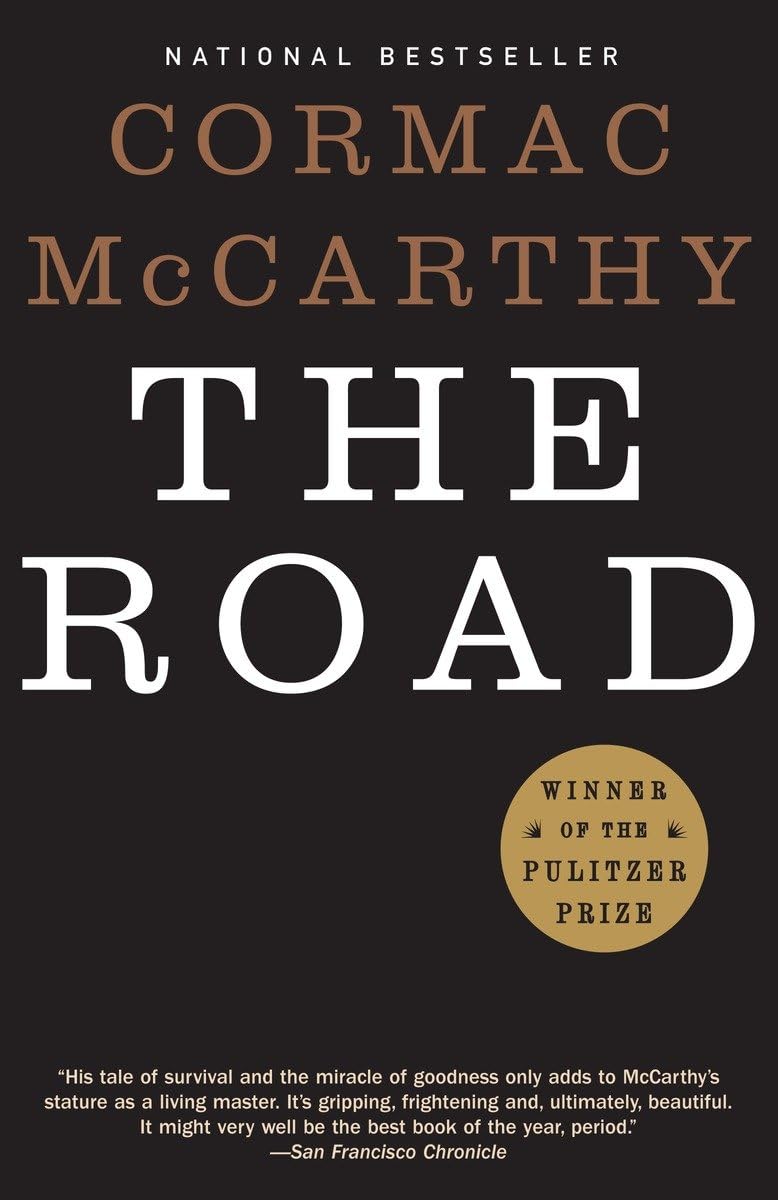
The Road, written by Cormac McCarthy and published by Alfred A. Knopf on September 26, 2006, is a post-apocalyptic novel about a father and his young son traveling south through a burned and largely emptied America toward the coast. The catastrophe that destroyed the world is never named or explained; the landscape is ash-covered, cold, and dark. Most plant and animal life is gone. Bands of survivors roam the roads, and some have turned to cannibalism. The father and son — neither named in the novel — carry what the boy calls “the fire”: the idea that they are “the good guys” and will not do what must not be done no matter how desperate their circumstances become. The father carries a pistol with two shells; he has made clear to himself that one of them is for the boy if capture becomes certain. The novel runs continuously without chapter divisions or numbers and throughout without quotation marks for dialogue — a deliberate stylistic choice McCarthy used across his work. McCarthy dedicated the book to his son John Francis McCarthy, who was approximately eight years old when the novel was written. The novel won the Pulitzer Prize for Fiction in 2007 and was a finalist for the National Book Critics Circle Award. It is among the most widely assigned contemporary novels in AP Literature curricula. This guide covers reading level, age appropriateness, content, McCarthy’s prose style, themes, and similar books.
For Parents
A post-apocalyptic novel about a dying father and his young son traveling through a destroyed America, carrying the idea that they will not commit atrocities against other survivors no matter what. Ages 15–18, grades 11–12 and AP Literature. Content: graphic and sustained depictions of violence and cannibalism; a child in mortal danger throughout; the father’s plan to kill his son rather than allow him to be captured; extreme bleakness of setting and situation. Among the most content-intensive novels in the standard AP curriculum. Most appropriate for mature grades 11–12 readers with classroom support.
For Teachers
A grades 11–12 and AP Literature novel. Lexile 670L; ATOS 4.0; word count ~58,700; 287 pages; no chapters or chapter numbers. The Lexile drastically understates the reading demands — McCarthy’s prose style, without quotation marks or chapter breaks, requires close attention and stylistic analysis that the formula cannot measure. Pulitzer Prize 2007. McCarthy (1933–2023) dedicated the novel to his son John. The prose style — stripped of conventional punctuation, including quotation marks — is itself a productive AP analysis topic. Content is extremely graphic; parental awareness is recommended before assigning.
The Road at a Glance
Find on Amazon →| Author | Cormac McCarthy (1933–2023) |
| Published | September 26, 2006 (Alfred A. Knopf) |
| Grade Level | 11–12 (our assessment); AP Literature |
| Recommended Age | 16–18 |
| Lexile | 670L (see caveat below) |
| ATOS Level | 4.0 |
| Word Count | ~58,700 |
| Pages | 287 |
| Structure | No chapter divisions or numbers; continuous text |
| Genre | Post-apocalyptic fiction / literary fiction |
| Setting | Post-catastrophe United States; heading south toward the coast |
| Awards | Pulitzer Prize for Fiction (2007); National Book Critics Circle Award finalist |
For official Lexile and AR levels, visit Lexile.com or AR BookFinder. ReadingVine provides independent editorial assessments.
What Reading Level Is The Road?
Lexile 670L, ATOS 4.0, word count ~58,700, interest level grades 9–12. These scores are among the most misleading in this catalog and require significant context. The Lexile of 670L and ATOS of 4.0 reflect McCarthy’s sentence-level prose style — short sentences, stripped vocabulary, minimal punctuation — and register it as simple prose. The actual reading demands are entirely different. McCarthy’s decision to write without quotation marks means that all dialogue must be parsed from surrounding prose without conventional signals; the continuous text without chapter breaks or numbers means there are no structural resting points; the prose style, which strips away conventional markers of setting transition and time passage, requires close attention to what is actually happening at any given moment. The novel is most appropriate for grades 11–12 and AP Literature students who are reading it with instruction. For official scores, visit Lexile.com or AR BookFinder.
What Age Is The Road Appropriate For?
Ages 16–18, grades 11–12. Content worth noting:
The Road contains graphic and sustained depictions of post-apocalyptic violence, including the discovery of people being kept alive for food by cannibals; the father’s plan to kill his son rather than allow him to be captured; descriptions of burned, mutilated, and displayed human remains throughout the landscape. The child protagonist is in mortal danger throughout the novel, and the father’s terminal illness means that the boy faces the prospect of surviving alone in this world. The novel’s sustained bleakness and its specific forms of violence are among the most extreme in the standard AP Literature curriculum. Parents should preview the content before sharing with students; most teachers discuss the content in advance of assigning.
McCarthy’s Prose Style — No Quotation Marks, No Chapters
Cormac McCarthy’s prose style in The Road — as in his other major works — removes several conventional markers that readers rely on:
No quotation marks. All dialogue is written without quotation marks. The conversation between the father and son is the novel’s emotional center, and it must be parsed from surrounding prose by attention to context, sentence structure, and the rhythm of exchange. The absence of quotation marks is not a typographical error; it is a deliberate choice McCarthy maintained across his work. New readers typically need a few pages to calibrate how to read the dialogue before it becomes natural.
No chapter breaks or numbers. The text runs continuously. There are occasional white-space breaks between sections, but no numbered chapters. This means there are no conventional structural landmarks to orient the reader; the novel’s progression must be tracked by internal context.
Stripped punctuation throughout. McCarthy uses no apostrophes in contractions (“dont,” “cant,” “wont”) and minimal commas. This is a consistent stylistic choice across his work.
For AP Literature, the prose style is itself a productive analysis topic: what effect does the removal of conventional markers create, and how does it relate to the novel’s subject — a world in which the markers of civilization have been stripped away?
What Is The Road About?
In a post-catastrophic America — the nature of the catastrophe is never explained; the sky is dark with ash, the landscape burned, most life gone — a man and his young son are traveling south toward the coast. The man is sick; he is dying, though this is not stated explicitly. The boy was born after the catastrophe and has no memory of the world before. The mother, who appears in the man’s dreams and memories, killed herself rather than survive what the world had become.
The father and son travel with a shopping cart of scavenged food, a pistol with limited ammunition, and the knowledge — held by both, articulated primarily by the boy — that they are “the good guys.” The boy distinguishes constantly between those who “carry the fire” (who maintain some moral code, who will not commit atrocities against other survivors) and those who do not. The father’s primary orientation is survival; the boy’s is moral. The tension between these is the novel’s central dynamic.
The road is populated by other survivors, most of them dangerous. The father and son encounter bands of men who keep people alive for food; they find a bunker stocked with provisions; they are robbed; they encounter an old man they name Ely; they reach the coast, which offers no resolution — just more gray ocean and cold. The father dies near the coast. The boy is found by a man with a family, who has been following them; the novel ends with the boy joining this family.
The narrative is episodic — a series of encounters and survivals — with the relationship between the father and son as the continuous element. The man’s dreams of his wife and of the world before provide the novel’s only warmth of memory; the boy’s conversations with his father provide its only sustained dialogue.
The Road Themes and Lessons
The novel’s central moral question — what obligations does a person have to other people when civilization has collapsed and survival is the only available goal — is posed primarily through the contrast between the father and the boy. The father’s position is that their survival is the only moral priority; he will not help strangers, will not share provisions, will not take risks for others. The boy consistently pushes against this: he wants to help the people they encounter; he is troubled by the father’s willingness to leave others to their fates; he insists on the distinction between the good guys and the others even when that distinction costs them.
The phrase “carrying the fire” — the boy’s formulation for what distinguishes them from the cannibals and the violent survivors — is the novel’s central moral metaphor. The boy does not fully articulate what the fire is; it functions as the residual moral inheritance of the world before, maintained in the boy despite his having been born into the world after. The novel’s ending — the boy joins a family, and the final paragraph describes something of the pre-catastrophe world in an elegiac register — suggests that what the boy carries is not extinguished.
Discussion questions: Why does McCarthy not name the father, the son, or the catastrophe? What does “carrying the fire” mean — and who decides what it means? Where does the father’s moral framework differ from the boy’s — and does the novel endorse one over the other? What does McCarthy’s prose style — stripped of quotation marks, chapter breaks, and conventional punctuation — add to the reading experience of a novel about a stripped world?
Books Similar to The Road
About Cormac McCarthy
Cormac McCarthy was born Charles Joseph McCarthy Jr. on July 20, 1933, in Providence, Rhode Island, and grew up in Knoxville, Tennessee. He attended the University of Tennessee, served in the US Air Force, and published his first novel, The Orchard Keeper, in 1965. He lived in poverty for much of his early career, receiving a MacArthur Fellowship in 1981. His major works include Blood Meridian, or the Evening Redness in the West (1985), the Border Trilogy — All the Pretty Horses (1992), The Crossing (1994), and Cities of the Plain (1998) — and No Country for Old Men (2005). The Road (2006) was his tenth novel and won the Pulitzer Prize for Fiction in 2007. He dedicated it to his son John Francis McCarthy, then approximately eight years old; in interviews he described writing the novel partly as a meditation on fatherhood and what he would want for his son if the world became unlivable. His final two novels, The Passenger and Stella Maris, were published simultaneously in 2022. He died on June 13, 2023, in Santa Fe, New Mexico, at age eighty-nine.
The Road: Frequently Asked Questions
What reading level is The Road?
Lexile 670L, ATOS 4.0, word count ~58,700, interest level grades 9–12. These scores significantly understate the actual reading demands — they reflect McCarthy’s short, stripped sentences but cannot measure the difficulty of reading prose without quotation marks, chapter breaks, or conventional punctuation markers. Our assessment: grades 11–12, ages 16–18, primarily for AP Literature. For official scores, visit Lexile.com or AR BookFinder.
What is The Road about?
A father and his young son travel south through a burned, largely emptied America toward the coast after an unnamed catastrophe has destroyed civilization. The father is dying. Most survivors are violent; some are cannibals. The boy insists that they are “the good guys” who “carry the fire” — a moral distinction the novel tracks against the father’s more purely survivalist approach. The father dies near the coast; the boy is found by a surviving family.
Why are there no quotation marks in The Road?
McCarthy removed quotation marks from The Road — as he did throughout his work — as a deliberate stylistic choice. All dialogue is written without quotation marks and must be parsed from context and sentence rhythm. New readers typically need a few pages to calibrate before it becomes natural. For AP Literature, the absence of conventional dialogue markers is a productive formal analysis topic: the stripped prose mirrors the stripped world the novel depicts.
What caused the catastrophe in The Road?
The novel never explains it. The catastrophe is described only through its effects — the burned landscape, the ash-covered sky, the absence of animal and plant life. McCarthy has declined to specify the cause in interviews. The deliberate omission is part of the novel’s design: the story is about what remains of human life and human morality after catastrophe, not about the catastrophe itself.
What does “carrying the fire” mean in The Road?
The phrase is the boy’s formulation for the moral quality that distinguishes him and his father from the cannibals and violent survivors they encounter. The boy does not fully define what the fire is; it functions as a residual moral inheritance — the belief that there are things you will not do regardless of circumstances. The novel’s ending suggests the fire is not extinguished with the father’s death.
What grade is The Road typically assigned?
Most commonly in 11th or 12th grade AP Literature and Composition. Its graphic content (violence, cannibalism, sustained depictions of a child in mortal danger) and its formal demands (no quotation marks, no chapters) make it most appropriate for mature high school readers in advanced courses with classroom instruction. Parental awareness of the content is recommended before assigning.