
 = Partner Site
Touching Spirit Bear Reading Level: A Complete Guide
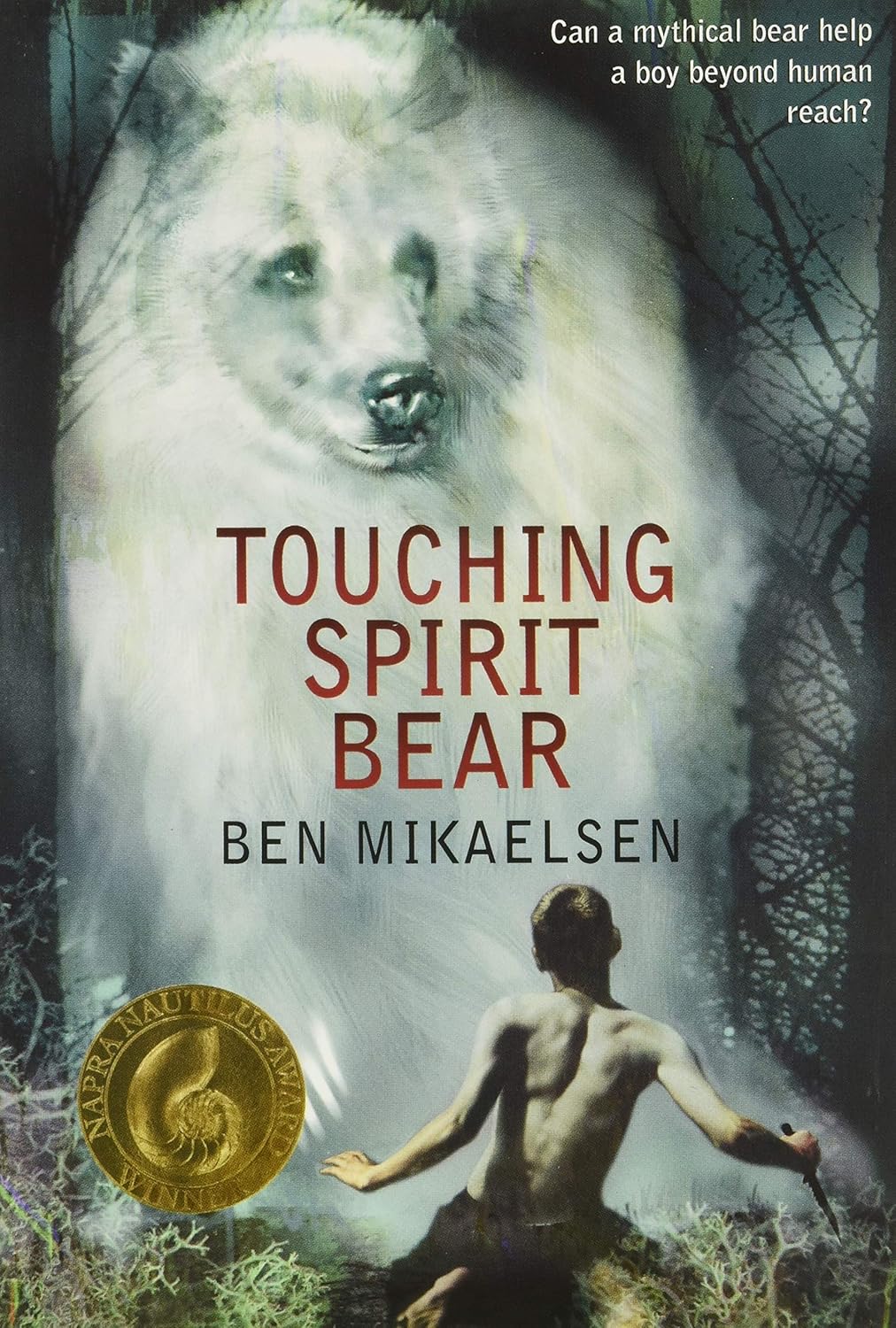
Touching Spirit Bear by Ben Mikaelsen is one of the most intense, most physically immediate, and most genuinely transformative novels in middle grade fiction — a story about a violent, angry boy who is sent alone to a remote Alaskan island as an alternative to prison and who must survive, literally, the consequences of his own rage. Cole Matthews has hurt people his whole life, and the system has consistently failed to stop him — until a restorative justice program called Circle Justice sends him to an island with nothing but the basics of survival and the mandate to sit with himself until something changes. What changes him is the island, the bear, and the slow, painful work of being stripped of every defense he has. Unflinching, elemental, and deeply sincere, it is a novel that takes seriously the possibility that even the most damaged and most dangerous person can become something different — and that shows, without sentimentality, what that transformation actually costs. This complete guide covers the reading level, age appropriateness, themes, characters, and everything parents and teachers need to know about this essential novel.
For Parents
Touching Spirit Bear is a novel for readers ages 10-13 who are ready for a story that does not protect them from physical extremity and moral difficulty. Cole has committed a serious act of violence before the novel begins, and the consequences he faces — including a near-fatal mauling by the Spirit Bear and a winter alone on the island — are depicted with the directness of a novel that believes its readers can handle reality. The novel also deals with child abuse: Cole’s father is violent, and the abuse Cole has suffered is presented as context for his behavior without being used as an excuse for it. Parents who read this novel with their children will find it one of the richest available for conversations about anger, accountability, and what genuine change requires.
For Teachers
Widely taught in grades 5-7, Touching Spirit Bear is an exceptional text for teaching restorative justice as an alternative to punitive justice, the relationship between trauma and behavior, and how authors use setting — particularly wilderness — as both physical challenge and spiritual landscape. The novel’s Circle Justice framework opens some of the most productive discussions available at this level about what justice actually means and what it is for. Cole’s journal assignments, assigned by Garvey, also make the novel particularly well suited to reflective writing exercises.
Touching Spirit Bear at a Glance
Find on Amazon →| Author | Ben Mikaelsen |
| Published | 2001 |
| Grade Level | 5-7 (our assessment) |
| Recommended Age | 10-13 |
| Flesch-Kincaid Grade | 5.4 |
| Word Count | ~56,000-58,000 |
| Pages | 241 (standard paperback) |
| Chapters | 22 |
| Genre | Realistic fiction / survival / coming-of-age |
| Setting | A remote island in southeast Alaska; Minneapolis, Minnesota |
| Awards | ALA Notable Children’s Book; ALA Best Book for Young Adults; Pacific Northwest Library Association Young Reader’s Choice Award |
For official Lexile and AR levels, visit Lexile.com or AR BookFinder. ReadingVine provides independent editorial assessments.
What Reading Level Is Touching Spirit Bear?
Touching Spirit Bear reads at approximately a 5th-7th grade level by our editorial assessment, with a Flesch-Kincaid grade level of around 5.4. That score is reasonably accurate for the sentence-level prose — Mikaelsen writes with a directness and physical specificity that reflects Cole’s worldview: a boy who has learned to read situations for threat, who processes everything through his body before his mind, and whose relationship to language is utilitarian rather than reflective. The prose is clear, immediate, and unadorned, and it moves with the urgency of a survival narrative for most of the novel’s first half.
What makes the novel more demanding than its score suggests is the emotional and philosophical weight it carries beneath the physical narrative. The survival sections — Cole alone on the island, badly mauled, unable to move, spending days lying in the rain — are not just adventure sequences; they are the mechanism of Cole’s transformation, and what is happening in them is simultaneously physical and deeply interior. Readers who engage only with the survival plot will miss the novel’s central argument about anger, accountability, and the relationship between suffering and change. The novel’s second half, in which Cole returns to the island with Peter — the boy he hurt — is even more demanding, requiring readers to hold the complexity of a restorative justice process and two damaged people’s simultaneous, painful growth.
The book is most commonly recommended for grades 5-7. For official Lexile and Accelerated Reader scores, visit Lexile.com or AR BookFinder.
What Age Is Touching Spirit Bear Appropriate For?
We recommend Touching Spirit Bear for readers ages 10-13. The novel depicts sustained physical suffering, child abuse, serious violence, and the slow, difficult work of genuine psychological change — all handled with the honesty of a novel that does not believe in protecting its readers from the reality of its subject matter.
Cole is mauled by the Spirit Bear early in the novel, and the attack and its aftermath are described in considerable physical detail — broken bones, torn flesh, hypothermia, days of lying helpless in the rain unable to move. These sections are among the most physically intense in middle grade fiction and are handled with the specificity of a novelist who wants the reader to feel what Cole feels, because feeling it is part of what transforms him. Cole’s father is physically abusive, and the abuse is described clearly as context for Cole’s anger and behavior; it is presented honestly rather than graphically. Cole has committed a serious act of violence against another boy, Peter, before the novel begins — he beat Peter severely and left him with lasting physical and psychological damage — and Peter’s trauma is depicted honestly in the novel’s second half. The novel’s restorative justice framework means that Cole and Peter must eventually face each other, and those scenes are emotionally intense. There is no sexual content. There is some language appropriate to Cole’s character and circumstances. The novel’s physical and emotional intensity is in service of a story that takes seriously the possibility of genuine transformation, and most educators and parents who have read it find it one of the most meaningful novels available at this level for readers who are ready for it.
Touching Spirit Bear is a novel that asks a great deal of its readers and gives back in proportion to what they bring. The Tlingit cultural elements — the Spirit Bear, the healing practices, the relationship between the natural world and human accountability — are handled with respect and inform the novel’s deepest arguments about what healing requires. Parents and teachers who read it alongside students will find it among the most productive novels available for conversations about anger, accountability, justice, and the specific conditions under which genuine change is possible.
What Is Touching Spirit Bear About?
Cole Matthews is fifteen years old and has been in trouble his entire life. His father is violent and his mother is emotionally absent, and Cole has learned to manage the world through aggression — hurting people before they can hurt him, controlling situations through intimidation, and taking out on others the rage he cannot afford to feel toward the people who have actually damaged him. His latest act of violence — beating a classmate named Peter Driscal so severely that Peter is left with brain damage and lasting physical injury — has finally reached a threshold that the conventional justice system intends to address with serious prison time.
Garvey, a parole officer who has been working with Cole, and Edwin, a Tlingit elder, offer an alternative: Circle Justice, a restorative process rooted in Indigenous tradition that focuses on healing rather than punishment. Cole will be sent alone to a remote island in southeast Alaska for a year — supplied with the basics of survival, required to engage with the healing process, and given the chance to become something different from what he is. Cole agrees to the arrangement because it keeps him out of prison, not because he believes in it or intends to do anything other than find a way to escape.
On the island, Cole’s first acts are what anyone who knows him would predict: he burns his shelter, destroys his supplies, and tries to swim to freedom. The attempt nearly kills him. And then, weakened and exposed, he encounters the Spirit Bear — a rare white black bear that moves through the island with a stillness and presence that Cole cannot process through his usual framework of threat and control. He attacks it. The bear mauls him — thoroughly, efficiently, and without malice — and leaves him broken on the island’s shore.
What follows is the novel’s most remarkable section: Cole alone, unable to move, lying in the rain for days while the island — the rain, the animals, the cold, the light — continues around him. He is stripped of every defense he has. There is nothing left to control, no one to intimidate, nowhere to direct his rage. And in that extended, excruciating helplessness, something begins to shift — not dramatically or cleanly, but in the way things actually shift when a person has no choice but to sit with themselves. When he is finally rescued, barely alive, he asks to go back.
The novel’s second half is the harder and more interesting part of the story. Cole returns to the island — this time with Edwin and Garvey, who teach him the practices and disciplines of the healing process: the carving of a totem pole, the daily carrying of a heavy ancestor rock up the hill and back, the at.óow blanket, the soak in the freezing pond. He begins, slowly and not always convincingly, to do the work. But the test of whether the work is real arrives when the Circle decides that Peter — the boy Cole hurt, who has been suffering the consequences of that violence every day — must come to the island too, and that genuine healing will require both of them to face what happened between them.
Touching Spirit Bear Characters
Is Touching Spirit Bear Banned?
Touching Spirit Bear has been challenged in some school districts, typically for its depictions of violence — particularly the mauling scene and the violence Cole inflicted on Peter — and occasionally for its frank treatment of child abuse. Challenges have not been widely sustained, and the novel remains widely taught and widely available. Most educators and librarians who have reviewed challenges to the novel have defended its inclusion on the grounds that it handles difficult material with purpose, that the violence is neither gratuitous nor glorified, and that the novel’s core argument about accountability and transformation is among the most valuable available at this level. It is particularly widely used in programs for at-risk youth and in justice-focused curricula.
Touching Spirit Bear Themes and Lessons
The central theme of Touching Spirit Bear is the difference between punishment and healing — the argument, embedded in the Circle Justice framework that structures the novel’s plot, that punitive justice and restorative justice are asking fundamentally different questions. Punitive justice asks: what does this person deserve for what they did? Restorative justice asks: what does this situation require to be genuinely repaired? The novel does not argue that Cole deserves no consequences — it is very clear that he does, and that Peter’s suffering is real and ongoing — but it argues that consequences whose only purpose is punishment leave everyone involved in the same place they started, while consequences whose purpose is genuine repair require something harder and more valuable from everyone involved.
Anger and its origins are the novel’s second great themes. Cole’s rage is not presented as a character flaw or a moral failing — it is presented as the logical outcome of a childhood in which he was consistently hurt by the people who were supposed to protect him, with no legitimate outlet for the pain that produced. What the island strips away, in those days of helpless suffering after the mauling, is Cole’s ability to direct that rage outward — and what he is left with, for the first time, is the rage itself and its actual source. The novel’s argument is not that anger is wrong but that misdirected anger — anger taken out on people who did not cause it — perpetuates the cycle of damage rather than breaking it.
The natural world as a teacher and a mirror is the novel’s third great theme, expressed through the island’s landscape and most fully through the Spirit Bear itself. Cole’s initial response to the island is the same as his response to everything: an attempt to control, dominate, and if necessary destroy. The island does not respond to this. The bear does not respond to this. The rain and cold and silence do not respond to this. And in their non-response — in the world’s utter indifference to Cole’s aggression — he discovers, slowly and painfully, that his aggression is not what he thought it was: not strength, but the absence of it.
Discussion starters for classrooms: What is the difference between punitive justice and restorative justice, and which does the novel argue for? Why does Cole attack the Spirit Bear? What changes for Cole during the days he spends helpless on the island after the mauling? Why does Cole ask to go back? What does Cole’s healing require of Peter, and is that fair? What does the ancestor rock represent, and why does carrying it matter?
How Many Pages and Chapters Are in Touching Spirit Bear?
The standard paperback edition of Touching Spirit Bear is 241 pages, divided into 22 chapters averaging around eleven pages each. The word count is approximately 56,000-58,000 words — substantial for this grade range but moving at the pace of a survival narrative, which tends to feel faster than its length suggests. The chapters are organized in a clear two-part arc: Cole’s first time on the island (the mauling and its aftermath), and Cole’s return with Peter. Each part has its own internal rhythm, with the first dominated by physical extremity and the second by the slower, more difficult work of psychological and relational change.
For readers in the target age range of 10-13, expect a reading time of roughly 5-6 hours, or about ten days of comfortable reading at 30 minutes per session. As a classroom text it works well in a three-week unit, with natural discussion breaks at the end of the novel’s first half — Cole’s rescue and decision to return — and at the major turning points of Peter’s arrival and the novel’s climactic confrontation. The novel has a companion volume, Ghost of Spirit Bear (2008), which follows Cole and Peter as they return to Minneapolis and navigate school and community — many teachers who teach Touching Spirit Bear recommend the companion for students who want to continue the story. Mikaelsen himself has spoken at schools extensively about the novel’s themes and about his own experience raising a bear, which informs the novel’s portrait of the Spirit Bear.
Books Similar to Touching Spirit Bear
About Ben Mikaelsen
Ben Mikaelsen was born in 1952 in La Paz, Bolivia, and grew up between South America and the United States before settling in Montana, where he lived for many years with a black bear named Buffy — a bear he rescued as a cub and raised for twenty-six years. The experience of living closely with a bear informs every aspect of Touching Spirit Bear‘s portrait of the Spirit Bear: its movements, its presence, its specific combination of power and indifference to human drama. Mikaelsen has spoken extensively at schools about the novel’s origins and about his own history as a troubled young person who found in the natural world the kind of accountability and clarity that human institutions had not provided. His other novels for young readers include Petey (1998), about a man with cerebral palsy whose story spans most of the twentieth century, and Countdown (1996), about a boy selected for a NASA mission. Touching Spirit Bear, published in 2001, is his best-known and most widely taught work, and Ghost of Spirit Bear (2008) continues Cole and Peter’s story as they return to Minneapolis. Mikaelsen is known for the intensive research and personal experience he brings to his fiction, and for his commitment to visiting schools and speaking directly with the young readers who are most likely to need what his novels offer.
Touching Spirit Bear: Frequently Asked Questions
What reading level is Touching Spirit Bear?
Touching Spirit Bear has a Flesch-Kincaid grade level of approximately 5.4, which is reasonably accurate for the sentence-level prose. Mikaelsen writes with a directness and physical specificity that reflects Cole’s worldview. What the score does not capture is the emotional and philosophical weight beneath the survival narrative — particularly the novel’s second half, which requires readers to hold the complexity of a restorative justice process and two damaged people’s simultaneous, painful growth. For official Lexile and AR scores, visit Lexile.com or AR BookFinder.
What is Circle Justice in Touching Spirit Bear?
Circle Justice is a restorative justice process rooted in Indigenous tradition — in the novel, it is presented as an alternative to conventional punitive sentencing that focuses on healing for everyone affected by a harmful act rather than punishment for the person who committed it. The Circle includes Cole, his parents, Garvey, Edwin, the victim’s family, and community members, and its process requires each person to speak honestly and to take responsibility for their role in what happened. The fundamental difference between Circle Justice and conventional justice, as the novel frames it, is that Circle Justice asks what this situation requires to be genuinely repaired, while conventional justice asks only what the offender deserves. Teachers find the Circle Justice framework one of the novel’s most productive discussion topics, as it raises questions about the purpose of justice that students at this level can engage with seriously and productively.
Is the Spirit Bear in the novel a real animal?
Yes — the Spirit Bear, also called the Kermode bear, is a real subspecies of black bear found in the rainforests of coastal British Columbia and southeast Alaska. Roughly one in ten Kermode bears carries the recessive gene that produces white or cream-colored fur — the result of genetics rather than albinism — and the bear has deep significance in the traditions of the First Nations peoples of the region, including the Tlingit. Mikaelsen researched the Spirit Bear carefully and renders it with the accuracy of someone who spent decades living closely with a bear. Its whiteness in the novel is both naturalistic and symbolic, and its indifference to Cole’s aggression is rooted in the actual behavior of bears who have not learned to associate humans with threat.
Why does Cole attack the Spirit Bear?
Cole attacks the Spirit Bear because attacking is what Cole does when he encounters something he cannot control — it is his only available response to power he does not understand and cannot dominate. The Spirit Bear moves through the island with a stillness and presence that Cole finds maddening precisely because it does not respond to his aggression or his attempts at intimidation. When it stands its ground rather than fleeing, Cole experiences this as a challenge that must be met with force. The attack and its consequence — the mauling that leaves Cole broken and helpless — is the novel’s turning point: the moment when Cole’s strategy for managing the world fails so completely that something new becomes possible. What the bear does is not punishment; it is simply the consequence of attacking something far more powerful than yourself, and the novel is careful to present it as such.
What does the ancestor rock represent in Touching Spirit Bear?
The ancestor rock is one of the healing practices Edwin teaches Cole — each day Cole must carry a large, heavy rock up a steep hill to the top and then carry it back down. Edwin explains that the rock represents Cole’s anger: it is heavy, it is burdensome, and carrying it is exhausting. But the rock can also be put down, and the practice of carrying it and bringing it back is the practice of choosing, each day, what to do with the weight of what Cole carries. The rock also connects Cole to the island and to something larger than himself — it is a physical discipline with a spiritual argument, the kind of practice that requires you to keep doing it before you understand why. It is one of the novel’s most teachable symbols, accessible to students across a wide range of reading levels and productive for both analytical and reflective writing.
Does Cole change by the end of the novel?
Yes — but Mikaelsen is careful to present Cole’s change as real without presenting it as complete or easy. Cole at the end of the novel is genuinely different from Cole at the beginning: he has done the hard work of sitting with himself, he has begun to understand the relationship between what was done to him and what he has done to others, and he has taken the first steps toward accountability that are not coerced. But the novel is not naive about what transformation requires — Cole’s change is imperfect, ongoing, and continuously tested, particularly by Peter’s arrival and the confrontation their shared history demands. The ending is hopeful without being triumphant, and the hope it offers is earned rather than given — which is one of the most important things the novel models for its readers.
What grade is Touching Spirit Bear typically assigned in?
Touching Spirit Bear is most commonly assigned in grades 5, 6, and 7, both as independent reading and as a classroom text. It is particularly widely used in programs for at-risk youth and in justice-focused curricula, where the Circle Justice framework provides a concrete and accessible entry point for discussions about the purpose and practice of justice. It pairs naturally with Hatchet for a wilderness survival unit, and with Holes for a unit on juvenile justice and what punitive versus restorative approaches actually produce. The novel’s companion volume, Ghost of Spirit Bear, is frequently recommended for students who want to continue Cole and Peter’s story.