
 = Partner Site
Watercress Reading Level: A Complete Guide
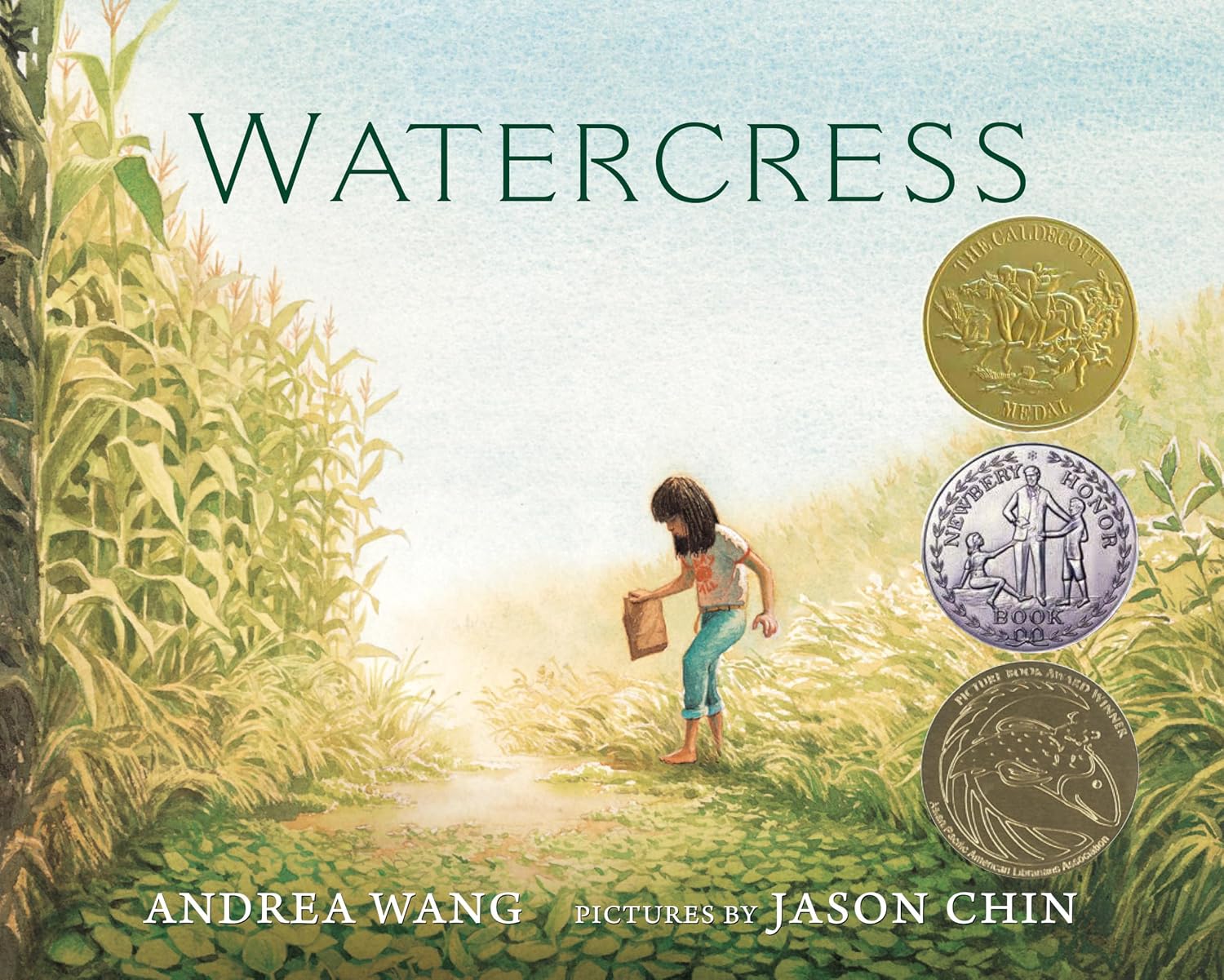
Watercress follows a young Chinese American girl who’s embarrassed when her family stops on an Ohio roadside to gather wild watercress growing in a muddy ditch, until her mother shares a painful memory that changes how she sees the meal in front of her. Andrea Wang and illustrator Jason Chin’s picture book won both the Caldecott Medal and a Newbery Honor, a rare double honor. This guide provides parents and teachers with reading level information, age recommendations, content insights, and discussion questions.
For Parents
Find the right reading level for your child, understand how the book handles a difficult family memory involving hunger and loss, and get tips for talking with your child about family history and heritage.
For Teachers
Access grade-level guidance and discussion questions for classroom use. This rare Caldecott Medal and Newbery Honor double winner offers a gentle, powerful entry point into conversations about immigrant family history and intergenerational memory.
Watercress at a Glance
Find on Amazon →| Author | Andrea Wang |
| Illustrator | Jason Chin |
| Published | 2021 |
| Grade Level | K–3 (our assessment) |
| Recommended Age | 5–9 |
| Best For | Read-aloud ages 5–8; independent reading ages 7–9 |
| Flesch-Kincaid Grade | ~2.5 |
| Word Count | ~600 |
| Pages | 32 (standard picture book) |
| Genre | Picture book / free verse |
| Setting | Rural Ohio, 1970s, with flashbacks to China |
| Awards | Caldecott Medal (2022), Newbery Honor (2022), APALA Award for Literature (2022) |
For official Lexile and AR levels, visit Lexile.com or AR BookFinder. ReadingVine provides independent editorial assessments.
What Reading Level Is Watercress?
Watercress is written in spare, poetic free verse, which keeps the vocabulary itself accessible for early readers. Our editorial Flesch-Kincaid estimate is around 2.5, typical for a picture book of this length.
Young children can often understand and connect with books read aloud to them well above what they could read independently, and that’s especially true here: the emotional content of Watercress, involving a parent’s difficult childhood memory, is more sophisticated than the reading level alone suggests. A child who can sound out every word may still need help processing what the story is really about.
For official Lexile and AR scores, visit Lexile.com and AR BookFinder.
Is Watercress a Read-Aloud or Independent Read?
This is primarily a read-aloud for ages 5–8, and an independent read for ages 7–9.
As a read-aloud, Watercress rewards a slow, thoughtful pace. Its free-verse text and Jason Chin’s detailed watercolor illustrations, which shift between the Ohio countryside and sepia-toned memories of China, both invite pausing to look closely and talk about what’s happening on each page.
For independent reading, a child needs to be comfortable with figurative, poetic language rather than straightforward narrative sentences, since the text moves associatively between the present and the mother’s memories.
Watercress includes a serious real event: the girl’s mother shares that her own younger brother died of starvation during a famine in China when she was a child. This isn’t described graphically, and the book’s illustrations carry much of this moment rather than the words, but it’s central to the story and worth knowing before you read it with a child. The book handles it with real gentleness, and it opens a natural door to talking with kids about family history, hardship, and gratitude.
What Is Watercress About?
Driving through the Ohio countryside in their old Pontiac, a young girl’s parents spot watercress growing wild in a muddy roadside ditch and immediately pull over, delighted at the free find. The girl is mortified: wading into the mud with rusty scissors and an old paper bag, worried that a passing car might carry someone from school who will see her family gathering “dinner from a ditch.”
That night, watercress served for dinner, the girl refuses to eat it, frustrated that her family can’t just buy vegetables from the grocery store like everyone else. Her mother, who rarely talks about her childhood in China, finally shares an old photograph and a story she’s never told before: growing up during a terrible famine, when there wasn’t enough food to go around, and losing her own younger brother to hunger.
Understanding at last why the watercress means so much to her parents, the girl tries it for the first time, finding it “delicate and slightly bitter, like Mom’s memories of home.” The book closes with the family beginning to build a new memory around the very meal that once embarrassed her, one now filled with understanding instead of shame.
Watercress Themes and Lessons
Watercress is fundamentally about the gap that can grow between immigrant parents and their children when painful memories go unshared. The girl’s embarrassment at the start of the book comes from not understanding her parents’ history; once her mother finally tells her, that same embarrassment transforms into empathy and connection.
The book also gently explores gratitude, showing how something a child initially sees as a source of shame, free food gathered from a ditch, can become a treasured family tradition once its deeper meaning is understood.
Discussion questions for families: Why do you think the girl’s mother never talked about her childhood in China before? How did the girl’s feelings about the watercress change after hearing her mother’s story? Is there a food or tradition in your own family that has a special story behind it?
How Long Is Watercress?
Watercress is 32 pages long, a standard length for a picture book, and approximately 600 words in total.
Most adults can read Watercress aloud in about 5 minutes, though its illustrations reward lingering over each page for longer. A child reading independently at a second- or third-grade level will finish it in about the same amount of time.
Books Similar to Watercress
About the Author and Illustrator
Andrea Wang is a Chinese American author whose own childhood memory of picking watercress with her family in rural Ohio inspired this book, which she has described as “both an apology and a love letter” to her parents. Watercress won the 2022 Caldecott Medal and a 2022 Newbery Honor, a rare double honor for a picture book. Illustrator Jason Chin, a Caldecott Honor recipient for his own book Grand Canyon, created Watercress’s watercolor artwork using a mix of Chinese and Western brush techniques to move between the story’s Ohio setting and its Chinese memories.
Watercress: Frequently Asked Questions
What reading level is Watercress?
Our editorial assessment places it at grade K–3, with an estimated Flesch-Kincaid grade of about 2.5. For official Lexile and AR levels, visit Lexile.com or AR BookFinder.
What grade is Watercress appropriate for?
We recommend it for grades K–3, or roughly ages 5–9, and it works well as a read-aloud for younger children with a parent present to help talk through its more serious content.
Can a kindergartner read Watercress alone?
A kindergartner can likely sound out the words, but the book’s emotional content, a family member’s death from hunger, is better suited to a read-aloud with an adult who can help provide context.
What is Watercress about?
It follows a young Chinese American girl who’s embarrassed when her family gathers wild watercress from a roadside ditch, until her mother shares a painful memory of a famine in China that changes how she understands her family’s history.
Does Watercress deal with difficult topics?
Yes. The girl’s mother reveals that her own younger brother died of starvation during a famine in China. It’s handled gently and isn’t described graphically, but it’s a real and central part of the story.
What awards has Watercress won?
Watercress won the 2022 Caldecott Medal, a 2022 Newbery Honor, and the 2022 Asian/Pacific American Award for Literature, a rare combination of honors for a single picture book.