
 = Partner Site
Wishtree Reading Level: A Complete Guide
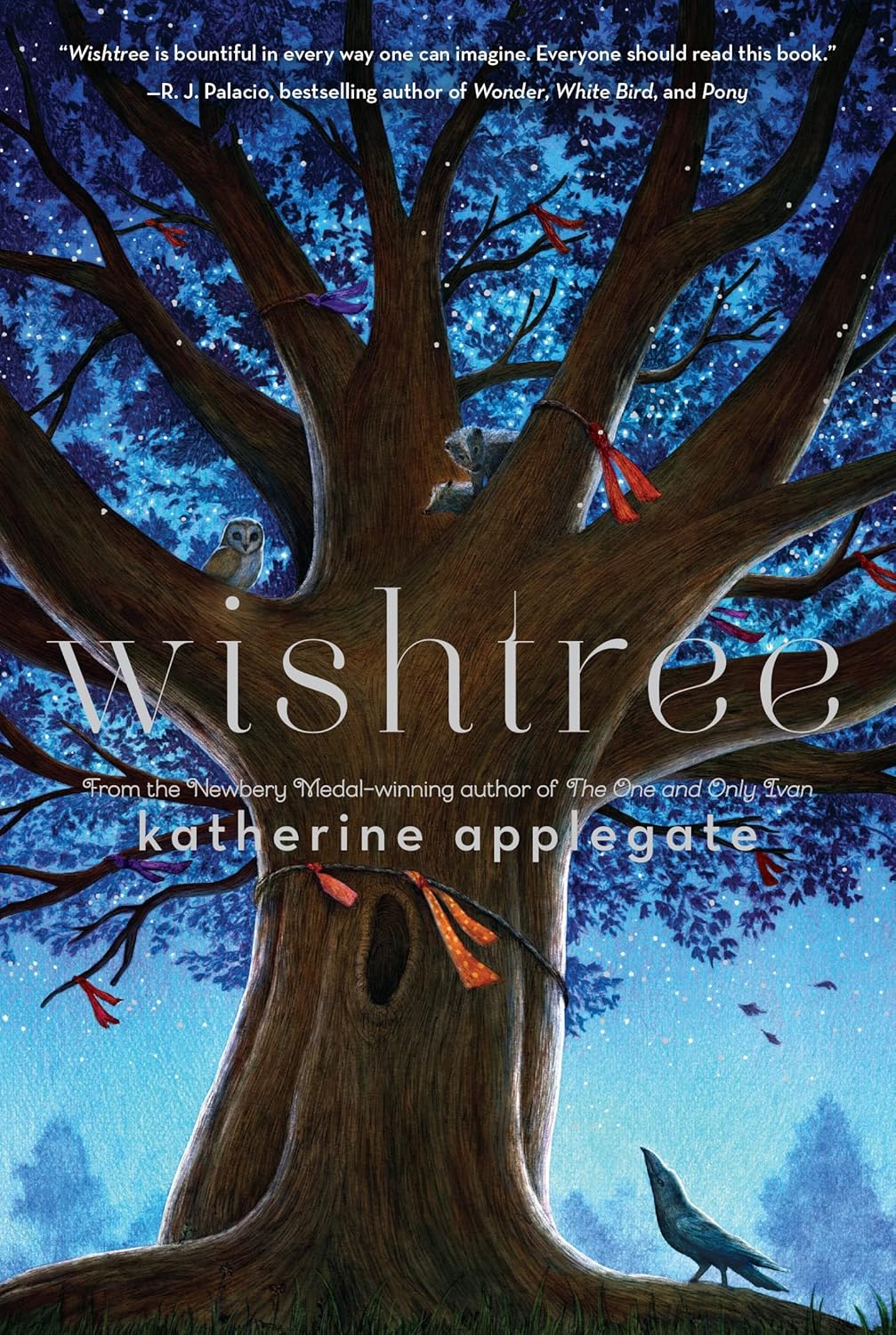
Wishtree by Katherine Applegate is a gentle, funny, and quietly wise novel narrated by a red oak tree named Red who has stood in a neighborhood for two hundred and sixteen years, hosting generations of wishes tied to her branches every May Day. When a Muslim family moves in next door and a hateful word is carved into Red’s bark, Red must find a way — with the help of a crow named Bongo and an unlikely gathering of animals and neighbors — to remind her street what it means to welcome someone new. From the author of The One and Only Ivan and Crenshaw, it is a novel about belonging, community, and the long view that only something as old as a tree can offer. This complete guide covers the reading level, age appropriateness, themes, characters, and everything parents and teachers need to know about this warm and important book.
For Parents
Wishtree is a novel about what it feels like to be new and unwelcome, told from the perspective of something old enough to have seen this before and wise enough to know it can change. Best suited for readers ages 8-12, it addresses anti-Muslim prejudice and the experience of being made to feel unwelcome in a neighborhood with honesty and without condescension. It is also funny and warm and full of animals with strong opinions, which is its way of being serious about something without being heavy about it. Parents who want their children to think about welcoming and belonging will find it one of the best possible starting points for that conversation.
For Teachers
A novel well suited to grades 3-5, Wishtree is an exceptional text for teaching nonhuman narration, the long view as a narrative device, and how authors address social issues through unexpected perspectives. Red’s two-hundred-year vantage point — she has seen generations of newcomers become neighbors — allows the novel to address contemporary prejudice with historical depth that a human child narrator could not provide. The novel opens rich discussions about community, belonging, immigration, and what it means to be a neighbor in the fullest sense.
Wishtree at a Glance
Find on Amazon →| Author | Katherine Applegate |
| Published | 2017 |
| Grade Level | 3-5 (our assessment) |
| Recommended Age | 8-12 |
| Flesch-Kincaid Grade | 4.3 |
| Word Count | ~22,000 |
| Pages | Approximately 200–215 depending on edition |
| Chapters | 61 |
| Genre | Realistic fiction / magical realism |
| Setting | A residential street in an unnamed American town, present day |
| Awards | ALA Notable Children’s Book (2018) |
For official Lexile and AR levels, visit Lexile.com or AR BookFinder. ReadingVine provides independent editorial assessments.
What Reading Level Is Wishtree?
Wishtree reads at approximately a 3rd-5th grade level by our editorial assessment, with a Flesch-Kincaid grade level of around 4.3. Applegate writes Red’s narration with the unhurried, observational quality of a being who has had two hundred and sixteen years to think about how sentences should go — the prose is gentle, precise, and occasionally very funny, with the dry warmth that characterizes all of Applegate’s best work. The vocabulary is accessible and the chapters are extremely short, making it one of the more approachable novels at this level for developing readers.
At approximately 22,000 words, Wishtree is one of the shorter novels in its target range — shorter than Crenshaw, shorter than most novels commonly assigned in grades 3-5. The brevity is intentional and is itself a craft choice: Applegate compresses a great deal of emotional and thematic substance into a very small space, in the way that a tree might — patiently, densely, with everything in the right place. The novel does not feel thin; it feels exact.
The book is most commonly recommended for grades 3-5. For official Lexile and Accelerated Reader scores, visit Lexile.com or AR BookFinder.
What Age Is Wishtree Appropriate For?
We recommend Wishtree for readers ages 8-12. The novel addresses anti-Muslim prejudice and the experience of being made to feel unwelcome, which are real and serious subjects handled with care and age-appropriate honesty. The content is not frightening, but it is real.
The novel’s precipitating event is a hateful word carved into Red’s bark — the word “LEAVE” directed at the new Muslim family next door. The carving is depicted matter-of-factly rather than dramatically, and Red’s response to it is equanimity rather than alarm, which models a response for young readers without minimizing the seriousness of the act. The new family, Samar and her parents, experiences the hostility of some neighbors and the uncertainty of not knowing whether they are welcome. This is handled with full emotional honesty. There is no violence, no strong language beyond the carved word, and no content beyond what is described. The novel’s treatment of prejudice is age-appropriate: honest about its existence, clear about its wrongness, and focused on what community members can do in response.
Wishtree has been used in classrooms and libraries following periods of increased anti-immigrant and anti-Muslim sentiment, and it is well suited for opening conversations about belonging and welcome with elementary-age students. Its nonhuman narrator gives children a perspective on these events that is both compassionate and slightly removed from the immediate social dynamics — the tree has seen this before and knows it can be different — which makes the difficult subject matter more approachable without softening it.
What Is Wishtree About?
Red is a red oak tree who has stood on the same street for two hundred and sixteen years. She has watched the neighborhood change around her — different families in different houses, different children climbing her branches, different wishes tied to her trunk every May Day. She cannot walk or speak, but she can observe, and she can tell her story to the animals who live in and around her, which is how we come to hear it.
The street’s May Day tradition is the wishtree: children write their wishes on scraps of cloth and tie them to Red’s branches at the start of May. Red has held thousands of wishes over the years — for ponies, for puppies, for someone to stop being mean, for mothers to get better. This year, a girl named Samar has moved in next door, and her wish is the one Red most wants to help come true: Samar wishes for a friend.
Samar’s family is Muslim and has moved from a different part of the country. Some neighbors are warm. Some are not. And then one morning the word LEAVE is carved into Red’s bark, directed at the family next door, and the street changes. Red cannot remove the carving. She cannot speak to the neighbors. What she can do is watch, and remember, and — with the help of Bongo the crow and the remarkable community of animals who have made their homes in her branches over the years — find a way to bring the street together before May Day arrives and Samar’s wish goes unanswered.
The novel’s resolution involves a gathering — of animals, of neighbors, of wishes — that is orchestrated by Red and Bongo with the gentle ingenuity of creatures who have been watching humans for a very long time and who understand, perhaps better than the humans do, what they actually need. It is not a resolution that pretends prejudice is easily fixed. It is a resolution that argues, quietly and with conviction, that community is built one small act of welcome at a time, and that trees have seen enough of history to know this is true.
Katherine Applegate has spoken about writing the novel in 2016 and 2017, a period of heightened national anxiety about immigration and belonging. She wanted to write a book that addressed these anxieties for young readers from a perspective that was compassionate, historically grounded, and — given that the narrator is a tree — constitutionally incapable of panic.
Wishtree Characters
Is Wishtree Banned?
Wishtree has not been widely banned, but it has appeared on challenge lists in some districts, typically in communities where its sympathetic portrayal of a Muslim family and its direct address of anti-Muslim prejudice have generated objections. These challenges have not been sustained, and the novel has been embraced by many educators, librarians, and parents as an important and age-appropriate book for discussing belonging and community with elementary-age students. The ALA Notable designation and its widespread classroom use reflect the educational community’s strong support for the novel and its subject matter.
Wishtree Themes and Lessons
The central theme of Wishtree is belonging — specifically, what a community owes to the people who are new to it, and what it looks like when a community either extends or withholds welcome. Red has watched generations of newcomers arrive on her street: Irish immigrants, Italian immigrants, Jewish families, and now a Muslim family. From her two-hundred-year vantage point, every family on the street is descended from someone who was once new, once uncertain, once in need of a welcome that might or might not come. The novel’s argument is that this history is visible if you are old enough to see it — and that understanding it makes the right response to a new neighbor obvious.
The long view is the novel’s second great theme and its structural foundation. Red’s narration does something no human narrator in a contemporary novel could do: it places the current moment in genuine historical context. She has seen prejudice before. She has seen newcomers made unwelcome before. And she has seen those same newcomers become the established neighbors who have forgotten they were ever new. This perspective is not sentimental — Red does not pretend that prejudice is easily overcome — but it is hopeful in the specific way that only deep time can be hopeful: because she has seen it before and she has seen it change.
Bystanders and action are the novel’s third great theme. The street’s neighbors see what has been carved into Red’s bark. Most of them do nothing. Francesca does something. The novel is careful not to make Francesca’s choice seem easy or automatic — she is uncertain, she is worried about what other people will think, she is a child navigating adult social dynamics. What she eventually does is small and specific and entirely within her power, which is precisely the novel’s point: community is built from small, specific acts that are entirely within ordinary people’s power.
Discussion starters for classrooms: Why does Red have a long view that the human characters don’t? What does Samar’s wish tell us about what she needs most? What stops Francesca from acting sooner, and what finally moves her to act? What does the novel suggest a good neighbor does? What does Red mean when she says she has seen this before? Who carved the word into Red’s bark, and does the novel tell us?
How Many Pages and Chapters Are in Wishtree?
Wishtree runs approximately 200–215 pages depending on edition, divided into 61 very short chapters averaging around three to four pages each. The word count is approximately 22,000 words, making it one of the shorter novels commonly assigned in grades 3-5. The chapters are brief enough that the novel can be read in a single long afternoon or taught across a week at a comfortable pace. The white space on each page — a design feature that reflects the novel’s quiet, deliberate voice — means the page count reads longer than the word count suggests.
For readers in the target age range of 8-12, expect a reading time of roughly 2-3 hours, making Wishtree one of the more accessible length commitments at this grade level. It is an ideal classroom read-aloud: the chapters are short enough to complete in a single sitting, Red’s voice rewards being read aloud, and Bongo’s comic interjections land particularly well with a group. Many teachers read the entire novel over five days at about twelve chapters per session, leaving substantial time for discussion. It is also widely used as a first independent novel for students transitioning out of early chapter books.
Books Similar to Wishtree
About Katherine Applegate
Katherine Applegate is one of the most celebrated American authors of middle grade fiction, winner of the Newbery Medal in 2013 for The One and Only Ivan. Wishtree, published in 2017, was written during a period of heightened national conversation about immigration and belonging, and Applegate has spoken about wanting to address those anxieties for young readers from a perspective — a tree’s — that was both compassionate and constitutionally unhurried. Her other novels include Crenshaw (2015), Endling: The Last (2018), and The One and Only Bob (2020). Before writing literary middle grade fiction she spent years writing genre series fiction, and the craft she developed writing quickly and accessibly for young readers is visible throughout her solo work: she is extraordinarily good at short chapters, emotional precision, and finding the nonhuman vantage point that allows her to address the most difficult human subjects without losing warmth. She lives in California with her husband, the author Michael Grant. Wishtree was illustrated by Charles Santoso, whose quiet, intricate drawings of Red and her animal community extend the novel’s world with the same gentle specificity that characterizes Applegate’s prose.
Wishtree: Frequently Asked Questions
What reading level is Wishtree?
Wishtree has a Flesch-Kincaid grade level of approximately 4.3. Our editorial assessment places it at grades 3-5 (ages 8-12). At approximately 22,000 words it is one of the shorter novels at this level, and the sixty-one very short chapters make it highly approachable for developing readers. The emotional and thematic content — prejudice, belonging, community — is handled with age-appropriate honesty. For official Lexile and AR scores, visit Lexile.com or AR BookFinder.
Why is the narrator a tree?
Because a two-hundred-and-sixteen-year-old tree has seen what a ten-year-old child — or a fifty-year-old adult — cannot see: the full sweep of a neighborhood’s history, the generations of newcomers who became neighbors who became the established families who forgot they were ever new. Red’s longevity is not a whimsical narrative choice; it is a structural argument. The novel is saying that the long view changes how you understand the present moment — that prejudice looks different, and the capacity for welcome looks more reliable, when you have two centuries of evidence. No human narrator could provide that evidence. The tree can.
Who carved the word into the tree?
The novel indicates that the carving was done by a boy, though it does not name him or make his identification the story’s focus. This is a deliberate choice: Applegate is not writing a mystery or a story about catching a perpetrator. She is writing a story about a community’s response to an act of hostility, and the question of who committed it matters less than what the people who witness it choose to do next. The act is taken seriously throughout — it is not minimized — but the novel keeps its attention on the neighborhood’s response rather than the individual responsible, reflecting something true about how such acts work in communities: the more important question is always what everyone else decides to do.
What is the wishtree tradition?
On May Day, the children of the neighborhood tie written wishes to Red’s branches on scraps of cloth. Red has held thousands of wishes over two centuries — wishes for animals, for health, for friendships, for things children want and things they need. The tradition is loosely based on real clootie trees, or cloutie trees — trees in Celtic folk tradition (particularly in Scotland and Ireland) where strips of cloth are tied to branches as offerings or petitions, often near healing springs. Applegate has acknowledged this inspiration. In the novel the tradition becomes a way of measuring what a community hopes for, and Samar’s wish — for a friend — is the one that focuses the whole novel’s energy.
What is the novel’s message about prejudice?
The novel does not deliver its message about prejudice as a lesson or a speech. It delivers it as a history: Red has seen every wave of newcomers to her street, and every wave has faced some version of what Samar’s family faces, and every wave has eventually become part of the neighborhood’s fabric. The message is not that prejudice is trivial or easily overcome — the carving in Red’s bark is taken seriously throughout — but that it is neither new nor permanent, and that communities have always contained people willing to do the small, specific things that make welcome possible. The novel trusts children to draw their own conclusions from that history.
What grade is Wishtree typically assigned in?
Wishtree is most commonly used in grades 3, 4, and 5, both as a classroom read-aloud and as independent reading. It is particularly well suited to units on community, belonging, and social-emotional learning, and to classroom discussions about immigration, identity, and what it means to be a good neighbor. It has been used in classrooms as a response text following news events involving anti-immigrant or anti-Muslim sentiment, and teachers often find it a useful starting point for opening these conversations with elementary-age students in a way that is honest, age-appropriate, and ultimately hopeful.
How does Wishtree compare to Crenshaw?
Both are short, accessible Katherine Applegate novels with nonhuman elements at their center and a serious social concern beneath their warmth. Crenshaw is slightly longer and its subject — childhood poverty and housing insecurity — is more personal and more interior, centered on one family’s private struggle. Wishtree is more communal: its subject is an entire neighborhood, its narrator is a tree who belongs to everyone, and its concern is with what communities owe each other rather than what families survive alone. Both use humor as a vehicle for seriousness. Both refuse easy resolution. Crenshaw is the right book for a child asking what it feels like to not have enough; Wishtree is the right book for a child asking what it feels like to not be welcome. They are natural companions.