
 = Partner Site
Crenshaw Reading Level: A Complete Guide
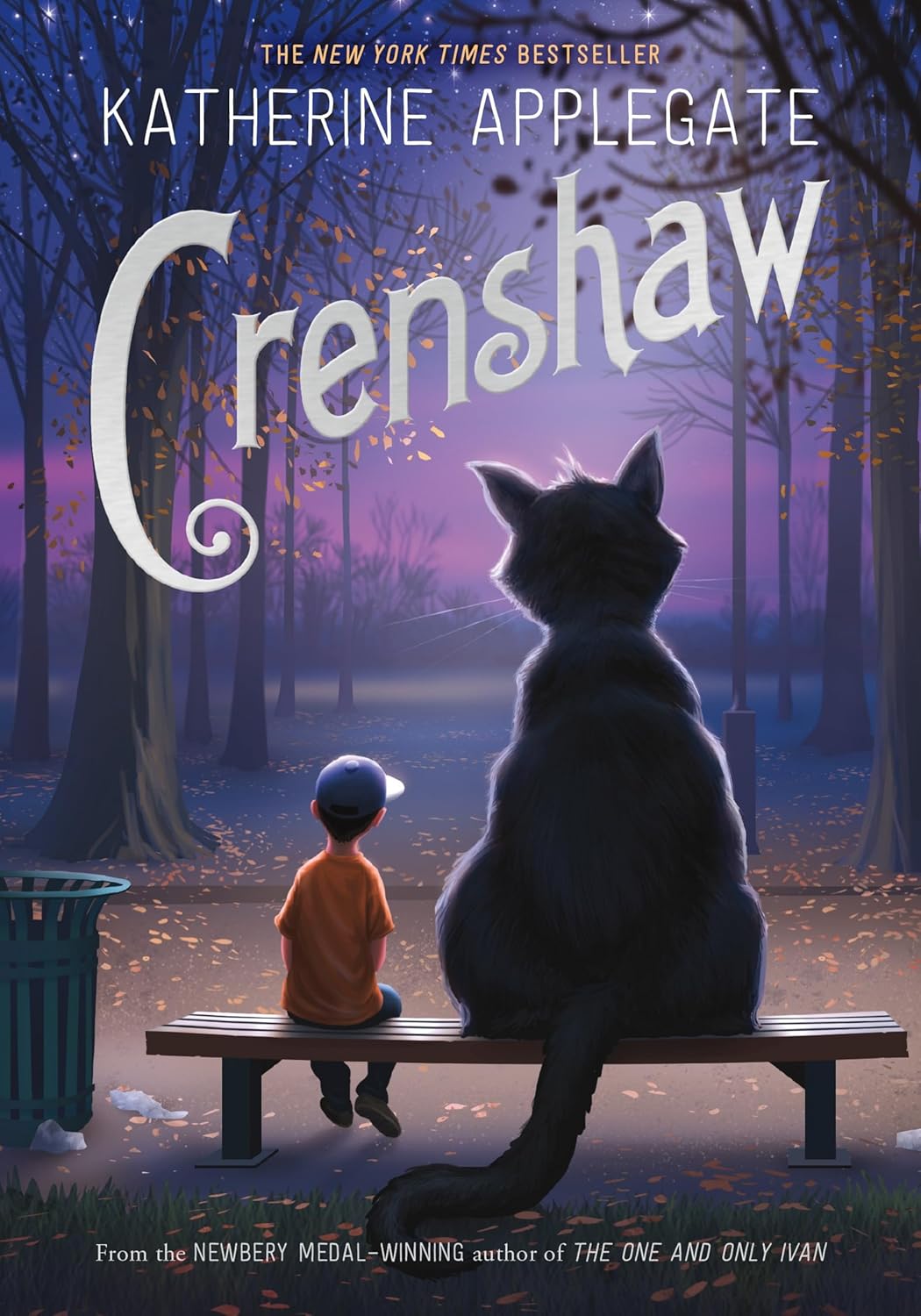
Crenshaw by Katherine Applegate is a warm, funny, and quietly heartbreaking novel about a fifth grader named Jackson who is facing homelessness for the second time in his life — and who has been visited, again, by a large imaginary cat named Crenshaw who shows up when Jackson needs him most and absolutely refuses to be ignored. From the author of the Newbery Medal-winning The One and Only Ivan, it is a novel about the lies children tell themselves to survive hard truths, about the specific pride of families who are struggling and do not want to be seen struggling, and about what imagination actually does for children when the real world becomes too much. This complete guide covers the reading level, age appropriateness, themes, characters, and everything parents and teachers need to know about this important and tender book.
For Parents
Crenshaw is one of the few middle grade novels to address childhood poverty and housing insecurity with full honesty and without sensationalism. Best suited for readers ages 8-11, it deals with food insecurity, living in a van, and the specific shame and confusion of a child who does not have enough and who has been asked, implicitly, not to talk about it. It is also funny and warm and full of a large imaginary cat who surfs and eats jelly doughnuts, which is its way of being honest about something very hard without being crushing. Parents who give their children this book are giving them language for something that is real in many children’s lives and almost never named in the books they read.
For Teachers
A widely taught novel well suited to grades 3-5, Crenshaw is an exceptional text for teaching the function of imagination in coping with difficulty, the difference between what characters say and what they feel, and how authors handle serious social issues through a child’s perspective without losing the child’s voice. The imaginary friend structure opens rich discussions about what it means to need something you know isn’t real, and about the specific pride and silence that surround poverty in American family life. The novel pairs naturally with units on community helpers, economic inequality, and social-emotional learning.
Crenshaw at a Glance
Find on Amazon →| Author | Katherine Applegate |
| Published | 2015 |
| Grade Level | 3-5 (our assessment) |
| Recommended Age | 8-11 |
| Flesch-Kincaid Grade | 4.1 |
| Word Count | ~40,000 |
| Pages | 245 (standard hardcover) |
| Chapters | 62 |
| Genre | Realistic fiction / magical realism |
| Setting | A California suburb, present day |
| Awards | ALA Notable Children’s Book (2016) |
For official Lexile and AR levels, visit Lexile.com or AR BookFinder. ReadingVine provides independent editorial assessments.
What Reading Level Is Crenshaw?
Crenshaw reads at approximately a 3rd-5th grade level by our editorial assessment, with a Flesch-Kincaid grade level of around 4.1. Applegate writes in Jackson’s voice with the directness and economy that characterize her best work — short sentences, clear observations, the occasional dry joke. The prose is highly accessible, and the sixty-two short chapters (most run three to five pages) give the novel a momentum that carries even reluctant readers forward.
What makes the novel more demanding than its word-level score might suggest is its emotional register. Jackson is a child carrying adult-sized worries — about his family’s finances, about where they will live, about whether his father’s illness is serious — and processing them with a child’s partial understanding. The gap between what Jackson knows and what he is trying not to know, between what Crenshaw represents and what Jackson will allow himself to admit Crenshaw represents, is where the novel’s deepest work happens. Readers who pick up on this gap will find the novel emotionally resonant well beyond its reading level; readers who take the story at face value will find it a warm and funny book about a boy and his imaginary cat.
The book is most commonly recommended for grades 3-5 and works especially well as a classroom or family read-aloud. For official Lexile and Accelerated Reader scores, visit Lexile.com or AR BookFinder.
What Age Is Crenshaw Appropriate For?
We recommend Crenshaw for readers ages 8-11. The novel deals with poverty, food insecurity, and the experience of living in a car, all of which are handled with honesty and care. The content is not graphic or frightening, but it is real, and parents should be prepared for children who have questions about homelessness and economic hardship after reading it.
Jackson’s family has previously lived in their van for a period, and the novel makes clear that this situation may be returning. His father has a chronic illness (described as multiple sclerosis) that affects the family’s financial stability. The family experiences food insecurity — there are scenes in which Jackson is hungry and the refrigerator is nearly empty. None of this is depicted with graphic distress; Applegate handles it with the matter-of-fact acceptance of a child who has normalized difficult circumstances. Crenshaw himself is funny and warm and actively comic throughout, which keeps the novel from ever feeling crushing. There is no violence, no strong language, and no sexual content. The novel’s difficulty is entirely economic and emotional, which is precisely what makes it valuable and what makes it unusual in the middle grade canon.
For children who have experienced financial hardship or housing instability, the novel offers something rare: a story in which a child like them is the protagonist, whose experience is treated as real and serious and worth a book. For children who have not had this experience, it offers honest, humanizing, non-condescending access to a reality that is part of many of their classmates’ lives. Both are important gifts.
What Is Crenshaw About?
Jackson is in fifth grade, and his family is in trouble again. His father has multiple sclerosis and cannot always work. His mother works hard but it is not always enough. Once before — Jackson was in first grade — the family ran out of money entirely and lived in their van, selling their possessions at a roadside stand and eating free samples at Costco. Jackson remembers this. He remembers it in the specific, helpless way that children remember the things they were not supposed to see but saw anyway.
Now the signs are familiar again: the mostly-empty refrigerator, the hushed conversations that stop when Jackson enters the room, the specific quality of his parents’ cheerfulness when things are not cheerful. Jackson is a facts kid — he believes in science and data and the concrete, observable world — and the fact that his family may be losing their apartment is one he can see clearly even as everyone around him is trying to make it invisible.
And then Crenshaw shows up. Crenshaw is a very large black-and-white cat, six feet tall at least, who walks on his hind legs and surfs and has opinions about jelly doughnuts. He is imaginary. Jackson knows he is imaginary. Jackson had him before, in first grade, and made him go away when things got better, because imaginary cats are not consistent with Jackson’s worldview. But Crenshaw is back, sitting on Jackson’s dresser and demanding to be acknowledged, and Jackson cannot quite make himself send him away again.
The novel follows the weeks leading up to what Jackson increasingly understands will be a second period of homelessness — the process of selling possessions, having difficult conversations, and watching his parents try to protect him from something he already knows. Crenshaw is present throughout: funny, absurd, occasionally wise in the sideways manner of creatures who exist outside the ordinary rules, and refusing to explain himself or his purpose. What Crenshaw is for — what imagination is for, in the specific circumstances of a child who needs something the real world cannot provide — is the question the novel builds toward and answers, quietly and completely, at its end.
Katherine Applegate has spoken about drawing on her own family’s experience of financial hardship when she was a child — periods of real precarity that were handled by the adults around her with the same silence and protective cheerfulness that Jackson’s parents employ. She wanted to write a book that named this experience for children who were living it and that did not pretend it did not exist.
Crenshaw Characters
Is Crenshaw Banned?
Crenshaw has not been banned or challenged and does not appear on lists of frequently challenged books. It is widely embraced by educators, librarians, and parents as an important and compassionate novel that addresses a real aspect of many children’s lives with honesty and care. Its frank treatment of childhood poverty — unusual in the middle grade canon — has been cited as one of its greatest contributions rather than a source of concern. Katherine Applegate’s other work, including The One and Only Ivan, has similarly received strong institutional support despite — and because of — its willingness to address difficult subjects directly.
Crenshaw Themes and Lessons
The central theme of Crenshaw is what imagination is actually for — not escapism, not fantasy, but the specific work that imagination does for children in circumstances that exceed what they can process directly. Jackson is a facts kid who distrusts imagination on principle, and Crenshaw’s arrival forces him to confront the limits of that principle: that there are things facts cannot help with, things that require a different kind of knowing. Crenshaw is not a denial of Jackson’s situation; he is a way of being present to it that does not destroy him. The novel’s argument is that imagination, properly understood, is not the opposite of truth but one of its instruments.
The novel is also one of the rare middle grade books to address childhood poverty with full honesty — without condescension, without resolution that is too easy, and without the implicit suggestion that poverty is a problem characters have because of personal failing. Jackson’s family is struggling because of circumstances that are real and complicated: illness, unstable employment, the specific economics of American family life when one earner becomes unreliable. The novel does not offer solutions, which is part of its honesty. It offers witness — the specific, humanizing act of naming an experience that most children’s books pretend does not exist.
Pride and shame are the novel’s third great theme: the specific pride of Jackson’s parents, who do not want to be seen in their difficulty, and the specific shame of Jackson, who has internalized their silence and does not tell even Marisol the truth about what is happening at home. The cost of that silence — what it takes from Jackson to carry it alone — is one of the novel’s most honest portraits of what poverty does to children beyond the material facts.
Discussion starters for classrooms: Why does Jackson distrust imagination? What does Crenshaw do for Jackson that Jackson can’t do for himself? Why do Jackson’s parents try to keep the family’s situation secret from him? What is the difference between a lie and a kindness in this novel? What does Marisol’s friendship give Jackson that Crenshaw can’t?
How Many Pages and Chapters Are in Crenshaw?
The standard hardcover edition of Crenshaw is 245 pages, divided into 62 very short chapters averaging around four pages each. The word count is approximately 40,000 words. The short chapters — many of which end with a small revelation, a comic beat, or a quiet emotional note — give the novel a pace that makes it nearly impossible to stop at a convenient place. Each chapter is complete enough to provide a sense of satisfaction and open-ended enough to require the next one.
For readers in the target age range of 8-11, expect a reading time of roughly 3-5 hours, or about a week of comfortable reading at 20-30 minutes per session. It is an ideal classroom read-aloud book — the short chapters are perfectly sized for a single reading session, Crenshaw’s appearances are consistently funny aloud, and the novel’s emotional beats land particularly well when shared. Many teachers complete it in two weeks at three chapters per day, leaving substantial time for discussion. It is also a natural choice for the family read-aloud shelf, particularly for families with children who are independent readers approaching this age range but not yet there.
Books Similar to Crenshaw
About Katherine Applegate
Katherine Applegate is one of the most celebrated and prolific American authors of middle grade fiction, best known for The One and Only Ivan, which won the Newbery Medal in 2013. Before writing literary middle grade fiction she spent years writing genre series fiction under pen names, and the craft she developed writing quickly and accessibly for young readers is visible throughout her solo work: she is extraordinarily good at short chapters, propulsive pacing, and the kind of sentence that does three things at once. Crenshaw, published in 2015, drew on her own childhood experience of financial hardship — periods of real precarity that her family navigated with the same protective silence Jackson’s parents employ. Her other notable solo novels include Wishtree (2017), Endling: The Last (2018), and The One and Only Bob (2020), a sequel to The One and Only Ivan. She lives in California with her husband, the author Michael Grant.
Crenshaw: Frequently Asked Questions
What reading level is Crenshaw?
Crenshaw has a Flesch-Kincaid grade level of approximately 4.1. Our editorial assessment places it at grades 3-5 (ages 8-11). The prose is highly accessible and the sixty-two short chapters give it strong forward momentum, but the emotional register — a child carrying adult-sized worries with a child’s partial understanding — is more demanding than the word-level score suggests. For official Lexile and AR scores, visit Lexile.com or AR BookFinder.
Is Crenshaw real or imaginary?
Crenshaw is explicitly imaginary — Jackson knows this, the novel knows this, and the reader is never invited to doubt it. Crenshaw is an imaginary friend who returns when Jackson needs him, which is not the same as being a ghost or a magical creature. The novel’s interest is not in whether Crenshaw is real but in what he is for: what imagination does for a child in circumstances that exceed what he can process directly, and why a facts kid who distrusts imagination might need one anyway.
Does the family end up homeless in Crenshaw?
The novel builds toward the possibility of a second period of homelessness with accumulating honesty — the sold possessions, the difficult conversations, the familiar signs. The ending does not resolve the family’s financial situation with a sudden rescue or an implausible windfall. What it resolves is Jackson’s relationship with what is happening: his ability to stop carrying it alone, to tell Marisol the truth, and to accept that Crenshaw — imagination, the part of himself that needs more than facts — is not something to be ashamed of. The novel is honest that hard circumstances do not always resolve cleanly, and that what children can be given in those circumstances is presence rather than solution.
Why does Crenshaw eat jelly doughnuts?
Because Jackson’s family can’t afford them, and hasn’t been able to for a while, and Crenshaw shows up covered in powdered sugar and licking his paws with complete satisfaction. This is the novel’s most quietly devastating comic detail: Crenshaw embodies the specific pleasures that are currently out of Jackson’s reach, not to torment him but because he exists in the register of imagination rather than scarcity. He is what abundance looks like when you cannot have it. He is also, in the way of all good comic details, simply very funny — a six-foot cat with jelly doughnut residue is hard to argue with.
What is Jackson’s father’s illness?
Jackson’s father has multiple sclerosis, a chronic neurological condition that affects mobility and stamina in ways that are variable and unpredictable. The novel depicts this with accuracy: there are periods when Jackson’s father functions well and periods when he cannot work, and the family’s financial precarity is directly tied to the unpredictability of his illness. The novel does not explain multiple sclerosis in detail — it presents Jackson’s partial understanding of his father’s condition — but it is named clearly enough that teachers and parents who want to discuss it further with children have the information they need.
What grade is Crenshaw typically assigned in?
Crenshaw is most commonly used in grades 3, 4, and 5, both as a classroom read-aloud and as independent reading. It is particularly well suited to units on social-emotional learning, empathy, and community, and to classroom discussions about economic inequality and what it means to be a good friend to someone who is struggling. Many teachers use it in conjunction with nonfiction resources about homelessness and housing insecurity to provide context. It is also widely used as a bridge book for readers moving from early chapter books to longer middle grade fiction.
How does Crenshaw compare to The One and Only Ivan?
Both novels are short, accessible, emotionally serious, and told in a distinctive first-person voice — and both use an animal presence (Ivan the gorilla, Crenshaw the imaginary cat) as the emotional and moral center of the story. The One and Only Ivan is told from the animal’s perspective, which gives it a particular quality of innocence and observation. Crenshaw is told from Jackson’s perspective, with the animal as companion rather than narrator. Ivan addresses captivity and freedom; Crenshaw addresses poverty and imagination. Both are characteristic Applegate: short chapters, precise warmth, a willingness to take hard subjects seriously without losing tenderness. Readers who love one will almost certainly love the other, and they pair naturally as a two-book Applegate unit.