
 = Partner Site
Among the Hidden Reading Level: A Complete Guide
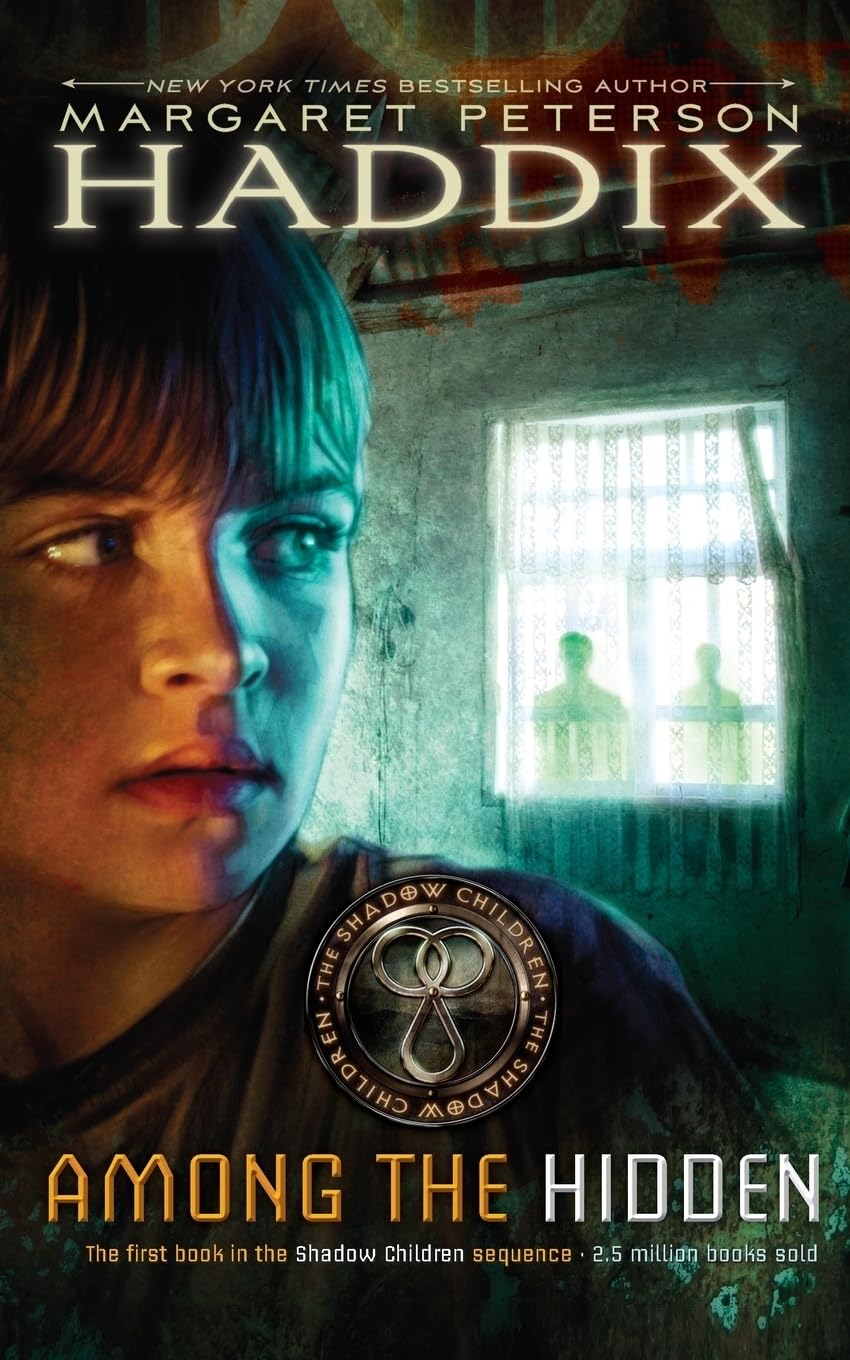
This complete guide to Among the Hidden by Margaret Peterson Haddix covers everything parents, teachers, and students need to know — from reading level and age appropriateness to characters, themes, and similar books. Published in 1998, Among the Hidden is the first book in Haddix’s seven-book Shadow Children series and one of the most widely taught dystopian novels in American middle schools. Set in a bleak near-future where overpopulation and famine have prompted a totalitarian government to restrict families to two children, the novel follows twelve-year-old Luke Garner — an illegal third child who has spent his entire life hidden from the world. When a new housing development destroys the woods that sheltered his family’s farm, Luke is confined to his attic, watching through a vent — until the day he spots movement in a neighbor’s window and realizes he may not be as alone as he thought. Compact, tense, and emotionally devastating in its final chapters, it was recognized as one of the ten most taught texts in American middle schools in 2013 and remains a gateway novel for an entire generation of dystopian fiction readers.
For Parents
Among the Hidden is a short, fast-paced dystopian novel with genuine emotional depth — and a significant emotional punch in its final act. The content is relatively clean: no language, no sexual content, no graphic violence. The primary consideration for parents is the death of a major character, which occurs offstage and is not described graphically but lands hard emotionally, particularly for readers who have become attached to that character. The novel also depicts a government that hunts and kills children for the crime of existing, which is conceptually disturbing even when not shown in detail. Parents of sensitive or younger readers should be prepared to discuss the ending. For most readers in the 9–13 range, these elements are appropriate and will spark meaningful conversation rather than distress. The novel’s themes of government control, individual rights, and what it means to exist as a person the state doesn’t recognize are weighty but handled with restraint and honesty.
For Teachers
Among the Hidden is one of the most reliably effective entry points into dystopian fiction for middle-grade readers, and it has been a classroom staple for that purpose since the late 1990s. Its brevity (153 pages, 30 short chapters) makes it unusually manageable for a novel study, and its political content — government control of reproduction, class inequality, propaganda, the ethics of civil disobedience — generates rich discussion at every level from grade 4 through grade 8. It pairs naturally with social studies units on government, population policy, and human rights, as well as with other dystopian texts like The Giver and The Hunger Games for cross-text comparison. The novel’s inspiration in China’s one-child policy (which Haddix has discussed openly) makes it an accessible bridge between fiction and contemporary global issues. Common classroom grades are 5–7, with many teachers using it as the first dystopian novel in a progression toward more complex texts.
Among the Hidden at a Glance
Find on Amazon →| Author | Margaret Peterson Haddix |
| Published | 1998 |
| Grade Level | 4–6 (our assessment) |
| Recommended Age | 9–13 |
| Flesch-Kincaid Grade | 4.8 |
| Word Count | ~32,000 |
| Pages | 153 (hardcover) / 160 (paperback) |
| Chapters | 30 (very short chapters, avg. 5–6 pages) |
| Genre | Dystopian fiction / Middle-grade / Science fiction |
| Setting | A near-future totalitarian society (unnamed country) |
| Series | Shadow Children, Book 1 of 7 |
| Awards | ALA recognized title; widely taught in US middle schools (2013) |
For official Lexile and AR levels, visit Lexile.com or AR BookFinder. ReadingVine provides independent editorial assessments.
What Reading Level Is Among the Hidden?
Among the Hidden has a Lexile score of 800L and an ATOS level of 4.8, worth 5 AR points. Our Flesch-Kincaid calculation aligns closely with the ATOS at approximately 4.8. These metrics place the reading level firmly in the 4th–5th grade range — notably accessible for a novel that tackles dystopian political themes typically associated with higher grade levels. Haddix writes in clean, direct prose with short sentences and very short chapters, and the narrative voice stays close to Luke’s twelve-year-old perspective throughout. There are no passages that will challenge a motivated 4th-grade reader at the word level.
The important nuance here — and it matters more for this book than most — is the gap between the reading level metrics and the emotional weight of the content. At ATOS 4.8, the prose is accessible to readers as young as grade 4. But the novel ends with the death of a beloved character and asks readers to sit with real grief and moral complexity. The themes of a government that kills children for the crime of existing, and the question of how much risk is worth taking in the name of freedom, are ideas that emotionally younger readers may find heavier than they expected. Our recommendation for independent reading is grades 4–6, but with an honest flag to parents about the ending. For teacher read-alouds or guided classroom reading, it works beautifully from grade 4 up. For official Lexile and AR scores, visit Lexile.com or AR BookFinder.
What Age Is Among the Hidden Appropriate For?
We recommend Among the Hidden for readers ages 9–13. Common Sense Media rates it for ages 10 and up, flagging the death of a major character as the primary content consideration. The publisher lists interest level as grades 5–8. For most readers in the 9–13 range, this is an ideal entry into serious dystopian fiction — short enough to be approachable, emotionally honest enough to be meaningful.
The primary content consideration is the death of a significant child character near the end of the novel. It occurs offstage — Luke does not witness it directly — and is not described graphically, but it is confirmed clearly and the grief it generates is real and not fully resolved before the book closes. Readers who have become attached to this character (and most will) will feel it deeply. Parents of emotionally sensitive readers or younger readers in the 8–9 age range should be aware this is coming and be prepared to discuss it. Beyond this, the content is notably restrained: there is no profanity, no sexual content, and no graphic violence. The government’s Population Police are conceptually menacing — they exist to find and punish third children, with the implied consequence of imprisonment or death — but their actions are kept largely offstage in this first book. The novel also depicts economic inequality and food scarcity with quiet intensity, including a farm family that cannot always have enough to eat. Nothing here is gratuitous; the darkness is entirely in service of the story’s moral seriousness.
Among the Hidden is deliberately designed as the first book in a seven-book series, and the ending is an opening rather than a resolution. Readers who are upset by open endings, or who will find the death of a beloved character difficult to process without immediate continuation, should know that the series continues and that Luke’s story goes on. Many teachers who assign the book have the class move into Among the Impostors for exactly this reason.
What Is Among the Hidden About?
Luke Garner is twelve years old and has never been to school. He has never had a birthday party or a friend. He has never done any of the things that define a normal childhood — because Luke is not supposed to exist. In a future where overpopulation and food scarcity have driven the government to mandate a strict two-child policy, Luke is a third child: illegal, hidden, and kept from the world since the day he was born. For most of his life, the woods surrounding his family’s farm provided enough cover that he could at least go outside. Then the government clears the woods to build a housing development for the wealthy, and Luke is confined to the attic of the farmhouse, watching the world through a small vent. His only company is the radio — and the knowledge that if anyone outside his family discovers he exists, the consequences will be severe.
Then, one afternoon, Luke spots something impossible through the vent: movement in the window of a neighbor’s house. The family has two sons — both legally visible, both outside — so whoever is in that window is not supposed to be there either. Compelled by a desperate loneliness he has never been able to name, Luke does something he has never done before: he sneaks out of his house in daylight and breaks into the empty home next door. What he finds there is Jen Talbot — a third child like him, bold, outspoken, and furious at a world that has decided she has no right to exist. Where Luke has learned to survive by hiding, Jen has built an entire underground network of shadow children and is planning something that terrifies him: a rally at the president’s home, where hundreds of illegal children will march out of hiding and demand recognition.
The friendship between Luke and Jen is the emotional center of the novel — two children shaped by the same oppression into radically different responses to it. Luke’s journey is about courage: whether a person who has been taught his whole life that survival requires invisibility can learn to imagine a different kind of life. The novel ends with a choice Luke makes that will define who he becomes, and with a loss that the reader will carry into the next book and beyond.
Among the Hidden Characters
Is Among the Hidden Banned?
Among the Hidden does not have a documented history of significant formal challenges or library removals, and it does not appear on the ALA’s frequently challenged books lists. This is somewhat notable given its subject matter: a government that mandates family size and enforces that mandate lethally is a premise that could theoretically draw challenges from multiple directions. In practice, the novel has become a durable classroom staple — one of the ten most taught texts in American middle schools as recently as 2013 — without generating organized opposition. Its restrained handling of violence, its absence of language and sexual content, and its clear moral framework (the government is unambiguously wrong; the children’s desire to exist is unambiguously right) have likely helped it avoid controversy. Teachers and librarians may occasionally receive questions about the ending from parents of sensitive readers, but these are individual conversations rather than formal challenges.
Among the Hidden Themes and Lessons
The novel’s central question — what does it mean to exist as a person the state does not recognize? — is both philosophical and viscerally personal in Haddix’s treatment. Luke has never had a name outside his family’s walls. He has no legal identity, no rights, no recourse. The government’s claim that the Population Law is necessary for everyone’s survival is a utilitarian argument that requires someone to be sacrificed for the collective good — and Haddix asks her readers to consider what it feels like to be the one designated for sacrifice. The contrast between Luke’s life on the poor farm and Jen’s life in the wealthy suburb is equally important: the Population Law does not apply equally. Jen, raised by a government official with money and connections, has a computer and books and the cognitive framework to understand her own oppression. Luke, raised in poverty and isolation, must build that framework almost from scratch through his friendship with her.
The novel also opens a genuine debate about tactics — between Jen’s belief that visibility and direct action are the only path to recognition, and Luke’s learned conviction that survival requires invisibility. Both positions are presented seriously. Jen is not naive; she has thought harder about this than almost anyone. Luke is not cowardly; he is realistic about risk in ways that Jen, protected by her father’s position, has not had to be. Who is right? The novel does not resolve this cleanly, which is one of the reasons it generates such productive classroom discussion. Discussion questions worth exploring: Is it ever right for a government to decide how many children a family may have? What is the difference between a law that is unjust and a law that is merely inconvenient? What does Luke lose by staying hidden, and what does Jen risk by coming out?
How Many Pages and Chapters in Among the Hidden?
Among the Hidden is 153 pages in the original hardcover and 160 pages in the standard paperback — one of the shorter novels in the middle-grade dystopian genre. Its 30 chapters are very brief, averaging just 5–6 pages each, with some running only 2–3 pages. This structural choice is intentional: the short, episodic chapters mirror Luke’s constrained perspective and the way his world is divided into small, survivable segments of hiding and waiting. It also makes the book unusually readable for reluctant readers — each chapter ends quickly, creating constant momentum. At approximately 32,000 words, a motivated reader in the target age range can finish it in two to three hours.
In a classroom setting, the book typically runs one to two weeks as a novel study. Its brevity is a genuine teaching asset: it leaves plenty of time for discussion, writing, and pairing with nonfiction materials on government, population, and human rights. Teachers frequently pair the novel with research on China’s one-child policy, the history of population control legislation globally, and case studies of totalitarian government practices — all of which the book handles with enough accuracy to serve as an accessible fictional introduction to real-world parallels.
Books Similar to Among the Hidden
About Margaret Peterson Haddix
Margaret Peterson Haddix was born on April 9, 1964, in Washington Court House, Ohio, and grew up on a farm nearby — the second of four children in a family of readers. She has said that her father was particularly fond of telling stories, and that she knew from early childhood that she wanted to write them down. She graduated from Miami University of Ohio with degrees in English, journalism, and creative writing, then worked as a newspaper copy editor in Fort Wayne, Indiana, and as a reporter at The Indianapolis News, before teaching writing at a community college. Her debut novel, Running Out of Time (1995), established the template she would refine throughout her career: young protagonists, dangerous secrets, and a world that looks familiar until it doesn’t. Among the Hidden, published in 1998, was inspired significantly by China’s one-child policy, which Haddix researched extensively. She has said she considered setting the novel in China but ultimately chose a fictional near-future society so she could construct the government and its mechanisms on her own terms. The novel was named an ALA Best Book for Young Adults in 1998 and became the first book in the seven-book Shadow Children series, which concluded with Among the Free in 2006. Since then, Haddix has written more than forty books for young readers, including the Missing series, the Children of Exile series, the Under Their Skin series, and numerous standalones. Her books have repeatedly earned New York Times bestseller status and have received recognition from the International Reading Association, the ALA, and more than a dozen state reader’s choice awards. She lives in Columbus, Ohio, with her husband Doug Haddix, also a journalist who trains investigative reporters.
Among the Hidden: Frequently Asked Questions
What reading level is Among the Hidden?
Among the Hidden has a Lexile score of 800L and an ATOS level of 4.8, worth 5 AR points. Our editorial assessment is grades 4–6. The prose is clean and accessible — Haddix writes short sentences and very short chapters, staying close to Luke’s twelve-year-old perspective throughout. The reading level metrics are notably lower than the emotional and thematic weight of the content, which makes this a book where the age-appropriateness conversation matters more than the reading level conversation for most families.
What age is Among the Hidden appropriate for?
We recommend ages 9–13. Common Sense Media rates it 10 and up. The primary content consideration is the death of a significant child character near the end of the novel — it is offstage and not described graphically, but it is emotionally significant and does not fully resolve before the book ends. Beyond this, there is no profanity, no sexual content, and no graphic violence. The conceptual premise — a government that hunts and kills children for the crime of being born third — is disturbing in the way all serious dystopian fiction is disturbing, but Haddix handles it with restraint. For most readers in the 9–13 range it is appropriate, powerful, and worth it.
How many books are in the Shadow Children series?
The Shadow Children series consists of seven books: Among the Hidden (1998), Among the Impostors (2001), Among the Betrayed (2002), Among the Barons (2003), Among the Brave (2004), Among the Enemy (2005), and Among the Free (2006). The series follows Luke and other shadow children through a continuing story of resistance against the Population Police, though some books focus on characters other than Luke. Readers who want to continue after Among the Hidden‘s open ending will find Luke’s story picks up in Among the Impostors.
Is Among the Hidden based on a true story?
The novel is fiction, but Haddix has confirmed it was inspired significantly by China’s one-child policy — the real-world population control measure China implemented in 1980 and formally ended in 2015. She considered setting the book in China but chose to create a fictional near-future society so she could build the government’s logic and mechanisms on her own terms. The novel also nods to George Orwell’s 1984: Haddix includes a scene where Luke’s mother fears the government can watch them through the television — a direct echo of Orwell’s telescreens.
What happens at the end of Among the Hidden?
This answer contains spoilers. Jen organizes a rally at the president’s home, where shadow children plan to march openly and demand recognition. Luke, afraid, does not attend. The rally ends in disaster — the Population Police intercept and kill the children who gathered, including Jen. Luke does not witness this directly; he learns of it afterward from Jen’s father. In the novel’s final pages, Jen’s father gives Luke a fake identity as “Lee Grant” and arranges for him to attend a boarding school — the beginning of Luke’s life outside hiding. The ending is a departure rather than a resolution, and Luke carries both his grief and his new identity into Among the Impostors.
Is Among the Hidden dystopian fiction?
Yes — it is one of the most widely taught dystopian novels written for middle-grade readers, predating The Hunger Games by a decade. The novel depicts a totalitarian near-future government that controls reproduction, food production, and information through propaganda and violent enforcement. Its accessibility — short, fast-paced, emotionally direct — has made it one of the most commonly assigned first dystopian texts in American middle schools, typically used in a progression toward more complex works like The Giver and eventually The Hunger Games.
Is there an Among the Hidden movie?
As of this writing, there is no film or television adaptation of Among the Hidden or the Shadow Children series. Given the series’ long history as a classroom staple and the ongoing demand for dystopian young adult adaptations, it remains a plausible candidate for future development — but no production has been announced.
How does Among the Hidden compare to The Giver?
Both are short, fast-paced dystopian novels set in near-future totalitarian societies where a government controls the most intimate aspects of human life, and both are among the most widely taught dystopian novels in American middle schools. The differences are meaningful. The Giver (1993) depicts a society that has eliminated pain and conflict by eliminating choice and memory — the horror is in the slow revelation of what has been sacrificed. Among the Hidden (1998) depicts a society enforcing scarcity through reproductive control — the danger is known from the first page, not gradually discovered. The Giver tends to run in grades 6–8; Among the Hidden is more accessible at grades 4–6. Many teachers assign both in sequence, using Among the Hidden as the entry point into dystopian fiction.