
 = Partner Site
Beautiful Oops! Reading Level: A Complete Guide
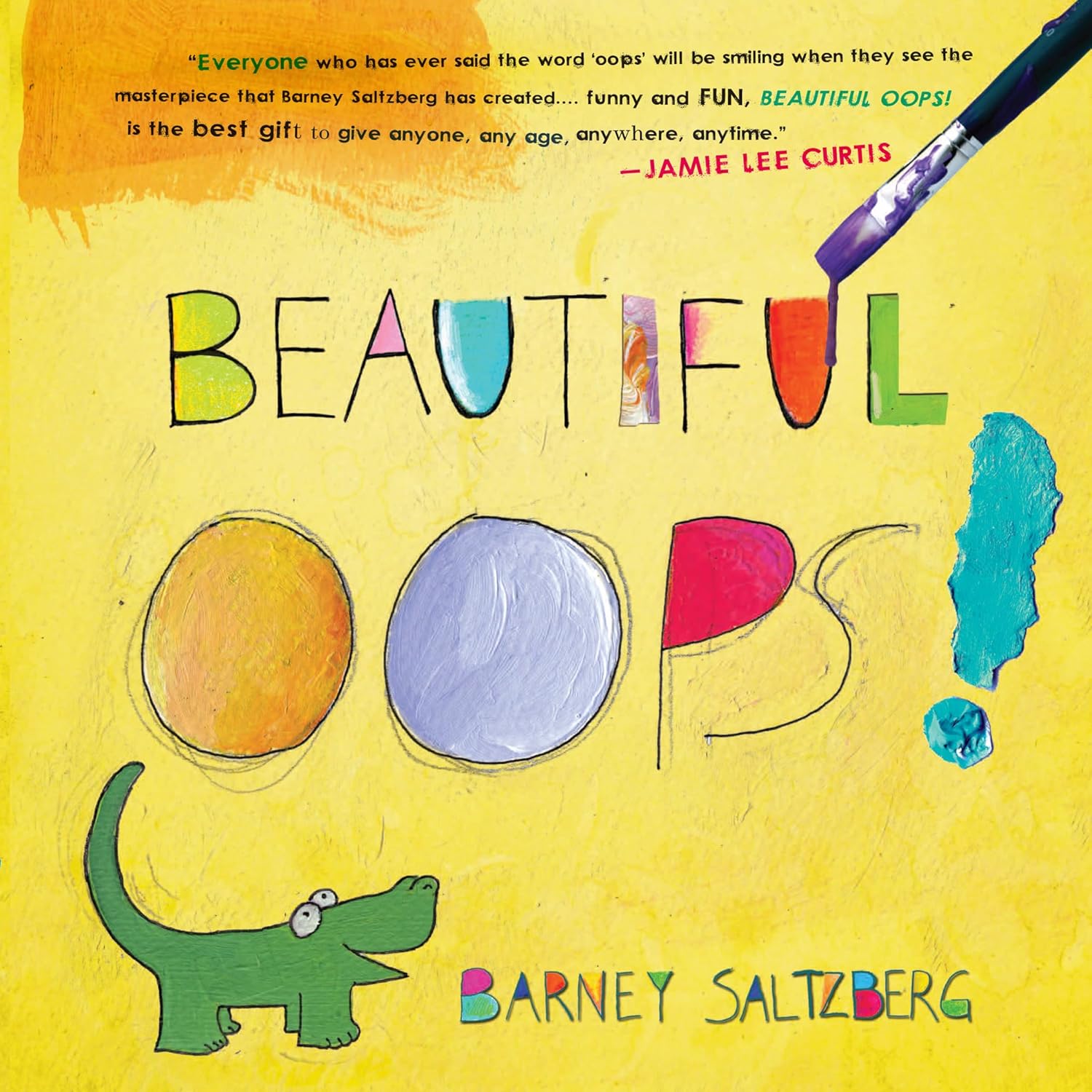
Beautiful Oops!, written and illustrated by Barney Saltzberg, is a 28-page interactive concept book — not a narrative picture book with characters and plot, but a demonstration of a single idea across every page: a mistake is the beginning of something beautiful. A spill. A smear. A smudge. A tear. A hole. A crumple. Each accident becomes, through Saltzberg’s playful transformations, a work of art — the paint spill becomes a frog’s body, the torn paper becomes a smiling dog, the hot-chocolate stain becomes a pond for a lily pad, the crumpled page becomes the fleece of a lamb. The book features real interactive elements: folded pages that open to reveal the transformed image, a pop-up that rises from a hole, torn and textured surfaces that invite touching. Published in 2010 by Workman Publishing with only 82 words of text, it has become one of the most widely used art education and SEL picture books in American classrooms, and it is the shortest and most tactile book in this catalog. This guide covers Beautiful Oops!‘s reading level, whether it’s a read-aloud or independent experience, what it’s about, its themes, how long it takes to read, and similar books — designed for parents and teachers of K–2 readers.
For Parents
An interactive concept book — not a story but a demonstration — showing how every creative mistake can become something beautiful. Best for ages 3–8. No content concerns. The book that makes a child look at a spilled glass and think “what can I make?” instead of “oh no.”
For Teachers
A PreK–2 art and SEL staple — best read alongside an art activity where children turn a mark or blob on paper into something new. Pairs directly with The Dot and Ish for a complete creative courage unit. The companion journal My Book of Beautiful Oops! extends the concept into a child’s own art practice.
Beautiful Oops! at a Glance
Find on Amazon →| Author & Illustrator | Barney Saltzberg (author & illustrator) |
| Published | 2010 (Workman Publishing Company) |
| Grade Level | PreK–2 (our assessment) |
| Recommended Age | 3–8 |
| Lexile | AD320L |
| Word Count | 82 |
| Pages | 28 |
| Format | Interactive concept book with folded pages, pop-up, and tactile elements |
| Genre | Concept book / art / social-emotional |
For official Lexile and AR levels, visit Lexile.com or AR BookFinder. ReadingVine provides independent editorial assessments.
What Reading Level Is Beautiful Oops?
Beautiful Oops! has a Lexile of AD320L. At 82 words, it is by far the shortest text in this catalog — shorter even than Leo the Late Bloomer (164 words) and Knuffle Bunny (211 words). The ATOS level is not available because the book’s format — interactive concept book with folded pages and tactile elements — does not fit standard scoring criteria. The text itself is extremely simple: brief captions describing each transformation (“a spill,” “a smear,” “a smudge”) alongside the illustrated results. Any child who can read a simple sentence can read the words independently.
The reading level scores, however, are almost beside the point for this book. Beautiful Oops! is not primarily a reading experience; it is a looking and touching and thinking experience. The text is the caption for the concept; the interactive elements are the concept. A two-year-old who cannot read a word and a ten-year-old who can read fluently will both find something in this book, because what it demonstrates does not require decoding — it requires looking, and the looking rewards everyone. For official Lexile and AR scores, visit Lexile.com or AR BookFinder. ReadingVine’s assessments are independent editorial judgments.
Is Beautiful Oops a Read-Aloud or Independent Experience?
Beautiful Oops! is most powerful as a shared experience for ages 3–8 — read together, explored together, ideally followed by making something together. Unlike other books in this catalog, it is not primarily a read-aloud in the traditional sense: at 82 words, the text takes about two minutes to read, and the real time is spent looking at each transformation and exploring the interactive elements. A child who reads it alone will have a genuine experience; a child who reads it with an adult who pauses at each page and asks “what do you see?” will have a richer one.
For classroom use, the book is almost always paired with an art activity — giving children a paper with a blob of paint or a tear already on it and asking them to make it into something. This extension is not just a nice addition; it is the book’s actual invitation. Beautiful Oops! is a prompt as much as a picture book, and the right response is to pick up a pencil or a brush.
Before showing each transformation, fold the page or cover the result and show your child only the “mistake” — the spill, the smear, the torn edge. Ask: “What could this become?” Let them answer before you reveal the transformation. Then look together at what Saltzberg made and ask if their idea was different — and whether their idea might have been even better. The conversation is the book’s real content.
What Does Beautiful Oops Do?
Beautiful Oops! has no plot, no characters, and no narrative arc. What it has instead is a series of transformations, each one demonstrating the same idea from a different angle: a creative accident is not a failure but a beginning. Here is what Saltzberg transforms across the book’s 28 pages:
A torn piece of paper becomes a smiling dog’s mouth, painted with a few strokes. A spill of paint becomes the body of a frog, with legs and eyes added. A piece of crumpled paper becomes the curly fleece of a lamb. A smear becomes a sky. A drip of paint becomes a flower stem. A hot-chocolate stain becomes a pond with a lily pad and a frog. A fold in the paper becomes a penguin’s beak. A hole in the page becomes — via a telescoping pop-up — a window onto a landscape, or a sun, or any of countless other things. Each transformation is specific and inventive, and each one is also clearly achievable: these are not the tricks of a master artist but the moves of a playful one, the kind of moves any child could make with the same starting material.
The interactive elements reinforce the concept physically: the folded pages require the reader to open them, which is itself the gesture of a transformation. The pop-up that rises from the hole in the paper turns looking through the hole into a three-dimensional experience. The torn and textured surfaces invite touching. The book asks its reader to participate, not just observe — which is exactly right for a book about making things.
Beautiful Oops Themes and Lessons
The book makes a single argument with great specificity: what looks like a mistake is actually a starting point. This is not an abstract claim — Saltzberg demonstrates it concretely, page by page, with actual art made from actual accidents. The demonstration is more powerful than any statement could be because it shows rather than tells: here is a spill; here is what it became; you could do this too.
Beautiful Oops! sits in the same creative courage tradition as The Dot and Ish in this catalog. All three books address the fear of making something bad, and all three argue that the fear is based on a false premise. The Dot says: start with a mark and see where it takes you. Ish says: vase-ish is better than wrong. Beautiful Oops! says: the accident is already a start. The three books together cover the full landscape of creative block — the blank page, the critic’s laugh, and the ink spill — and each one offers the same essential permission: make the thing anyway.
For children who are perfectionists about their art — who rip up drawings that are “wrong,” who refuse to try because they might fail — this book is specific medicine. It does not argue that mistakes don’t matter; it shows that mistakes are raw material. The child who spills paint on their paper and then transforms it into a frog is not a child who made a mistake and recovered; they are a child who made something new from what they had.
Talking with your child: Which transformation surprised you most? What would you have made from the spill, if you had gotten there first? Have you ever made a mistake while drawing or making something and then turned it into something new? What do you think makes a piece of art “wrong” — or is there even such a thing?
How Long Is Beautiful Oops?
Beautiful Oops! is 28 pages with 82 words — the shortest text in this catalog by a significant margin. Reading the words alone takes about two minutes; exploring the interactive elements thoroughly takes ten to fifteen minutes with a young child who wants to fold and unfold every page and look through the pop-up hole multiple times. It is the right length for what it does: brief enough not to overstay its premise, rich enough in its interactive elements to reward sustained attention. The companion journal, My Book of Beautiful Oops!: A Scribble It, Smear It, Fold It, Tear It Journal for Young Artists (2014), provides blank pages with built-in “mistakes” — smears, tears, and blobs — for children to transform on their own. It is the book’s natural sequel and one of the most useful children’s art journals available.
Books Similar to Beautiful Oops
About Barney Saltzberg
Barney Saltzberg was born and now lives in Los Angeles, California. He has written and illustrated close to fifty books for children, including Beautiful Oops!, Good Egg, the Touch and Feel Kisses series, and Andrew Drew and Drew. He has also recorded four albums of children’s music. He has lectured extensively about creativity, imagination, and where ideas come from — including through a US State Department cultural exchange program that took him to China and Russia. He has said that Beautiful Oops! grew from his own experience as a child who was afraid of making mistakes in art class, and from his belief that the fear of making mistakes is one of the primary things that prevents children from making things at all. The book took him many years to develop because the interactive format required the physical elements to work in sync with the concept — he wanted each transformation to be not just illustrated but tangible, which required the folded pages, the pop-up, and the textured surfaces to be engineered as well as drawn.
The companion journal My Book of Beautiful Oops! (2014) extends the concept directly to the reader’s own practice, providing pre-made “mistakes” on each page for children to transform. Both books are used widely by art therapists and occupational therapists as well as classroom teachers, reflecting that the permission to make mistakes without shame has applications beyond art.
Beautiful Oops: Frequently Asked Questions
What reading level is Beautiful Oops?
Beautiful Oops! has a Lexile of AD320L. At 82 words — the shortest text in this catalog — the reading level is effectively not the point: the book is a looking, touching, and thinking experience rather than a primarily reading one. Our assessment: PreK–2, ages 3–8. For official Lexile scores, visit Lexile.com.
What is Beautiful Oops about?
Beautiful Oops! is a concept book, not a story. It demonstrates, page by page, how every creative accident — a spill, a smear, a tear, a crumple, a hole — can become the beginning of something beautiful. A paint spill becomes a frog. A torn piece of paper becomes a smiling dog. A crumpled page becomes a lamb’s fleece. A hole becomes a pop-up window onto limitless possibilities. The book has interactive elements: folded pages, a telescoping pop-up, and textured surfaces that invite touching.
How is Beautiful Oops different from a regular picture book?
It is a concept book rather than a narrative: there are no characters, no plot, and no story. It is a demonstration of a single idea — mistakes are beginnings — across 28 interactive pages. The text is only 82 words; the real content is in the transformations and the physical elements (folded pages, pop-up, textures). It is best experienced as a shared looking-and-making experience rather than a traditional read-aloud.
What age is Beautiful Oops for?
Ages 3–8, preschool through second grade. The concept is accessible to the youngest children (a two-year-old who watches a spill become a frog understands the transformation intuitively) and meaningful to older children who are developing perfectionism about their creative work. The interactive elements are designed to be handled by young children; the board book edition is available for the very youngest.
Is there a companion to Beautiful Oops?
Yes — My Book of Beautiful Oops!: A Scribble It, Smear It, Fold It, Tear It Journal for Young Artists (2014) provides blank pages with built-in “mistakes” — smears, tears, and blobs already on each page — for children to transform on their own. It is the book’s natural companion and one of the most useful children’s art journals available. Used widely by art teachers, art therapists, and parents who want to continue the conversation the book starts.
How long does it take to read Beautiful Oops?
Reading the 82 words takes about two minutes. Exploring the interactive elements — folding and unfolding each page, looking through the pop-up hole, feeling the textured surfaces — takes ten to fifteen minutes with a young child who wants to try everything multiple times. The best use of the book is not to read through it quickly but to sit with each transformation and the conversation it generates.