
 = Partner Site
The Very Clumsy Click Beetle Reading Level: A Complete Guide
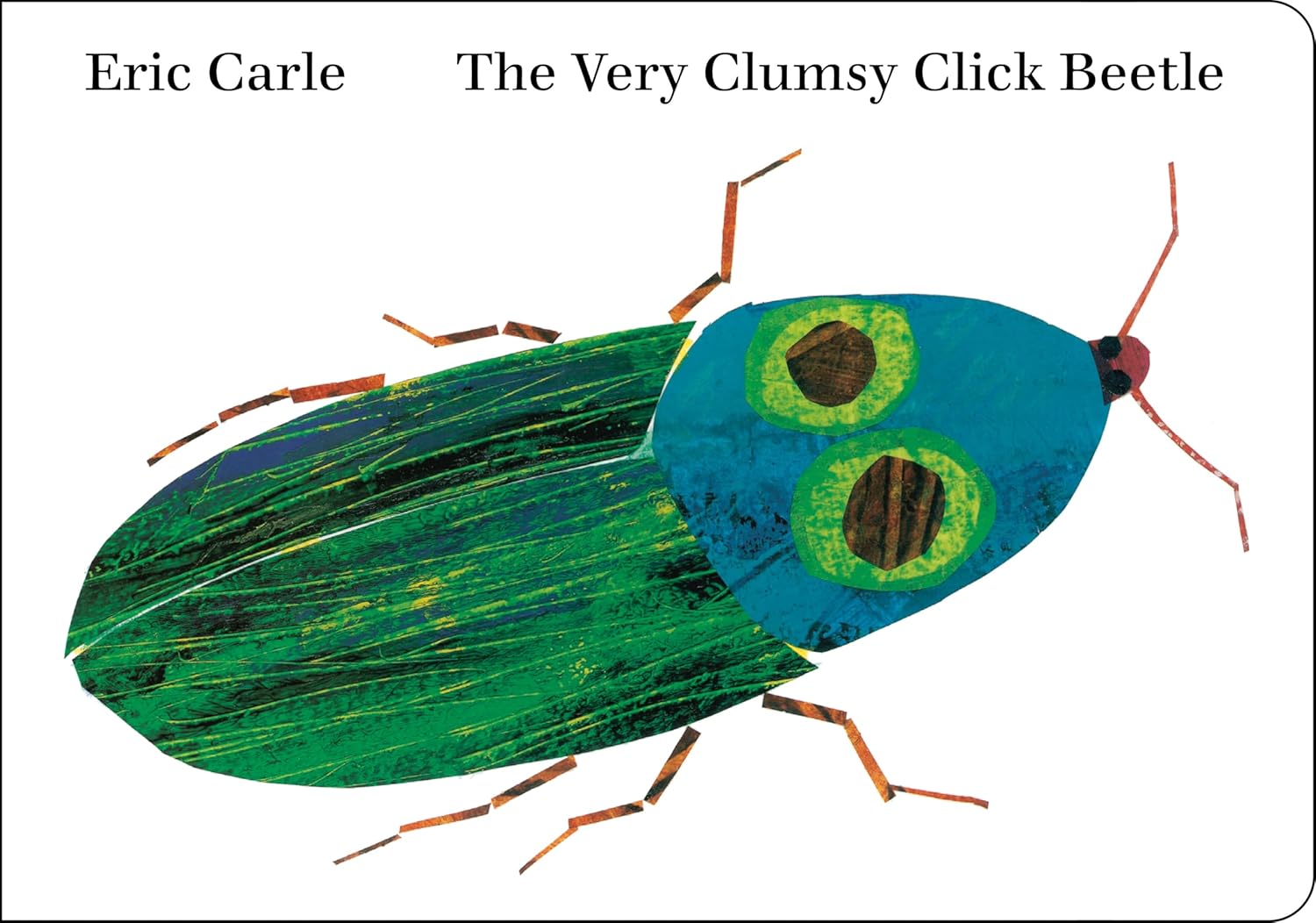
The Very Clumsy Click Beetle, written and illustrated by Eric Carle, is a 32-page picture book about a young click beetle who has learned what click beetles do — click their bodies to flip upright when they fall on their backs — but cannot quite manage to land on his feet. Again and again he tries; again and again he lands on his back. A turtle encourages him. A snail encourages him. A worm and a mouse encourage him. None of it helps him actually do it. Then a curious boy approaches, and from the beetle’s perspective, two enormous feet loom overhead. The beetle is frightened. He stretches, he clicks — and this time, at last, he flips and lands on his feet. Published in 1999 by Philomel Books and featuring an embedded microchip that produces a real clicking sound each time the reader turns the last pages, it received starred reviews from School Library Journal and Library Journal and takes its place in Carle’s celebrated “Very” series alongside The Very Hungry Caterpillar, The Very Lonely Firefly, The Very Quiet Cricket, and The Very Busy Spider. This guide covers The Very Clumsy Click Beetle‘s reading level, whether it’s a read-aloud or independent read, what it’s about, its themes, how long it takes to read, and similar books — designed for parents and teachers of K–2 readers.
For Parents
A warm Eric Carle picture book about a beetle who keeps trying until he succeeds — with an embedded microchip that produces a real clicking sound when the last pages are turned. Best for ages 2–7. No content concerns. The interactive click feature makes it one of the most immediately engaging picture books for toddlers and preschoolers in Carle’s catalog.
For Teachers
A PreK–K classroom staple for perseverance and growth mindset discussions — part of Carle’s “Very” series and a natural companion to The Very Hungry Caterpillar for author studies. The science content (how click beetles actually work) makes it useful for early nature and life science units as well as SEL. The boy-as-enormous-feet perspective technique connects to the same point-of-view concept explored in Two Bad Ants.
The Very Clumsy Click Beetle at a Glance
Find on Amazon →| Author & Illustrator | Eric Carle (author & illustrator) |
| Published | 1999 (Philomel Books / Penguin) |
| Grade Level | PreK–2 (our assessment) |
| Recommended Age | 2–7 |
| Lexile | AD470L |
| ATOS Level | 2.8 |
| Fountas & Pinnell | ~M |
| Word Count | 457 |
| Pages | 32 |
| Series | The “Very” books by Eric Carle |
| Genre | Picture book / nature / social-emotional |
| Special Feature | Embedded microchip produces real clicking sound |
For official Lexile and AR levels, visit Lexile.com or AR BookFinder. ReadingVine provides independent editorial assessments.
What Reading Level Is The Very Clumsy Click Beetle?
The Very Clumsy Click Beetle has a Lexile of AD470L and an ATOS level of 2.8, with an estimated Fountas & Pinnell level of M. The AD designation indicates it is designed as a read-aloud. At 457 words across 32 pages, it is accessible and well-paced, with Carle’s characteristic clear, simple sentences set against his vivid tissue-paper collage illustrations. The ATOS 2.8 is consistent with early second grade for comfortable independent reading; strong kindergartners and first-graders who know the book from read-alouds can work through the text independently.
The reading level scores accurately capture the prose complexity. What they cannot capture is the book’s interactive feature: the embedded microchip that produces a real clicking sound when the last pages are turned. This physical, sensory element makes the book’s ending genuinely exciting for young children in a way that no reading score can measure. For official Lexile and AR scores, visit Lexile.com or AR BookFinder. ReadingVine’s assessments are independent editorial judgments.
Is The Very Clumsy Click Beetle a Read-Aloud or Independent Read?
This is primarily a read-aloud for ages 2–7, with independent reading accessible for strong K–1 readers. As a read-aloud, the book builds toward its interactive climax: the clicking sound chip activates when the last pages are turned, and children who have been rooting for the little beetle through every failed attempt experience its success with a physical, audible payoff. The click is the exclamation point the story has been building toward, and it lands best when heard rather than read silently.
For independent reading, the clear sentence structures and strong illustration support make it accessible for early readers. Children who love the book will return to it on their own specifically to trigger the click sound — which is one of the most reliable re-reading motivators in the catalog.
Each time the beetle fails, pause and ask: “Should he try again?” Let your child decide — and let them give the answer the beetle gives, which is always yes. Then, before the final pages, ask: “Do you think he can do it this time?” The click, when it finally comes, is more satisfying when the child has been an active participant in the beetle’s long journey to get there.
What Is The Very Clumsy Click Beetle About?
A young click beetle has learned what click beetles do: when they fall on their backs, they cannot simply roll over. Instead, they arch their bodies, build tension between their thorax and abdomen, and release it in a sudden CLICK — flipping themselves through the air and landing on their feet. The wise old click beetle demonstrates. It looks easy.
The young beetle tries. He lands on his back. He tries again. He lands on his back again. A turtle passes and offers encouragement. A snail offers encouragement. A worm. A mouse. Each time, the beetle tries, and each time he fails. He is not giving up — he is simply not getting it right, no matter how hard he tries and how much he wants to.
Then a pair of enormous feet appears — a curious boy, seen entirely from the beetle’s perspective as two huge, looming sneakers. The beetle is frightened. In his fright, something clicks. He arches, he clicks, he flips — and this time he lands on his feet. The book’s final pages produce the real clicking sound from the embedded microchip: CLICK. He did it. He really, finally did it.
The book opens with a brief author’s note explaining the real biology of click beetles — that they actually do this, that the click is a real mechanical mechanism, and that the sound is audible. The science and the story are genuinely aligned.
The Very Clumsy Click Beetle Characters
The young click beetle is the book’s heart — neither a failure nor a success through most of the story, simply a creature who is still learning something genuinely difficult and who keeps trying anyway. The wise old click beetle is a brief but essential presence: patient, accomplished, willing to demonstrate without shame. The encouraging animals — turtle, snail, worm, mouse — are the community of witnesses to the beetle’s struggle, each offering what they can without being able to give the beetle what he actually needs, which is the right moment. The boy appears only as enormous feet from the beetle’s point of view — an explicit perspective technique that connects to the ants’-eye view of Two Bad Ants, and that makes the human world feel vast and potentially threatening from where the beetle stands.
The Clicking Sound — What Makes This Book Unique
The first edition of The Very Clumsy Click Beetle features an embedded electronic microchip that produces an audible clicking sound when the last pages are turned. This is not a gimmick separate from the story; it is the story’s final word. The click is what the beetle has been trying to produce for the entire book, and when the reader turns the page and hears the real click, they experience exactly what the beetle experiences: success, at last, in a form that can be heard.
Carle was publishing a series of interactive “Very” books around this period — The Very Lonely Firefly (1995) features lights that glow, and The Very Quiet Cricket (1990) features a cricket that chirps. The clicking sound in The Very Clumsy Click Beetle is the most narratively satisfying of these interactive elements because it is also the story’s climax: the sound is not decorative, it is the resolution. Parents and teachers should note that some later paperback editions may not include the sound chip; the hardcover original edition is the one that clicks.
The Very Clumsy Click Beetle Themes and Lessons
The book’s central argument — that perseverance and repeated effort eventually produce success, sometimes in a moment of unexpected breakthrough — is one of the most universal in children’s literature, and Carle delivers it with the specific biological accuracy of a real natural phenomenon. Click beetles actually do this. The click is real. The mechanism is real. The difficulty is real — the beetle cannot roll over; it must build and release tension in its body in a very precise way, which is genuinely hard. This scientific grounding gives the beetle’s struggle a specificity that makes the perseverance argument feel earned rather than generic.
The breakthrough moment — the beetle clicks successfully when frightened by the boy — is the book’s most interesting structural choice. The beetle does not succeed through harder trying; he succeeds when something startles him out of his self-conscious effort and his body does what it was always capable of doing. This is an honest account of how some skills actually develop: sometimes what prevents success is the trying itself, and the breakthrough comes when the learner stops monitoring the process and just responds. This is a more nuanced perseverance message than most books offer, and it is worth discussing with older children who are struggling with learned skills.
Talking with your child: Why do you think the beetle kept failing even though he was trying so hard? What did all the animals do — did their encouragement help him actually click? Why do you think he was finally able to do it when the boy appeared? Is there something you have been practicing that you couldn’t do at first but can do now?
How Long Is The Very Clumsy Click Beetle?
The Very Clumsy Click Beetle is 32 pages with 457 words. Most adults can read it aloud in about five to seven minutes. It is the fifth entry in Carle’s “Very” series, following The Very Hungry Caterpillar (1969), The Very Busy Spider (1984), The Very Quiet Cricket (1990), and The Very Lonely Firefly (1995). Each book features an insect protagonist navigating its natural world, Carle’s tissue-paper collage illustrations, and a clear SEL or nature theme. The interactive series — Firefly with lights, Cricket with chirping, Click Beetle with clicking — demonstrates Carle’s ongoing interest in making picture books physical experiences as well as reading ones. The hardcover original edition includes the clicking sound chip; some later paperback editions do not.
Books Similar to The Very Clumsy Click Beetle
About Eric Carle
Eric Carle was born on June 25, 1929, in Syracuse, New York, and was taken as a six-year-old to his parents’ native Germany, where he grew up during World War II and studied at the Akademie der Bildenden Künste (Academy of Applied Arts) in Stuttgart. He returned to New York in the early 1950s as a graphic designer, working in the art department of The New York Times and later as a freelance advertising artist. His picture book career began with 1, 2, 3 to the Zoo (1968) and accelerated dramatically with The Very Hungry Caterpillar (1969), which became one of the bestselling children’s books in history — translated into more than 66 languages, with over 50 million copies sold. He illustrated more than 70 books across his career, with more than 170 million copies sold worldwide.
Carle’s signature technique is tissue-paper collage: he paints sheets of tissue paper with various colors, textures, and patterns, then cuts and layers them to create his illustrations. The resulting images are simultaneously flat and luminous, with a warmth and vitality that distinguish his work from any other illustrator in children’s book history. In 2002, Carle and his wife Barbara co-founded The Eric Carle Museum of Picture Book Art in Amherst, Massachusetts — a 40,000-square-foot museum dedicated to the art of picture book illustration. He received the Children’s Literature Legacy Award in 2003. Eric Carle passed away on May 23, 2021, at the age of 91. His work remains one of the most enduring and influential bodies of work in American children’s publishing.
The Very Clumsy Click Beetle: Frequently Asked Questions
What reading level is The Very Clumsy Click Beetle?
The Very Clumsy Click Beetle has a Lexile of AD470L and an ATOS of 2.8, with an estimated Fountas & Pinnell Level M. Our assessment: PreK–2, ages 2–7. The AD designation means it is designed as a read-aloud; strong K–1 readers can work through the text independently. For official Lexile and AR scores, visit Lexile.com or AR BookFinder.
What is The Very Clumsy Click Beetle about?
A young click beetle learns from a wise elder what click beetles do — click their bodies to flip upright — but cannot quite land on his feet. Encouraged by turtle, snail, worm, and mouse, he keeps trying and keeps failing. When a curious boy approaches and the enormous feet frighten him, he finally clicks successfully. The book’s last pages produce a real clicking sound from an embedded microchip.
Does The Very Clumsy Click Beetle make a clicking sound?
Yes — the hardcover original edition contains an embedded electronic microchip that produces a real clicking sound when the last pages are turned. The click is the story’s climax: the beetle has been trying to click throughout the book, and when the reader turns the final pages and hears the sound, they experience the beetle’s success directly. Some later paperback editions do not include the sound chip; the hardcover edition is the one that clicks.
Do click beetles really click?
Yes — the book opens with a scientific note explaining the real biology. Click beetles belong to the family Elateridae and cannot roll over when they land on their backs. Instead, they arch their bodies, building tension between their thorax and abdomen, and release it in a sudden spring — producing an audible click and launching themselves into the air. There are over 500 species of click beetles in the United States alone. The mechanism the beetle learns in the book is based on real insect biology.
What other “Very” books did Eric Carle write?
The “Very” series includes: The Very Hungry Caterpillar (1969), The Very Busy Spider (1984), The Very Quiet Cricket (1990, with a chirping sound chip), The Very Lonely Firefly (1995, with glowing lights), and The Very Clumsy Click Beetle (1999, with a clicking sound chip). Each features an insect protagonist, Carle’s tissue-paper collage illustrations, and either a nature theme or a social-emotional theme.
How long does it take to read The Very Clumsy Click Beetle aloud?
About five to seven minutes. The story moves at a satisfying pace, with each new encouraging animal adding to the beetle’s escalating frustration before the final breakthrough. Budget a few extra minutes for the clicking sound at the end — children will want to trigger it multiple times, which is exactly the right response.