
 = Partner Site
Catch-22 Reading Level: A Complete Guide
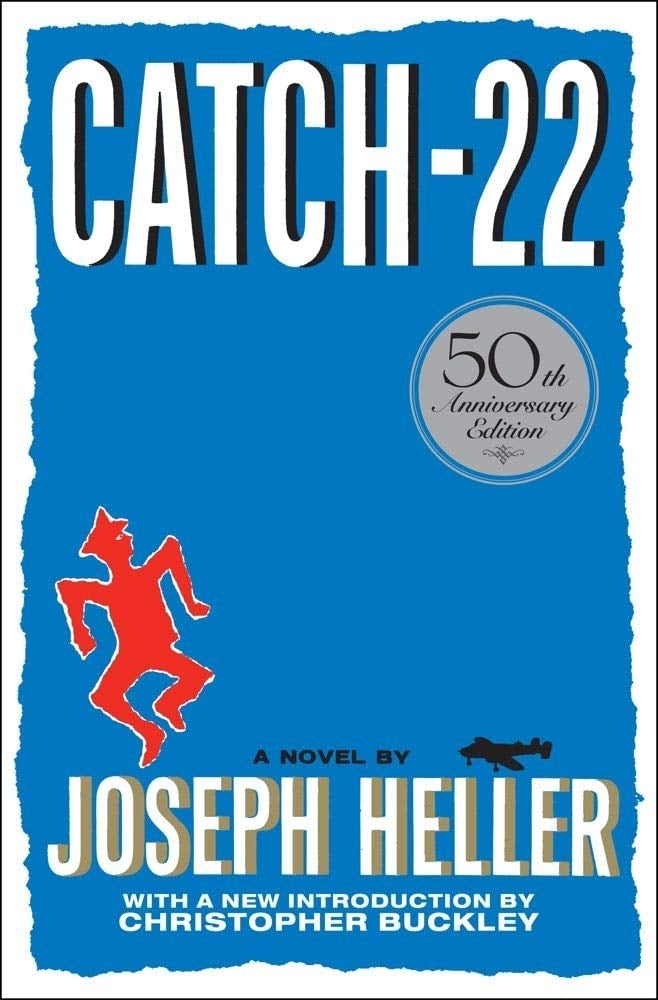
Catch-22, written by Joseph Heller and published by Simon & Schuster on October 10, 1961, is a satirical novel set during World War II on the fictional island of Pianosa in the Mediterranean. The protagonist is Captain John Yossarian, an Assyrian-American B-25 bombardier with the fictional 256th Squadron, who has concluded that the people trying to kill him — including, in a meaningful sense, his own military superiors — are numerous and serious, and who wants to stop flying combat missions before one of them succeeds. His difficulty is Catch-22: the military rule establishing that a man is considered insane if he willingly continues to fly dangerous combat missions, but if he makes a formal request to be relieved of duty, he thereby demonstrates that he is sane, and a sane man is not eligible for relief. Heller began writing the novel in 1953, eight years after his own service as a B-25 bombardier — he flew around 60 missions from May to October 1944. Published in 1961, the novel was not an immediate bestseller; it became massively popular during the Vietnam War era, when readers recognized in its satire of military bureaucracy and institutional irrationality a framework applicable to their own moment. The novel’s title entered the English language as a common phrase. This guide covers reading level, age appropriateness, content, structure, the Catch-22 rule itself, themes, the challenge history, and similar books.
For Parents
A satirical WWII novel about a bombardier who wants to stop flying combat missions and cannot escape the bureaucratic logic that makes this impossible. Ages 15–18, grades 10–12. Content: sexual content throughout (Yossarian’s relationships and the novel’s treatment of women are significant discussion points); the violence of combat, most concentrated in the Snowden scene; profanity; dark comedy that treats death casually until it doesn’t. The nonlinear structure is deliberately disorienting. Standard 11th–12th grade and AP Literature assignment.
For Teachers
A grades 10–12 and AP Literature standard — most commonly assigned in 11th or 12th grade. Lexile 1140L; ATOS 7.1; word count ~174,000; 453 pages. The nonlinear, chapter-based structure (each chapter named for a character) is central to how the novel works; the chronology becomes clearer across multiple readings or with teacher guidance. The deliberate anachronisms (IBM computers, loyalty oaths) situate the novel in the Cold War despite its WWII setting. Frequently paired with Slaughterhouse-Five in war literature and satire units.
Catch-22 at a Glance
Find on Amazon →| Author | Joseph Heller (1923–1999) |
| Published | October 10, 1961 (Simon & Schuster) |
| Grade Level | 10–12 (our assessment); AP Literature |
| Recommended Age | 15–18 |
| Lexile | 1140L |
| ATOS Level | 7.1 |
| Word Count | ~174,000 |
| Pages | ~453 |
| Chapters | 42 (each named for a character or concept) |
| Genre | Satirical fiction / war novel / black comedy |
| Setting | Pianosa (fictional island), Mediterranean; WWII, 1942–1944 |
For official Lexile and AR levels, visit Lexile.com or AR BookFinder. ReadingVine provides independent editorial assessments.
What Reading Level Is Catch-22?
Lexile 1140L, ATOS 7.1, word count ~174,000, interest level grades 9–12. Our assessment: grades 10–12, ages 15–18, most commonly assigned in 11th or 12th grade. The 1140L reflects Heller’s prose style — complex sentences, dense irony, frequent repetition used for comic and structural effect — as well as the novel’s length. The ATOS of 7.1 reflects sentence-level complexity. The more significant reading challenges are structural: the novel’s deliberately nonlinear chronology, its shifting perspectives, and its sustained ironic mode require readers who can hold ambiguity and track a large cast of characters across a non-sequential narrative. Most teachers who assign it provide chronological frameworks and character guides. For official scores, visit Lexile.com or AR BookFinder.
The Catch-22 Rule — What It Means
The novel’s title comes from the military regulation at its center, stated in Chapter 5: a man is considered insane if he willingly continues to fly dangerous combat missions, but if he makes a formal request to be relieved of duty on the grounds of insanity, he thereby demonstrates that he is sane — because only a sane man would recognize the danger and try to get out of it — and a sane man does not qualify for relief. The rule is self-sealing: there is no action Yossarian can take within the system that will result in relief from combat duty, because any rational action he takes proves his sanity, and a sane man flies missions.
Heller extended the Catch-22 logic throughout the novel as a structural principle: characters repeatedly encounter rules, regulations, and institutional arrangements that are self-sealing in the same way — logical systems that cannot be challenged from within because any challenge is absorbed by the system’s own logic. The phrase entered common English usage during the Vietnam War era to describe any such no-win situation imposed by institutional or bureaucratic logic.
What Age Is Catch-22 Appropriate For?
Ages 15–18, grades 10–12. Content worth noting for parents and teachers:
The novel contains sexual content throughout — Yossarian’s relationships with women, and the novel’s treatment of women more broadly, are a significant critical discussion point. The violence of combat is present throughout in dark-comic mode and concentrated most intensely in the Snowden scene (see below), which is the emotional pivot of the novel. Profanity appears throughout. The novel’s sustained black-comedy mode — treating death casually, with gallows humor — can be disorienting for readers who encounter it without preparation. These elements are central to the novel’s satirical mode rather than incidental. Most appropriate for grades 10–12 with classroom context.
What Is Catch-22 About?
Captain John Yossarian is a bombardier stationed on the fictional island of Pianosa with the 256th Squadron during WWII. He has flown more than enough combat missions to qualify for rotation home — but his commanding officer, Colonel Cathcart, keeps raising the required number of missions each time Yossarian approaches the total. Yossarian’s goal is straightforward: to survive the war. The novel follows his various attempts to escape combat duty — by feigning illness, by manipulating records, by whatever means are available — and his growing awareness that the institutional logic of the military makes this impossible.
The 42 chapters are each named for a character and follow different members of the squadron. The novel’s chronology is deliberately scrambled — events are presented out of sequence, and the narrative returns repeatedly to certain key moments (particularly a mission over Avignon and the Snowden scene) from different angles and with progressively more information, until the full picture assembles near the end. The comedy of the first two-thirds — the absurdist military bureaucracy, the cartoonish villains, the black humor about death — gives way to something darker in the novel’s final sections as the deaths accumulate and are no longer absorbed by the comic mode.
Major characters and their satirical functions include: Milo Minderbinder, the mess officer who builds a private enterprise empire (M&M Enterprises) by privatizing military resources; Colonel Cathcart, who keeps raising the mission count to impress his superiors; Major Major Major Major, who was promoted to Major by an IBM computer and refuses to see anyone in his office; Doc Daneeka, the flight surgeon who is officially dead; and the chaplain, whose genuine moral seriousness makes him an outlier in the institutional world he inhabits.
The Snowden Scene
The novel’s emotional and thematic center is the death of a gunner named Snowden on a mission over Avignon — an event referenced obliquely from the novel’s early chapters and only fully revealed near the end. Yossarian tries to treat Snowden’s visible wound while Snowden keeps saying he is cold. When Yossarian opens Snowden’s flak jacket, he discovers the wound that has actually killed him. The scene and what Yossarian reads in it — about what a man is made of when you strip away the things that clothe and protect him — is the novel’s most discussed passage and the one that most directly states its argument about war and human dignity. Teachers typically flag this scene before students encounter it; it arrives with much more weight for readers who have been holding the repeated oblique references across the novel’s first two-thirds.
The Deliberate Anachronisms
Heller deliberately inserted references to post-WWII phenomena into the novel’s WWII setting — IBM computers, loyalty oaths, a character based on aspects of Senator Joseph McCarthy’s anti-Communist investigations. These anachronisms were intentional: Heller began writing the novel in 1953, during the McCarthy era and the Korean War, and the novel’s satire of military bureaucracy and institutional conformity is aimed at its Cold War present as much as its WWII setting. Milo Minderbinder’s statement “What’s good for M&M Enterprises is good for the country” deliberately echoes the 1953 Senate testimony of Charles Erwin Wilson (then-president of General Motors): “What’s good for General Motors is good for the country.” The question “Who promoted Major Major?” references McCarthy’s inquiry into the promotion of Major Peress, an army dentist who refused loyalty oaths. For classroom use, identifying these anachronisms and understanding their targets is one of the most productive close-reading exercises the novel offers.
Is Catch-22 Banned?
Catch-22 has been challenged and banned in school districts since the early 1970s, primarily for sexual content and profanity. The most documented challenge is in Strongsville, Ohio, where the novel was banned in 1972; the case was subsequently the subject of a lawsuit in which a federal district court ruled in 1976 that the ban was unconstitutional. It has been challenged in Dallas, Texas; Snoqualmie, Washington; and other districts. It appears on the ALA’s Banned & Challenged Classics list. These challenges have been largely unsuccessful in removing the novel from curricula; it remains a standard AP Literature text.
Catch-22 Themes and Lessons
The novel’s central satirical argument is that the institutions of war — military hierarchy, bureaucratic rules, the chain of command — operate according to a logic that is internally coherent but systematically indifferent to the survival of the individual people inside them. Cathcart raises the mission count because it will impress his superiors; whether his men survive the additional missions is not the relevant variable. Milo contracts with the enemy to bomb his own squadron because the contracts are profitable; whether the men survive is not the relevant variable. The Catch-22 rule protects the system from individual opt-out; whether the system’s goals are achievable or coherent is not the relevant variable.
The novel’s structural decision to become gradually less funny and more devastating — as the deaths accumulate and are no longer absorbed by the comic mode — is itself the argument: the comedy is not a distance from the horror but a mode of experiencing it that the novel eventually revokes.
Discussion questions: What is the logical structure of the Catch-22 rule — why can’t Yossarian simply cite it to get out of flying? What does Milo Minderbinder represent — what is the novel saying about the relationship between war and commerce? How does the novel’s structure (nonlinear, each chapter named for a character) affect how you experience the deaths? What does Yossarian read in Snowden’s wound — what is “Snowden’s secret”?
Books Similar to Catch-22
About Joseph Heller
Joseph Heller was born on May 1, 1923, in Coney Island, Brooklyn, New York, the son of Russian Jewish immigrants. He enlisted at nineteen in 1942 and served as a B-25 bombardier in the Mediterranean theater, flying around 60 combat missions from May to October 1944, before being promoted to first lieutenant. He received a B.A. from New York University in 1948 and an M.A. from Columbia University in 1949, and studied at Oxford University on a Fulbright scholarship. He worked as an advertising copywriter while writing fiction. Catch-22 (1961) was his debut novel; he began writing it in 1953. His subsequent novels include Something Happened (1974), Good as Gold (1979), God Knows (1984), and Closing Time (1994), a sequel to Catch-22 following Yossarian and other characters into old age. He suffered a severe case of Guillain-Barré syndrome in 1981, which he described in the memoir No Laughing Matter (1986, co-written with Speed Vogel). He died on December 12, 1999, in East Hampton, New York.
Catch-22: Frequently Asked Questions
What reading level is Catch-22?
Lexile 1140L, ATOS 7.1, word count ~174,000, interest level grades 9–12. Our assessment: grades 10–12, ages 15–18, most commonly 11th or 12th grade. The more significant challenges are structural — nonlinear chronology, large cast of characters, sustained ironic mode — rather than sentence-level. For official scores, visit Lexile.com or AR BookFinder.
What is Catch-22 about?
Captain John Yossarian, a WWII bombardier on a fictional Mediterranean island, wants to stop flying combat missions before one of the many people trying to kill him succeeds. The military rule called Catch-22 makes this impossible: he can only be grounded for insanity, but requesting to be grounded proves he is sane. The novel follows his attempts to escape a system whose logic forecloses all rational exit, across a satirical, nonlinear, darkly comic narrative that grows progressively less funny as the deaths accumulate.
What does “Catch-22” mean?
The novel’s central military rule: a man is considered insane if he willingly continues to fly dangerous combat missions, but if he requests relief from duty on grounds of insanity, he demonstrates that he is sane — and only an insane man can be grounded. The rule is self-sealing: no action Yossarian takes within the system can result in relief. The phrase entered common English to describe any no-win situation imposed by self-sealing bureaucratic or institutional logic.
Why is Catch-22 set in WWII but full of references to the 1950s?
Deliberately. Heller began writing the novel in 1953 during the McCarthy era and the Korean War, and he intentionally inserted anachronisms — IBM computers, loyalty oaths, a character echoing McCarthyite anti-Communist investigations — to situate the novel’s satire in the Cold War present rather than limiting it to its WWII setting. Milo Minderbinder’s motto echoes a 1953 Senate statement by General Motors’ president; the character Major Major Major Major’s promotion alludes to McCarthy’s investigation of a specific Army dentist.
Is Catch-22 a banned book?
It has been challenged and banned in several school districts since the early 1970s, primarily for sexual content and profanity. The Strongsville, Ohio ban (1972) was overturned by a federal district court in 1976 as unconstitutional. It appears on the ALA’s Banned & Challenged Classics list. These challenges have been largely unsuccessful; it remains a standard AP Literature text.
What grade is Catch-22 typically assigned?
Most commonly in 11th or 12th grade and in AP Literature and Composition. Its length (453 pages), Lexile (1140L), nonlinear structure, and content make it most appropriate for mature high school readers with classroom instruction. It is frequently paired with Slaughterhouse-Five in war literature units.