
 = Partner Site
Curious George Reading Level: A Complete Guide
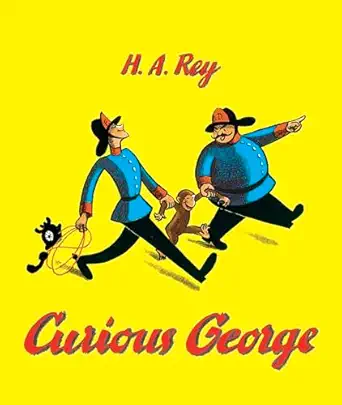
Curious George by H.A. Rey and Margret Rey is a widely recognized character in children’s literature — a little monkey whose irrepressible curiosity gets him into trouble on every page, and whose adventures have delighted readers since 1941. This guide covers the reading level, recommended age, read-aloud vs. independent reading guidance, themes, and everything parents and teachers need to know about sharing this classic with young readers.
For Parents
Find out whether Curious George works best as a read-aloud or independent read for your child, what age range it suits, and what to know about the original book before diving into the enormous series that followed.
For Teachers
Grade-level data, read-aloud timing, key themes, and discussion questions for one of the most recognized characters in K–2 classrooms. Strong connections to curiosity as a learning disposition, cause-and-effect reasoning, and the consequences of impulsive behavior.
Curious George at a Glance
Find on Amazon →| Authors | H.A. Rey and Margret Rey |
| Illustrator | H.A. Rey |
| Published | 1941 |
| Grade Level | K–1 (our assessment) |
| Recommended Age | 4–7 |
| Best For | Read-aloud ages 3–6; independent reading ages 5–7 |
| Flesch-Kincaid Grade | 3.1 |
| Word Count | ~1,500 |
| Pages | 64 |
| Genre | Picture book / fiction |
| Setting | Africa; a city |
| Awards | Indie Choice Book Awards Picture Book Hall of Fame (2012) |
For official Lexile and AR levels, visit Lexile.com or AR BookFinder. ReadingVine provides independent editorial assessments.
What Reading Level Is Curious George?
Curious George is a K–1 reading level by our editorial assessment, with a Flesch-Kincaid grade level of approximately 3.1. At around 1,500 words it is one of the longest picture books on this list — longer than most others in this category — and the text reads as continuous illustrated narrative rather than the short, patterned sentences typical of beginning readers. H.A. Rey wrote in a clear, third-person storytelling voice that moves quickly from incident to incident, keeping children engaged even as the word count accumulates.
The original 1941 book is a fuller, more complex text than many of the later Curious George titles in the series, which were written for younger or beginning-reader audiences. Parents who know the shorter, simpler board books or I Can Read adaptations should be aware that the original is a longer and more demanding read. For parents who use specific reading level systems: we recommend checking your child’s level on Lexile.com or AR BookFinder for official scores, or asking your child’s teacher for their Guided Reading or DRA level.
Is Curious George a Read-Aloud or Independent Read?
Curious George works well as both a read-aloud for ages 3–6 and an independent read for ages 5–7. As a read-aloud, the original book’s brisk, episodic plot — George is captured, brought to the city, escapes, causes chaos, ends up in jail, escapes again, rides a bunch of balloons — keeps even young children engaged from beginning to end. Most adults can read it aloud in about 15–20 minutes, making it better suited to a daytime or afternoon read-aloud than a bedtime book.
As a read-aloud, Rey’s illustrations — bold, confident line drawings in warm yellows, browns, and greens — give the story a visual energy that matches its narrative pace. George’s facial expressions are particularly expressive, and children who look closely at the pictures often catch details the text doesn’t mention. The book’s episodic structure — one mishap leading to the next — means that even young children who can’t track a complex plot can follow the immediate situation on each page and enjoy the cumulative chaos.
For independent reading, a confident first grader can handle the text, though some sentences are longer and more complex than those in typical beginning readers. Children who are ready for Frog and Toad or Henry and Mudge will find Curious George accessible, though it requires more sustained reading than those books because it lacks chapter breaks. Many children find it easiest to read in two sittings — George’s capture and city arrival, then his escape and balloon adventure.
A note for parents: the original Curious George begins with the Man with the Yellow Hat capturing George in Africa and bringing him to the United States. Some parents find this opening worth a brief conversation with their children, particularly in the context of discussions about zoos, animal captivity, and colonialism that the book’s contemporary critics have raised. The book presents George’s capture as an adventure, which is how young children read it, but the conversation is available if you want it.
George’s balloon escape is the sequence children most want to revisit. After the first reading, go back to the balloon pages and ask: “Where do you think the balloons are taking him? What do you think it would feel like?” The flight sequence is one of the purest expressions of the book’s central theme — what it feels like to follow your curiosity somewhere wonderful and completely unexpected.
What Is Curious George About?
George is a little monkey living in Africa who is captured by a man in a yellow hat and brought to the United States to live in a zoo. On the ship, George’s curiosity gets him into his first spot of trouble when he tries to call someone on the telephone and ends up calling the fire department. In the city, waiting to be taken to the zoo, George escapes from his room, tries to fly like a seagull, falls into the ocean, and is rescued by a passing boat. He is put in jail — briefly — before escaping again. A man selling balloons passes by. George, fascinated by the balloons, grabs too many and floats up into the sky. He drifts over the city, gradually losing balloons, until he lands safely in the zoo’s monkey house — exactly where he was supposed to go all along.
The story is fast-moving, frequently funny, and built on a simple and deeply satisfying premise: curiosity leads to trouble, trouble leads to adventure, and adventure leads somewhere worth going. George never means to cause chaos. He is simply interested in everything, and everything he touches generates consequences. Children find this combination of good intentions and spectacular results both funny and reassuring.
Curious George Characters
Curious George Themes and Lessons
The central theme of Curious George is the nature of curiosity — specifically, the way genuine interest in the world leads to both trouble and discovery. George doesn’t investigate the telephone because he wants to cause a problem; he investigates it because telephones are fascinating. The trouble is a side effect of the curiosity, not its purpose. This distinction is important for young children, who are themselves natural investigators and who are often told their curiosity is inconvenient. Curious George validates the curiosity while acknowledging the consequences with good humor rather than punishment.
The book also models resilience and adaptability in the face of rapidly changing circumstances. George moves from Africa to a ship to a city to jail to the sky in the course of a single book, and in each new situation he adjusts, explores, and finds something interesting. He ends up where he was supposed to be — the zoo’s monkey house — not by following a plan but by following his nature, which the book treats as a form of wisdom rather than a flaw.
A word for teachers on the book’s context: the original Curious George has received scholarly attention for its framing of George’s capture and transportation from Africa, which some critics read as mirroring colonial and captivity narratives. Young children reading the book experience it as a funny adventure story, which it is. But teachers who use the original book with older K–2 students may find that the opening sequence — particularly with students who have discussed animal captivity, zoos, or historical events involving forced displacement — opens a conversation worth having. The book is not primarily about these themes, but the conversation is available.
Discussion starters for families: Why does George keep getting into trouble? Was he trying to be bad? What happened when he picked up the telephone? Have you ever been so curious about something that it got you into trouble? What do you think it felt like to float over the city on a bunch of balloons?
How Long Is Curious George?
The original Curious George has 64 pages and approximately 1,500 words — one of the longer picture books on the K–2 list. Most adults can read it aloud in about 15–20 minutes. The book’s episodic structure makes it natural to pause at certain points — between George’s arrival in the city and his balloon adventure, for instance — if a shorter session is needed.
A child reading independently at a first-grade level will typically finish in about 20–30 minutes. The lack of chapter breaks means some children benefit from a natural stopping point around the middle of the book. Note that many shorter Curious George titles in the series — the I Can Read adaptations, the board books — are significantly shorter and simpler than the original, and are often a better fit for younger or beginning independent readers.
Books Similar to Curious George
If your child loves Curious George, these titles share its humor, its mischievous energy, or its portrait of a character whose curiosity leads somewhere wonderful:
About the Authors and Illustrator
H.A. Rey (Hans Augusto Rey, 1898–1977) and Margret Rey (1906–1996) were a German Jewish couple who created Curious George under circumstances as extraordinary as any of George’s adventures. Hans grew up in Hamburg near the famous Hagenbeck Zoo, where he spent his childhood drawing animals — a habit that would define his career. The two met in Brazil, married in 1935, and moved to Paris, where Hans published his first children’s book and where George first appeared as a minor character named Fifi in a 1939 book called Cecily G. and the Nine Monkeys.
In June 1940, as the German army invaded Paris, the Reys — Jewish and stateless, in a city about to fall to the Nazis — fled on bicycles they had assembled from spare parts. Among the few items they carried were the manuscript and drawings for a Curious George book. Their escape took them through France, Spain, and Portugal before they finally reached the United States. Curious George was published in New York in 1941. The story of their flight — a Jewish couple escaping Nazi-occupied Europe with a children’s book manuscript strapped to their bicycles — has been told in a picture book of its own: The Journey That Saved Curious George, by Louise Borden, published in 2005.
The Reys went on to write seven original Curious George books together, and H.A. Rey also wrote and illustrated Find the Constellations and other non-George titles. After both of the Reys passed away — Hans in 1977 and Margret in 1996 — Houghton Mifflin continued the series with books written by other authors, and the character has since expanded into television, film, and hundreds of additional titles. The Curious George Foundation, established in 1989, funds children’s literacy and education programs. The original book has sold more than 25 million copies and has never gone out of print.
Curious George: Frequently Asked Questions
What reading level is Curious George?
The original Curious George is a K–1 reading level by our editorial assessment, with a Flesch-Kincaid grade level of approximately 3.1. At around 1,500 words it is one of the longer picture books on the K–2 list. It works best as a read-aloud for ages 3–6 and as an independent read for ages 5–7. Note that many shorter Curious George adaptations and series books are simpler than the original. For official Lexile and AR levels, visit Lexile.com or AR BookFinder.
What age is Curious George for?
The original Curious George is appropriate for ages 3–7. As a read-aloud it works from age 3 — the episodic plot and visual comedy keep young children engaged even when the text is above their decoding level. As an independent read it suits confident first graders ages 5–7. The book’s length (64 pages, about 1,500 words) makes it better suited to a daytime reading session than a bedtime book for most families.
What is the difference between the original Curious George and the series books?
The original Curious George (1941) is a 64-page, roughly 1,500-word illustrated narrative written by H.A. and Margret Rey — significantly longer and more complex than most of the later series titles. The seven original series books (Curious George Takes a Job, Curious George Rides a Bike, etc.) are in a similar format. Later additions to the series — including the I Can Read adaptations, board books, and tie-in books based on the PBS television series — are shorter, simpler, and better suited to very young or beginning readers. The original and the seven Reys’ own books are the source; everything else is an extension.
How long does it take to read Curious George aloud?
Most adults can read the original Curious George aloud in about 15–20 minutes — one of the longer picture book read-alouds on the K–2 list. The episodic structure makes it easy to pause between sequences if a shorter session is needed. Many families read it over two sittings without losing momentum.
What is Curious George about?
Curious George is about a little monkey from Africa who is brought to the United States by a man in a yellow hat. In the city, George’s curiosity immediately gets him into trouble: he calls the fire department by accident, escapes from his room, falls into the ocean, ends up in jail, and floats over the city on a bunch of balloons — before landing safely in the monkey house of the zoo where he was supposed to go all along. It is a fast-moving, funny story about a monkey whose curiosity leads him into chaos and adventure in equal measure.
Are there other Curious George books?
Yes — H.A. and Margret Rey wrote seven original Curious George books, starting with the original in 1941 and ending with Curious George Flies a Kite in 1958. After the Reys’ deaths, Houghton Mifflin continued the series with many additional titles, and the character has been adapted into an Emmy Award-winning PBS television series, several films, board books, I Can Read adaptations, and hundreds of other titles. The original seven books by the Reys are widely considered the essential series; the rest range considerably in quality and complexity.