
 = Partner Site
Encyclopedia Brown, Boy Detective Reading Level: A Complete Guide
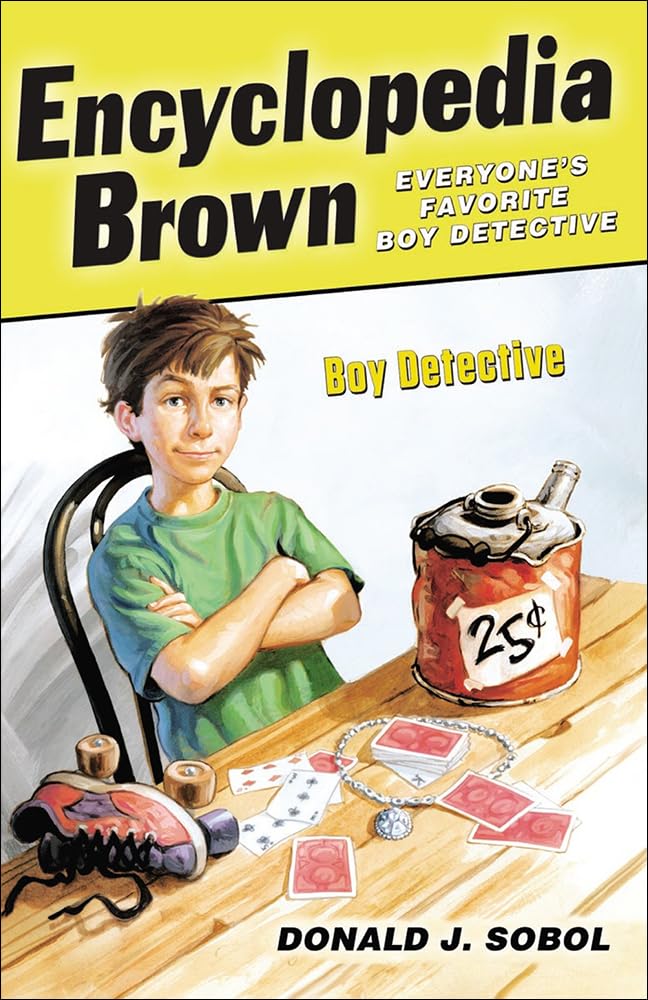
Encyclopedia Brown, Boy Detective by Donald J. Sobol is the first book in the Encyclopedia Brown series, introducing ten-year-old Leroy “Encyclopedia” Brown — the son of Idaville’s police chief, a boy whose encyclopedic knowledge and razor-sharp logic make him the neighborhood’s most reliable problem-solver. First published in 1963, it contains ten short mysteries, each presenting the reader with all the clues needed to solve the case before Encyclopedia’s solution is revealed at the end of the book. One of the founding texts of the interactive mystery genre for children, it has been in print for over sixty years and remains a staple of elementary school reading. This complete guide covers Encyclopedia Brown, Boy Detective‘s reading level, recommended age, content considerations, characters, themes, and books similar to Encyclopedia Brown, Boy Detective, designed for parents, teachers, and students.
For Parents
A classic of children’s mystery fiction — ten short, fair-play mysteries in a single book, each solvable by a careful reader. The interactive format is its defining feature and its greatest appeal: children who solve a case before turning to the answer feel genuinely accomplished. Best for readers ages 7–10.
For Teachers
An excellent grades 3–5 independent read and an outstanding classroom tool for teaching inference, close reading, and logical reasoning. The ten-cases-per-book format makes it easy to assign individual mysteries as short exercises. A natural starting point for a unit on mystery fiction or detective reasoning.
Encyclopedia Brown, Boy Detective at a Glance
Find on Amazon →| Author | Donald J. Sobol |
| Illustrator | Leonard Shortall |
| Published | 1963 (Thomas Nelson); current edition Puffin Books |
| Grade Level | 3–6 (our assessment) |
| Recommended Age | 7–10 |
| Flesch-Kincaid Grade | ~4.5 |
| Word Count | 9,068 |
| Pages | 96 (Puffin Books paperback) |
| Cases | 10 |
| Genre | Mystery / detective fiction |
| Setting | Idaville, a fictional American town; mid-20th century |
| Series | Encyclopedia Brown, Book 1 (of 29) |
For official Lexile and AR levels, visit Lexile.com or AR BookFinder. ReadingVine provides independent editorial assessments.
What Reading Level Is Encyclopedia Brown, Boy Detective?
Encyclopedia Brown, Boy Detective reads at approximately a 3rd–6th grade level by our editorial assessment, with a Flesch-Kincaid grade level of around 4.5 and a Lexile of 560L. Sobol writes in clear, accessible prose — sentences are short and direct, vocabulary is age-appropriate, and each case is built to be followed by a reader who is paying attention. The 560L Lexile is on the lower end for the recommended age range, which reflects the simplicity of the prose rather than the simplicity of the thinking required; following the clues and arriving at the solution before Encyclopedia reveals it demands inference, attention, and logical reasoning that is appropriate for grades 3–5.
At 9,068 words and 96 pages, this is one of the shortest books in the catalog — each of the ten cases is roughly 800–1,000 words, making each mystery as long as a magazine story. The book can be finished in a single sitting by most readers in the target age range, but it is best read one case at a time with genuine attempts to solve each mystery before turning to the answer. Readers who rush tend to miss the pleasure entirely. For official Lexile and AR scores, visit Lexile.com or AR BookFinder. ReadingVine’s assessments are independent editorial judgments.
What Age Is Encyclopedia Brown, Boy Detective Appropriate For?
We recommend Encyclopedia Brown, Boy Detective for readers ages 7–10. The book contains no violence, no profanity, and no mature themes. The “crimes” in the cases are the small-scale wrongdoings of children and minor criminals — stolen property, petty fraud, cheating — handled with the gentle moral seriousness of mid-century children’s fiction. There is nothing in the book that requires a content note. It is one of the most content-safe recommendations in the catalog for the elementary age range.
What Is Encyclopedia Brown, Boy Detective About?
Leroy Brown is ten years old, the son of Idaville’s police chief, and owner of a brain that has absorbed the contents of most of the volumes in the town library. His father calls him “Encyclopedia” — a nickname Leroy has mixed feelings about but has learned to live with. Every evening at dinner, Chief Brown brings home the cases that have stumped the Idaville police department, and Encyclopedia solves them over the meal. The town of Idaville has an unusually low crime rate, and nobody outside the Brown household knows why.
During the summer, Encyclopedia runs the Brown Detective Agency from the family garage — charging twenty-five cents per day plus expenses — solving the mysteries of the neighborhood: stolen bicycles, disputed contests, exposed cheaters, and the schemes of Bugs Meany, the local bully and Encyclopedia’s recurring antagonist. His partner in many cases is Sally Kimball, widely regarded as the best fighter in the fifth grade, who handles situations requiring physical intervention while Encyclopedia handles situations requiring thought.
Each case in the book follows the same structure: a problem is presented, the relevant details are laid out, and Encyclopedia makes an observation that solves it. The reader is given all the same information Encyclopedia receives, and is invited — before turning to the answers at the back — to figure out what he noticed. The cases turn on a variety of knowledge: geography, natural science, sports rules, common sense about how things work. Some are easier than others. All of them are fair — Sobol never withholds a clue the reader needed.
Encyclopedia Brown Characters
Is Encyclopedia Brown, Boy Detective Banned?
Encyclopedia Brown, Boy Detective has not been banned or formally challenged in American schools or libraries and does not appear on any lists of frequently challenged books. It is widely considered a classic of American children’s mystery fiction and has been continuously in print since 1963. No challenge activity has been documented against the series at any significant scale.
Encyclopedia Brown Themes and Lessons
The Encyclopedia Brown series is, at its core, an argument that paying attention and knowing things matters — that the world makes more sense if you look at it carefully, and that someone who has taken the trouble to learn a range of things is better equipped to identify when something is wrong. Encyclopedia’s solutions almost always turn on a piece of knowledge the criminal didn’t realize would be relevant: how eggs behave when hard-boiled, which direction rivers flow, what a particular sport’s rules require. The lesson is not just that knowledge is valuable but that its value is often unpredictable — you don’t know in advance which fact will matter.
The fair-play structure is the series’ most important contribution to the genre. Sobol’s agreement with the reader is explicit: you have all the clues. Every solution is reached from information available in the story. There are no hidden facts, no privileged insights, no cheating. This is both a structural constraint and a moral position — it treats the reader as an intelligent person who deserves the chance to solve the problem themselves.
Sally Kimball’s role is worth discussing with young readers. In a series from 1963, she is consistently presented as Encyclopedia’s equal and frequently his superior in physical situations. She is never patronized, never needs to be rescued, and is the one who ensures that Encyclopedia’s logical solutions are actually enforced. Her presence argues that the two kinds of capability — thinking and acting — are both essential and neither is more important.
Discussion questions for families and classrooms: How does Encyclopedia solve most of his cases — what skill is he really using? Can you solve a case before reading the answer? What clues did you notice that you didn’t use? Is there a case that you think is unfair — where Sobol withheld something you needed? What does Sally add to the partnership that Encyclopedia can’t provide himself?
How Many Pages and Cases in Encyclopedia Brown, Boy Detective?
The Puffin Books paperback is 96 pages containing 10 cases, each roughly eight to ten pages long. Word count is 9,068 words — extremely short, comparable to a long picture book in total prose length. The book can be finished in a single sitting of less than an hour, but the experience is significantly better if read one case at a time with a genuine attempt to solve each mystery before reading the answer. The answers are printed at the back of the book, making it physically easy to cheat — which Sobol clearly anticipated and was fine with, since the satisfaction is in the attempt rather than the result.
The series runs to 29 books, all structured identically: ten cases per book, answers at the back, same cast of characters, same Idaville setting. Each book is completely self-contained and can be read in any order. The cases do not reference each other, and no prior knowledge of the series is required for any volume.
Books Similar to Encyclopedia Brown, Boy Detective
About Donald J. Sobol
Donald J. Sobol was born in 1924 in New York City and studied history at Oberlin College. He worked as a newspaper reporter and researcher before turning to children’s books. The first Encyclopedia Brown book was written in two weeks; Sobol has said he spent considerably more time on subsequent volumes, typically around six months each. He published 29 Encyclopedia Brown books between 1963 and 2012, the last appearing posthumously the year after his death.
Sobol received a special Edgar Award from the Mystery Writers of America for his contribution to mystery writing for young people — an acknowledgment that the series had effectively introduced an entire generation of American children to the fair-play detective fiction tradition. He has been cited as an influence by numerous mystery writers, and the series has been credited by educators and librarians as a particularly effective tool for teaching logical reasoning and inference. He died in 2012 in Miami, Florida, having spent nearly five decades writing cases for a ten-year-old boy detective who never aged and never lost.
Encyclopedia Brown, Boy Detective: Frequently Asked Questions
What reading level is Encyclopedia Brown, Boy Detective?
Encyclopedia Brown, Boy Detective has a Flesch-Kincaid grade level of approximately 4.5 and a Lexile of 560L. Our editorial assessment places it at grades 3–6 (ages 7–10). The prose is accessible to strong 2nd-grade readers; the inference and logical reasoning the cases require is appropriate for grades 3–5. For official Lexile and AR scores, visit Lexile.com or AR BookFinder.
What grade is Encyclopedia Brown, Boy Detective appropriate for?
We recommend grades 3–6, ages 7–10. It is one of the most content-safe recommendations in the catalog for this age range — no violence, no mature themes, and entirely appropriate for the youngest readers in the range. Strong 2nd-grade readers will handle it comfortably.
How many pages are in Encyclopedia Brown, Boy Detective?
The Puffin Books paperback is 96 pages containing 10 cases, each roughly eight to ten pages long. Word count is 9,068 words. The book can be finished in under an hour, but is best read one case at a time with genuine attempts to solve each mystery before reading the answer.
What is Encyclopedia Brown, Boy Detective about?
Ten-year-old Leroy “Encyclopedia” Brown — son of Idaville’s police chief — solves ten mysteries in this first book, ranging from cases his father brings home from work to cases brought to his own neighborhood detective agency. Each case gives the reader all the clues needed to solve it, with the answers printed at the back of the book.
Is Encyclopedia Brown, Boy Detective part of a series?
Yes — the first of 29 Encyclopedia Brown books published between 1963 and 2012. Each book contains ten cases and is completely self-contained; no prior knowledge of the series is required for any volume. The cases do not reference each other and can be read in any order.
Can children actually solve the mysteries themselves?
Yes — this is the series’ defining feature and its most important promise. Sobol wrote in the fair-play tradition: every case provides the reader with all the information needed to reach the same conclusion Encyclopedia does. Some cases are easier than others, and the solutions turn on a range of knowledge (natural science, geography, sports rules, common sense). Readers who solve cases before turning to the answer find the experience genuinely satisfying; even readers who don’t solve them often recognize the solution immediately once they see it.
Who is Bugs Meany?
Bugs Meany is Encyclopedia’s recurring antagonist — a neighborhood bully and the leader of a gang called the Tigers who regularly tries to cheat, steal, and intimidate. He serves as the source of many cases and as a reliable target for Encyclopedia’s detection and Sally’s physical enforcement of the results. He never wins and never learns, which is both the series’ moral position and one of its most consistent sources of satisfaction.
Is there an Encyclopedia Brown TV show or movie?
Yes — a television series based on the books aired on HBO in 1989, starring Scott Kraft as Encyclopedia Brown. It ran for one season of 30 episodes. There is no current film or streaming adaptation of the series in production as of this writing.