
 = Partner Site
Fox in Socks Reading Level: A Complete Guide
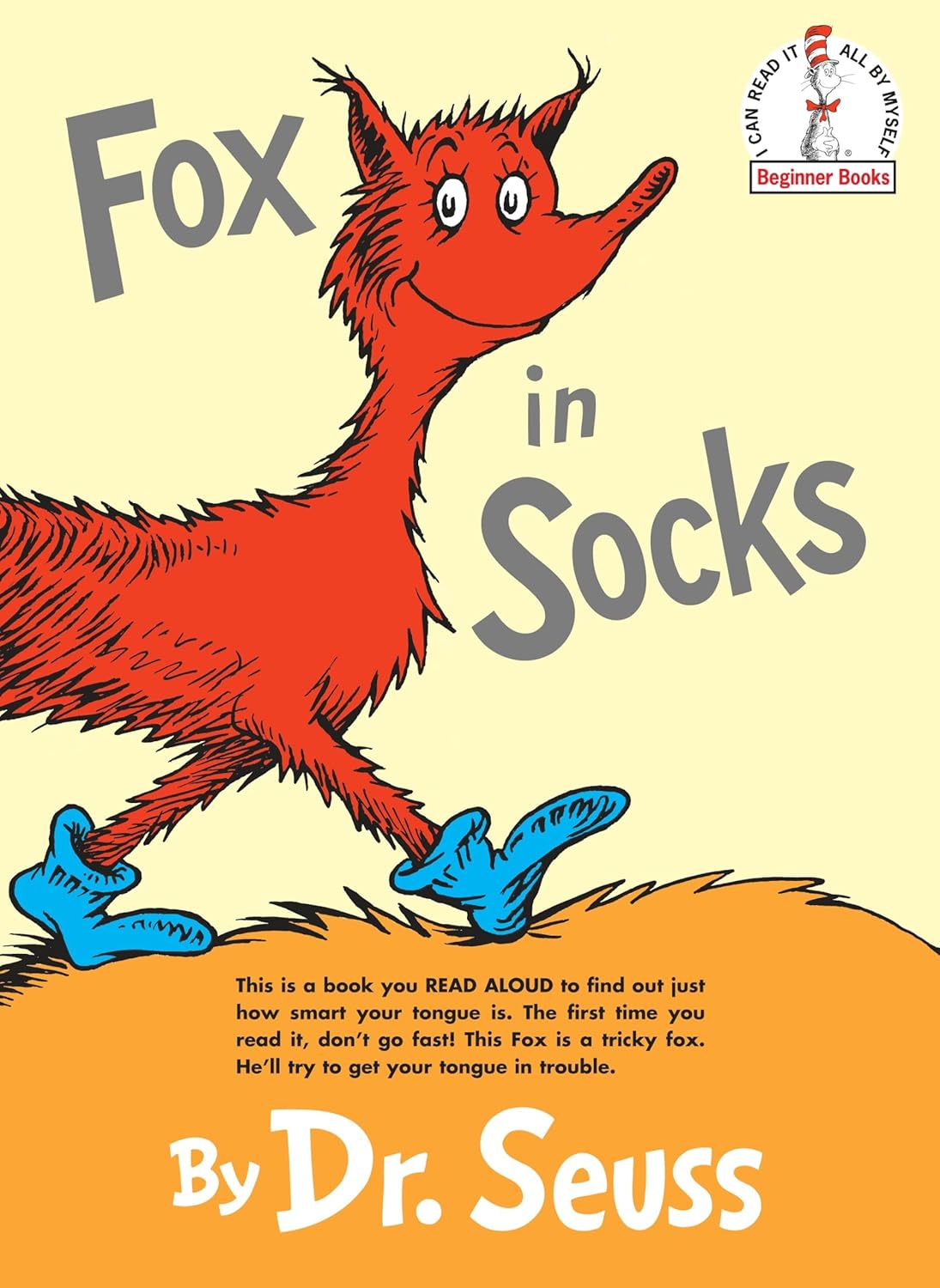
Fox in Socks, written and illustrated by Dr. Seuss, opens with a warning printed right on the first page: “This is a book you READ ALOUD to find out just how smart your tongue is. The first time you read it, don’t go fast! This Fox is a tricky fox. He’ll try to get your tongue in trouble.” This is not false advertising. Published in 1965 as part of Seuss’s Beginner Books series, Fox in Socks is the most purely performative book in his catalog — a 72-page escalating sequence of tongue twisters, in which a gleeful red fox named Mr. Fox leads a long-suffering character named Mr. Knox through increasingly complex phonological knots until Knox has finally had enough and fires the entire thing back at Fox. No other beginning reader in American children’s literature is so specifically and openly designed to make the person reading it fail — and no other makes that failure so funny for everyone within earshot. This guide covers Fox in Socks‘s reading level, whether it’s a read-aloud or independent read, what it’s about, its key skills and themes, how long it takes to read, and similar books — designed for parents and teachers of K–2 readers.
For Parents
A pure tongue-twister book in escalating rhyme — simple enough for a beginning reader to attempt independently, but genuinely challenging to read aloud fast even for adults. The book itself tells you to go slow the first time. Appropriate for ages 3–7 as a read-aloud and ages 5–7 as an independent reader. No content concerns. One of the most reliable ways to make an entire family laugh at the same time.
For Teachers
A PreK–2 classroom staple for phonological awareness — specifically for phoneme discrimination, blending, and the ability to hear and reproduce similar-sounding words in sequence. The escalating tongue-twister structure makes it ideal for fluency work, choral reading, and performance read-alouds where the goal is joyful engagement with sound rather than silent comprehension. Pairs naturally with other Seuss Beginner Books for author studies.
Fox in Socks at a Glance
Find on Amazon →| Author & Illustrator | Dr. Seuss (Theodor Seuss Geisel) |
| Published | 1965 (Beginner Books / Random House) |
| Grade Level | PreK–1 read-aloud; K–2 independent (our assessment) |
| Recommended Age | Read-aloud ages 3–7; independent reading ages 5–7 |
| Best For | Read-aloud ages 3–7; independent reading ages 5–7 |
| Lexile | 380L |
| ATOS Level | 2.1 |
| Fountas & Pinnell | L |
| Word Count | 834 |
| Pages | 72 |
| Genre | Beginning reader / tongue-twister / verse / humor |
For official Lexile and AR levels, visit Lexile.com or AR BookFinder. ReadingVine provides independent editorial assessments.
What Reading Level Is Fox in Socks?
Fox in Socks has a Lexile of 380L and an ATOS level of 2.1, placing it between One Fish Two Fish Red Fish Blue Fish (270L, ATOS 1.7) and How the Grinch Stole Christmas! (590L, ATOS 3.0) in the Seuss catalog’s reading level ladder. The 380L reflects a genuine middle ground: more complex than a pure beginning reader, less narratively demanding than the Grinch. The ATOS 2.1 corresponds to early second grade for comfortable independent reading.
However, Fox in Socks is unusual in that its reading-level scores significantly understate its difficulty as a read-aloud. The Lexile and ATOS measure vocabulary and sentence complexity — and by those measures, the book is simple. What they cannot measure is the phonological challenge of actually producing the tongue twisters at speed: “tweetle beetle noodle poodle bottled paddled muddled duddled fuddled wuddled fox in socks” is not a difficult sentence to understand, but it is genuinely difficult to say. Fox in Socks is probably the only book in American children’s literature that is harder for adults to read aloud than it is for children to read silently. The book’s own opening warning acknowledges this — Seuss tells readers directly that the Fox will try to get their tongue in trouble, and he was not wrong. For official Lexile and AR scores, visit Lexile.com or AR BookFinder. ReadingVine’s assessments are independent editorial judgments.
Is Fox in Socks a Read-Aloud or Independent Read?
This is both a brilliant read-aloud for ages 3–7 and an appropriate independent read for ages 5–7 — but with an important distinction from other books in this catalog: the read-aloud experience here is participatory in a way that most picture books are not. Fox in Socks is specifically designed to be performed, and it is specifically designed to make the performer stumble. The book says this on the first page. The failure is the point.
As a read-aloud, Fox in Socks is an event rather than a session. The adult begins confidently — “Fox, socks, Knox in box” — and the book slowly, systematically destroys that confidence across seventy-two pages, until the final tongue twister arrives and the entire family is laughing at whoever is doing the reading. Children love this specifically because the adult is the one failing. The power dynamic of the read-aloud is inverted: the child is the audience watching the grown-up get tongue-tied, and this is among the best things that can happen to a young child’s relationship with books and with the adults who read to them.
For independent reading, a confident kindergartner or first-grader can work through the text — the vocabulary is controlled and accessible, the rhyme and rhythm scaffold decoding, and the tongue twisters are as fun to attempt silently as they are to say aloud. Many children who love this book will spend time alone with it simply trying to get the harder twisters right.
The book’s own advice is the best advice: go slow the first time. Then try it faster. Let your child time you on the harder pages and cheer when you stumble — which you will. On subsequent readings, challenge your child to try the tongue twisters with you. The goal is not to read it perfectly; the goal is to enjoy failing at it together, which is one of the most underrated things a book can offer a family.
What Is Fox in Socks About?
Mr. Fox — a red fox in socks — arrives to entertain Mr. Knox with a series of tongue twisters. Mr. Knox does not want to be entertained. He would prefer to be left alone. The Fox does not care. He begins simply: “Fox, socks, Knox in box. Knox in box on fox in socks.” Simple enough. Clear. Then it escalates: chicks with bricks arrive, and clocks, and blocks. Sue and Slow Joe Crow appear, sewing, and the sewing and the crowing and the growing combine into something that requires more mouth than Mr. Knox has available. Luke Luck appears with lake ducks. Tweetle beetles arrive in puddles for paddle battles. The Goo-Goose chews blue goo. By the time the fox reaches the climactic compound construction — the full-sentence stack of tweetle beetle noodle poodle bottled paddled muddled duddled fuddled wuddled fox in socks — Mr. Knox has had enough. He turns the entire thing back on the Fox, at speed, leaving the Fox sputtering. Knox walks away. The Fox, for the first time in the book, is silenced.
There is a narrative arc here — the escalation, the turning of the tables, the Fox’s comeuppance — but it is in the service of the sound rather than the story. The plot is a delivery mechanism for increasingly complex phonological constructions, and Seuss knows this and celebrates it. The book is less a story than a game, and Mr. Knox’s final victory is the reader’s victory: we have survived the tongue twisters, we have gotten our tongues in trouble, and we have made it to the end.
Fox in Socks Characters
Mr. Fox is the book’s irresistible instigator — a red fox in socks whose entire purpose is to make tongue twisters and see what happens when someone tries to say them. He is cheerful, relentless, and entirely untroubled by the chaos he creates. He has named specific characters after himself: Fox, of course, but also the broader category of fox in socks, which becomes its own character as the compounding builds. Mr. Knox is the book’s audience surrogate: long-suffering, increasingly irritated, and finally triumphant — the ordinary person who endures extraordinary nonsense with patience and, eventually, turns the tables. Secondary characters include Sue and Slow Joe Crow (who sew), Luke Luck (whose lake ducks enjoy luck), the tweetle beetles (who have puddle paddle battles), and the Goo-Goose (who chews blue goo), each appearing in specific tongue-twister sequences before vanishing into the book’s sound-world. Seuss dedicated the book to Audrey Dimond — who became his wife in 1968 — because she was the only adult in his circle who could read the tongue twisters aloud without stumbling.
What Skills Does Fox in Socks Build?
Fox in Socks is among the most effective phonological awareness texts available for young children — not because it teaches phonemes directly, but because it makes children genuinely attend to the sounds of language in a way that no worksheet or drill can replicate. The tongue twisters work by using phonemes that are similar enough to be easily confused: the /ks/ in Knox, fox, and socks; the /s/ and /sl/ sounds in Sue, sew, slow; the /oo/ and /ew/ sounds throughout. A child who has played with this book has exercised their ability to discriminate between similar sounds at a level that directly supports phonics instruction and early decoding.
The escalating structure also builds a specific kind of reading stamina: each page is harder than the last, and the book asks its reader — child or adult — to keep going even when it gets difficult. The fact that the difficulty is funny rather than discouraging is what makes this possible. Children who encounter challenging text in a context of play rather than evaluation build a relationship with difficulty that is productive rather than aversive — they learn that hard things can be fun to try, even when you fail.
Talking with your child: Which tongue twister was the hardest to say? Can you say “tweetle beetle” five times fast? Can you make up your own tongue twister using words that sound alike? Which character would you rather be — Fox or Knox?
How Long Is Fox in Socks?
Fox in Socks is 72 pages with 834 words. As a read-aloud at the recommended slow pace, it takes about ten to fifteen minutes — though this varies enormously based on how often the reader stumbles and how long the laughter lasts. Reading it fast, as one inevitably attempts on subsequent readings, takes about five to eight minutes; recovering from the inevitable failures adds time. The book’s word count is lower than One Fish Two Fish (1,308 words) despite having the same page count, reflecting the generous white space Seuss gives the tongue twisters — each construction gets room to breathe and be looked at before the next arrives. A beginning independent reader working through it carefully may take fifteen to twenty minutes; motivated children often return to specific pages to try again and again.
Books Similar to Fox in Socks
About Dr. Seuss
Dr. Seuss — Theodor Seuss Geisel — wrote Fox in Socks through most of 1964, prioritizing the sound and structure of the tongue twisters over coherence, which is why the book contains constructions like “tweetle beetle noodle poodle bottled paddled muddled duddled fuddled wuddled fox in socks” — a phrase that retains grammatical structure while being nearly impossible to say aloud. He met Audrey Dimond while working on the manuscript and found that she was the only adult who could read the tongue twisters correctly; he dedicated the book to her and married her in 1968. He also added the line “Moe blows Joe’s nose, Joe blows Moe’s nose” specifically to test his editor Bennett Cerf — a similar editorial provocation to his earlier addition of the word “contraceptive” to the manuscript of Hop on Pop. Cerf kept the nose-blowing line.
For a full biography of Dr. Seuss, see our Sneetches guide. Fox in Socks was not among the six Dr. Seuss titles withdrawn from publication by Dr. Seuss Enterprises in March 2021 and remains in print. In 2001, it was listed as the 31st best-selling hardcover children’s book in the United States.
Fox in Socks: Frequently Asked Questions
What reading level is Fox in Socks?
Fox in Socks has a Lexile of 380L and an ATOS level of 2.1 — placing it between One Fish Two Fish (270L) and the Grinch (590L) in the Seuss reading-level ladder. These scores measure vocabulary and sentence complexity; they do not measure the tongue-twister difficulty of actually saying the text aloud, which is considerably greater. Our assessment: read-aloud for ages 3–7; independent reading for ages 5–7. For official Lexile and AR scores, visit Lexile.com or AR BookFinder.
Can a kindergartner read Fox in Socks alone?
A confident kindergartner can work through the text independently — the vocabulary is controlled and the rhyme scaffolds decoding. Many children who love the book spend time alone trying to get the tongue twisters right. The challenge of independent reading is not the words but the phonological complexity of the constructions, which is exactly the challenge that makes the book so valuable for phonological awareness.
How long does it take to read Fox in Socks aloud?
About ten to fifteen minutes at the recommended slow pace — though this varies significantly based on how often the reader stumbles and how long the laughter lasts. Reading it fast takes about five to eight minutes, not accounting for recovery time. The book itself tells you to go slow the first time.
What is Fox in Socks about?
A gleeful red fox named Mr. Fox leads a long-suffering Mr. Knox through a series of escalating tongue twisters — from simple rhymes about fox, socks, and Knox in a box, through chicks with bricks, tweetle beetles in puddles, a Goo-Goose chewing blue goo, and ultimately the climactic compound tongue twister that is nearly impossible to say at speed. Knox endures all of it, then fires the whole thing back at Fox and walks away victorious.
What is the hardest tongue twister in Fox in Socks?
The climactic “tweetle beetle noodle poodle bottled paddled muddled duddled fuddled wuddled fox in socks” is the book’s most famous challenge — a compound construction that stacks modifiers onto “fox in socks” until the phrase becomes genuinely difficult to say at any speed. It appears near the end, after the reader has already been softened up by dozens of earlier twisters. Seuss built to it deliberately across the whole book.
Why did Dr. Seuss dedicate Fox in Socks to Audrey Dimond?
Seuss was working on the book when he met Audrey Dimond, and she was the only adult in his circle who could read the tongue twisters aloud without stumbling. He dedicated the book to her — and later married her in 1968. The dedication reads “For Audrey and Mitzi Long, my friends of the Mt. Soledad Lingual Laboratories” — a fictional institution Seuss invented for the occasion.
Is Fox in Socks good for teaching phonics?
Yes — it is one of the most effective phonological awareness texts available for young children, specifically because it is not trying to be educational. The tongue twisters require children to discriminate between similar-sounding phonemes, blend sounds in rapid sequence, and attend closely to the specific sounds of words rather than their meanings. These are precisely the skills that support phonics instruction and early decoding — and Fox in Socks builds them through play rather than drill.