
 = Partner Site
One Fish Two Fish Red Fish Blue Fish Reading Level: A Complete Guide
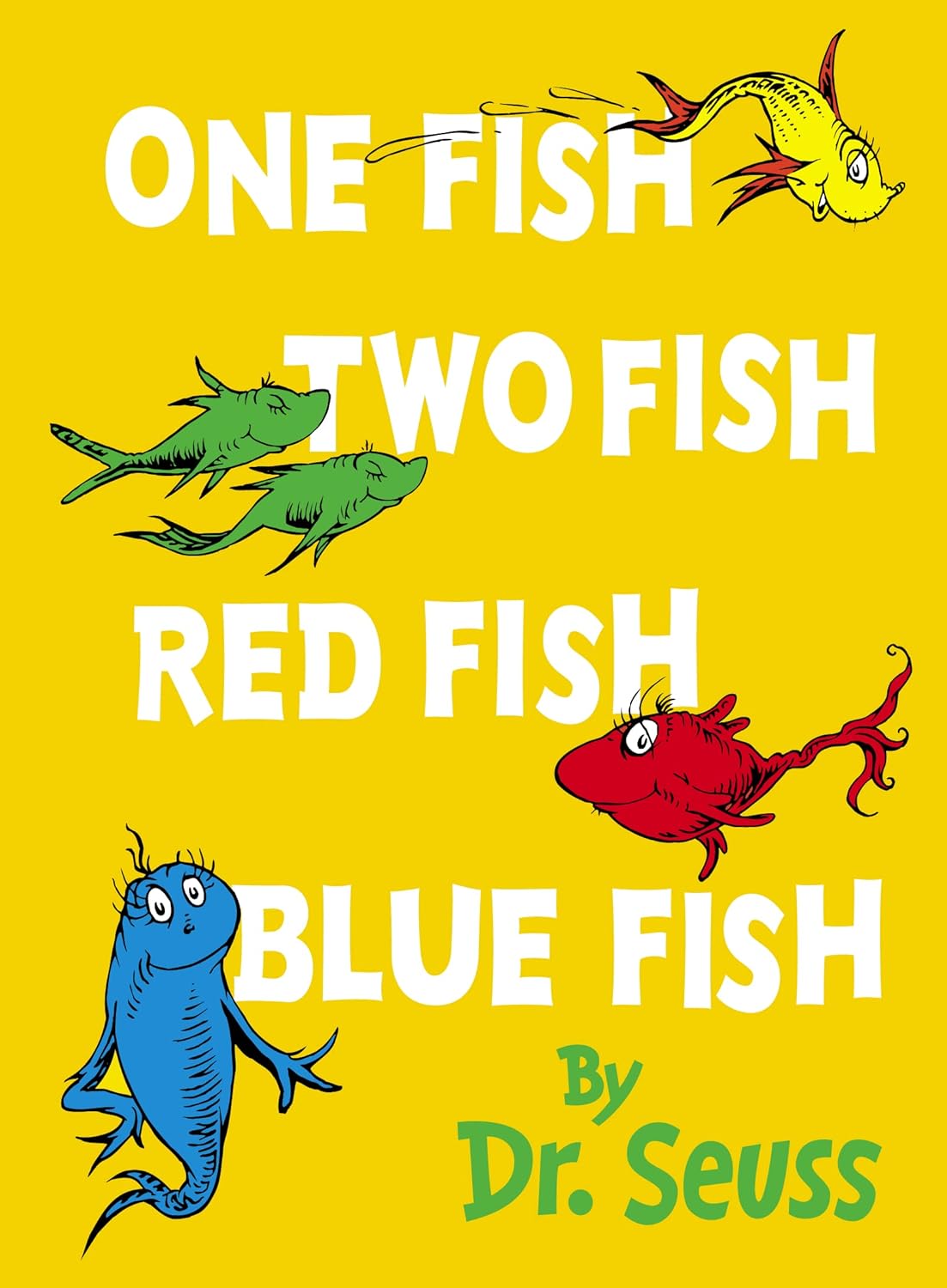
One Fish Two Fish Red Fish Blue Fish, written and illustrated by Dr. Seuss, is a 72-page beginning reader published in 1960 as part of Seuss’s Beginner Books series — the line of early readers he founded in 1957 alongside The Cat in the Hat, specifically designed to replace the dull “Dick and Jane” primers that dominated American classrooms with something children would actually want to read. Unlike most of the Seuss books in this catalog, One Fish Two Fish has no plot, no villain, no moral argument, and no traditional characters — just a joyful, rhyming parade of invented creatures (the Yink who drinks pink ink, the Zans who open cans, the boxing Gox, the winking Wump) organized around counting, color, opposites, and the simple pleasure of words fitting together perfectly. It is one of the bestselling children’s books in American publishing history, found in more homes and more classroom libraries than almost any other early reader. This guide covers One Fish Two Fish Red Fish Blue Fish‘s reading level, whether it’s a read-aloud or independent read, what it’s about, its key skills and themes, how long it takes to read, and similar books — designed for parents and teachers of K–2 readers.
For Parents
The gold-standard beginning reader — designed to be a child’s first successful independent reading experience. Short rhyming vignettes built on simple phonics patterns, counting concepts, and color words make it ideal for children just beginning to decode. Best as a read-aloud for ages 3–5 and a first independent reader for ages 5–7. No content concerns whatsoever. Buy two copies — one for the bookshelf and one for the car.
For Teachers
A PreK–1 classroom staple for phonics instruction, rhyme awareness, counting concepts, and color words. The book’s structure — short, contained vignettes with clear rhyme pairs — makes it ideal for choral reading, partner reading, and repeated reading practice. Pairs naturally with other Beginner Books for early reader units and with The Sneetches and How the Grinch Stole Christmas! for Dr. Seuss author studies across ability levels.
One Fish Two Fish Red Fish Blue Fish at a Glance
Find on Amazon →| Author & Illustrator | Dr. Seuss (Theodor Seuss Geisel) |
| Published | 1960 (Beginner Books / Random House) |
| Grade Level | PreK–K read-aloud; K–1 independent (our assessment) |
| Recommended Age | Read-aloud ages 3–5; independent reading ages 5–7 |
| Best For | Read-aloud ages 3–5; independent reading ages 5–7 |
| Lexile | 270L |
| ATOS Level | 1.7 |
| Fountas & Pinnell | ~L |
| Word Count | 1,308 |
| Pages | 72 |
| Genre | Beginning reader / early reader / verse |
For official Lexile and AR levels, visit Lexile.com or AR BookFinder. ReadingVine provides independent editorial assessments.
What Reading Level Is One Fish Two Fish Red Fish Blue Fish?
One Fish Two Fish Red Fish Blue Fish has a Lexile of 270L and an ATOS level of 1.7 — the lowest reading level scores of any Dr. Seuss book in this catalog, and among the lowest of any book on the K–2 master list. These scores accurately reflect what the book is: a carefully engineered beginning reader, written with a controlled vocabulary designed to be accessible to children who are just learning to decode. The 270L Lexile places it at a kindergarten-to-early-first-grade independent reading level; the ATOS 1.7 is consistent with mid-to-late first grade for comfortable independent reading.
Comparing the Seuss books in this catalog by Lexile tells the story clearly: One Fish Two Fish at 270L is a true beginning reader; How the Grinch Stole Christmas! at 590L is an early independent reader for second-graders; The Sneetches (NP — Non-Prose) is a more complex rhyming text. For a child who is just beginning to read independently, One Fish Two Fish is the right starting Seuss. For official Lexile and AR scores, visit Lexile.com or AR BookFinder. ReadingVine’s assessments are independent editorial judgments.
Is One Fish Two Fish Red Fish Blue Fish a Read-Aloud or Independent Read?
This is both a delightful read-aloud for ages 3–5 and the ideal first independent reader for ages 5–7.
As a read-aloud, One Fish Two Fish is pure pleasure — the rhymes land cleanly, the invented creatures are intrinsically funny (“I do not like this one so well / All he does is yell yell yell”), and the book’s loose vignette structure means you can stop anywhere without losing momentum. Toddlers and preschoolers who cannot yet follow a plotted story can engage fully with each small rhyming unit, and the counting and color sequences give them something to identify and call out. Children who hear it read aloud dozens of times — which many will — are building phonemic awareness and rhyme recognition without any awareness that they are doing so.
As an independent reader, One Fish Two Fish is specifically engineered for the child who is just beginning to decode. Dr. Seuss designed the Beginner Books series to give beginning readers text they could successfully read on their own, using a limited vocabulary with a high proportion of decodable words, rhyme pairs that scaffold word recognition, and illustrations that provide strong context clues. A child who can read this book independently has reached a genuine milestone — and Seuss writes each vignette so that succeeding with one gives a child the momentum to try the next.
Give your child the rhyming word: read “One fish, two fish, red fish” and then pause, letting them supply “blue fish.” Build up to having them read entire short vignettes while you follow along. The rhyme structure makes it possible for a child to be a successful reader before they can decode every word — and that experience of success is what keeps them wanting to read more.
What Is One Fish Two Fish Red Fish Blue Fish About?
One Fish Two Fish Red Fish Blue Fish does not have a plot in the traditional sense — it is a book of vignettes, each built around a rhyming pair or a short sequence of connected ideas. It begins with the famous counting and color opening (“One fish, two fish, red fish, blue fish”) and moves through a series of brief scenes featuring invented creatures: the Yink, who drinks pink ink; the Zans, who are very good at opening cans but not at other things; the Gox, who boxes; the Wump, who has a bump; the Nook, who likes to read in a special hook. Each creature is introduced in two to eight lines, illustrated with one of Seuss’s loose-limbed, cheerful drawings, and then left behind as the book moves on to the next one.
The underlying structure, beneath the surface variety, is a tour through early learning concepts: counting (one, two), colors (red, blue, black, old, new), opposites (near and far, here and there, day and night, left and right), body parts, feelings, and simple actions. None of these are taught didactically — the counting appears in the opening, but then the book moves on. The concepts are embedded in the play rather than presented as lessons. The final lines — “Today is gone. Today was fun. Tomorrow is another one. From there to here, from here to there, funny things are everywhere” — are the book’s nearest approach to a theme: the world is full of funny things, and reading is how you find them.
What Skills Does One Fish Two Fish Build?
The book was explicitly designed as a teaching tool, and it delivers on multiple fronts simultaneously. The rhyme pairs (fish/dish, Yink/pink/ink, Zans/cans) build phonemic awareness — the ability to hear and manipulate sounds in words — which is one of the strongest predictors of future reading success. The controlled vocabulary means a beginning reader encounters the same high-frequency words repeatedly across the book, building sight-word recognition through repetition. The short-vowel CVC patterns (fish, can, box, Gox) are among the first phonics patterns taught in kindergarten and first grade, and Seuss deploys them in a context that makes practice feel like play rather than drill.
The counting and color concepts are delivered so naturally that children often don’t realize they are being taught. A child who can identify one, two, red, and blue by the end of the opening page has practiced four early learning concepts without encountering a single worksheet. This integration of playful content with structured learning targets is what makes Seuss’s Beginner Books enduringly useful in classrooms long after many more explicitly educational materials have been abandoned.
Perhaps most importantly, the book teaches children that reading is pleasurable — that the reward for decoding a word is often a good joke, a funny image, or the satisfaction of a rhyme clicking into place. Children who learn to read with texts like this one associate reading with delight rather than difficulty, and that association is one of the most durable gifts early literacy instruction can provide.
Talking with your child: Can you find all the different colors in the book? Let’s count the fish on the first page. What silly creature is your favorite — and why? Can you think of a rhyme for “fish”? What do you think a Yink looks like?
How Long Is One Fish Two Fish Red Fish Blue Fish?
One Fish Two Fish Red Fish Blue Fish is 72 pages with 1,308 words — about 21 words per page, consistent with the Beginner Books format that places illustrations in generous proportion to text. As a read-aloud, most adults can read it in about ten to twelve minutes. As an independent reader, a beginning kindergartner working through it carefully may take twenty to thirty minutes across one or more sittings; a confident first-grader may read it in one fifteen-minute session. The book’s vignette structure makes it easy to stop and start without losing narrative thread — there is no narrative thread to lose, which is one of its most practical virtues for parents reading with children who have short attention spans or need to pause frequently.
Books Similar to One Fish Two Fish Red Fish Blue Fish
About Dr. Seuss
Dr. Seuss — Theodor Seuss Geisel — founded the Beginner Books imprint at Random House in 1957 alongside The Cat in the Hat, which he wrote after reading a report by education researcher Rudolf Flesch arguing that American children were failing to learn to read because primers were boring. Seuss agreed. He wrote The Cat in the Hat using a vocabulary of 236 words drawn from a list of words that beginning readers could be expected to know, and produced a book that children would choose to read on their own. It became one of the bestselling children’s books in history. One Fish Two Fish Red Fish Blue Fish followed three years later as part of the same series — applying the same controlled vocabulary approach to an even younger target audience, using counting, colors, and invented creatures to make the earliest stages of reading feel like an adventure rather than a task.
For a fuller biography of Dr. Seuss, see our Sneetches guide or our Grinch guide. One Fish Two Fish Red Fish Blue Fish was not among the six Dr. Seuss titles withdrawn from publication by Dr. Seuss Enterprises in March 2021; it remains in print and in active classroom use. March 2 — Seuss’s birthday — is celebrated as Read Across America Day, and One Fish Two Fish is among the most commonly read-aloud books on that day in American schools.
One Fish Two Fish Red Fish Blue Fish: Frequently Asked Questions
What reading level is One Fish Two Fish Red Fish Blue Fish?
One Fish Two Fish Red Fish Blue Fish has a Lexile of 270L and an ATOS level of 1.7 — among the lowest reading level scores in this catalog, accurately reflecting its design as a true beginning reader. Our assessment: read-aloud for ages 3–5; independent reading for ages 5–7. For official Lexile and AR scores, visit Lexile.com or AR BookFinder.
Can a kindergartner read One Fish Two Fish alone?
Yes — this is one of the books most specifically designed for a kindergartner’s first independent reading experiences. A child in mid-to-late kindergarten who is beginning to decode will find the rhyme structure and controlled vocabulary supportive. Many children succeed with this book before they can independently read most picture books, because the short vignette structure lets them succeed one small chunk at a time.
How long does it take to read One Fish Two Fish aloud?
About ten to twelve minutes as a read-aloud. The vignette structure means you can stop anywhere — there is no narrative thread to lose. A beginning independent reader may take twenty to thirty minutes across one or more sittings.
What is One Fish Two Fish Red Fish Blue Fish about?
There is no plot — it is a joyful collection of short rhyming vignettes about invented creatures (the Yink, the Zans, the Gox, the Wump) organized around counting, colors, opposites, and the pleasure of words fitting together. Each vignette is two to eight lines, funny in itself, and then the book moves on to the next one. The final lines sum it up: “From there to here, from here to there, funny things are everywhere.”
What skills does One Fish Two Fish teach?
Phonemic awareness and rhyme recognition, counting to ten, color words, opposites, high-frequency sight words, and basic CVC phonics patterns — all embedded in rhyming play rather than presented as lessons. It is among the most effectively structured beginning readers for building early literacy skills while maintaining a child’s genuine enthusiasm for the text.
Is One Fish Two Fish the same as other Dr. Seuss books?
It is in the same anapestic verse style and visual world as other Seuss books, but it belongs to his Beginner Books series — specifically engineered for beginning independent readers, with a controlled vocabulary and no narrative plot. It is structurally simpler than The Cat in the Hat, The Grinch, or The Sneetches, all of which have full narrative arcs. Think of it as the Seuss that teaches a child to read, while those other books are the Seuss that rewards a child who is learning.