
 = Partner Site
Half Magic Reading Level: A Complete Guide
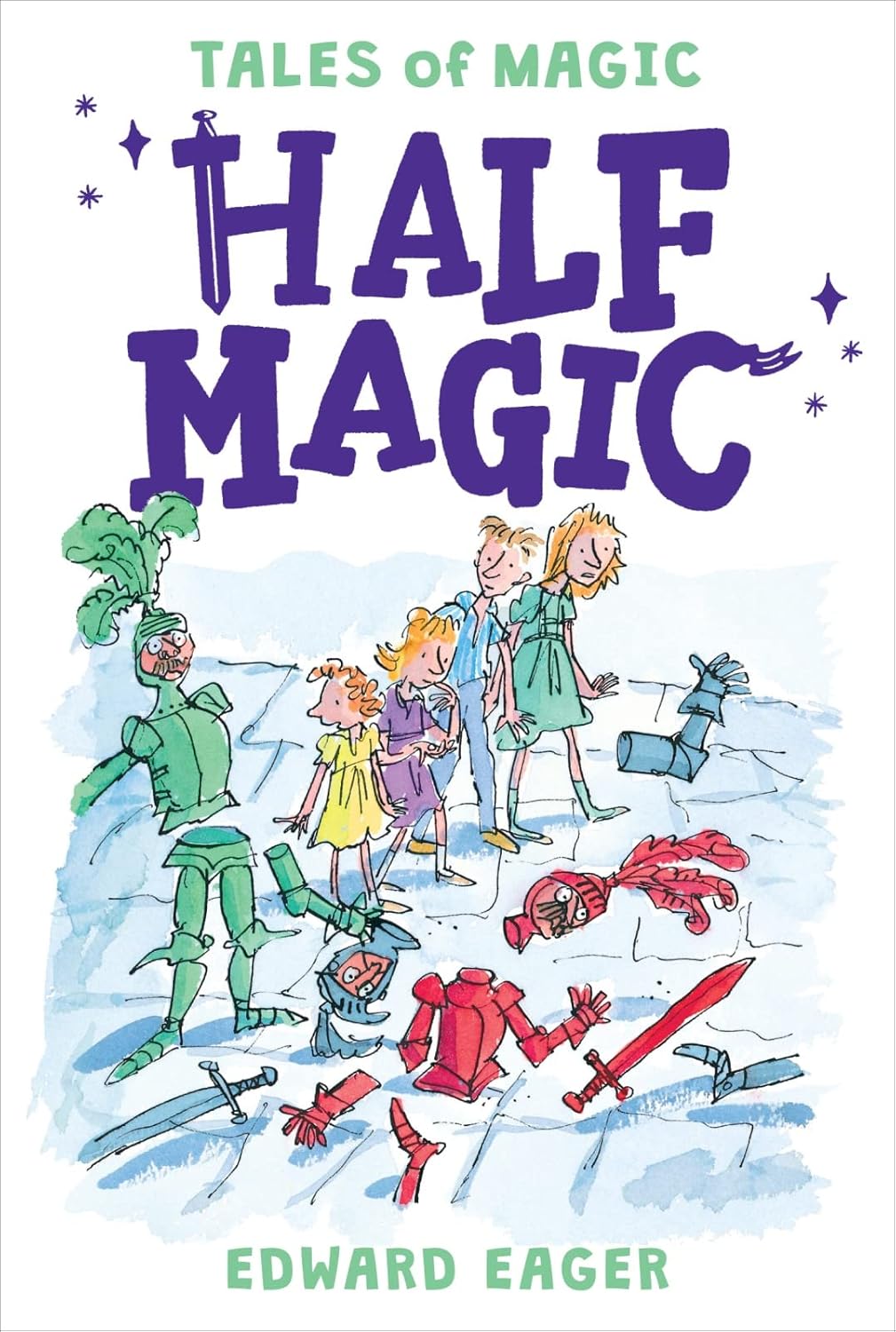
Half Magic by Edward Eager is a beloved classic of American children’s fantasy about four siblings who discover a magic coin on a summer sidewalk — one that grants exactly half of any wish — and must learn to wish twice as much as they want in order to get anything done at all. This complete guide covers Half Magic’s reading level, recommended age, content considerations, characters, themes, and books similar to Half Magic, designed for parents, teachers, and students.
For Parents
Half Magic is one of the most purely enjoyable middle-grade fantasy novels ever written — funny, inventive, and warm without ever being saccharine. The half-magic premise generates an almost inexhaustible supply of comic situations, and Eager’s prose has a dry wit that makes it as entertaining for adults reading aloud as it is for children listening. Content concerns are essentially nonexistent. The book is appropriate for most readers ages 7 and up and is a perennial family read-aloud favorite. It is especially beloved by parents who grew up with it and want to share it with their own children.
For Teachers
Half Magic works beautifully in grades 3–5 as a classroom read-aloud or independent reading selection. The half-magic premise is an excellent model for creative writing exercises — students love inventing their own half-wishes and working out the consequences — and the book’s episodic structure makes it easy to read in manageable sessions. Eager’s frequent, affectionate references to E. Nesbit’s fantasy novels provide a natural entry point for discussions of how authors are influenced by books they love, making it a useful text for units on literary tradition and intertextuality.
Half Magic at a Glance
Find on Amazon →| Author | Edward Eager |
| Published | 1954 |
| Grade Level | 3–5 (our assessment) |
| Recommended Age | 7–11 |
| Flesch-Kincaid Grade | 4.8 |
| Word Count | ~31,000 |
| Pages | 217 (standard paperback) |
| Chapters | 9 |
| Genre | Fantasy / adventure / humor |
| Setting | A small American city; 1950s; with magical excursions to medieval England, ancient Egypt, and elsewhere |
| Awards | — |
For official Lexile and AR levels, visit Lexile.com or AR BookFinder. ReadingVine provides independent editorial assessments.
What Reading Level Is Half Magic?
Half Magic reads at approximately a 4th- to 5th-grade word level by standard readability measures (Flesch-Kincaid grade 4.8), somewhat above the grade range where it is most commonly enjoyed. Our editorial assessment is grades 3–5 for independent reading. As with The Borrowers and similar mid-century British-influenced fantasy, the gap reflects the formal literary quality of Eager’s prose rather than genuine difficulty: the vocabulary is largely accessible, the humor is immediate, and the story’s comic momentum carries readers through any passages that require more effort. Strong 3rd-grade readers tackle it comfortably.
What distinguishes Half Magic at the sentence level is Eager’s voice — witty, self-aware, and occasionally addressing the reader directly in the tradition of E. Nesbit, whose Five Children and It and other books were an acknowledged inspiration. This narrative playfulness rewards readers who are paying close attention, and makes the book particularly satisfying as a read-aloud where the humor of the voice can be fully performed. For official Lexile and AR scores, visit Lexile.com or AR BookFinder.
What Age Is Half Magic Appropriate For?
We recommend Half Magic for readers ages 7–11, with the strongest fit at ages 8–10. The comic fantasy premise, the sibling dynamics, and the brisk adventure pacing make it broadly appealing across the late-elementary range. It works especially well as a family read-aloud for children as young as 6, where the humor of the half-wishes and the exasperation of the children when things go entertainingly wrong are irresistible for all ages. Readers who love it reliably seek out the rest of Eager’s Tales of Magic series.
Half Magic is almost entirely free of content concerns. The magical adventures take the children into some mildly perilous situations — medieval battles, a desert, a fire — but none of these are frightening in tone; the book maintains its comic register throughout, and the children are never in genuine danger that the humor doesn’t immediately defuse. The book was written in the 1950s and reflects that era’s domestic arrangements: the mother is a widow who works as a secretary, and a romantic subplot involving their mother and a kind stranger is handled with warmth and appropriate discretion. There is no violence beyond slapstick-level adventure, no profanity, and no frightening content.
Half Magic has a particular quality that makes it beloved across generations: the four children feel genuinely like children — squabbling, inventive, loving, occasionally thoughtless — rather than idealized or exemplary. This authenticity, combined with the comic rigor of the half-magic premise, is why the book has remained in print for more than seventy years and why readers who encounter it as children reliably press it on their own children decades later.
What Is Half Magic About?
It is the summer in a mid-sized American city in the 1950s, and Jane, Mark, Katharine, and Martha are four siblings facing a long, dull vacation. Their father is dead, their mother works, and the family is looked after during the day by a housekeeper named Miss Bick, who is reliable but distinctly unmagical. On an ordinary morning, Jane finds a coin on the sidewalk that turns out to be no ordinary coin: it is a magic charm. The problem — which becomes immediately apparent when Jane’s wish to go somewhere interesting results in the family being transported exactly halfway to a desert island — is that the charm grants only half of any wish.
The rest of the summer unfolds as a series of episodic adventures, each driven by a different child’s attempt to use the charm — with varying degrees of forethought and success. Mark wishes during a fight with a neighbor boy and gets half the result. Katharine accidentally transports the family cat to the court of King Arthur, and half-transports herself along behind it. Martha, the youngest, makes a wish involving their mother and a kind man she has been reading to at the library, setting in motion a subplot that turns out to be the book’s warmest thread. Through it all, the children gradually learn to wish twice as much as they want, to work together, and to think carefully about exactly what they are asking for.
Edward Eager wrote Half Magic as a deliberate love letter to the fantasy novels of E. Nesbit — particularly Five Children and It, The Phoenix and the Carpet, and The Story of the Amulet — which he had read as a child and read again to his own son. He acknowledged the debt openly within the book itself, having the children discover and read Nesbit’s novels and use them as guides for navigating magical situations. Half Magic was the first of seven Tales of Magic books Eager wrote between 1954 and 1958, all featuring children in contemporary American settings who encounter magic that operates by specific, consistent rules.
Half Magic Characters
Half Magic Themes and Lessons
Half Magic is at its core a book about the gap between what we wish for and what we actually need — and about the importance of thinking carefully before asking for something. The half-magic premise is a perfect comic engine for exploring this idea: every wish that goes wrong does so because the wisher failed to think through exactly what they wanted and how to ask for it. The children who do best with the charm are the ones who have learned to be precise, patient, and genuinely thoughtful about what they want. This makes the book a surprisingly sophisticated meditation on the nature of desire and the value of clear thinking, wrapped in a comedy of magical errors.
Eager also uses the charm to explore something more personal: the family’s adjustment to life without a father and the possibility of new happiness. The children’s mixed feelings about their mother’s growing friendship with Mr. Smith — wanting her to be happy, afraid of change, occasionally using the charm to meddle — give the book an emotional depth that elevates it beyond pure comic fantasy. Discussion questions worth exploring: Why does the charm grant only half of a wish — what does that say about how wishes work? How do the children change in how they use the charm as the story progresses? What does the book suggest about the relationship between getting what you wish for and actually being happy? How do the Nesbit books within the story shape how the children think about magic?
How Many Pages and Chapters Are in Half Magic?
Half Magic is 217 pages in the standard paperback edition, divided into 9 chapters. The word count is approximately 31,000 words — a short novel that reads quickly and energetically. At an average upper-elementary reading pace of around 200 words per minute, most readers in the target age range finish the book in roughly 2–3 hours of total reading time, typically one week or less of 20–30 minute daily reading sessions. The chapters are long by middle-grade standards — each runs roughly 20–25 pages and covers one main adventure — which means the book is best read in sustained sessions rather than short bursts. As a classroom read-aloud it works very well, with each chapter providing a complete, self-contained comic adventure that generates discussion. Most editions include charming illustrations by N.M. Bodecker throughout.
Books Similar to Half Magic
About Edward Eager
Edward Eager was born in 1911 in Toledo, Ohio, and spent most of his career as a playwright and lyricist for Broadway and television before turning to children’s fiction. He came to write the Tales of Magic series in the early 1950s because he was reading aloud to his young son and found a severe shortage of the kind of fantasy he wanted — the warm, witty, rule-governed magic of E. Nesbit’s Edwardian novels transplanted to a contemporary American setting. He set out to write that book himself, and Half Magic, published in 1954, was the result. He was open about his debt to Nesbit throughout his career, dedicating books to her and having his child characters read and discuss her work within the stories. Eager wrote seven Tales of Magic books between 1954 and 1958: Half Magic, Knight’s Castle, The Time Garden, Magic by the Lake, The Well-Wishers, Seven-Day Magic, and Magic or Not? — all featuring different sets of children encountering magic that operates by specific, internally consistent rules. Eager died in 1964 at the age of 53, having completed the series. His books have never been out of print and are consistently cited by authors of children’s fantasy — including Diana Wynne Jones and others — as foundational influences. The Tales of Magic series was reissued in handsome new editions by Harcourt in the early 2000s with new illustrations and introductions.
Half Magic: Frequently Asked Questions
What grade level is Half Magic?
By standard readability measures, Half Magic reads at approximately a 4th- to 5th-grade word level (Flesch-Kincaid grade 4.8). Our editorial assessment is grades 3–5 for independent reading, with the book working well as a read-aloud for children as young as 6 or 7. The formal literary quality of Eager’s prose produces a higher readability score than the actual reading experience warrants — strong 3rd-grade readers tackle it comfortably, and the comic momentum of the story carries readers through any passages that require more effort.
Is Half Magic part of a series?
Yes. Half Magic is the first book in Edward Eager’s Tales of Magic series, though the books can be read in any order and are all standalone stories. The other six books are Knight’s Castle (1956), The Time Garden (1958), Magic by the Lake (1957), The Well-Wishers (1960), Seven-Day Magic (1962), and Magic or Not? (1959). Each features a different set of children encountering a different kind of rule-governed magic. Knight’s Castle and Magic by the Lake feature the same children as Half Magic and are the most natural next reads for readers who love the first book.
How does the half-magic work exactly?
The charm grants exactly half of any wish stated in its presence. If you wish to go to a desert island, you end up halfway to a desert island. If you wish a fire would go out, it goes half out — and half stays lit. The only way to get what you actually want is to wish for twice as much: wish to go to two desert islands, and you end up at one. This requires the children to think very precisely about what they want and to do the mental arithmetic of doubling every wish, which is both the comic engine of the story and its central lesson about the value of careful, exact thinking.
What is the connection between Half Magic and E. Nesbit?
Edward Eager openly acknowledged that Half Magic and all his Tales of Magic books were inspired by and modeled on the fantasy novels of E. Nesbit — particularly Five Children and It, The Phoenix and the Carpet, and The Story of the Amulet. Nesbit was an Edwardian British author who pioneered the formula of contemporary children encountering magic that operates by specific rules, and her books were enormously influential on 20th-century children’s fantasy. Eager’s children actually read Nesbit’s books within the story, using them as guides for how to handle magical situations. Eager dedicated several of his books to Nesbit and has been described as her American successor. Readers who love Half Magic will very likely love Nesbit’s books as well.
Is Half Magic appropriate for a 2nd grader?
As a read-aloud, yes — Half Magic is a wonderful read-aloud for children as young as 6 or 7, and the comedy of the half-wishes is immediately funny even for very young listeners. For independent reading, 2nd grade is on the young end; the prose style is more formal than most 2nd-grade independent reading material and the chapters are long. 3rd grade is the more natural starting point for reading it independently, though strong 2nd-grade readers who are ready for chapter books often manage it comfortably.
When and where is Half Magic set?
The frame story takes place in a mid-sized American city in what appears to be the 1950s — Eager never names the city or specifies the year, but the domestic details (a widowed mother working as a secretary, the absence of television, the neighborhood geography) place it clearly in mid-century America. The magical adventures within the story take the children to medieval England, to ancient Egypt, and to various other times and places, all reached via the half-magic charm. The contemporary American setting was a deliberate choice: Eager wanted to do for American children what Nesbit had done for British ones — show that magic could happen in an ordinary modern neighborhood, not only in fairy tale kingdoms.
Are there other books like Half Magic?
The closest parallels are the other books in Eager’s own Tales of Magic series — particularly Knight’s Castle and Magic by the Lake, which continue the adventures of the same four children. Beyond Eager, readers who love Half Magic tend to also love E. Nesbit’s originals (Five Children and It is the natural first read), The Phantom Tollbooth for its similar delight in precise, rule-governed fantasy logic, and The Borrowers for its mid-century literary charm. All are on the ReadingVine master list and have their own guides.
Does Half Magic have a happy ending?
Yes — Half Magic has a thoroughly satisfying ending that resolves both the magical plot and the family’s personal story in ways that feel genuinely earned rather than contrived. Without giving away specifics, the ending involves a wish that requires exactly the kind of precise, thoughtful thinking the children have been slowly developing all summer, and the personal subplot involving their mother reaches a resolution that readers of all ages find warm and convincing. It is one of those endings that sends readers directly back to the beginning of the book or immediately to the next in the series.