
 = Partner Site
The Borrowers Reading Level: A Complete Guide
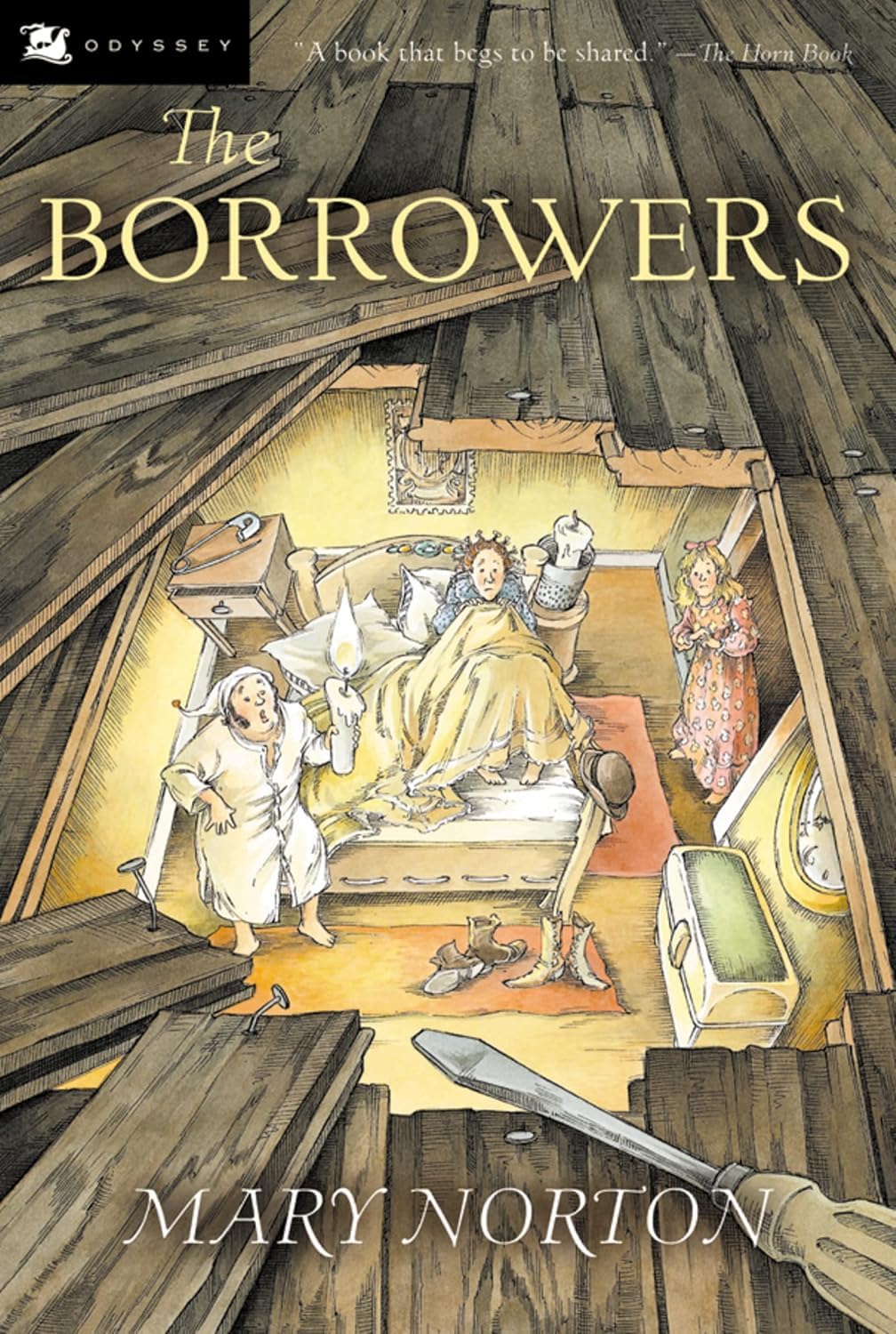
The Borrowers by Mary Norton is a classic of British children’s literature about a family of tiny people — no bigger than a thumb — who live hidden beneath the floorboards of an old English house and survive by “borrowing” small items from the human family above them, until the day a young boy discovers them and changes everything. This complete guide covers The Borrowers’ reading level, recommended age, content considerations, characters, themes, and books similar to The Borrowers, designed for parents, teachers, and students.
For Parents
The Borrowers is one of the most imaginative and quietly original books in the middle-grade canon — a story that takes a single fanciful premise (tiny people living inside your house) and follows it with remarkable consistency and care to its logical conclusions. The writing is gentle and literary, the characters are warmly human despite their miniature scale, and the story’s emotional depth rewards readers who bring patience and attention. Content concerns are minimal. Appropriate for most readers ages 7 and up, and a particularly rewarding family read-aloud.
For Teachers
The Borrowers works beautifully in grades 3–6 as a classroom read-aloud or independent reading selection. Its nested narrative structure — a story within a story within a story — is a sophisticated literary device that rewards discussion of how framing shapes meaning and reliability. The book’s themes of perspective, belonging, and the precariousness of small lives in a large world support rich discussion. It pairs naturally with units on British literature, fantasy, or point of view, and Norton’s attention to the physical details of miniature life makes it an excellent model for descriptive writing exercises.
The Borrowers at a Glance
Find on Amazon →| Author | Mary Norton |
| Published | 1952 |
| Grade Level | 3–5 (our assessment) |
| Recommended Age | 7–11 |
| Flesch-Kincaid Grade | 6.1 |
| Word Count | ~32,000 |
| Pages | 180 (standard paperback) |
| Chapters | 20 |
| Genre | Fantasy / children’s fiction |
| Setting | A large old English country house; mid-20th century |
| Awards | Carnegie Medal (1952) |
For official Lexile and AR levels, visit Lexile.com or AR BookFinder. ReadingVine provides independent editorial assessments.
What Reading Level Is The Borrowers?
The Borrowers reads at approximately a 6th-grade word level by standard readability measures (Flesch-Kincaid grade 6.1), which places it somewhat above the grade range where it is most commonly enjoyed. Our editorial assessment is grades 3–5 for independent reading. The gap between the readability score and the actual reading experience reflects something important about the book: Norton writes with a formal, literary precision that produces a higher Flesch-Kincaid score, but the vocabulary is largely accessible in context, the sentences — though carefully constructed — are not difficult to follow, and the story itself is immediately engaging for younger readers. Many 3rd and 4th graders read and love it independently without difficulty.
What gives The Borrowers its literary texture is Norton’s meticulous attention to the physical logic of a miniature world — how a cotton reel becomes a stool, how a postage stamp becomes a painting, how the gap beneath a floorboard becomes a home. This precision rewards careful, imaginative readers who enjoy noticing details. The nested framing device — the story is told to a child by a woman who heard it from a boy who knew the Borrowers — adds a layer of structural sophistication that makes it an excellent text for classroom discussion of narrative reliability. For official Lexile and AR scores, visit Lexile.com or AR BookFinder.
What Age Is The Borrowers Appropriate For?
We recommend The Borrowers for readers ages 7–11, with the strongest fit at ages 8–10. The book’s gentle fantasy, its warmly realized characters, and the irresistible logic of its miniature world make it broadly appealing across the late-elementary range. It works particularly well as a family read-aloud for children as young as 5 or 6, where an adult reader can bring out the prose’s quiet humor and the descriptions of the Borrowers’ ingeniously improvised home life.
The Borrowers is almost entirely free of content concerns. The story’s central tension involves the danger of a small family being discovered by humans — “seen,” in the Borrowers’ terminology — which carries consequences ranging from relocation to something more permanent and unspecified. The ending of the first book is somewhat abrupt and unresolved, leaving the Borrowers’ fate uncertain in a way that may be unsatisfying or mildly upsetting for very young readers. There is no violence, profanity, or frightening content. The housekeeper Mrs. Driver is unpleasant and antagonistic, but not in a way that is threatening to child readers. Some editions include a note explaining that the series continues, which helps prepare readers for the open ending.
The Borrowers has a particular quality that is rare in children’s fiction: it takes its premise completely seriously. Norton never winks at the reader or treats the Borrowers as cute novelties — they are a complete family with genuine concerns, a real culture, and a deeply felt sense of home. This seriousness of intent is what makes the book feel literary rather than merely charming, and it is what has kept it in print and in classrooms for more than seventy years.
What Is The Borrowers About?
Pod, Homily, and their teenage daughter Arrietty are Borrowers — a tiny family, no bigger than a child’s hand, who live in a hidden set of rooms beneath the kitchen floor of an old English country house called Firbank Hall. They survive by borrowing small things from the human family upstairs: a safety pin, a cotton reel, a thimble, a small square of carpet cut from a stair tread. Borrowers are acutely aware that being seen by a human is the greatest possible danger — it means discovery, and discovery means the end of everything. So when Arrietty, curious and restless and tired of her confined life beneath the floorboards, encounters a human boy recuperating from illness in the house, both of their lives begin to change in ways neither can anticipate.
The boy — who is never named in the story — is kind and genuinely fascinated by the Borrowers. He and Arrietty form a tentative friendship, and he begins secretly helping them: bringing Arrietty books from the library, passing along a doll’s house that becomes Homily’s greatest dream, leaving out items for Pod to borrow. But the boy’s kindness, however well-meant, draws the attention of the housekeeper Mrs. Driver, and the danger that has always shadowed the Borrowers begins to close in.
Mary Norton conceived the idea for the Borrowers as a child, lying in the grass and imagining that the world looked entirely different from a much lower height — that ordinary English countryside could be a wilderness of vast grasses and enormous flowers. The book is the first in a series of five, and Norton’s careful consistency about the rules of the Borrowers’ world — how they travel, how they communicate, how they understand and misunderstand the human world around them — gives the series a coherence and depth unusual for fantasy of its era. The book was published in 1952 and awarded the Carnegie Medal, the most prestigious British award for children’s literature, that same year.
The Borrowers Characters
The Borrowers Themes and Lessons
The Borrowers is fundamentally a book about perspective — about how radically different the same world looks depending on where you stand in it. Norton’s great achievement is making readers inhabit the Borrowers’ scale so completely that the human world becomes genuinely strange and enormous. A kitchen is a vast and dangerous plain. A stair carpet is a quarry of useful material. A clock case is a home. This perceptual shift — the ordinary made extraordinary through a change of scale — is the book’s most lasting imaginative gift, and it is the reason children who read it often find themselves looking at ordinary household objects differently for years afterward.
The novel is also about the precariousness of small lives in a large world, and about the particular vulnerability of those who survive by remaining invisible. The Borrowers’ culture is entirely organized around the principle of not being seen, and the book treats this not as a game but as a genuine existential condition — one that produces its own kind of dignity, ingenuity, and fear. Arrietty’s longing to be seen, to matter, to exist in the world rather than hiding from it, gives the story its emotional weight. Discussion questions worth exploring: Why do Borrowers consider it so dangerous to be seen by humans? What does Arrietty gain from her friendship with the boy — and what does she risk? How does Norton use physical detail to make the Borrowers’ world feel real? What does the book suggest about the relationship between home and safety?
How Many Pages and Chapters Are in The Borrowers?
The Borrowers is 180 pages in the standard paperback edition, divided into 20 chapters. The word count is approximately 32,000 words — a short novel that reads quickly despite its literary density. At an average upper-elementary reading pace of around 200 words per minute, most readers in the target age range finish the book in roughly 2–3 hours of total reading time, typically one week or less of 20–30 minute daily reading sessions. The chapters are short and consistently paced, making it easy to find natural stopping points and lending themselves well to classroom read-aloud. Most editions include illustrations — the original Beth Krush and Joe Krush illustrations are particularly beloved and appear in many standard editions. The book ends somewhat inconclusively, which is worth noting for parents and teachers: the story continues in four sequels, beginning with The Borrowers Afield (1955).
Books Similar to The Borrowers
About Mary Norton
Mary Norton was born in 1903 in London and grew up in Leighton Buzzard, Bedfordshire — the English countryside that forms the landscape of the Borrowers’ world. She has said that the idea for the Borrowers came from her own childhood shortsightedness: unable to see clearly at a distance, she spent a great deal of time examining things up close, at ground level, and imagining what the world might look like from an even smaller perspective. She worked as an actress before turning to writing, and published her first children’s book in 1943. The Borrowers, published in 1952, was the book that established her reputation and earned her the Carnegie Medal. She wrote four sequels: The Borrowers Afield (1955), The Borrowers Afloat (1959), The Borrowers Aloft (1961), and The Borrowers Avenged (1982) — the last published more than twenty years after the previous installment. Norton died in 1992. The Borrowers has been adapted multiple times for film and television, most notably as a 1997 British film and a 2010 Japanese animated film by Studio Ghibli’s parent company. The series remains one of the most beloved works of 20th-century British children’s literature.
The Borrowers: Frequently Asked Questions
What grade level is The Borrowers?
By standard readability measures, The Borrowers reads at approximately a 6th-grade word level (Flesch-Kincaid grade 6.1), but this score reflects the formality of Norton’s literary prose more than actual difficulty. Our editorial assessment is grades 3–5 for independent reading, with the book working well as a read-aloud for children as young as 7. Many 3rd and 4th graders read and love it without difficulty. The vocabulary is accessible in context, and the story’s imaginative appeal carries readers through the more formally written passages.
Is The Borrowers part of a series?
Yes. The Borrowers is the first of five books in the Borrowers series by Mary Norton. The sequels are The Borrowers Afield (1955), The Borrowers Afloat (1959), The Borrowers Aloft (1961), and The Borrowers Avenged (1982). Each book follows Pod, Homily, and Arrietty as they are forced out of Firbank Hall and must find new ways to survive in the wider world. The first book ends somewhat inconclusively — readers who find the ending unsatisfying will want to continue with the series, which resolves the family’s situation and expands their world considerably.
What exactly are Borrowers?
Borrowers are tiny human-like people — typically described as being the height of a pencil — who live hidden inside the walls and floors of human houses and “borrow” small items that humans won’t notice are missing: a safety pin, a cotton reel, a postage stamp, a hairpin, a dropped coin. The Borrowers’ entire material culture is built from repurposed human objects: their furniture is made from matchboxes and cotton reels, their paintings are postage stamps, their carpets are cut from human rugs. Norton’s genius was in working out this premise with complete logical consistency, so that every detail of Borrower life reflects what tiny people living inside a human house would actually need and use.
Is there a movie version of The Borrowers?
Yes — several. The most notable adaptations are a 1997 British live-action film starring John Goodman as the villainous Ocious Potter, which is a loose and considerably more action-oriented adaptation aimed at younger viewers; a well-regarded 1992 BBC television film that is generally considered more faithful to the book; and The Secret World of Arrietty (2010), a Japanese animated film produced by Studio Ghibli and directed by Hiromasa Yonebayashi, which is a beautifully made adaptation that transposes the story to contemporary Japan. The Ghibli adaptation in particular is widely praised and is a natural companion viewing for readers who have loved the book.
Why does the book have a nested storytelling structure?
The Borrowers is told as a story within a story within a story: a woman named Mrs. May tells the story to a child called Kate, having heard it from her brother as a child, who in turn knew the Boy who knew the Borrowers. This framing device is a deliberate literary choice that serves several purposes. It creates a sense of distance and half-remembered wonder — we are always hearing about the Borrowers at one remove, as something that might have happened, might be real. It also raises questions about reliability and imagination that make the book richer than a straightforward fantasy: did the Boy really see the Borrowers, or did he imagine them? Norton leaves the question deliberately open, inviting readers to decide for themselves.
What award did The Borrowers win?
The Borrowers won the Carnegie Medal in 1952, the most prestigious British award for children’s literature, given annually by the Chartered Institute of Library and Information Professionals to the most outstanding children’s book published in the United Kingdom. It is one of the most distinguished awards in children’s publishing, equivalent in prestige to the American Newbery Medal. The Carnegie Medal win in 1952 established Mary Norton’s reputation and helped secure the book’s long-term place in the British children’s literary canon.
Is The Borrowers appropriate for a 2nd grader?
As a read-aloud, yes — The Borrowers is a wonderful read-aloud for children as young as 6 or 7, and the descriptions of the Borrowers’ miniature home life are especially delightful for children who love imaginative play. For independent reading, 2nd grade is on the younger end; the prose style is more formal than most 2nd-grade independent reading material, and readers who are still building fluency may find it challenging without support. 3rd grade is the more natural starting point for independent reading.
Why is the boy in The Borrowers never given a name?
The boy who befriends Arrietty is never named in the text — he is referred to throughout simply as “the boy.” This is a deliberate authorial choice that reflects the nested narrative structure: Mrs. May, who is telling the story to Kate, says she does not know the boy’s name because her brother never told her. The namelessness also gives the boy a slightly archetypal quality — he is any curious, lonely child who might stumble upon something magical — and keeps the focus of the story firmly on the Borrowers themselves rather than on the human characters around them.