
 = Partner Site
Much Ado About Nothing Reading Level: A Complete Guide
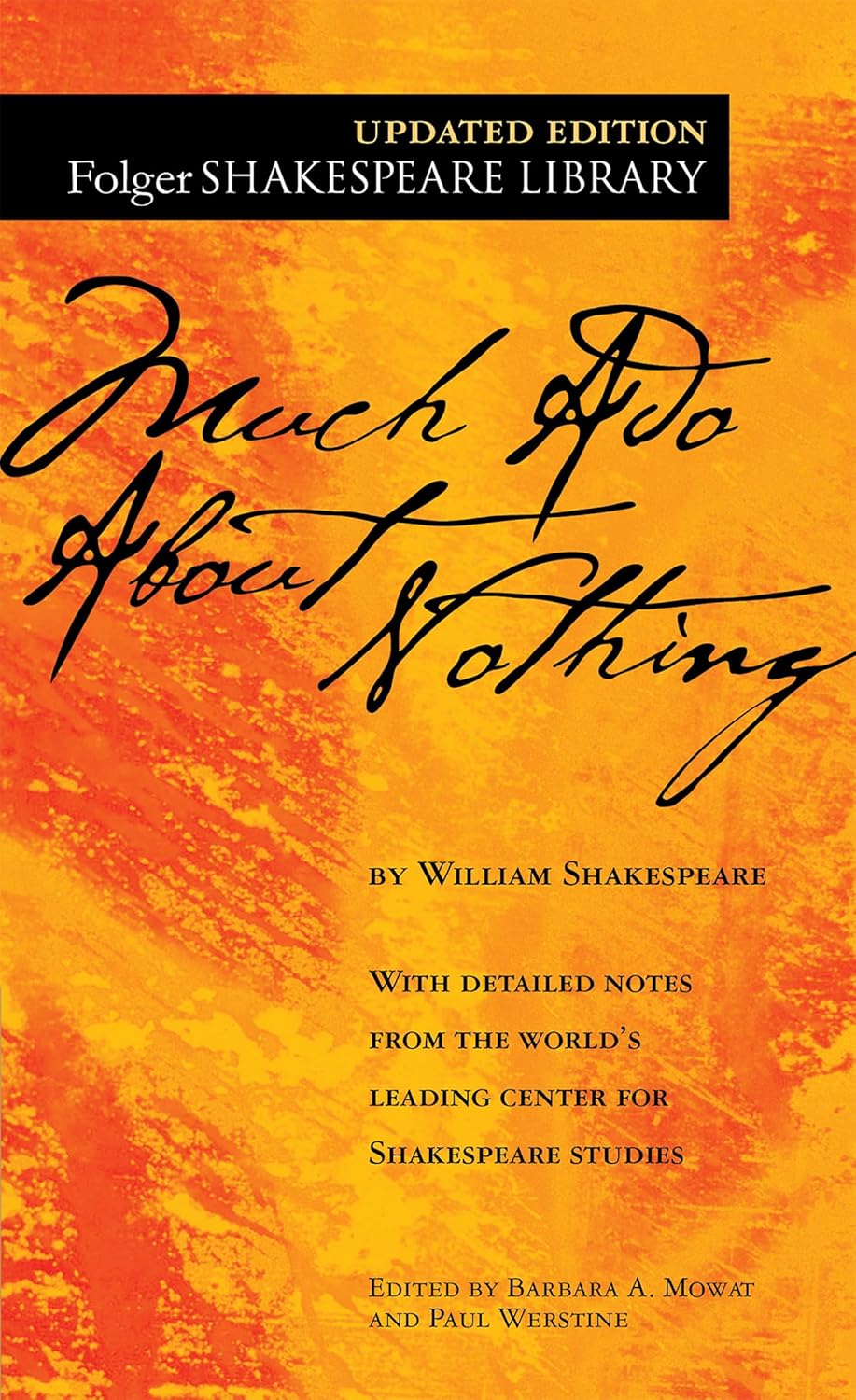
Much Ado About Nothing by William Shakespeare is a comedy set in Messina in which two pairs of lovers navigate romance through very different routes: Claudio and Hero fall in love at first sight, become engaged, and are nearly destroyed by a slander plot; Benedick and Beatrice have been sparring with each other for years, are tricked by their friends into admitting they love each other, and end the play reluctantly, joyfully married. Written around 1598–1599 and first published in 1600, it is Shakespeare’s most modern-feeling comedy — the Beatrice and Benedick plot invented a template for witty romantic comedy that the stage, screen, and novel have been borrowing ever since. This complete guide covers Much Ado About Nothing‘s reading level, recommended age, content considerations, characters, themes, and plays and books similar to Much Ado About Nothing, designed for parents, teachers, and students.
For Parents
A witty romantic comedy with a genuinely dark undercurrent: the main plot turns on a false accusation of premarital sex and a public shaming at the altar that is brutal even when the audience knows it is wrong. More linguistically accessible than most Shakespeare — significant portions are written in prose — but the content requires some maturity. Appropriate for ages 13 and up; widely assigned in grades 9–11.
For Teachers
An excellent grades 9–11 text for teaching the mechanics of comic plotting alongside the play’s darker argument about honor, shame, and how quickly a community will believe the worst about a woman. The Beatrice and Benedick scenes are the most natural Shakespeare dialogue for students new to the plays. The “noting” pun — noting as overhearing, noting as nothing — rewards close attention to the play’s language of rumor and misperception.
Much Ado About Nothing at a Glance
Find on Amazon →| Author | William Shakespeare |
| First Performed | c. 1598–1599 |
| First Published | 1600 (Quarto) |
| Grade Level | 9–11 (our assessment) |
| Recommended Age | 13+ |
| Lexile | Varies by edition (see reading level note) |
| Word Count | ~22,300 |
| Structure | 5 acts, 17 scenes |
| Genre | Comedy / romantic drama |
| Setting | Messina, Sicily; late Renaissance period |
For official Lexile and AR levels, visit Lexile.com or AR BookFinder. ReadingVine provides independent editorial assessments.
What Reading Level Is Much Ado About Nothing?
As with all Shakespeare plays, Lexile scores for Much Ado About Nothing vary significantly by edition and are unreliable for Early Modern dramatic writing. The same verse-measurement problem applies to this play’s blank verse scenes; the Lexile algorithm handles the substantial prose sections better but still does not capture the difficulty of archaic vocabulary and compressed syntax. ATOS data is not available for the original text.
What makes Much Ado distinctive — and somewhat more accessible than Shakespeare’s other major comedies — is that a larger proportion of the text is written in prose rather than verse. The comic characters, particularly Dogberry and the Watch, speak in prose throughout; Beatrice and Benedick conduct much of their sparring in prose; even some of the more serious scenes between Benedick and Claudio use prose rather than blank verse. This does not make the play easy, but it removes one layer of difficulty. Students who find the metrical demands of verse Shakespeare taxing often find Much Ado a somewhat gentler experience.
At approximately 22,300 words, the play is slightly shorter than Romeo and Juliet and comparable in length to Macbeth. Most classrooms complete it in two to three weeks. We place it at grades 9–11, appropriate for students who have already read one Shakespeare play and are ready for something with more tonal range — comedy and near-tragedy in the same two hours. For official Lexile and AR scores, visit Lexile.com or AR BookFinder. ReadingVine’s assessments are independent editorial judgments.
What Age Is Much Ado About Nothing Appropriate For?
We recommend Much Ado About Nothing for readers ages 13 and up. The play is considerably darker in its central plot than its reputation as a romantic comedy suggests. The Claudio-Hero storyline involves a false accusation of premarital sex, a public humiliation at the altar in which Claudio denounces Hero in front of her father and their community, and Hero’s apparent death from shame. The play treats all of this seriously even as it resolves comedically, and it requires readers mature enough to hold both the comedy and the cruelty simultaneously.
The play’s central crisis — Don John’s plot to slander Hero as unchaste — involves staging a scene in which Hero’s waiting-woman Margaret is seen in a window at night with Don John’s henchman Borachio, disguised as Hero. Claudio, watching from outside, believes Hero has slept with another man the night before their wedding. At the wedding ceremony, he publicly denounces her in language that is deliberately and calculatedly humiliating, questioning her virginity in front of her father and the assembled community. Hero faints; her father, initially believing the accusation, says he would rather she had died. The play presents this as genuinely catastrophic, not as a comic misunderstanding. Parents and teachers should be prepared to discuss the play’s treatment of female honor and social shame, which reflects Renaissance values that are worth examining critically rather than accepting at face value. The play also contains sexual jokes and innuendo throughout, particularly in the Benedick and Beatrice exchanges.
What Is Much Ado About Nothing About?
Don Pedro, Prince of Aragon, arrives in Messina after a successful military campaign, accompanied by his officers Benedick and Claudio and his illegitimate brother Don John. Leonato, the Governor of Messina, welcomes them. Claudio immediately falls in love with Leonato’s daughter Hero. Don Pedro agrees to court her on Claudio’s behalf at a masked ball that evening. Hero accepts; an engagement is announced. The wedding is set for a week away.
Don Pedro, pleased with his matchmaking success, turns his attention to a more difficult project: Benedick, who has famously sworn off women and love, and Beatrice, Leonato’s niece, who has declared equal contempt for marriage. Beatrice and Benedick have an existing history — something happened between them before the play begins that is never fully explained — and their public exchanges are a sustained performance of mutual hostility that contains more feeling than either will acknowledge. Don Pedro, with the help of Leonato, Claudio, and Hero, stages an elaborate double deception: Benedick overhears friends discussing Beatrice’s secret love for him; Beatrice overhears Hero and her waiting-women discussing Benedick’s secret love for her. Both believe what they hear. Both decide, separately, to stop resisting and love.
Don John — resentful of his brother’s success and of Claudio in particular — devises a slander plot. His henchman Borachio arranges to be seen at Hero’s window at night with Margaret, dressed in Hero’s clothes. Don John brings Claudio and Don Pedro to witness it. They believe it. At the wedding, Claudio denounces Hero publicly and leaves. Hero collapses. The Friar, convinced of Hero’s innocence, advises Leonato to pretend Hero has died of shock — giving time for the truth to emerge. Meanwhile Benedick, who has finally declared his love to Beatrice and asked how he can serve her, is asked to do something he did not expect: challenge Claudio to a duel, to avenge Hero’s honor.
The truth surfaces through the most improbable means: Dogberry, the comically inept constable, and his equally inept Watch overhear Borachio boasting about the plot and arrest him. The truth comes out. Claudio and Don Pedro are horrified. Claudio is sent to mourn at Hero’s tomb and agrees to marry Leonato’s “niece” as penance — who proves, at the wedding, to be Hero herself. Benedick and Beatrice marry alongside them, still trading insults all the way to the altar.
Much Ado About Nothing Characters
Is Much Ado About Nothing Banned?
Much Ado About Nothing has not been a significant target of formal challenge or banning. It does not appear prominently on ALA challenged books lists and is not among the Shakespeare plays most frequently cited in school censorship cases. The general Shakespeare objections — adult language, sexual content, occult references — apply mildly; there are no documented formal challenges that have produced significant removal activity specific to this play.
The play was caught in the Hillsborough County, Florida, Shakespeare restrictions of 2023 along with the other plays discussed in this catalog, but the Florida situation was a broad Shakespeare review rather than a challenge specific to this play’s content.
Much Ado About Nothing Themes and Lessons
The play’s title is a pun that only fully works in Elizabethan pronunciation: “nothing” was pronounced “noting,” and noting — overhearing, gossip, rumor, the act of observing and misinterpreting — is what drives all of the play’s plots. Benedick is “noted” overhearing a conversation staged for his benefit; Beatrice is “noted” overhearing another; Claudio “notes” what appears to be Hero at her window. Every plot turn in the play is driven by someone hearing something that is either engineered or misread. The play is an extended argument about how much of social life consists of performance and misperception, and how easily a person’s reputation can be destroyed by a single convincing lie.
The Hero-Claudio plot is the play’s dark engine, and its darkness is not resolved so much as papered over by the comedic ending. Claudio publicly destroys Hero on the basis of a deception he never interrogates; his friends believe him; her own father initially believes the accusation. The community’s readiness to accept the worst about a woman’s sexual behavior — and the mechanism by which her value is entirely collapsed into that single question — is the play’s most serious argument, delivered in the middle of a comedy. Shakespeare gives Beatrice the clearest statement of what this means: “O that I were a man for his sake! Or that I had any friend would be a man for my sake! But manhood is melted into courtesies, valor into compliment, and men are only turned into tongue, and trim ones too: he is now as valiant as Hercules that only tells a lie and swears it.” She cannot avenge Hero herself because the society of the play does not give her that option. Benedick is her only instrument.
The Beatrice and Benedick plot is the play’s greatest invention and the template from which almost every subsequent witty romantic comedy descends. What makes it work — beyond the quality of the writing — is that Shakespeare gives both characters genuine feeling beneath the wit, and reveals it gradually. The trick played on each of them does not create their love; it gives them permission to acknowledge it. When Beatrice says “I was born to speak all mirth and no matter” and Benedick says “thou and I are too wise to woo peaceably,” both are confessing that the performance of indifference has been protecting something real, and the comedy of the ending is the comedy of that protection becoming unnecessary.
Discussion questions for classrooms and families: Is the title’s pun on “noting/nothing” more than a wordplay — how does the theme of overhearing and misperception connect all the play’s plots? Should Hero forgive Claudio? What does Beatrice’s inability to avenge Hero herself argue about the position of women in the play’s world? What is the difference between the harmful deception of Don John’s plot and the benevolent deception of the Benedick and Beatrice trick — does the play treat them as morally equivalent? What would this play look like if Beatrice, not Benedick, were the one with the power to challenge someone to a duel?
How Long Is Much Ado About Nothing?
Much Ado About Nothing is a play in five acts and seventeen scenes. At approximately 22,300 words, it is slightly shorter than Romeo and Juliet and somewhat longer than A Midsummer Night’s Dream. Standard annotated paperback editions run 130–160 pages of play text; the Folger Shakespeare Library edition is 340 pages including scholarly apparatus. In performance, the play runs approximately two to two and a half hours. Most classrooms complete it in two to three weeks.
The play’s two-plot structure — the Claudio-Hero plot and the Benedick-Beatrice plot — run in parallel through Acts 1–4 and converge in Act 5. Acts 2 and 3 contain the most taught scenes: the two overhearing sequences (Benedick in Act 2, Beatrice in Act 3) are among the most actable scenes in the curriculum and work especially well for classroom performance. The Dogberry scenes reward reading aloud — his malapropisms land on the ear before the eye — and are often students’ favorite material in the play.
Plays and Books Similar to Much Ado About Nothing
About William Shakespeare
William Shakespeare wrote Much Ado About Nothing around 1598–1599, during the same period as Henry V and Julius Caesar and just before the great tragedies. He was in his mid-thirties and at the height of his commercial and artistic confidence — the plays from this period show a dramatist who has mastered every genre and is beginning to push each one to its limits. Much Ado is the most fully realized of his romantic comedies partly because he gives both its primary relationships genuine weight: the Beatrice and Benedick plot is not simply comic relief but the play’s emotional center, and the Hero-Claudio plot is not simply a plot mechanism but a serious argument about honor and social cruelty.
Shakespeare drew the Hero-Claudio plot from Matteo Bandello’s Novelle (1554–73), an Italian collection that also provided source material for Romeo and Juliet. The Beatrice and Benedick plot is largely his own invention — there is no equivalent pair in the sources — which helps explain why it feels so much more alive than the main plot. The comic constable Dogberry is drawn from the English tradition of the blundering officer figure, but the specific language — the malapropisms, the elaborate self-importance — is entirely Shakespearean. The play was first performed by the Lord Chamberlain’s Men around 1598–1599, with the comic actor William Kemp almost certainly playing Dogberry, and it has been among the most frequently performed of all Shakespeare’s plays ever since.
Much Ado About Nothing: Frequently Asked Questions
What reading level is Much Ado About Nothing?
Lexile scores vary by edition and are unreliable for Early Modern English — the same measurement problem applies to all Shakespeare plays. ATOS data is not available for the original text. Our editorial assessment places it at grades 9–11, ages 13 and up. It is somewhat more accessible than the tragedies because a significant portion of the text is prose rather than verse. For official Lexile and AR scores, visit Lexile.com or AR BookFinder.
What grade is Much Ado About Nothing appropriate for?
We recommend grades 9–11, ages 13 and up. The play’s central plot involves a false accusation of premarital sex and a public shaming at the altar that is genuinely cruel even within the comedic framework. Sexual jokes and innuendo are present throughout. Most commonly assigned in grades 9–10 as a second Shakespeare after Romeo and Juliet.
How long is Much Ado About Nothing?
Five acts, seventeen scenes, approximately 22,300 words. Standard paperback editions run 130–160 pages of play text. Performance runs approximately two to two and a half hours. Most classrooms complete it in two to three weeks.
What is Much Ado About Nothing about?
Two stories of love and deception set in Messina: Claudio falls for Hero and is nearly destroyed by a slander plot that makes him believe she is unfaithful; Beatrice and Benedick, old sparring partners who have secretly loved each other for years, are tricked by their friends into admitting it. Both plots converge in the final act, and both couples marry.
What does the title Much Ado About Nothing mean?
A pun that only works in Elizabethan pronunciation: “nothing” sounded like “noting” — meaning gossip, overhearing, and the act of observing. “Noting” drives every plot in the play: Benedick overhears a staged conversation; Beatrice overhears another; Claudio “notes” what appears to be Hero at her window. The title announces its theme: the play is about how much drama — how much ado — is generated by acts of noting that are either engineered or mistaken.
Who are Beatrice and Benedick?
Leonato’s niece and a soldier in Don Pedro’s service — old acquaintances with a history that is never fully explained, who maintain an elaborate public performance of mutual contempt while clearly caring about each other deeply. Their verbal sparring is the finest comic dialogue in the play. When Benedick is tricked into believing Beatrice loves him, and Beatrice is tricked into believing Benedick loves her, both immediately and genuinely fall: the trick gives them permission to feel what they were already feeling. Their marriage, still bickering at the altar, is the play’s most satisfying resolution.
Is Claudio a villain in Much Ado About Nothing?
Not in the play’s own terms — but the question is productive. Claudio is not a villain in the structural sense: he was deceived, he is genuinely remorseful, and his repentance is sincere. But his public humiliation of Hero — the speed with which he believed the worst, the cruelty of his chosen venue — is harder to excuse than the play’s comic resolution fully requires him to account for. Most contemporary readers and productions find Claudio the play’s most morally troubling element, and whether he is redeemable, and whether Hero should forgive him, are among the most important questions the play raises.
Is there a Much Ado About Nothing movie?
Two widely available adaptations: Kenneth Branagh’s 1993 film, set in a sun-drenched Tuscan villa with Branagh as Benedick and Emma Thompson as Beatrice, is warm, funny, and accessible, rated PG-13. Joss Whedon’s 2012 black-and-white version, shot in a modern Los Angeles setting, is sharper and faster, also rated PG-13. Both are excellent and handle the play’s darker material with care. Either works well alongside classroom study of the text.