
 = Partner Site
Percy Jackson and the Last Olympian Reading Level: A Complete Guide
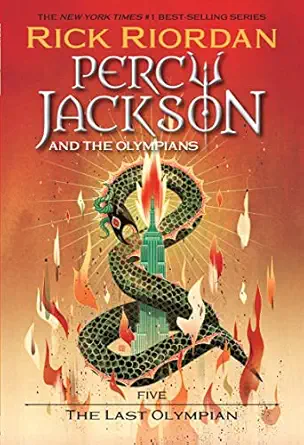
Percy Jackson and the Last Olympian by Rick Riordan is the fifth and final book in the Percy Jackson and the Olympians series, bringing to a close the story of Percy, Annabeth, and their allies as they face Kronos’s full invasion of Manhattan and the battle for Olympus itself. One of the longest and most ambitious book in the series, it pays off five volumes of accumulated mythology, character development, and foreshadowing in a conclusion that is both emotionally satisfying and structurally precise. This complete guide covers The Last Olympian‘s reading level, recommended age, content considerations, characters, themes, and books similar to Percy Jackson and the Last Olympian, designed for parents, teachers, and students.
For Parents
The series’ most sustained battle sequence and its highest body count — several named characters die, including one whose death hits harder than anything in the preceding books. Best for readers ages 10–14 who have read all four previous volumes. A satisfying and fully earned conclusion to one of the best adventure series in contemporary middle-grade fiction.
For Teachers
Most effectively taught as the conclusion of a complete series unit for grades 4–7. The resolution of the Great Prophecy, Luke’s full arc, and Percy’s decision about godhood offer rich discussion material on sacrifice, justice, and what it means to finish a story honestly. The Battle of Manhattan is one of middle-grade fiction’s most carefully staged climactic sequences.
Percy Jackson and the Last Olympian at a Glance
Find on Amazon →| Author | Rick Riordan |
| Published | 2009 |
| Grade Level | 4–7 (our assessment) |
| Recommended Age | 10–14 |
| Flesch-Kincaid Grade | ~4.8 |
| Word Count | ~100,000 |
| Pages | 381 (Disney Hyperion paperback) |
| Chapters | 24 |
| Genre | Fantasy / mythology / adventure |
| Setting | New York City; the River Styx; Olympus; contemporary |
| Series | Percy Jackson and the Olympians, Book 5 |
For official Lexile and AR levels, visit Lexile.com or AR BookFinder. ReadingVine provides independent editorial assessments.
What Reading Level Is Percy Jackson and the Last Olympian?
The Last Olympian reads at approximately a 4th–7th grade level by our editorial assessment, with a Flesch-Kincaid grade level of around 4.8 — consistent with the series overall and with Percy’s first-person voice, which remains immediate and funny even as the stakes reach their highest point. At 381 pages and 100,000 words, it is slightly longer than The Battle of the Labyrinth and moves at a faster overall pace, because the novel is essentially one extended battle sequence with essential mythological and emotional business conducted between fights.
The reading demands are primarily contextual: almost nothing in The Last Olympian works fully for a reader who has not read the previous four books. The Great Prophecy’s resolution, Luke’s full arc, Nico’s role, and the significance of Percy’s choices all depend entirely on what has been built across four volumes. For a reader who has followed the series, this book is enormously satisfying; it is not an entry point. For official Lexile and AR scores, visit Lexile.com or AR BookFinder. ReadingVine’s assessments are independent editorial judgments.
What Age Is Percy Jackson and the Last Olympian Appropriate For?
We recommend The Last Olympian for readers ages 10–14. The content escalation from the earlier books is real — this is a war novel in the adventure genre’s register — and parents should be aware of the specifics.
The novel contains the series’ most sustained battle sequences and its highest named-character death count. Several characters who have been present across multiple books die during the Battle of Manhattan, including one whose death is the series’ most emotionally significant since Zoe Nightshade’s. Percy’s immersion in the River Styx — during which he experiences the memories of every person whose death he has ever been connected to — is the book’s most psychologically intense sequence and may be disturbing for sensitive readers. Luke’s arc concludes in a way that is both violent and genuinely moving, requiring the reader to hold complicated feelings simultaneously. A character is revealed to have been acting under a curse for the entire series — a revelation that recontextualizes five books of behavior. None of the violence is graphic or gratuitous, but the cumulative emotional weight of the Battle of Manhattan is the heaviest the series carries. Parents of readers at the younger end of the age range should be prepared for a book that earns its conclusion through real loss.
For readers 10 and up who have followed the series, The Last Olympian is a genuinely satisfying conclusion — one that honors every major character arc, resolves the Great Prophecy with precision, and ends with a scene of earned happiness that the preceding five books have made fully meaningful.
What Is Percy Jackson and the Last Olympian About?
Kronos has fully risen, possessing Luke’s body and leading an army of monsters and disaffected demigods toward Manhattan. The Olympian gods are occupied — diverted to fight Typhon, the father of monsters, who is making his way across the country toward New York. Olympus is undefended except for the half-bloods of Camp Half-Blood, who take positions across Manhattan to hold the city against Kronos’s forces. Percy, having bathed in the River Styx to gain the invulnerability of Achilles, is at the center of every major engagement. The battle lasts days.
Running through the fighting are the threads the series has been building across four books. Nico di Angelo has been working in secret on a plan involving his father Hades — a plan that requires Percy to trust him despite every reason not to. Annabeth’s faith in Luke and her understanding of Kronos’s hold on him is the key to the battle’s resolution, though not in the way anyone anticipated. The Great Prophecy — a half-blood of the eldest gods shall reach sixteen against all odds, and see the world in endless sleep; the hero’s soul, cursed blade shall reap, a single choice shall end his days — delivers its resolution in a final act that is both completely surprising and, in retrospect, exactly right.
The novel’s final chapters — Percy’s conversation with the gods about the prophecy’s fulfillment, his decision about the gift of godhood, his conversation with Luke’s mother — are among Riordan’s most carefully written. The series has always been, beneath its adventure surface, about what it means to be a child of absent or inadequate parents, and Percy’s choice at the end is the clearest statement of what he has learned about that question over five books. The epilogue places everything in a context of hard-won normality that the series has earned the right to offer.
Percy Jackson and the Last Olympian Characters
Is Percy Jackson and the Last Olympian Banned?
The Percy Jackson series has been challenged in some schools and libraries on the grounds that its portrayal of Greek mythology promotes paganism or conflicts with religious beliefs. These challenges have not resulted in widespread removal. The Last Olympian does not appear on any major challenged books lists as a standalone title and is widely available in school and public libraries.
Percy Jackson and the Last Olympian Themes and Lessons
The series’ central question — what do children owe to parents who have failed them, and what do they become as a result — reaches its answer here across two parallel arcs. Percy, son of an often-absent god, has spent five books learning that love is a practice rather than an entitlement, that loyalty is chosen rather than inherited, and that the best use of power is on behalf of others. His refusal of godhood — the greatest gift the Olympians can offer — is the clearest expression of what he has understood: that a life among the people he loves is more valuable than immortal status among those who considered him disposable. Luke’s arc reaches the same question from the opposite direction. His legitimate grievance against the Olympians — that they are negligent, self-interested, and callous toward their half-blood children — never becomes wrong. What becomes wrong is what he does with it: his willingness to become the instrument of something ancient and annihilating in the service of a revenge that cannot be satisfied. The difference between Percy and Luke is not that Percy suffered less or had better parents; it is in the choice each of them makes about what their suffering means.
Riordan’s resolution of the Great Prophecy is worth examining carefully because it is a genuine literary achievement in the adventure genre. The prophecy’s language — “the hero’s soul, cursed blade shall reap” — is fulfilled by Luke rather than Percy, and in a way that requires Percy to understand what Luke actually needs rather than what he appears to want. The resolution is earned across five books and could not have been delivered at any earlier point in the series.
Percy’s request to the gods — that they claim all their half-blood children and treat them with acknowledgment rather than negligence — is the series’ most direct political statement, and one of its most important. It is an act of justice on behalf of all the children who have been abandoned by powerful parents who considered them secondary to their own concerns, and it is what distinguishes Percy’s heroism from simple adventure-protagonist luck.
Discussion questions for classrooms and families: Why does Percy refuse godhood — what does his reason tell you about what he values? What is the difference between Luke’s grievance and what Luke becomes — and at what point does one turn into the other? How does the Great Prophecy’s resolution differ from what you expected, and why does Riordan’s version work better? What does Percy’s request to the gods say about what the series has been about all along?
How Many Pages and Chapters in Percy Jackson and the Last Olympian?
The Disney Hyperion paperback is 381 pages across 24 chapters. At approximately 100,000 words it is comparable in length to The Battle of the Labyrinth and moves faster — the Battle of Manhattan propels the narrative from roughly Chapter 10 onward with very few pauses, and most readers report the second half being essentially impossible to put down. Readers who have followed the series through four books typically finish it in one intensive week; many finish it in a weekend.
The novel concludes the original Percy Jackson and the Olympians series completely. The story continues in The Heroes of Olympus series, which begins with The Lost Hero and takes place several months after the events of The Last Olympian, following a new set of demigods alongside the returning cast. Most readers who finish The Last Olympian move directly to The Lost Hero.
Books Similar to Percy Jackson and the Last Olympian
About Rick Riordan
Rick Riordan was born in 1964 in San Antonio, Texas. He spent fifteen years as a middle school English and history teacher before the Percy Jackson series made him one of the best-selling children’s authors in the world. He has said in interviews that Percy’s refusal of godhood — a decision Riordan knew he would make before he finished the first book — was always the series’ moral center: the clearest expression of what he wanted to say about power, love, and what it means to choose an ordinary life over an extraordinary one. The request Percy makes of the gods — to claim all their half-blood children — was, Riordan has said, the reason he wanted to write the series in the first place.
The Percy Jackson and the Olympians series has sold more than 180 million copies worldwide. The story continues in The Heroes of Olympus (5 books), The Trials of Apollo (5 books), and several companion series drawing on Egyptian, Norse, and other mythologies. A Disney+ television series adaptation premiered in 2023. He lives in Boston.
Percy Jackson and the Last Olympian: Frequently Asked Questions
What reading level is Percy Jackson and the Last Olympian?
The Last Olympian has a Flesch-Kincaid grade level of approximately 4.8. Our editorial assessment places it at grades 4–7 (ages 10–14). The prose is accessible and fast-moving; the emotional and contextual demands are the highest in the series, and the book works only for readers who have completed all four previous volumes. For official Lexile and AR scores, visit Lexile.com or AR BookFinder.
What grade is Percy Jackson and the Last Olympian appropriate for?
We recommend grades 4–7, with ages 10 and up for independent reading. The sustained battle sequences, named character deaths, and emotional weight of the conclusion make it more demanding than its predecessors. Parents of readers at the younger end of the range should review the content note above.
How many pages are in Percy Jackson and the Last Olympian?
The Disney Hyperion paperback is 381 pages across 24 chapters. Word count is approximately 100,000 words. Readers who have followed the series typically finish it in one week; many finish it in a weekend once the Battle of Manhattan begins.
What is Percy Jackson and the Last Olympian about?
Kronos has fully risen in Luke’s body and is leading an army toward Manhattan while the Olympian gods are diverted fighting Typhon. Percy and the half-bloods of Camp Half-Blood must defend Olympus alone through a sustained battle across New York City, while the Great Prophecy — a half-blood child of the eldest gods whose single choice will decide the fate of Olympus — reaches its resolution.
What is the Great Prophecy in Percy Jackson?
The Great Prophecy states: a half-blood of the eldest gods shall reach sixteen against all odds, and see the world in endless sleep; the hero’s soul, cursed blade shall reap, a single choice shall end his days. The prophecy has been the series’ governing mystery since Book 1 and its resolution — which turns on Luke rather than Percy, and on a choice about mercy rather than combat — is one of the most carefully prepared reveals in the series.
Does Percy become a god in The Last Olympian?
He is offered godhood and refuses. After the battle, the Olympians offer Percy immortality as a reward for his role in saving Olympus. Percy declines, asking instead that the gods formally acknowledge and claim all their half-blood children. His reason — that he wants to live a normal life among the people he loves — is both entirely in character and the series’ clearest moral statement about power and what it’s for.
What happens to Luke in The Last Olympian?
Luke is possessed by Kronos for most of the novel, but in the final confrontation he reasserts control long enough to ask Annabeth where Kronos’s weak point is — and then uses that knowledge to kill himself and destroy Kronos with him. His death fulfills the Great Prophecy and is treated as a genuine act of heroism, complicated by everything that came before it. It is the series’ most emotionally complex death and the one that requires the most from the reader.
Is there a Percy Jackson and the Last Olympian movie?
No film adaptation of The Last Olympian exists. The two Percy Jackson films — released in 2010 and 2013 — covered only the first two books and were not continued. A Disney+ television series that adapts the books faithfully premiered in 2023, beginning with The Lightning Thief; subsequent seasons are expected to cover the remaining books.