
 = Partner Site
Press Here Reading Level: A Complete Guide
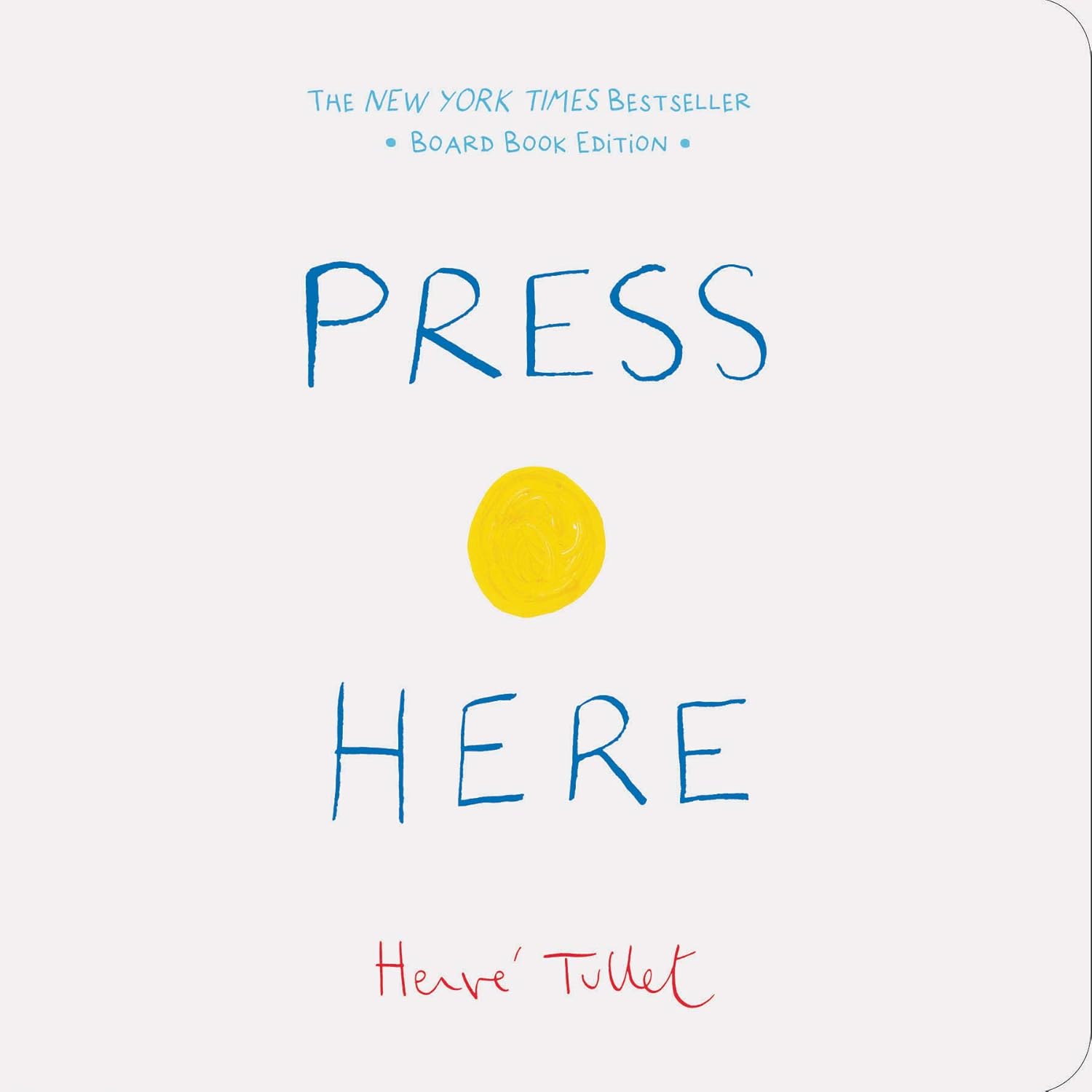
Press Here by Hervé Tullet is one of the most unusual and most joyful picture books ever published — a book that contains no story, no characters, and no plot, and is nonetheless one of the most engaging reading experiences available for young children. Readers are invited to press a yellow dot on the cover, and what follows is a 56-page sequence of instructions — press here, rub there, shake the book, tilt it, blow on it — that appear to cause the dots on each page to multiply, change color, rearrange themselves, and respond. Press Here has been translated into 27 languages and named one of Time Magazine’s 100 Best Children’s Books of All Time. This guide covers the reading level, recommended age, read-aloud vs. independent reading guidance, themes, and everything parents and teachers need to know about sharing Press Here with young readers.
For Parents
Find out whether Press Here works best as a read-aloud or independent read for your child, what age range it suits, and why this book — which has no story, no characters, and no traditional illustrations — is one of the most reliably magical reading experiences for toddlers, preschoolers, and early readers.
For Teachers
Grade-level data, read-aloud timing, key themes, and discussion questions for a book that works beautifully in groups of any size. Exceptional for discussions of cause and effect, color and shape, imagination, and the nature of interactivity — and for making a classroom of children gasp and laugh simultaneously.
Press Here at a Glance
Find on Amazon →| Author & Illustrator | Hervé Tullet |
| Published | 2011 (English); 2010 (French) |
| Grade Level | PreK–1 (our assessment) |
| Recommended Age | 2–5 |
| Best For | Read-aloud ages 2–5; independent reading ages 4–6 |
| Flesch-Kincaid Grade | 1.1 |
| Word Count | ~200 |
| Pages | 56 |
| Genre | Interactive picture book |
| Setting | The pages of the book itself |
| Awards | NYT Bestseller (longest-running picture book); Time Magazine 100 Best Children’s Books of All Time; School Library Journal Starred Review |
For official Lexile and AR levels, visit Lexile.com or AR BookFinder. ReadingVine provides independent editorial assessments.
What Reading Level Is Press Here?
Press Here is a PreK–1 reading level by our editorial assessment, with a Flesch-Kincaid grade level of approximately 1.1. At around 200 words it is one of the shortest books on this list, and the text consists almost entirely of simple imperative sentences: “Press here.” “Rub here.” “Shake the book.” “Now tilt it to the right.” The vocabulary is minimal, the sentences are short, and the grammar is direct. This is one of the most accessible texts available to beginning readers at any level.
But as with The Book With No Pictures, the FK score captures almost nothing of what makes Press Here distinctive as a reading experience. The book’s premise is that pressing, rubbing, shaking, tilting, and blowing on the pages actually causes things to happen — and on each turn, they appear to. A single yellow dot becomes two after you press it. More pressing multiplies them further. Rubbing changes their color. Shaking scrambles their positions. Blowing scatters them. This is accomplished entirely through careful page design and the reader’s willing participation in the fiction that their actions have consequences. Children who engage with this fiction — and most do, completely and immediately — are not reading a book in the traditional sense; they are playing a game that happens to be formatted as a book. The FK score does not measure the quality of that game, which is very high.
For parents who use specific reading level systems: we recommend checking your child’s level on Lexile.com or AR BookFinder for official scores, or asking your child’s teacher for their Guided Reading or DRA level.
Is Press Here a Read-Aloud or Independent Read?
Press Here works beautifully as both a read-aloud for ages 2–5 and an independent read for ages 4–6, though the two experiences are distinctly different. As a read-aloud, it is one of the most participatory books in the entire K–2 library — every page instruction asks the reader and child to do something together, making it a genuine shared physical experience rather than a passive listening one. Most adults can read it aloud in about 5–8 minutes, though active participation almost always extends this.
As a read-aloud, Press Here rewards full theatrical commitment. The narrator’s voice — simple, direct, calm — should sound genuinely certain that pressing the dot will do something. The pause after “Press here” before turning the page to reveal the result should be a real pause, not a perfunctory one. Children who are given that beat of anticipation find the page turn significantly more satisfying than children who are rushed through it. The book is engineered for surprise, and surprise requires timing. Adults who give Press Here the performance it deserves — pressing seriously, rubbing carefully, shaking with conviction — will be rewarded by children who are absolutely certain that the book is doing something impossible and completely delighted by it.
For independent reading, Press Here is one of the most natural introductions to independent books available at the PreK–1 level. The instructions are simple enough for a child who knows basic sight words to follow independently, and the book gives the child complete agency — they are the one pressing, rubbing, shaking. This is unusual in early reading: most books ask children to watch a character do things. Press Here asks children to do things themselves. Many children return to it repeatedly on their own, pressing and tilting with the same conviction as the first time, which is both charming and a testament to the depth of the imaginative contract the book establishes.
There is nothing in this book that requires parental preparation. The dots are colorful, the instructions are friendly, and nothing goes wrong.
When you press the dot for the first time, press it slowly and deliberately — like you mean it. Pause. Then turn the page. Let the result land completely before moving on. Children who are given the time to register each cause and effect find the escalating sequence considerably more wondrous than children who are moved through it quickly. The magic of Press Here lives in the pause between the instruction and the page turn, and that pause belongs to the child.
What Is Press Here About?
A yellow dot sits on a white page. “Press here,” says the book, “and turn the page.” The reader presses. On the next page: two yellow dots. Press again: more dots. Press again: more still. Then instructions change — rub the dot on the left. On the next page, the dot has changed color. Rub more dots. They change too. Shake the book. The dots scatter. Tilt it to the right: they slide. Tilt it to the left: they slide back. Blow on the page: they scatter further. Clap: more appear. Make them all yellow again by rubbing. The book ends where it began — a single yellow dot on a white page — with an invitation to press it and start over.
There is no story, no character arc, no conflict, and no resolution. What Press Here has instead is something more fundamental: a sequence of cause-and-effect interactions that are physically impossible and completely convincing, sustained through the reader’s willingness to believe that their actions have consequences on the page. Tullet’s genius is that he never breaks the fiction, never winks at the reader, never explains the trick. The dots just do what you make them do. That is the whole book, and it is enough.
Press Here Characters
Press Here has no characters in the conventional sense. The yellow dot that begins the book is the book’s protagonist — it multiplies, changes color, scatters, and returns — and the Reader is its co-creator, pressing and rubbing and shaking the world into new configurations on every page. The relationship between the dot and the reader is the entire drama of the book: the dot responds to everything the reader does, which means the reader is always both cause and audience, both performer and witness. This is a more unusual relationship with a book than most picture books establish, and children who experience it often describe it less as “reading a book” than as “playing with a book” — which is both accurate and high praise.
Press Here Themes and Lessons
The central theme of Press Here is the joy of having an effect on the world — specifically, the deep satisfaction of pressing something and watching something happen. This is a fundamental pleasure for children between 2 and 5, who are at precisely the developmental stage where they are learning that their actions have consequences and that they have genuine power over their environment. Press Here takes this developmental reality and builds an entire book around it, giving children 56 pages of cause-and-effect interactions in the safest, most colorful, most reversible possible format. Press the dot and it multiplies. Shake the book and the dots scatter. Tilt it back and they return. Children who engage with this sequence are not just having fun; they are practicing the fundamental cognitive structure of cause and effect with the joyful engagement that repetition usually drains from educational content.
Press Here is also one of the most effective available tools for teaching color recognition and color mixing. As the dots change from yellow to red to blue and back — through pressing, rubbing, and the reader’s actions — children encounter color vocabulary in a kinesthetic context that makes it more memorable than a color-naming exercise. The dots are the colors; the reader changes them; the colors respond. For children who are building color vocabulary, the book provides a physical anchor for each color word that is more emotionally vivid than a flash card.
For teachers, Press Here opens one of the most productive available conversations about what makes a book a book. It has no story in the traditional sense, no characters who want things, no arc. Yet it is undeniably a book, and it is undeniably engaging. Children who have discussed Press Here often arrive at the insight that books can do more things than tell stories — that a book can be a game, an experience, a conversation — which is one of the most useful things an early reader can understand about reading.
Discussion starters for families: Did you think pressing the dot would really work? Why do you think the dots changed? What would happen if you pressed the dot ten times? Is Press Here more like a book or a game? What’s the difference? Could you make a book like this?
How Long Is Press Here?
Press Here has 56 pages and approximately 200 words — one of the lowest word counts relative to page count on the K–2 list. Most adults can read it aloud in about 5–8 minutes, though the participatory physical actions — pressing, rubbing, shaking, tilting, blowing — extend the reading meaningfully. Children who are performing each action seriously, with the full conviction that it is working, typically take longer and are fully engaged throughout.
A child reading independently will typically finish in about 6–10 minutes, though “finish” is a somewhat misleading word for a book that ends with an invitation to start over. Press Here is one of the most revisited books at this level — children return to it again and again, pressing the dot with complete conviction each time, which is a testament to the depth of the imaginative agreement it establishes on the first page.
Books Similar to Press Here
If your child loves Press Here, these titles share its interactive premise, its direct address to the reader, or its place in the Humor and Read-Aloud cluster:
About the Author and Illustrator
Hervé Tullet is a French author and illustrator born in 1958 who studied Fine Art and worked as an art director in advertising for many years before publishing his first children’s book in 1994. He has since created more than 80 internationally acclaimed children’s books and is known in France as “the Prince of Preschool Books” — a title that reflects both his enormous influence in early childhood education and his conviction that books for very young children can be as conceptually sophisticated and as genuinely surprising as books for any other audience. Press Here was originally published in French in 2010 under the title Un Livre — meaning simply “A Book” — a title that is itself a statement: this is not a book about something, it is a book about what a book can be.
Press Here was published in English by Chronicle Books in 2011 and became, improbably, the longest-running picture book on the New York Times bestseller list — a record for a book that has no story, no characters, and no traditional illustrations. Time Magazine named it one of its 100 Best Children’s Books of All Time, and it has been translated into 27 languages. Tullet has said that his books are designed to provoke surprise and to involve children physically and imaginatively in the act of reading, and Press Here achieves both goals more completely than almost any other picture book. He runs interactive workshops for children and adults around the world, bringing the same philosophy — that the reader is a participant, not an audience — to live events that his books model in print. He lives in Paris.
Press Here: Frequently Asked Questions
What reading level is Press Here?
Press Here is a PreK–1 reading level by our editorial assessment, with a Flesch-Kincaid grade level of approximately 1.1. The text consists almost entirely of simple imperative sentences — “Press here,” “Rub here,” “Shake the book” — at around 200 words total. It works best as a read-aloud for ages 2–5 and as an independent read for ages 4–6. For official Lexile and AR levels, visit Lexile.com or AR BookFinder.
What age is Press Here for?
Press Here is appropriate for ages 2–5. As a read-aloud it works from age 2 — the physical interaction and the color changes engage very young toddlers immediately and reliably. As an independent read it suits children ages 4–6 who can follow simple instructions independently. It is one of those rare books that works with equal effectiveness in a one-on-one session with a toddler and in a classroom of twenty-five kindergartners, which is genuinely unusual.
Does pressing the dot in Press Here actually do something?
Not physically — the dots change because Tullet designed each page turn to show the expected result of the previous instruction, and because the reader agrees to believe the fiction that their actions are causing the changes. This is how Press Here works: it establishes a contract with the reader on the first page, and both parties honor it. Children who ask whether the pressing is really working are asking a genuinely interesting question about imagination and fiction, and the most honest answer — that the book is real but the magic is imaginary, and that the imaginary magic is what makes the book wonderful — is one of the more useful things a child can learn about how stories work.
How long does it take to read Press Here aloud?
Most adults can read Press Here aloud in about 5–8 minutes, though the physical participation — pressing, rubbing, shaking, tilting, blowing — meaningfully extends the reading. Children who perform each action deliberately, with full conviction that it is working, typically take longer and remain fully engaged throughout. It is a book that rarely feels rushed, regardless of how long it takes.
What is Press Here about?
Press Here is about a yellow dot that responds to whatever the reader does: pressing it makes more dots appear; rubbing changes their color; shaking scatters them; tilting slides them; blowing disperses them. There is no story, no characters, and no conflict. What Press Here is about — at its deepest level — is the joy of having an effect on the world: the fundamental satisfaction of doing something and watching something happen in response. It is a book about cause and effect, imagination, and the remarkable capacity of a printed page to feel interactive when the right person approaches it with the right attitude.
Are there other books by Hervé Tullet like Press Here?
Yes — Hervé Tullet has published more than 80 children’s books, many of them in the same interactive spirit as Press Here. The most closely related are Mix It Up! (2014), in which readers mix colors by pressing and rubbing; Let’s Play! (2016), a follow-up featuring the same dots with new interactions; and Say Zoop! (2017), which involves sounds and voices. All feature Tullet’s characteristic minimalist design and his conviction that the reader is a participant rather than an audience. Press Here is the original and most widely known, but the related titles offer equally inventive variations on the same premise.