
 = Partner Site
Restart Reading Level: A Complete Guide
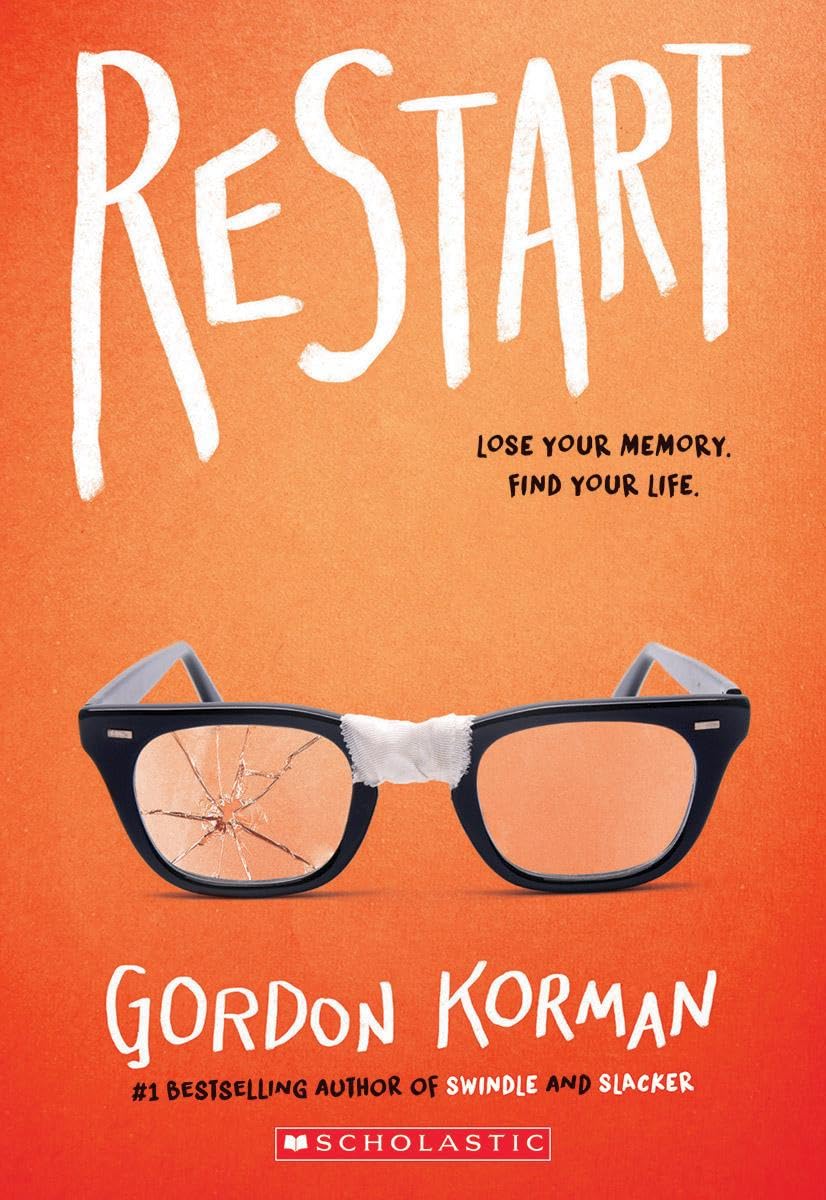
This complete guide to Restart by Gordon Korman covers everything parents, teachers, and students want to know — from reading level and recommended age to a full character breakdown, key themes, and the best books to read next. Published in 2017 by Scholastic Press, Restart is a New York Times bestseller and a widely assigned middle grade novels about bullying and identity. It follows Chase Ambrose, an eighth-grade football star and school bully who falls off his roof and wakes up with no memory of who he was — or what he did. Told from multiple first-person perspectives, it asks one of the most interesting questions in middle grade fiction: if you forgot everything about yourself, would you still become the same person? Whether you’re a parent deciding if it’s right for your child or a teacher building an anti-bullying or identity unit, this guide gives you the information you need.
For Parents
Restart is a warm, funny, and ultimately hopeful book that takes bullying seriously without being heavy-handed or preachy. It deals with both the experience of being a bully and the lasting damage done to victims — with honesty, from multiple perspectives, and with Gordon Korman’s trademark humor woven throughout. The main content to know about: bullying is depicted specifically, including a prank that involves rigging a piano to explode during a student’s recital and an incident involving fire extinguisher foam. Some physical confrontations. Theft of a Silver Star is a subplot. Chase’s father is emotionally overbearing and pushes him hard toward football. Common Sense Media rates it age 9+.
For Teachers
Restart is among the most classroom-friendly novels on bullying available at the middle grade level. Its multi-POV structure — we hear from Chase, his victims, his former friends, and bystanders — makes it an outstanding text for discussing perspective, narrative reliability, and what bullying looks like from different vantage points simultaneously. The parallel between Chase and Mr. Solway (both dealing with memory and identity) gives the novel depth beyond its anti-bullying message, and the central question — whether character is fixed or chosen — generates rich discussion. Lexile 730L, ATOS 5.1, grades 4–6, ideal for grades 5–6 in particular.
Restart at a Glance
Find on Amazon →| Author | Gordon Korman |
| Published | 2017 (Scholastic Press) |
| Grade Level | 4–6 (our assessment) |
| Recommended Age | 9–13 |
| Flesch-Kincaid Grade | ~5.1 |
| Word Count | 59,925 |
| Pages | 256 (standard paperback) |
| Genre | Realistic fiction / Contemporary middle grade |
| Setting | Hiawassee Middle School and surrounding community; present day |
| Awards | New York Times bestseller; Booklist starred review; OLA Silver Birch Award Fiction (2018); Manitoba Young Readers’ Choice Award (2019) |
For official Lexile and AR levels, visit Lexile.com or AR BookFinder. ReadingVine provides independent editorial assessments.
What Reading Level Is Restart?
Restart has a Lexile score of 730L and an ATOS (Accelerated Reader) level of 5.1, worth 9 AR points. Our Flesch-Kincaid assessment is consistent with the ATOS at approximately grade 5.1. By these metrics, the book is accessible to a confident reader in grades 4 or 5, though its emotional and thematic content makes it most naturally suited to grades 5 and 6. Gordon Korman writes in multiple first-person voices — each character section is labeled by name — and the alternating perspectives are easy to track because each narrator has a distinctive voice and a clear relationship to Chase. The chapters are short, the pacing is fast, and the plot’s central mystery (what exactly did Chase do, and how bad was it?) pulls readers forward with real momentum.
The multi-POV structure is worth noting for parents and teachers assessing readiness. Younger or less experienced readers may need some guidance at first, but Korman introduces each narrator clearly, and the technique quickly becomes intuitive. What the word-level metrics don’t capture is the novel’s emotional sophistication: it asks readers to hold Chase’s genuine kindness (without his memories) alongside an honest accounting of the harm he caused, and to decide for themselves whether those two things can coexist in the same person. That’s a genuinely complex moral question, and it’s delivered with enough humor and warmth to keep it from feeling like a lesson. For most readers in grades 5–6, it’s exactly the right level of challenge.
Our editorial assessment is grades 4–6, with grades 5–6 as the most common classroom assignment range. TeachingBooks lists the interest level as both grades 3–12 and 4–8, reflecting its broad appeal. For official Lexile and AR scores, visit Lexile.com or AR BookFinder.
What Age Is Restart Appropriate For?
We recommend Restart for readers ages 9–13. Common Sense Media rates it age 9+. The book is one of the more content-clean middle grade novels dealing with bullying — Korman keeps the tone humorous even when the subject matter is serious, and there are no sexual content, no profanity beyond mild insults, and no graphic violence. What the book does deal with, directly and honestly, is the experience of being bullied and the lasting psychological damage it causes.
Bullying is the central subject and is depicted specifically and without minimization. The most significant incident in Chase’s pre-amnesia past is that he and his football friends rigged a piano to explode with cherry bombs during a recital while a classmate, Joel Weber, was performing — the trauma was severe enough that Joel’s parents removed him from the school entirely. Bullying incidents involve physical intimidation, fire extinguisher foam sprayed on students, and repeated targeting of the same victims over time. A subplot involves Chase having stolen a Korean War veteran’s Silver Star to sell it — this is treated as a serious crime and drives the book’s resolution. Chase’s father, Frank, is emotionally controlling and overbearing, fixated on Chase’s athletic identity and dismissive of anything else. There is no sexual content, no significant profanity, and no graphic violence. A parent review notes that the depiction of bullying’s psychological impact is honest enough to be meaningful for children who have experienced it themselves.
For children who have experienced bullying — on either side — this book offers something relatively rare: it shows the experience from both the victim’s and the bully’s perspectives without excusing the bully or abandoning hope for him. Many teachers and school counselors use it specifically for that reason. Parents whose children have been bullied may want to read alongside and be prepared to talk about it.
What Is Restart About?
Chase Ambrose is the most feared kid at Hiawassee Middle School — eighth-grade football star, state championship MVP, and the kind of bully who makes sure everyone knows their place. Then he falls off the roof of his house, hits his head, and wakes up in a hospital with no memory of any of it. Not the football. Not the football team. Not his name, his family, or any of the people whose lives he has been making miserable for the past several years.
When Chase returns to school, the reactions he gets are a puzzle he has to solve. Some kids treat him like a hero; others are visibly afraid of him. One girl, Shoshanna Weber, dumps her frozen yogurt on his head the first chance she gets. His football friends, Aaron and Bear, are oddly anxious around him — as if there’s something specific they need him to remember. Without his memories to guide him toward his former crowd, Chase drifts toward the video club, befriends a boy named Brendan who turns out to be one of his former victims, and starts spending his community service hours at an assisted living facility talking to a sarcastic Korean War veteran named Mr. Solway. The more Chase learns about who he used to be, the less he wants to be that person. But he also begins to realize that some of what he did can’t simply be walked away from — there are debts he owes that only the old Chase can pay back.
The novel is told in alternating chapters from multiple perspectives — Chase, Shoshanna, Brendan, and others — giving readers a complete picture of a middle school social world and the damage that moves through it. At its heart, it asks a simple but genuinely difficult question: is who you are something that’s fixed in you, or something you choose?
Restart Characters
Is Restart Banned?
Restart has not been banned or formally challenged in any documented way. It does not appear on the American Library Association’s lists of challenged books and has no history of removal from school libraries or classrooms. It is a widely recommended classroom text, frequently used by teachers and school counselors specifically because of its honest treatment of bullying. The book’s anti-bullying message is unambiguous, and its warm, humorous tone likely contributes to its broad acceptance across school communities. If anything, the novel’s classroom use has grown since its publication in 2017, particularly as school districts look for middle grade fiction that addresses bullying with complexity rather than with simple moral instruction.
Restart Themes and Lessons
The novel’s most provocative idea is embedded in its premise: if you woke up tomorrow with no memory of your past, would the people who know you like you better or worse? For Chase, the answer is mostly worse — and that is itself an indictment. Without his memories to tell him who he is and what he’s supposed to want, he naturally gravitates toward kindness, curiosity, and genuine friendship. The implicit argument is that the old Chase was a performance, a role he had learned to play because the adults around him — especially his father — rewarded it. The question the novel leaves open is whether that makes him less responsible for what he did, or more.
Korman is careful to balance Chase’s redemptive arc with honesty about the damage his former self caused. Shoshanna’s anger is never dismissed; the chapter describing what bullying feels like from the inside — the constant vigilance, the dread, the way it becomes the texture of your daily life — is one of the most direct and useful accounts of the experience in middle grade fiction. The novel’s answer to “can people change?” is yes, but it costs something: real change requires specific accountability, not just becoming a nicer person with convenient amnesia. Chase has to go back and fix what he broke, including returning a stolen medal and clearing his name at real personal cost. Discussion questions worth exploring: Is the person Chase becomes after the accident the “real” Chase? Does Chase deserve forgiveness? What would forgiveness for Chase look like — and who gets to decide?
How Many Pages and Chapters in Restart?
Restart is 256 pages in the standard paperback edition, with 59,925 words. The novel is structured in short alternating chapters labeled by narrator — Chase, Shoshanna, Brendan, Kimberly, and others — and the brisk chapter length is a signature of Korman’s style, making the book feel faster than its page count. Most independent readers in grades 4–6 complete it in about one week. The multi-narrator format works exceptionally well in audio — each character is voiced distinctly, which makes the structural device even clearer for listeners. It’s a strong option for reluctant readers who respond better to audio.
Books Similar to Restart
About Gordon Korman
Gordon Korman was born on October 23, 1963, in Montreal, Quebec, and grew up in Thornhill, Ontario. His publishing career began in seventh grade — at age twelve, his English teacher (who was actually the gym teacher filling in) gave the class a four-month assignment to write a story. Korman wrote 120 pages about two prank-loving boys at a Canadian boarding school. His classmates urged him to try to publish it. Since he was the class’s Scholastic book order monitor, he mailed the manuscript to the Scholastic address on the book order forms. His mother had to type it for him. Scholastic accepted it, and two years later — when Korman was fourteen — This Can’t Be Happening at Macdonald Hall! was published. He reportedly got a B+ on the original assignment. By the time he graduated from high school, he had published five books. He went on to earn a BFA in Dramatic Writing from New York University, with a minor in film and television, and has been writing full-time ever since. His books have sold over 35 million copies worldwide, have been translated into 32 languages, and have appeared on the New York Times bestseller list. He lives on Long Island with his family and visits schools and libraries constantly. Korman has published over 100 books, including the Bruno and Boots/Macdonald Hall series, the Island trilogy, the Swindle series, the Everest series, the Masterminds series, and numerous standalones. Restart (2017) is widely considered one of his most serious and thematically rich standalone novels, representing a more emotionally grounded side of his work alongside the comic adventure he is best known for.
Restart: Frequently Asked Questions
What reading level is Restart?
Restart has a Lexile score of 730L and an ATOS level of 5.1, worth 9 AR points. Our editorial assessment places it at grades 4–6, with grades 5–6 as the most natural fit. The text is clear and fast-paced with short alternating chapters, but the thematic content — specifically the multi-perspective examination of bullying and the question of whether identity is fixed or chosen — is best suited to readers ages 9 and up with some emotional readiness to engage with those questions.
What age is Restart appropriate for?
We recommend Restart for readers ages 9–13. Common Sense Media rates it age 9+. The book deals with bullying honestly and specifically — including a piano-rigging prank, physical intimidation, and the lasting psychological damage done to victims. There is no sexual content, no significant profanity, and no graphic violence. It is well-suited to children who have experienced bullying (from either side), and many school counselors recommend it alongside classroom discussion.
Why does Restart have multiple narrators?
Gordon Korman tells Restart through alternating first-person chapters from Chase, Shoshanna, Brendan, Kimberly, and others because the novel’s central subject — bullying and its effects — looks completely different depending on where you’re standing. Amnesiac Chase experiences his return to school as confusing and alienating; Shoshanna experiences it as an ongoing injustice; Brendan experiences it as a frightening and then tentatively hopeful encounter. The multi-POV structure means readers can hold all of those truths simultaneously, which is what makes the moral question at the center of the book genuinely complex rather than simple.
What happened to Chase before the amnesia?
Before the accident, Chase was the school’s most feared bully. The worst incident that readers learn about: Chase and his friends Aaron and Bear rigged a piano with cherry bombs during a school recital while Joel Weber — one of their regular targets — was performing. The explosion traumatized Joel severely enough that his parents removed him from the school entirely. Chase also bullied his own four-year-old sister, Helene, including ripping the head off her teddy bear. Shortly before falling off the roof, he stole Mr. Solway’s Silver Star from the assisted living facility, intending to sell it with Aaron and Bear — he had hidden it on the roof when he slipped and fell.
Does Chase get his memory back in Restart?
Chase’s memory returns gradually and fragmentarily over the course of the novel rather than all at once — specific triggering moments (a sound, an image, his sister’s squeal of delight) bring back isolated memories that help him piece together who he was. The question of whether full memory recovery would change who he has become in the meantime is part of what the novel explores. By the end, he has enough memory to understand what he did and to take specific steps to address it — but the person he has become through the amnesia period is genuinely different from who he was before.
What is the significance of Mr. Solway in Restart?
Mr. Solway is a Korean War veteran at the assisted living facility where Chase does community service. He won a Silver Star for opening an enemy tank and throwing in a grenade — an act of extraordinary courage he cannot remember, because his own memory was affected by the trauma. The parallel with Chase is deliberate and precise: both are defined by a past they can’t access, both must reckon with what others tell them about who they are. Solway’s arc also mirrors Chase’s — he begins withdrawn and self-absorbed and gradually returns to engagement with the world. He is, additionally, unknowingly the victim of the crime Chase committed before the amnesia, which Chase must eventually confront and correct.
Is Restart a standalone novel or part of a series?
Restart is a standalone novel — it is not part of any series and has no sequel. It does share thematic DNA with other Gordon Korman standalones, particularly No More Dead Dogs (2000), which also features a protagonist forced to confront the social structures of his school from an unexpected angle. Readers who enjoy Restart‘s tone and style may also enjoy Korman’s series work, including the Swindle series (heist adventures featuring a recurring cast) and the Island trilogy (survival adventure).
How did Gordon Korman start writing?
Gordon Korman wrote his first novel at age twelve as a seventh-grade English class assignment. The teacher — who was actually the gym teacher filling in — gave the class four months to write a story. Korman wrote 120 pages about two troublemaking boys at a Canadian boarding school. Since he was the class’s Scholastic book order monitor, he mailed the finished manuscript to the Scholastic address on the order forms. His mother typed it for him. Scholastic published it in 1978, when Korman was fourteen. He reportedly got a B+ on the original assignment. By high school graduation, he had published five books. He has now published over 100.