
 = Partner Site
Riding Freedom Reading Level: A Complete Guide
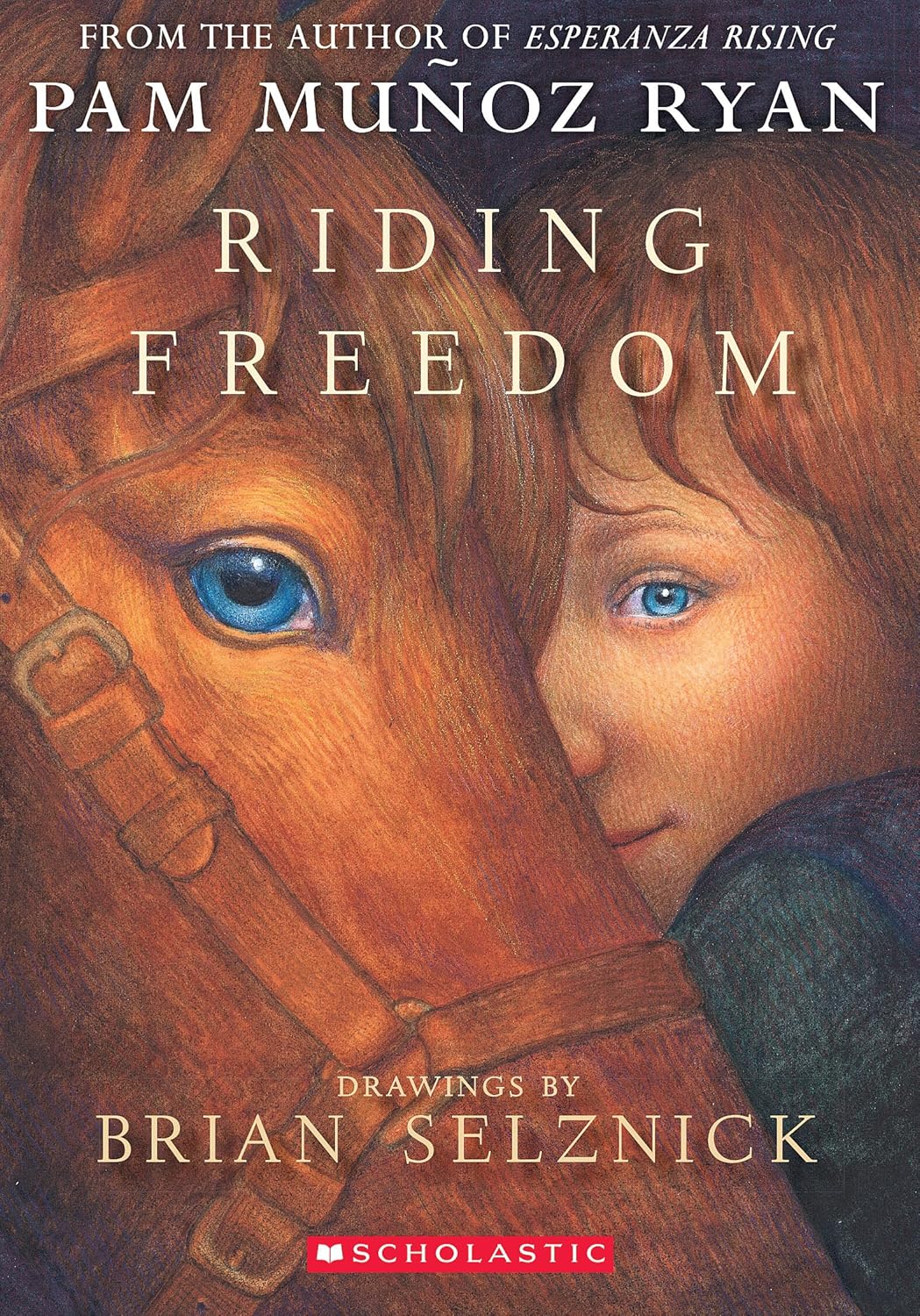
Riding Freedom by Pam Muñoz Ryan is a spirited, fast-moving, and quietly remarkable novel based on the true story of Charlotte Parkhurst — a girl who grew up in a New Hampshire orphanage in the 1840s, escaped dressed as a boy, became one of the most celebrated stagecoach drivers in California, and lived her entire adult life as a man named Charley. One of the most accessible and most exciting historical novels in the middle grade canon, it is a book about the specific freedom that horses give to a girl who has nothing else, about the courage required to build a life on your own terms in a world that has not made room for the life you need, and about identity, belonging, and what it means to choose who you are going to be. This complete guide covers the reading level, age appropriateness, themes, characters, and everything parents and teachers need to know about this essential novel.
For Parents
Riding Freedom is a novel about a girl who lives as a man — not as a political statement but as a survival strategy, and then as the fullest expression of who she actually is. Best suited for readers ages 8-11, it is fast-moving, exciting, and emotionally warm without being sentimental. Parents should be aware that the novel deals honestly with orphanhood, the hardships of 19th-century institutional care, and the specific vulnerability of a child with no family and no legal protections. It is also one of the most purely exciting horse-and-adventure novels in its age range, and children who love horses in particular will find it irresistible.
For Teachers
A widely taught novel well suited to grades 3-5, Riding Freedom is an exceptional text for teaching the difference between biography and biographical fiction, how authors make historical figures come alive on the page, and the specific freedoms and constraints available to women in 19th-century America. The novel also opens essential discussions about gender, identity, and what it means to live authentically — discussions that are grounded in a specific historical context and in a protagonist whose choices are entirely legible as survival rather than ideology. It pairs naturally with units on westward expansion, California history, and women’s suffrage.
Riding Freedom at a Glance
Find on Amazon →| Author | Pam Muñoz Ryan |
| Published | 1998 |
| Grade Level | 3-5 (our assessment) |
| Recommended Age | 8-11 |
| Flesch-Kincaid Grade | 4.3 |
| Word Count | ~25,000 |
| Pages | 138 (standard paperback) |
| Chapters | 14 |
| Genre | Historical fiction / biographical fiction |
| Setting | New Hampshire; California, 1840s-1860s |
| Awards | ALA Notable Children’s Book; California Young Reader Medal |
For official Lexile and AR levels, visit Lexile.com or AR BookFinder. ReadingVine provides independent editorial assessments.
What Reading Level Is Riding Freedom?
Riding Freedom reads at approximately a 3rd-5th grade level by our editorial assessment, with a Flesch-Kincaid grade level of around 4.3. Ryan writes with the same lyrical warmth that characterizes all her best work, but here in a faster, more compressed register suited to a shorter novel and a younger audience. The prose is clear and direct, the chapters are short and propulsive, and the horse sequences — the moments when Charlotte is riding or driving or simply in the presence of horses — have the specific, observant beauty of someone who has done her research and loves her subject.
The novel is accessible to strong 3rd grade readers and fully rewarding through 5th grade. The historical context — orphanages in the 1840s, the California Gold Rush, the mechanics of stagecoach driving — builds naturally through the story rather than requiring prior knowledge, and the novel’s pace ensures that readers who are new to historical fiction will be carried forward by the adventure before they have time to feel daunted by the period. What makes the novel more demanding than its score suggests is the weight of Charlotte’s situation — an orphan with no legal protections, living disguised as a boy in an era when the discovery of that disguise could cost her everything — which older readers in the recommended range will feel more fully.
The book is most commonly recommended for grades 3-5. For official Lexile and Accelerated Reader scores, visit Lexile.com or AR BookFinder.
What Age Is Riding Freedom Appropriate For?
We recommend Riding Freedom for readers ages 8-11. The novel is an adventure story at heart — exciting, warm, and entirely appropriate for its intended age range — but it deals honestly with the specific hardships of orphanhood and the vulnerability of a child with no family, no legal status, and no one required by law or love to protect her.
Charlotte’s life at the orphanage is depicted honestly: the children are treated as labor, poorly fed, and subject to the authority of adults who have no particular investment in their welfare. A beloved horse is sold away from Charlotte in a scene that is the novel’s most emotionally painful moment. Charlotte loses the sight in one eye in a stagecoach accident — depicted briefly and without graphic detail, but real. The novel’s central premise — that Charlotte lives her adult life as a man named Charley — is presented matter-of-factly and sympathetically, as a survival strategy and then as the life that fits her best. There is no sexual content, no strong language, and no violence beyond what is described above. The novel’s difficulty is historical and emotional, and Ryan handles both with the care appropriate to the age range.
The novel’s treatment of Charlotte’s gender — her choice to live as Charley — has been discussed in some classrooms and by some parents as raising questions about gender identity that they were not expecting at this age level. Ryan’s framing is historical and practical rather than ideological: Charlotte lives as a man because the life she wants — the freedom to drive horses, to own land, to move through the world without restriction — is available to men and not to women in the 1840s. The novel presents this choice with complete sympathy and without political editorializing, which makes it accessible to a wide range of families and classrooms.
What Is Riding Freedom About?
Charlotte Parkhurst grows up at the Millbrook Orphanage in New Hampshire, where the children are treated as servants and given little warmth and less future. Charlotte’s one escape, her one source of joy and competence and genuine selfhood, is horses. The stable master, a man named Vern, recognizes her gift — her ability to calm difficult horses, her natural seat, her fearlessness — and teaches her to drive. With horses, Charlotte is a different person than the girl the orphanage has tried to make her: confident, capable, and entirely at home in a way she has never been anywhere else.
When Vern is dismissed and Charlotte’s beloved horse Freedom is sold, she escapes from the orphanage dressed in boy’s clothing and makes her way to a horse farm in Rhode Island, where she presents herself as a boy named Charley and is hired for her evident skill. She is good at her work — better than good — and she discovers that the world available to Charley is a world that was entirely closed to Charlotte: the freedom to move, to earn, to be judged on her abilities rather than her sex.
The novel follows Charlotte west to California during the Gold Rush years, where she becomes a stagecoach driver of legendary skill. She drives the dangerous mountain routes with a combination of technical mastery and intuitive horsemanship that earns her a reputation and a living, and she acquires a ranch of her own — land that belongs to her, that no one can take from her, that she has earned through her own work. The specific pleasure of that ownership — of a girl from an orphanage who owned nothing, becoming a woman who owns land — is one of the novel’s most satisfying threads.
The historical Charlotte Parkhurst’s true identity was not discovered until after her death in 1879, when those who prepared her body for burial discovered that Charley, the legendary one-eyed stagecoach driver, had been born female. Ryan’s novel imagines Charlotte’s inner life — her feelings about her disguise, about the life she has built, about freedom and identity and what it means to be fully yourself in a world that does not have room for who you actually are — with warmth and precision. An author’s note at the end distinguishes the historical facts from Ryan’s fictional additions.
Riding Freedom Characters
Is Riding Freedom Banned?
Riding Freedom has not been widely banned or challenged, though it has been the subject of occasional parental questions about its depiction of Charlotte living as a man — questions that Ryan’s historical framing typically resolves when teachers provide context about 19th-century women’s legal and social status. It has been embraced by educators, librarians, and children’s literature organizations as an important work of biographical historical fiction and an accessible, exciting novel for its age range. It is widely taught and widely available in school and public libraries.
Riding Freedom Themes and Lessons
The central theme of Riding Freedom is freedom — what it means, what it costs, and what a person will do to have it. For Charlotte, freedom has a specific, concrete shape: the ability to drive horses through open country, to own land, to be judged on skill rather than sex, to move through the world without the specific restrictions that 19th-century law and custom place on women. The novel does not abstract this into a lesson; it makes it physical and immediate. Freedom is what Charlotte feels when she is on a horse. Everything she does is in service of keeping that feeling available to her.
The novel is also a portrait of the specific constraints that 19th-century America placed on women — not as a historical lecture but as a lived reality that Charlotte navigates with practical intelligence. She does not live as Charley because she is making a statement. She lives as Charley because Charley can do the things Charlotte wants to do, and Charlotte cannot. The gap between those two possibilities is the novel’s quiet argument about what freedom actually requires when the world is organized to deny it to you.
Belonging is the novel’s third great theme. Charlotte begins the novel belonging to no one — an orphan with no family, no legal protections, no one whose love is her claim. What she builds across the novel — the ranch, the reputation, the life as Charley — is a form of belonging that does not depend on anyone else’s permission or anyone else’s love. It is earned, entirely hers, and entirely on her own terms. The novel’s ending, in which Charlotte votes — one of the first women in American history to do so, because she was registered as a man — is the quietest and most powerful image of what she has built.
Discussion starters for classrooms: Why does Charlotte decide to live as Charley rather than as Charlotte? What does freedom mean to Charlotte specifically? How does Vern change Charlotte’s life, and what does his belief in her make possible? What does Charlotte’s ranch represent to her? Why does the novel end with Charlotte voting, and what does that moment mean?
How Many Pages and Chapters Are in Riding Freedom?
The standard paperback edition of Riding Freedom is 138 pages, divided into 14 chapters averaging around ten pages each. The word count is approximately 25,000 words — making it one of the shorter historical novels in its recommended range and one of the most practical classroom texts for teachers who want to complete a historical fiction unit in two weeks. The novel moves in two clear geographical sections — New Hampshire and California — that together give it the shape of a journey: escape and arrival, the old life and the new.
For readers in the target age range of 8-11, expect a reading time of roughly 2-3 hours, or about a week of comfortable reading at 20-30 minutes per session. As a classroom text it works very well in a one-to-two week unit, with the author’s note providing an essential starting point for discussing the difference between historical fact and biographical fiction. Many teachers use the novel in conjunction with research assignments on the real Charlotte Parkhurst — the historical record, sparse as it is, gives students practice distinguishing between what is known and what Ryan has imagined. The novel also pairs naturally with Esperanza Rising for a two-book Pam Muñoz Ryan unit on girls who make their own way in California against significant odds.
Books Similar to Riding Freedom
About Pam Muñoz Ryan
Pam Muñoz Ryan is one of the most celebrated American authors of middle grade fiction, known for novels that combine lyrical prose, historical specificity, and protagonists — often female, often navigating worlds that underestimate them — whose determination and intelligence are their primary instruments of survival and freedom. Born in Bakersfield, California, she grew up in a large, multigenerational Mexican American family. Riding Freedom, published in 1998, was among her early novels and established the combination of historical research, sympathetic protagonist, and lyrical warmth that would characterize her best work. Her subsequent novels include Esperanza Rising (2000), Becoming Naomi León (2004), and Echo (2015), which won the Newbery Honor and the Pura Belpré Award. She has spoken about Charlotte Parkhurst as a subject that compelled her precisely because of how little was known about Charlotte’s inner life — the challenge and the freedom of biographical fiction is the opportunity to imagine what the historical record cannot tell you, while remaining faithful to what it can. She lives in California.
Riding Freedom: Frequently Asked Questions
What reading level is Riding Freedom?
Riding Freedom has a Flesch-Kincaid grade level of approximately 4.3. Our editorial assessment places it at grades 3-5 (ages 8-11). The prose is clear, lyrical, and accessible, with short propulsive chapters and horse sequences of particular beauty. The weight of Charlotte’s situation — an orphan living in disguise in an era when discovery could cost her everything — is more demanding than the word-level score suggests and rewards the upper end of the recommended range. For official Lexile and AR scores, visit Lexile.com or AR BookFinder.
Is Riding Freedom based on a true story?
Yes — Charlotte Parkhurst was a real person. Born in New Hampshire around 1812, she grew up in an orphanage, eventually made her way to California, and became one of the most celebrated stagecoach drivers of the Gold Rush era, known as One-Eyed Charley for the eye she lost in a horse-related accident. When she died in 1879, those who prepared her body discovered that Charley had been born female — making her, retroactively, one of the first women to vote in a California election, having registered to vote as a man. The historical record about Charlotte’s inner life and personal history is sparse, and Pam Muñoz Ryan has been transparent about which elements of the novel are historically documented and which she has imagined. The author’s note at the novel’s end distinguishes fact from fiction.
Why does Charlotte live as a man?
Because the life Charlotte wants — driving horses, owning land, moving freely through the world — is available to men in the 1840s and not to women. Ryan presents this choice as practical and survival-driven rather than ideological: Charlotte is not making a statement about gender; she is solving a specific problem about access. The life that fits her, the life she is good at, requires being Charley. The novel treats this with complete matter-of-factness — Charlotte’s choice is not dramatized as a crisis or a revelation but simply as the thing she does to have the life she needs. Teachers who want to extend this discussion can provide historical context about the legal and social status of women in the 1840s, which makes Charlotte’s calculation immediately legible.
What happened to Charlotte’s eye?
Charlotte loses the sight in one eye in a stagecoach accident — a horse kicks her during a difficult moment on the road. This is historically accurate: the real Charlotte Parkhurst was known throughout her career as One-Eyed Charley, and the eye injury is one of the few well-documented facts about her life. In the novel the injury is depicted briefly and without graphic detail, but it is real, and it becomes part of Charley’s legend rather than a limitation — the driver who lost an eye and kept driving is not less impressive but more so.
Did Charlotte really vote?
Yes — this is one of the most remarkable historical facts about Charlotte Parkhurst and the detail that gives the novel its ending. Because she was registered to vote as a man, Charlotte voted in the 1868 California election — more than fifty years before women’s suffrage was guaranteed by the 19th Amendment in 1920, and decades before California women had any legal right to vote. She is often cited as one of the first women to vote in an American election, though the circumstances were exceptional. The novel’s final image of Charlotte voting is its quietest and most powerful: a girl from an orphanage who owned nothing, exercising a right that would not be available to most American women for another half century.
What is the difference between historical fiction and biographical fiction?
Historical fiction is set in the past and uses real historical events as a backdrop for imagined characters and stories. Biographical fiction, like Riding Freedom, takes a real historical person as its protagonist and imagines their inner life, relationships, and experiences in ways that the historical record cannot confirm. Ryan’s novel is transparent about this distinction: the author’s note at the end clearly identifies what is historically documented about Charlotte Parkhurst and what Ryan has invented to fill the gaps. This makes Riding Freedom an excellent classroom text for discussing the responsibilities and freedoms of biographical fiction — how much a writer can invent, what obligations they have to the historical record, and how readers should approach a novel that blends documented fact with imagined interior life.
What grade is Riding Freedom typically assigned in?
Riding Freedom is most commonly assigned in grades 3, 4, and 5, both as independent reading and as a classroom text. It is particularly well suited to units on westward expansion, California history, women’s history, and the 19th-century American frontier. Many teachers pair it with the author’s note and supplementary research on the real Charlotte Parkhurst. It also pairs naturally with Esperanza Rising for a Pam Muñoz Ryan unit on girls navigating California against significant odds, and with Lyddie for a unit on 19th-century women’s choices about work and independence.