
 = Partner Site
Skellig Reading Level: A Complete Guide
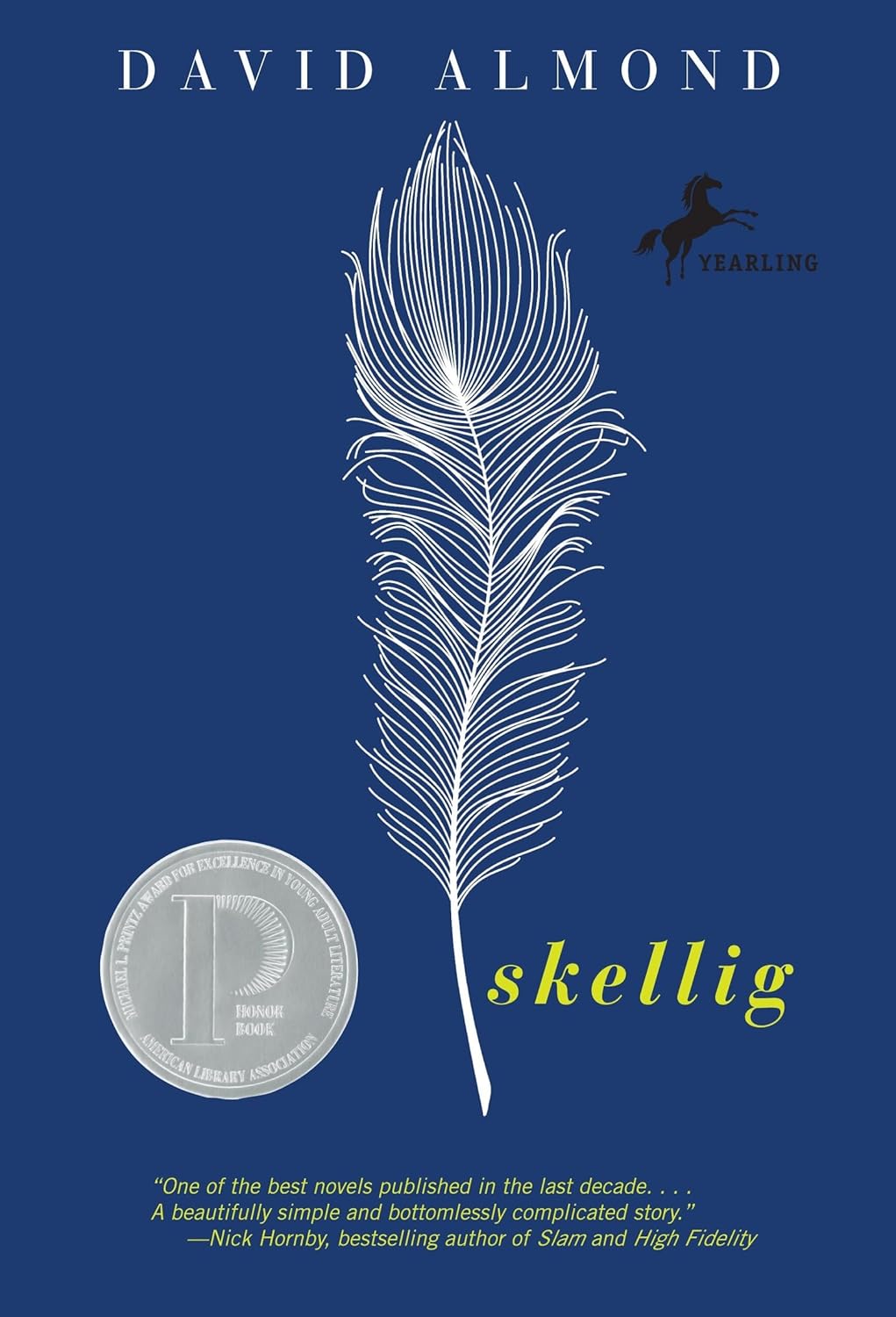
Skellig by David Almond is a luminous, quietly extraordinary novel about a boy who discovers a mysterious creature living in the crumbling garage of his new house — a being who is part owl, part angel, part something else entirely — at the same moment his newborn sister is fighting to survive. This complete guide covers Skellig’s reading level, recommended age, content considerations, characters, themes, and books similar to Skellig, designed for parents, teachers, and students.
For Parents
Skellig is one of the most celebrated British children’s novels of the past thirty years — a book that operates simultaneously as a realistic story about family crisis and as something harder to categorize: a fable, a spiritual meditation, a piece of magic realism that never fully explains itself. The writing is spare and beautiful, the mystery at its center is never cheaply resolved, and the emotional resonance is real. The book deals directly with a seriously ill infant and the family’s fear of losing her, which parents should know about before sharing it with children who may have personal experience of illness or loss. Appropriate for most readers ages 10 and up.
For Teachers
Skellig is an outstanding classroom text for grades 5–8, offering exceptional material for discussions of magical realism as a literary mode, the nature of belief and mystery, family and crisis, and the relationship between the real and the imagined. Almond’s prose — spare, precise, and deeply attentive to the physical world — is an excellent model for writing instruction. The book pairs naturally with poetry units, mythology, and discussions of what Blake’s Songs of Innocence and Experience (referenced within the novel) have to say about the relationship between childhood and adult understanding. The Carnegie Medal citation described it as a book that crosses genre boundaries with rare confidence.
Skellig at a Glance
Find on Amazon →| Author | David Almond |
| Published | 1998 |
| Grade Level | 5–7 (our assessment) |
| Recommended Age | 10–14 |
| Flesch-Kincaid Grade | ~5.5 |
| Word Count | ~32,000 |
| Pages | 182 (standard paperback) |
| Chapters | 34 |
| Genre | Magic realism / literary fiction |
| Setting | A terraced house in the north of England; contemporary |
| Awards | Carnegie Medal (1998); Whitbread Children’s Book Award (1998) |
For official Lexile and AR levels, visit Lexile.com or AR BookFinder. ReadingVine provides independent editorial assessments.
What Reading Level Is Skellig?
Skellig reads at approximately a 4th- to 5th-grade word level by standard readability measures (Flesch-Kincaid grade ~5.5), well below the grade range where it is most commonly taught and most fully appreciated. Our editorial assessment is grades 5–7 for independent reading, with the book most rewarding for readers in grades 6–7. This significant gap between the readability score and the recommended grade range is the defining characteristic of Skellig as a reading-level puzzle: the prose is deliberately plain — short sentences, simple vocabulary, enormous white space on the page — while the novel’s ideas, emotional complexity, and ambiguity are genuinely sophisticated.
Almond’s style is not simple because he is writing down to children. It is simple because he has stripped away everything that is not essential, in the way that a poet does — and the result is a prose that carries extraordinary weight in very few words. A 4th grader can read every sentence in Skellig without difficulty. What they may not yet have the emotional and intellectual context to fully receive is what those sentences, taken together, are doing. The book rewards readers who can sit with mystery without demanding resolution, who have some experience of loss or fear, and who are ready to engage with a story that does not answer its own central question. For official Lexile and AR scores, visit Lexile.com or AR BookFinder.
What Age Is Skellig Appropriate For?
We recommend Skellig for readers ages 10–14, with the strongest fit at ages 11–13. The accessible prose makes it approachable for readers as young as 9 or 10, but the full emotional and thematic weight of the book — the fear of a sibling dying, the mystery of what Skellig is and what he means, the William Blake references, the question of what we believe in and why — lands most fully with readers who are in or near middle school. It is one of those books that readers frequently describe as meaning more when they return to it as adults.
Skellig deals directly and honestly with a seriously ill infant — Michael’s baby sister has a heart defect and may not survive, and the family’s fear of losing her is the emotional engine of the entire novel. This is handled with care and without graphic medical detail, but the fear is real and sustained throughout. Families who have experienced infant illness or the death of a baby should be aware of this before sharing the book with children who may have personal connections to that experience. The creature Skellig himself is disturbing in his physical description — gaunt, filthy, covered in dead flies, eating flies and bluebottles — in a way that some sensitive younger readers may find upsetting. There is no profanity or sexual content. The book’s ending is not definitively happy or unhappy but occupies an ambiguous space that may be unsatisfying for readers who prefer clear resolution.
Skellig is a book that works differently at different ages, and this is part of its value as a classroom text. Younger readers may engage primarily with the mystery and the relationship between Michael and Mina; older readers and adults find in it a meditation on faith, fragility, and what we cannot know or explain. Teachers who have used it in grades 6–8 consistently report that it generates the most sustained and thoughtful classroom discussion of any novel they assign.
What Is Skellig About?
Michael has just moved with his family to a new house — a crumbling, half-derelict terraced house that needs enormous work before it is liveable. His parents are distracted and exhausted: the move itself has been difficult, and his newborn baby sister has been rushed to hospital with a serious heart defect whose outcome no one can predict. Michael is lonely, frightened, and displaced in every sense. On his first exploration of the collapsing garage at the back of the house — which his parents have told him to stay out of — he discovers something extraordinary: a man, or something like a man, sitting hunched in the darkest corner beneath cobwebs and dead flies. The creature tells Michael his name is Skellig. He is filthy, thin, in pain, and deeply reluctant to be found. He eats Chinese takeaway and bluebottles with equal equanimity. And he is something that Michael cannot categorize or explain.
Michael tells no one about Skellig except Mina, the unusual, home-educated girl who lives next door and who shares his sense that the world contains more than adults usually admit. Together Michael and Mina begin visiting Skellig, bringing him food, trying to understand what he is, and gradually — in ways the book renders with great delicacy — helping him recover something he has been losing. All the while Michael’s sister fights for her life in the hospital, and the two threads of the novel — the creature in the garage and the baby in the ward — begin to intertwine in ways that resist easy explanation.
David Almond has said that Skellig grew from a recurring image he had of a figure in a garage — something between human and bird — and from his own experience of being a child surrounded by mystery and not quite knowing what to believe. The novel draws on William Blake’s poetry and thought, particularly Blake’s conviction that the world of imagination and spirit is as real as the physical world, and that children are closer to this truth than adults who have learned to distrust what they cannot measure. Skellig won both the Carnegie Medal and the Whitbread Children’s Book Award in 1998, the year of its publication.
Skellig Characters
Skellig Themes and Lessons
Skellig is a novel about the limits of what we can know and the importance of remaining open to what we cannot explain. Almond draws throughout on the poetry and philosophy of William Blake — who believed that imagination was not a distraction from reality but a deeper form of access to it, and that children’s capacity for wonder was a form of spiritual clarity that adults gradually lose. Michael’s openness to Skellig, his willingness to believe in something he cannot categorize, is precisely what the novel values most highly. The adults around him who would dismiss or explain away what he has found are not portrayed as wiser but as more closed.
The novel is also, at its most fundamental level, about fear — specifically the fear of losing someone you love before you have properly met them. Michael’s relationship with his baby sister is almost entirely composed of absence and proximity: he is in love with a person he barely knows, terrified of losing her, unable to do anything that the medical world would recognize as helpful. Skellig — whatever he is — offers him something to do with that love and that fear. The novel’s resolution, which involves both the baby and Skellig in ways that cannot be entirely explained, suggests that love and connection operate by rules that medicine and reason do not fully encompass. Discussion questions worth exploring: What do you think Skellig is — angel, human, something else? Why does the novel refuse to answer this question directly? What does Mina’s home education and her relationship with Blake add to the story? How does Michael’s fear for his sister change him across the novel?
How Many Pages and Chapters Are in Skellig?
Skellig is 182 pages in the standard paperback edition, divided into 34 very short chapters — most run just 4–6 pages, and many are considerably shorter. The word count is approximately 32,000 words, making it one of the shorter novels in the upper middle-grade range. At an average middle-grade reading pace of around 200 words per minute, most readers in the target age range finish the book in roughly 2–3 hours of total reading time — often over a single weekend or in less than a week of daily sessions. The brevity and the short chapters give the book a quality of urgency and immediacy that suits its subject perfectly. Almond’s prose is so compressed that the white space on the page feels as significant as the words — this is a book that rewards slow, attentive reading rather than rushing, despite how quickly it can be consumed. Most editions include a note on William Blake and his work that is worth reading alongside the novel.
Books Similar to Skellig
About David Almond
David Almond was born in 1951 in Newcastle upon Tyne, in the northeast of England, and grew up in the working-class Catholic community of Felling-on-Tyne — a landscape and community that forms the vivid, specific backdrop to most of his fiction. He worked for many years as a teacher, social worker, and editor of a literary magazine before publishing Skellig in 1998 as his first novel for children, at the age of 46. The book won both the Carnegie Medal and the Whitbread Children’s Book Award in the year of its publication — an almost unprecedented double for a debut children’s novel — and established Almond immediately as one of the most significant voices in British children’s literature. His subsequent novels include Kit’s Wilderness (1999), Heaven Eyes (2000), The Fire-Eaters (2003), Clay (2005), and many others, all characterized by the same quality of magic realism grounded in specific, physical northern English communities. In 2010 Almond received the Hans Christian Andersen Award, the highest international recognition in children’s literature, given every two years to an author whose complete works have made a lasting contribution to the field. He lives in Northumberland.
Skellig: Frequently Asked Questions
What grade level is Skellig?
By standard readability measures, Skellig reads at approximately a 4th- to 5th-grade word level (Flesch-Kincaid grade ~5.5). Our editorial assessment is grades 5–7 for independent reading, most rewarding for readers in grades 6–7. The gap reflects Almond’s deliberately spare, compressed prose style — the sentences are simple; the ideas and emotional complexity are not. This is one of the most important reading-level gaps in the middle-grade catalog: word-level difficulty significantly understates what the book actually requires of its reader.
What is Skellig — is he an angel?
The novel never answers this question, and the refusal to answer is deliberate and essential. Skellig might be an angel — he has shoulder blades that suggest vestigial wings, and what he does near the end of the novel is consistent with that reading. He might be a man who has become something else, or something else who has become partly human. Mina, who has a poet’s comfort with unanswerable questions, describes him using Blake’s concept of the divine in the ordinary. Michael never decides. Almond has said in interviews that he did not want to foreclose the mystery, because the mystery is the point — the book is about what happens when we allow ourselves to not know, to stay open to what we cannot categorize.
Who is William Blake, and why is he in the book?
William Blake (1757–1827) was a British poet, painter, and visionary whose work is threaded throughout Skellig. Mina recites and discusses his poems, and his ideas about imagination, innocence, and the relationship between the spiritual and physical worlds are central to the novel’s philosophy. Blake believed that imagination was not a fantasy but a form of deeper perception — that children, who had not yet learned to distrust what they could not measure, were closer to truth than educated adults who had closed off their capacity for wonder. This is exactly the argument Skellig makes about Michael and Mina: their openness to Skellig is not naivety but a form of knowledge. Blake’s most famous collections, Songs of Innocence and Experience, are referenced directly in the novel.
Is there a movie version of Skellig?
Yes. Skellig was adapted into a television film in 2009, starring Tim Roth as Skellig and Bill Milner as Michael. The film is a faithful and visually striking adaptation, well-regarded by fans of the novel. It is available on various streaming and home video platforms. The film handles the novel’s central ambiguity with considerable care, preserving the mystery rather than resolving it cinematically.
Is Skellig too sad for younger readers?
Skellig deals with a seriously ill infant and the sustained fear of loss, which gives it an emotional weight that distinguishes it from most middle-grade fiction. It is not a relentlessly sad book — there is warmth, humor, and genuine wonder throughout — but it does not soften its emotional honesty, and the fear that runs through Michael’s experience of his sister’s illness is real and sustained. Most readers ages 10 and up handle it well and find the emotional honesty part of what makes the book so affecting. For younger or more sensitive readers, particularly those with personal experience of infant illness or the death of a sibling, adult co-reading and conversation is worth considering.
What awards did Skellig win?
Skellig won both the Carnegie Medal and the Whitbread Children’s Book Award in 1998, the year of its publication. The Carnegie Medal is the most prestigious British award for children’s literature; the Whitbread Children’s Book Award (now the Costa Children’s Book Award) recognizes the best children’s book published in the United Kingdom each year. Winning both in the same year for a debut novel was virtually unprecedented. David Almond subsequently received the Hans Christian Andersen Award in 2010, the highest international recognition in children’s literature.
Is Skellig part of a series?
No — Skellig is a standalone novel. David Almond has returned to the same northeastern English landscape and similar themes of magic realism and childhood in his other novels — Kit’s Wilderness, The Fire-Eaters, Clay, and others — but none of them continue Skellig’s story or characters. Readers who love Skellig will find Almond’s other books share its sensibility and spirit without being sequels.
Why does Skellig eat flies and Chinese takeaway?
This detail — one of the most memorable in the book — is part of what makes Skellig so difficult to categorize. He eats what owls eat (insects, small creatures) and also what a hungry, weakened human might be grateful for (takeaway food). It is simultaneously funny, disturbing, and telling: he is not fully one thing or another, and his appetites reflect that hybridity. Almond handles it with a matter-of-fact quality that makes it feel completely natural within the novel’s register — one of many details that work because Almond never treats them as strange, simply as true.