
 = Partner Site
The Adventures of Tom Sawyer Reading Level: A Complete Guide
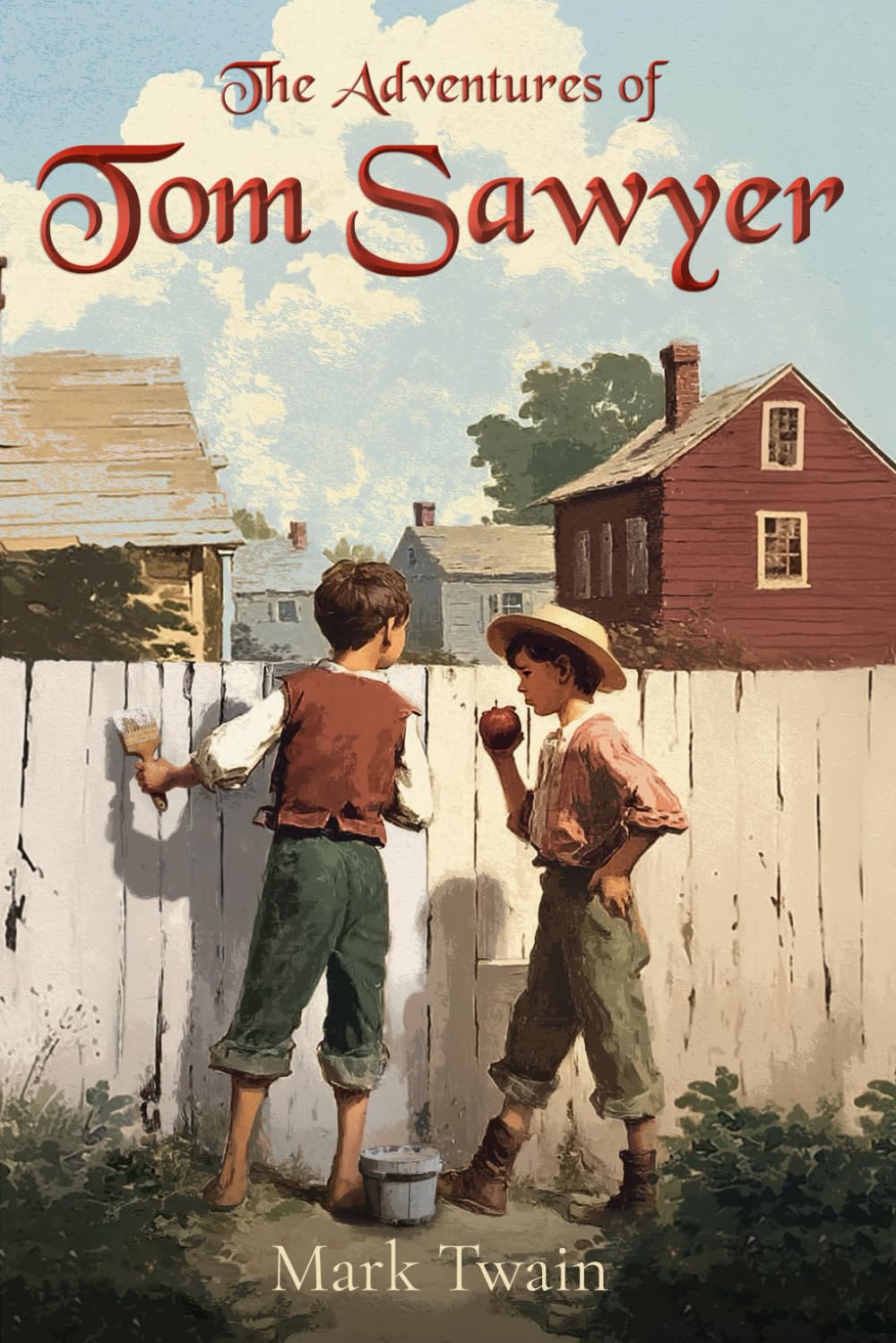
The Adventures of Tom Sawyer by Mark Twain follows the mischievous, imaginative Tom Sawyer through a summer of pranks, romance, pirate adventures, and a brush with real danger in a small Missouri river town. This guide provides parents and teachers with reading level information, age recommendations, content insights, and discussion questions for this classic American novel about childhood, conscience, and growing up.
For Parents
Find the right reading level for your child, understand the book’s period language and themes of danger and conscience, and get conversation starters to help your child explore questions about honesty, courage, and the difference between rules and doing what’s right.
For Teachers
Access grade-level guidance, reading metrics, character analysis support, and thematic discussion questions. This Twain classic offers rich opportunities for exploring antebellum America, Twain’s humor and satire, and the theme of moral development in a child protagonist.
The Adventures of Tom Sawyer at a Glance
Find on Amazon →| Author | Mark Twain |
| Published | 1876 |
| Grade Level | 5–7 (our assessment) |
| Recommended Age | 10–13 |
| Flesch-Kincaid Grade | 8.0 |
| Word Count | ~71,000 |
| Pages | ~274 (standard paperback) |
| Chapters | 35 |
| Genre | Classic fiction / adventure / humor |
| Setting | St. Petersburg, Missouri (fictional), 1840s |
| Awards | Classic (one of the foundational texts of American literature) |
For official Lexile and AR levels, visit Lexile.com or AR BookFinder. ReadingVine provides independent editorial assessments.
What Reading Level Is The Adventures of Tom Sawyer?
The Adventures of Tom Sawyer is appropriate for grades 5–7, with a Flesch-Kincaid grade level of 8.0. The score reflects 19th-century American prose with long sentences, complex punctuation, and period dialect—including the Missouri vernacular Twain renders with great care. The vocabulary includes archaic terms and Southern idioms that may require explanation. Despite the elevated score, Twain’s humor and storytelling are enormously accessible; the book just asks for a bit more patience than contemporary fiction.
Twain’s writing style is one of the great pleasures of American literature. His humor ranges from gentle satire (Tom manipulating his friends into whitewashing the fence) to sharp social observation (the church service scene, the Sunday school prize). The narrator maintains a warm, ironic distance from Tom—affectionate but never oblivious to Tom’s self-deceptions. Twain captures the interior logic of childhood—the elaborate games, the superstitions, the codes of honor among boys—with documentary precision. The dialect of Huck Finn and other characters requires some adjustment for modern readers but adds tremendous life to the dialogue.
The story resonates most deeply with readers ages 10–13 who can appreciate Twain’s irony, follow the shift in the book’s second half from light comedy to genuine danger, and reflect on Tom’s developing conscience. The book rewards readers who enjoy humor, historical settings, and a protagonist who is charming, maddening, and deeply human.
What Age Is The Adventures of Tom Sawyer Appropriate For?
The Adventures of Tom Sawyer is most appropriate for readers ages 10–13. The book includes violence—a murder, a near-execution, and a villain who poses real danger—that shifts the second half from lighthearted comedy to genuine suspense. Twain handles this shift skillfully but parents should be aware.
Murder and violence: Tom and Huck witness a murder in the graveyard early in the book. The villain Injun Joe is genuinely frightening. A man is stabbed and killed on the page. This is not graphic but it is real.
Injun Joe: The villain is referred to throughout as “Injun Joe,” reflecting period attitudes and language. The name and the character’s portrayal reflect 19th-century racist stereotypes about Native Americans that readers should be aware of and discuss.
Tom and Becky lost in a cave: The cave sequence, in which Tom and Becky are lost underground for several days, is genuinely suspenseful and may be frightening for younger or more anxious readers.
Period racial attitudes: The book reflects antebellum Missouri society and includes attitudes and language that were common at the time but are inappropriate by today’s standards.
What’s NOT in the book: No sexual content. The violence is in service of the plot and treated seriously. The book ends happily—Tom is a hero, Huck is provided for, and the villain meets his end. The core of the book is joyful and funny—the whitewashing scheme, the pirate adventure, the funeral—and Twain’s affection for his characters and his boyhood world is on every page.
What Is The Adventures of Tom Sawyer About?
Tom Sawyer lives with his Aunt Polly and half-brother Sid in the fictional town of St. Petersburg, Missouri, on the banks of the Mississippi River in the 1840s. Tom is imaginative, mischievous, and allergic to school and church—he prefers adventures and games to anything his elders want him to do. His best friend is Huckleberry Finn, the son of the town drunk, who is envied by other boys for being entirely free of adult supervision.
The book opens with a series of comic episodes: Tom tricks his friends into whitewashing his fence by convincing them it’s a privilege; he falls in love with the new girl, Becky Thatcher, and manages to both win and lose her affections multiple times; he collects Sunday school prize tickets through trading rather than memorizing scripture and is humiliated when asked to demonstrate his knowledge. These early chapters are purely comedic, establishing Tom’s character—his ingenuity, his vanity, his sentimentality—with Twain’s characteristic warm irony.
The tone shifts significantly when Tom and Huck sneak out at midnight to the graveyard, hoping to use a dead cat to cure warts. Instead, they witness Injun Joe—a dangerous and vengeful outlaw—stab and kill Dr. Robinson during a dispute while the men are digging up a grave. Joe then frames the crime on his drunken accomplice, Muff Potter, who was unconscious and remembers nothing. Terrified of Injun Joe’s revenge, Tom and Huck swear a blood oath never to reveal what they saw.
Guilt-ridden but sworn to silence, Tom throws himself into other adventures. He, Huck, and Joe Harper run away to Jackson’s Island in the Mississippi River, playing pirates for several days while the entire town mourns what they believe are three drowned boys. The boys return dramatically on the day of their own funeral—one of the book’s great comic set pieces.
Tom’s conscience battles his fear. When Muff Potter’s trial begins and the circumstantial evidence points to his execution, Tom can’t stay silent. He testifies against Injun Joe, who leaps from the courtroom window and escapes. Tom is a hero, but now he has a new fear: Injun Joe knows he testified and is out there, somewhere, planning revenge.
The book’s climax comes in two strands. Huck discovers that Injun Joe plans to harm the Widow Douglas as revenge for a grudge against her late husband. Huck warns a neighbor in time, and the Widow is saved while Injun Joe escapes. Meanwhile, Tom and Becky, during a school picnic, wander deep into McDougal’s Cave. They become hopelessly lost in the underground labyrinth. Days pass. Search parties look for them but cannot find them. Tom finally spots a way out through a crack in the rock and leads Becky to safety.
The town, celebrating Tom and Becky’s return, has sealed the cave to prevent further accidents. Injun Joe was inside the cave and has starved to death, trapped behind the sealed door. Tom and Huck discover that Injun Joe’s treasure—a cache of gold found earlier in the book—was in the cave. They retrieve it, and the story ends with Judge Thatcher investing Tom’s share and the Widow Douglas taking Huck in. Huck, briefly civilized, finds he can’t stand being indoors and escapes back to his barrel. Tom promises him he can be in Tom’s new robber gang—if he agrees to go back to the Widow’s and be respectable. The book ends with promise of more adventures to come.
The Adventures of Tom Sawyer Characters
The Adventures of Tom Sawyer Themes and Lessons
The Adventures of Tom Sawyer is, beneath its comedy, a book about the development of conscience. Tom begins the novel as a charming rogue—clever, self-serving, and entirely focused on his own pleasures and schemes. The murder he witnesses forces him into an adult situation: real violence, real fear, real moral responsibility. His eventual decision to testify against Injun Joe, despite genuine danger to himself, represents Tom’s first truly adult act. He does something brave and right because it is right, even though it costs him. Twain presents this not with heavy moralizing but with characteristic lightness—Tom’s courage is real, and the book celebrates it without becoming preachy.
The book is also Twain’s loving portrait of American childhood—specifically the particular freedom of boyhood in a small 19th-century river town, where children ranged freely and unsupervised in ways that no longer exist. Twain was writing from memory (the book is set in the 1840s, when he was a child), and his nostalgia infuses every chapter. But it’s not uncritical nostalgia—Twain’s satire of church, school, and respectable society is pointed, and Huck’s subplot shows that not all childhoods are free and happy. The contrast between Tom’s mischief within a loving household and Huck’s genuine homelessness adds depth to what could be mere comedy.
Discussion questions for families:
- Why does Tom keep his oath to Huck and stay silent about the murder, even though he knows an innocent man may hang?
- What finally makes Tom decide to testify? What does this tell us about his character?
- Tom often bends or breaks rules—but is he a bad person? How does Twain make us like him despite his mischief?
- How is Huck’s life different from Tom’s? What do they each envy about the other?
How Many Pages and Chapters in The Adventures of Tom Sawyer?
The Adventures of Tom Sawyer is approximately 274 pages in standard paperback editions and is divided into 35 chapters. The word count is about 71,000 words. Chapters average about 8 pages and vary considerably in tone—some are pure comedy, others are tense suspense.
For independent readers ages 10–13, the book typically takes 6–8 hours to read. The early chapters are the most purely comedic and accessible; the pace and tone shift in the second half when Injun Joe becomes an active threat. As a read-aloud, it takes approximately 5–6 hours. Twain’s dialogue and narration are extremely rewarding to read aloud—the humor lands better spoken, and the dialect is fun to perform. The book pairs well with discussions of Twain’s life (he grew up in Hannibal, Missouri, which is the model for St. Petersburg), the Mississippi River, antebellum America, and the relationship between this book and its sequel, Adventures of Huckleberry Finn.
Books Similar to The Adventures of Tom Sawyer
About Mark Twain
Mark Twain (1835–1910), born Samuel Langhorne Clemens in Florida, Missouri, grew up in Hannibal, Missouri, on the banks of the Mississippi River—the model for St. Petersburg in Tom Sawyer. He worked as a riverboat pilot, a miner, and a journalist before finding fame as a humorist and novelist. The Adventures of Tom Sawyer, published in 1876, was his first major novel and drew directly on his Hannibal childhood. The character of Tom Sawyer is partly autobiographical—Twain recognized his own boyhood mischief in Tom—and Huck Finn was based on a real childhood friend. The book’s success led to its sequel, Adventures of Huckleberry Finn (1884), which Twain considered his masterpiece. Huck Finn—darker, deeper, and more radical in its treatment of race and slavery—is generally considered one of the greatest American novels. Tom Sawyer Abroad (1894) and Tom Sawyer, Detective (1896) are minor sequels. Twain is widely regarded as the father of American literature, and Ernest Hemingway famously declared that all modern American literature comes from Adventures of Huckleberry Finn. Tom Sawyer remains the most widely read introduction to Twain, a perfect starting point for young readers before they tackle the deeper moral complexity of Huck Finn.
The Adventures of Tom Sawyer: Frequently Asked Questions
What is the famous fence scene in Tom Sawyer?
The fence-whitewashing scene is one of the most famous passages in American literature. Tom has been punished by Aunt Polly and must whitewash a long fence on a Saturday morning—the worst possible fate for a boy who wanted to play. When his friends come by to taunt him, Tom pretends that whitewashing is a wonderful privilege, not a chore. He acts as though he barely trusts his friends to do it at all—it’s too special. The other boys, completely taken in, beg to be allowed to paint. Tom eventually “consents,” accepting gifts and trades in exchange for the privilege of doing his chore. He ends up doing no work at all and comes away richer than he started. Twain uses the scene to introduce Tom’s character—his ingenuity, his manipulation, his understanding of human psychology—and delivers one of literature’s sharpest observations: “Work consists of whatever a body is obliged to do, and Play consists of whatever a body is not obliged to do.”
What grade level is The Adventures of Tom Sawyer?
The Adventures of Tom Sawyer is appropriate for grades 5–7 (ages 10–13). The Flesch-Kincaid level of 8.0 reflects 19th-century American prose with period dialect, long sentences, and archaic vocabulary. Strong fifth graders can manage it with support; sixth and seventh graders are the ideal audience. The book is widely taught in middle school, often as an introduction to Twain before reading the more complex Adventures of Huckleberry Finn. Despite the elevated reading level score, Twain’s humor and storytelling are very accessible—the challenge is the vocabulary and sentence structure, not the story itself.
Is The Adventures of Tom Sawyer appropriate for kids?
The Adventures of Tom Sawyer is appropriate for readers ages 10 and up. The book begins as light comedy but shifts significantly when Tom and Huck witness a murder. The villain Injun Joe is genuinely threatening, and the cave sequence is suspenseful enough to frighten some readers. There is also the issue of period language and the portrayal of the character “Injun Joe,” which reflects 19th-century racist attitudes about Native Americans and should be discussed with young readers. For readers 10 and up, these are valuable conversation starters rather than reasons to avoid the book. The core of Tom Sawyer is joyful and funny, and its treatment of moral courage is genuinely moving.
Is Tom Sawyer the same as Huckleberry Finn?
Tom Sawyer and Huckleberry Finn are separate books with overlapping characters. The Adventures of Tom Sawyer (1876) is the first book and focuses on Tom; Huck Finn is a supporting character. Adventures of Huckleberry Finn (1884) is the sequel and focuses on Huck, with Tom appearing mainly at the end. Tom Sawyer is lighter and more comedic—a nostalgic portrait of boyhood. Huck Finn is darker and more serious, a profound moral examination of slavery and racism set on the Mississippi River. Many readers read Tom Sawyer first as an introduction to Twain’s world and characters before tackling the more demanding Huck Finn. Both books are American classics, but Huck Finn is generally considered the greater literary achievement and the more important moral document.
What happens to Injun Joe in Tom Sawyer?
Injun Joe dies trapped in McDougal’s Cave. After Tom testifies against him at Muff Potter’s trial, Joe escapes through the courthouse window. He goes into hiding while plotting revenge against several people, including the Widow Douglas, whose late husband had caused him a past grievance. He is thwarted in that plot by Huck, who warns the Widow’s neighbor in time. When Tom and Becky get lost in McDougal’s Cave during the school picnic, Injun Joe is also inside—he had been using a secret section of the cave as a hideout. After Tom and Becky escape, the townspeople seal the cave’s entrance to prevent further accidents. Injun Joe, trapped inside, starves to death. When Tom reveals he knows a secret entrance, the treasure Joe had hidden in the cave is found and recovered by Tom and Huck.
Is The Adventures of Tom Sawyer based on a true story?
The Adventures of Tom Sawyer is fiction, but it draws heavily on Twain’s own childhood in Hannibal, Missouri. The fictional town of St. Petersburg is based directly on Hannibal. Several characters have real-life counterparts—Huck Finn was based on a childhood friend named Tom Blankenship, and Becky Thatcher was based on a girl named Laura Hawkins. The cave in the book is based on real caves near Hannibal, now known as Mark Twain Cave and open to tourists. Tom Sawyer himself is partly autobiographical—Twain recognized his own boyhood mischief in the character. The specific events are fictional, but the setting, atmosphere, and childhood culture are rooted in Twain’s genuine memory of antebellum Missouri. Twain wrote in the preface that “most of the adventures recorded in this book really occurred; one or two were experiences of my own, the rest those of boys who were schoolmates of mine.”
What is the cave scene in Tom Sawyer?
The cave scene is the book’s climax and one of the most suspenseful sequences in American children’s literature. During a school picnic, Tom and Becky wander away from the group and explore deep into McDougal’s Cave—a vast underground labyrinth near the river. They lose track of the group and cannot find their way back. Their candles burn low and then out. They are lost underground for several days, searching in different directions, their food running out, their strength failing. Meanwhile, the town has organized search parties but cannot locate them. Tom eventually spots a distant light through a crack in the rock and discovers an opening to the outside. He leads Becky out to safety just as their strength gives out. The scene is genuinely frightening—Twain doesn’t soften it—and Becky’s courage during the ordeal gives her real dimension beyond just being Tom’s love interest.
Does Tom Sawyer have a sequel?
Yes, Adventures of Huckleberry Finn (1884) is the primary sequel and is generally considered the more important book—one of the greatest American novels. It follows Huck Finn as he escapes his abusive father and travels down the Mississippi River with Jim, an enslaved man seeking freedom. Tom Sawyer appears near the end of Huck Finn in a controversial sequence. There are also two minor sequels: Tom Sawyer Abroad (1894), in which Tom, Huck, and Jim travel by balloon, and Tom Sawyer, Detective (1896), a mystery story based on a real case. Most readers go directly from Tom Sawyer to Huck Finn, which is set in the same world but is darker, deeper, and more serious. Huck Finn is appropriate for grades 7 and up due to its treatment of race and slavery and its more challenging language.