
 = Partner Site
The Black Stallion Reading Level: A Complete Guide
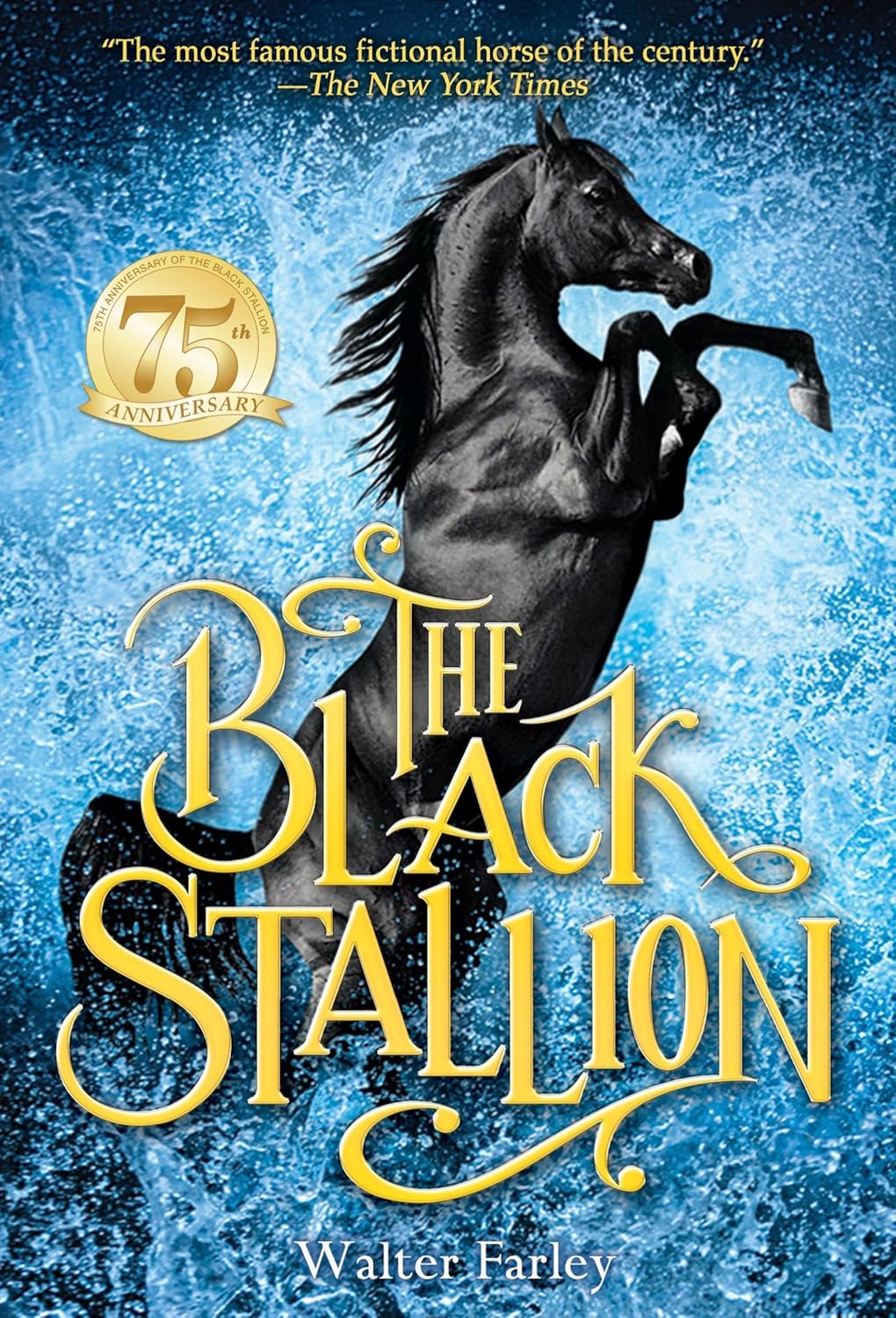
This complete guide to The Black Stallion by Walter Farley covers everything parents, teachers, and students need to know — from reading level and recommended age to a full character list, key themes, and similar books. Whether your child is a devoted horse lover or a reluctant reader who can’t resist an adventure story involving a shipwreck and a wild stallion, you’ll find honest, practical information here to help you get the most out of this beloved American classic, first published in 1941 and still captivating readers today.
For Parents
The Black Stallion is a pure adventure story with no inappropriate content and an irresistibly exciting premise: a boy, a shipwreck, a desert island, and the most magnificent wild horse anyone has ever seen. It has been a reliable gateway book for reluctant readers — especially children who love animals — for more than eighty years. The first half is gripping survival fiction; the second half is a classic underdog racing story.
For Teachers
A Common Core State Standards Text Exemplar for grades 4–5, The Black Stallion offers rich material for studying setting, character development, and the human-animal bond. The novel’s two-part structure — survival on the island, then training and racing in New York — provides a natural framework for discussing how setting shapes character and plot. It pairs well with nonfiction on horse behavior, Arabian horse history, and the Golden Age of horse racing.
The Black Stallion at a Glance
Find on Amazon →| Author | Walter Farley |
| Published | 1941 |
| Grade Level | 4–6 (our assessment) |
| Recommended Age | 9–12 |
| Flesch-Kincaid Grade | 5.2 |
| Word Count | ~55,000 |
| Pages | 224 (standard paperback) |
| Chapters | 18 |
| Genre | Adventure / Animal story |
| Setting | Arabian Sea; a deserted island; New York City (1940s) |
| Awards | Newbery Honor (1942); CCSS Text Exemplar (Gr. 4–5) |
For official Lexile and AR levels, visit Lexile.com or AR BookFinder. ReadingVine provides independent editorial assessments.
What Reading Level Is The Black Stallion?
Based on our editorial assessment, The Black Stallion is best suited for readers in grades 4–6. The book carries a Lexile score of 680L, which places it at the lower end of the upper elementary range. Our Flesch-Kincaid calculation puts it at approximately grade 5.2. These numbers reflect the novel’s accessible, fast-paced prose — Farley writes with clarity and momentum, making the reading experience considerably smoother than many books assigned at the same grade level.
What makes the book work so well across a range of readers is its structure. The island survival section (roughly the first half of the novel) is almost entirely action and sensation — Alec and the Black communicate through instinct and physical proximity, with very little dialogue or interior reflection. This makes it immediately gripping even for readers who typically struggle with longer books. The second half, set in New York, involves more character interaction and some racing detail that assumes basic familiarity with thoroughbred horse racing, which is worth discussing with readers who have no background there. Overall, the novel reads quickly, and many children who are not strong readers finish it faster than they expect to. It is an especially good choice for reluctant readers ages 9–12 who respond to adventure and animals.
For official Lexile and AR scores, visit Lexile.com or AR BookFinder. ReadingVine’s assessments are independent editorial evaluations.
What Age Is The Black Stallion Appropriate For?
We recommend The Black Stallion for readers ages 9–12. The book is genuinely accessible to strong readers as young as 7 or 8, and Farley himself reportedly began writing it when he was in high school, aiming at the widest possible young audience. The story contains no content of concern for any family, making it one of the most reliably safe classic adventure novels in the canon.
The book opens with a dramatic shipwreck in which the ship sinks, and Alec appears to be the only survivor. This sequence is intense and may be frightening for very young or sensitive readers. There is one brief scene in which the Black fights and kills a snake on the island. Horse racing involves competitive physical exertion, and Alec is thrown from the Black during training and briefly knocked unconscious. There is no language, no sexual content, and no violence between human characters. Overall the book is appropriate for the full elementary age range with the caveat about the shipwreck sequence.
The shipwreck scene, while intense, has served as an introduction to adventure fiction for generations of readers — and Farley’s pacing ensures it is over quickly, giving way to the warmer, more hopeful survival story on the island. Parents who read aloud to younger children may want to note the sequence in advance, but it is not gratuitous and does not linger.
What Is The Black Stallion About?
Alec Ramsay, a red-haired New York City boy in his early teens, is sailing home from a summer visit to his uncle in India when the tramp steamer Drake makes an unscheduled stop at a small Arabian port. There, Alec witnesses something extraordinary: a magnificent, ink-black stallion being loaded onto the ship under terrified protest — blindfolded, lathered with sweat, barely contained by the men struggling to handle him. Alec is transfixed. He begins leaving sugar cubes outside the Black’s pen each night, and slowly, against all logic, a fragile thread of trust begins to form between boy and horse.
Then, in the Mediterranean Sea, a violent storm strikes the Drake. The ship founders and sinks. In the chaos, Alec cuts the Black free from his pen, and both are swept into the sea. When Alec regains consciousness, he is gripping a rope still attached to the Black’s neck, and the stallion is swimming hard toward land. They wash ashore on a tiny deserted island somewhere in the Atlantic. For weeks — perhaps months — the two are alone together, entirely dependent on each other for survival. Alec forages for food, tends to the Black, and gradually, painstakingly, earns the trust of this wildest of wild animals until the day he climbs onto the Black’s back for the first time and the horse runs with him as if they have always been one creature.
Rescued by a passing ship and eventually returned to New York, Alec faces the challenge of keeping a wild Arabian stallion in a Queens suburb — and finds an unexpected ally in his neighbor Henry Dailey, a retired jockey whose own greatest days seemed behind him. Together, Alec and Henry begin training the Black in secret for a match race against the two fastest horses in America. What began as a survival story ends as a classic underdog racing triumph, but at its heart the novel is always about the bond between a boy and a horse who saved each other from the sea.
The Black Stallion Characters
Is The Black Stallion Banned?
The Black Stallion has no history of being banned or challenged and does not appear on any American Library Association lists. It is one of the most universally accepted titles in the middle grade canon — a book parents, teachers, and librarians have pressed into the hands of reluctant readers for generations without hesitation. Published in 1941, it has remained continuously in print for more than eighty years without generating any documented objections. It is a Common Core State Standards Text Exemplar and is included in elementary reading curricula across the country.
The Black Stallion Themes and Lessons
The novel’s deepest theme is the one it never quite states directly: that some connections between living creatures transcend explanation. Alec cannot tell anyone — not Henry, not his parents, not the sportswriters who eventually cover the Black — why the horse accepts him when he accepts no one else. The bond simply exists, forged in the extremity of the shipwreck and cemented on the island through shared vulnerability. Farley treats this with unusual respect for a children’s author of his era; he never reduces it to a trick or a technique but presents it as something real and mysterious.
The survival section of the novel is also a quiet lesson in patience and observation. Alec gains the Black’s trust not through force or clever training methods but through consistent, patient presence — offering food, keeping his distance, letting the horse set the pace of their relationship. This makes the book a natural conversation-starter about how humans and animals communicate, what trust requires, and why wildness deserves respect rather than conquest. Discussion questions worth exploring: Why does the Black trust Alec when he trusts no one else? What does Alec learn on the island that he couldn’t have learned anywhere else? How does Henry Dailey change because of his friendship with Alec and the Black?
How Many Pages and Chapters in The Black Stallion?
The standard paperback edition of The Black Stallion runs 224 pages and is divided into 18 chapters. The book contains approximately 55,000 words. For a reader ages 9–12 reading at a pace of 25–30 pages per hour, the book can be completed in approximately 7–9 hours of reading time. At a classroom pace of one or two chapters per session, it typically spans three to four weeks. The chapters run 10–15 pages on average and tend to end on moments of tension or transition, making them natural stopping points for nightly reading assignments. The brisk pacing means many children who are slow starters finish it faster than they expect to.
Books Similar to The Black Stallion
About Walter Farley
Walter Farley (1915–1989) was born in Syracuse, New York, and grew up in New York City, where his family moved when he was young. His passion for horses began in childhood despite growing up in an urban environment — he spent time around horses whenever he could and was deeply influenced by an uncle who shared his love of the animals. He began writing The Black Stallion while still in high school and completed it during his college years at Columbia University. The novel was published in 1941, when Farley was 26, and became an immediate bestseller. Its success launched one of the most prolific series in American children’s literature: Farley eventually wrote more than twenty Black Stallion novels, and the series has sold over twelve million copies. The original Black Stallion was adapted into a celebrated 1979 film directed by Carroll Ballard, widely regarded as one of the most visually beautiful horse movies ever made. Near the end of his life, Farley co-wrote The Young Black Stallion with his son Steven, who has continued the series. Walter Farley died in 1989, shortly before that final book was published.
The Black Stallion: Frequently Asked Questions
What reading level is The Black Stallion?
The Black Stallion is best suited for grades 4–6, based on our editorial assessment. The Lexile score is 680L, and it is a Common Core State Standards Text Exemplar for grades 4–5. The accessible, action-driven prose makes it read faster and easier than many books assigned at the same level, which is part of why it has long been a trusted gateway book for reluctant readers. Strong readers in grades 3–4 can handle it without difficulty.
What is the Lexile level of The Black Stallion?
The Black Stallion has a Lexile score of 680L. For the most current and official score, visit Lexile.com directly.
Is The Black Stallion part of a series?
Yes — a very long one. Walter Farley wrote more than twenty Black Stallion novels, beginning with The Black Stallion Returns (1945) and continuing through The Black Stallion Legend (1983). His son Steven Farley has continued the series with additional titles. Each book follows Alec Ramsay and the Black through new adventures and racing challenges. The books do not need to be read in order, though starting with the original novel provides the richest foundation for the characters and their bond.
Is there a Black Stallion movie?
Yes. The 1979 film adaptation directed by Carroll Ballard is widely considered one of the finest children’s films ever made and one of the most visually stunning horse movies in cinema history. It stars Kelly Reno as Alec and Mickey Rooney as Henry Dailey, with extraordinary footage of horse and boy on the island. It is rated G and is an excellent companion viewing for readers of any age. A sequel, The Black Stallion Returns, followed in 1983, and a prequel, The Young Black Stallion, was released in 2003.
What breed is the Black Stallion?
In the novel, the Black is described as larger than a purebred Arabian — suggesting he is a crossbreed with Arabian blood but also carrying the size of another breed, possibly a thoroughbred. Farley describes him as “too big to be pure Arabian” but with all the characteristics of an Arabian head and spirit. His origins are deliberately left somewhat mysterious, which is part of what makes him legendary within the story’s world.
Does anyone die in The Black Stallion?
No human characters die in a way that directly affects the main story, though the shipwreck implies the deaths of all other passengers and crew. This loss is not dwelt upon — Alec is the sole survivor, and the novel moves quickly past the disaster to focus on the island survival. The Black kills a snake on the island in a single brief scene. No other deaths occur in the main narrative.
Why is The Black Stallion still popular after 80 years?
At its core, The Black Stallion satisfies two powerful childhood desires simultaneously: the desire for survival adventure and the desire for a profound, exclusive bond with an animal. Alec is the only person in the world the Black will fully trust — a fantasy that resonates deeply with young readers who dream of a connection that no one else could share. The novel is also exceptionally well-structured, with a natural two-act shape (island, then city) that gives it the momentum of a much longer book in a compact 224 pages. It has remained in print continuously for over eight decades for good reason.
How long does it take to read The Black Stallion?
At a reading pace of 25–30 pages per hour, most readers ages 9–12 will finish The Black Stallion in approximately 7–9 hours of reading time. In a classroom setting, it typically takes three to four weeks at a pace of one or two chapters per session.