
 = Partner Site
The Inquisitor’s Tale Reading Level: A Complete Guide
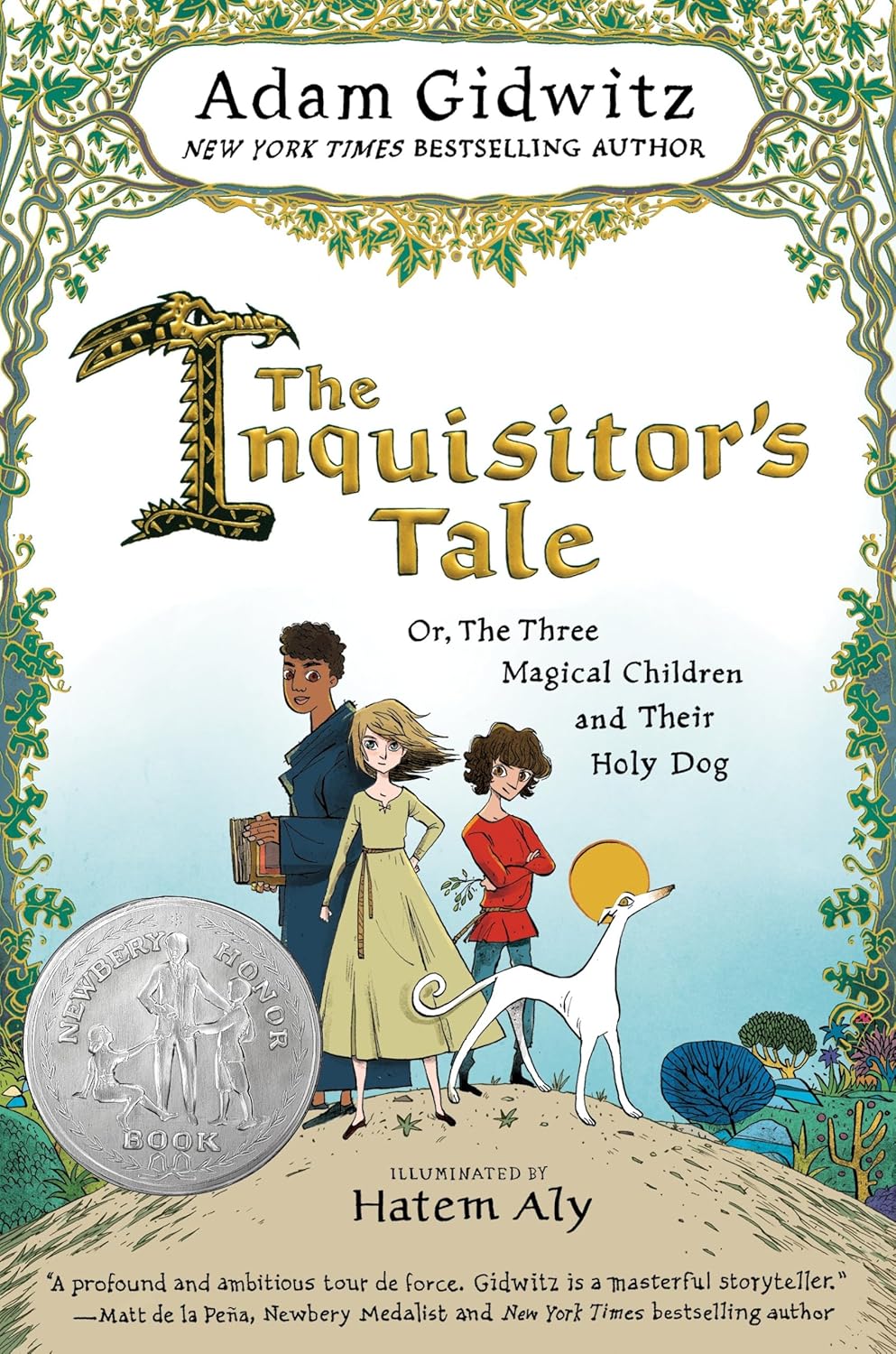
The Inquisitor’s Tale: Or, The Three Magical Children and Their Holy Dog, written by Adam Gidwitz and illuminated by Hatem Aly, is a 384-page historical fantasy novel set in 13th-century France. It is 1242. At the Holy Cross-Roads Inn outside Paris, travelers from across France tell the story of three children who have become the most wanted outlaws in the kingdom of King Louis IX: William, a young Black oblate from a monastery who has the gift of healing; Jacob, a Jewish boy whose village was burned by an antisemitic mob, who can bring the dead back to life; and Jeanne, a peasant girl with prophetic visions, accompanied by her greyhound Gwenforte who has herself been miraculously returned from the dead. The three children are on the run from the king’s agents, sheltered by some, betrayed by others, and finally converging on Mont Saint-Michel for a showdown that requires them to leap into a burning pyre to save a stack of Talmuds — a single book of which feels, Gidwitz notes, like higher stakes than any world-incinerating superhero battle. Modeled explicitly on The Canterbury Tales, told through multiple narrators who piece the children’s stories together at the inn, and illuminated with Hatem Aly’s manuscript-style drawings that wrap around the text exactly as in a medieval illuminated manuscript, it received starred reviews from every major children’s literature journal, won a Newbery Honor and the Sydney Taylor Book Award in 2017, and was named one of the best middle-grade books of 2016 by Entertainment Weekly, the New York Times Book Review, and the Wall Street Journal. This complete guide covers The Inquisitor’s Tale‘s reading level, recommended age, content considerations, key characters, themes, and similar books — designed for parents, teachers, and students.
For Parents
A medieval adventure that is simultaneously funny (farting dragon, stinky cheese), historically rigorous, and genuinely moving — one of the most ambitious middle-grade novels of the past decade. Ages 10–14, grades 5–8. Content includes antisemitic violence, religious persecution, and some battle scenes; nothing gratuitous. The thematic depth rewards readers who are ready for genuine philosophical discussion alongside their adventure.
For Teachers
An extraordinary grades 5–8 classroom text — the Canterbury Tales framing device, multi-narrator structure, medieval manuscript illustration, and historical rigor make it one of the most teachable novels in the middle-grade catalog. The antisemitic persecution of 1242, the burning of the Talmud, and the three children’s different religious backgrounds give the book more substantive historical and ethical content than any other novel in this catalog. Includes a detailed author’s note and bibliography. Gidwitz narrates the audiobook himself.
The Inquisitor’s Tale at a Glance
Find on Amazon →| Author | Adam Gidwitz |
| Illustrator | Hatem Aly |
| Published | 2016 (Dutton Children’s Books / Penguin) |
| Grade Level | 5–8 (our assessment) |
| Recommended Age | 10–14 |
| Lexile | 620L |
| ATOS Level | 4.5 |
| Fountas & Pinnell | Z |
| Word Count | 74,487 |
| Pages | 384 |
| Genre | Historical fantasy / adventure / middle grade |
| Setting | France, 1242; reign of King Louis IX |
| Awards | Newbery Honor (2017); Sydney Taylor Book Award; starred reviews from Booklist, Kirkus, Publishers Weekly, SLJ, Shelf Awareness |
For official Lexile and AR levels, visit Lexile.com or AR BookFinder. ReadingVine provides independent editorial assessments.
What Reading Level Is The Inquisitor’s Tale?
The Inquisitor’s Tale has a Lexile of 620L and an ATOS level of 4.5, with a Fountas & Pinnell level of Z. The Lexile and ATOS scores are notably lower than the book’s actual reading demands would suggest — lower, for instance, than Stone Fox (650L, ATOS 4.0) despite being far more complex in structure, historical context, and thematic depth. The reason is the multi-narrator Canterbury Tales framing: the travelers’ inn segments are told in simple, conversational prose that pulls the formula scores down, even though the book’s full demands include tracking multiple narrators across 384 pages, processing 13th-century French historical context, and engaging with philosophical and theological questions that many adult novels don’t attempt. The Fountas & Pinnell Level Z is a more reliable indication of the book’s actual complexity for classroom placement purposes.
Our editorial assessment places it at grades 5–8, ages 10–14, consistent with the publisher’s recommendation and with its placement on the SpringBoard Grade 8 curriculum list. Motivated readers at grades 4–5 can certainly engage with it — particularly as a read-aloud or with scaffolding — but the book’s full richness is available to readers who are ready to handle the multi-narrator structure and the historical depth. For official Lexile and AR scores, visit Lexile.com or AR BookFinder. ReadingVine’s assessments are independent editorial judgments.
What Age Is The Inquisitor’s Tale Appropriate For?
We recommend The Inquisitor’s Tale for readers ages 10–14, grades 5–8. The content considerations are primarily historical rather than gratuitous:
The book depicts antisemitic violence — specifically, the burning of a Jewish village by a mob — and the historical burning of Talmudic texts in 1242 Paris. These are real historical events depicted with the seriousness they deserve, not with gratuitous detail. The villain characters include Christian zealots who persecute Jews and other religious minorities, which is an accurate portrayal of the historical period but which parents should be aware of before reading with younger children. There is also moderate battle violence and one scene involving an Inquisition-era interrogation. The farting dragon, stinky cheese humor, and general comic energy of the book significantly leaven these heavier elements.
The book has been warmly reviewed by Jewish educators and organizations — the Sydney Taylor Book Award specifically honors books that authentically portray the Jewish experience — and is considered by many educators one of the most effective and humane introductions to the history of medieval antisemitism available for middle-grade readers.
What Is The Inquisitor’s Tale About?
It is March 1242, and at the Holy Cross-Roads Inn outside Paris, travelers tell each other stories about three children who have recently become the most wanted outlaws in France. As each traveler tells their piece of the story, a fuller picture of the three children emerges:
Jeanne is a peasant girl from the village of Saint-Geneviève who has visions and seizures that her neighbors interpret as either holiness or witchcraft. When her greyhound Gwenforte saves her life and is executed for it, and then rises from the dead, Jeanne’s community determines that the dog is holy — and then panics. Jeanne flees into the forest with Gwenforte. William is a young Black oblate from a monastery — the son of an African woman and an unknown father — who has the miraculous gift of healing but who finds that his monastery is not the refuge he thought it was. He also flees. Jacob is a Jewish boy from Nogent-sur-Oise whose village has been burned by an antisemitic mob. He can bring the dead back to life. He flees with a donkey named Mazel.
The three children meet in the forest outside Paris, wary and frightened of each other — a Christian girl, a Black Christian boy, and a Jewish boy — and gradually discover that their gifts, their flight, and their sense of justice are more important than the differences their world insists should separate them. They are taken captive by knights, interrogated by an Inquisitor, sit alongside King Louis IX, and ultimately converge on Mont Saint-Michel for a climax in which they must leap into a burning pyre to save a library of Talmuds from destruction. The book’s frame — the travelers at the inn, collecting pieces of the story — is told by Étienne, an agent of the Pope’s Inquisition who is trying to determine whether the children performed genuine miracles or diabolical magic, and who finds himself increasingly uncertain.
The Canterbury Tales Structure — Why This Book Is Unique
The Inquisitor’s Tale is explicitly modeled on Geoffrey Chaucer’s Canterbury Tales (c. 1400), which is itself one of the most structurally sophisticated works of medieval literature: a framing narrative (pilgrims traveling to Canterbury) within which multiple narrators tell their own stories, each revealing as much about the teller as about the tale. Gidwitz applies this structure to his novel with complete seriousness — the travelers at the inn are not a gimmick but a genuine narrative device that allows the three children’s stories to be told in pieces, from multiple perspectives, each new narrator adding detail, color, and occasional contradiction to what came before.
The multiple-narrator structure has several effects that reward careful readers. Each narrator has their own voice, their own biases, and their own relationship to the children they are describing. The same event told by different narrators looks different each time. The reader must do the work of assembling the full picture from partial accounts — which is how most historical knowledge actually works, and which gives the book a quality of archival reconstruction that is appropriate to its setting. The framing narrator Étienne’s growing uncertainty about whether the miracles were real is one of the book’s most sophisticated ongoing questions.
Hatem Aly’s illustrations reinforce the medieval manuscript conceit: they wrap around the text in the margins exactly as illuminations appear in genuine medieval manuscripts, and they carry the same mix of sacred content and bawdy humor (including, memorably, a dragon in the process of generating a catastrophic fart) that characterized actual medieval manuscript illumination. The book is visually unlike any other in the middle-grade catalog.
The Inquisitor’s Tale Characters
The Inquisitor’s Tale Themes and Lessons
The book’s central argument is about the specific and terrible power of religious and ethnic prejudice — and about the specific, difficult, earned quality of friendship across those divisions. Jeanne, William, and Jacob are drawn together not because they are identical but because they are each being persecuted for what they are, and because they choose each other anyway. Their friendship does not paper over their differences — Jacob and Jeanne have genuine theological disagreements; William’s African heritage makes him conspicuous in ways that affect the group’s safety — but it holds across those differences in ways that the 13th-century world around them considers impossible. This is the book’s argument, delivered through adventure rather than sermon: impossible friendship is not only possible but necessary.
The historical content is both specific and resonant. The 1242 burning of the Talmud is a real historical event — 24 cartloads of Talmudic manuscripts were burned in Paris on the orders of King Louis IX, following a disputation in which Jewish representatives were required to defend their holy texts against Christian accusations. Gidwitz learned of this event from a plaque in a Paris museum and found it the most moving and most relevant piece of medieval history he encountered in years of research. The book’s climax — three children of different faiths leaping into a fire to save a Talmud — is the most direct contemporary resonance the book offers: when sacred texts are burned, everyone who believes in the value of learning is burning.
The farting dragon deserves acknowledgment as a genuine thematic element. The dragon’s farts, which are cured when Jacob realizes stinky French cheese is igniting them, is both the book’s funniest passage and a demonstration of Gidwitz’s essential point about the Middle Ages: these people were not only devout, frightened, and often cruel; they were also funny, earthy, and very much like us. The gross humor is not a concession to middle-grade readers but an accurate representation of medieval sensibility — the same manuscripts that contain the most solemn theological content also contain detailed fart jokes and talking cats with two heads.
Discussion questions for classrooms and families: Why do Jeanne, William, and Jacob each have a different reason to be afraid of the others — and what makes them trust each other anyway? What does the burning of the Talmud represent — and why does saving it feel like such high stakes? How does Étienne’s view of the three children change across the book — and what changes it? What does it mean for something to be a miracle versus a heresy? Why do you think Gidwitz includes the farting dragon alongside the most serious content in the book?
The History Behind The Inquisitor’s Tale
Gidwitz’s wife, Lauren Mancia, is a professor of medieval history at Brooklyn College, and the historical research behind the novel is meticulous. The author’s note at the end of the book is itself an excellent teaching text — it carefully distinguishes what is history, what is legend, and what is Gidwitz’s invention, which is one of the most useful exercises available for teaching readers to think about historical fiction as a genre. Key historical facts embedded in the novel include: the 1242 Paris burning of the Talmud (real, ordered by Louis IX after the Disputation of Paris); Saint Gwenforte the greyhound (a real medieval local cult in the Dombes region of France, condemned by the Church); the historical presence of Africans in medieval Europe (more common and more varied than popular history suggests); and the role of the Dominican Inquisition in 13th-century France.
How Long Is The Inquisitor’s Tale?
The Inquisitor’s Tale is 384 pages with 74,487 words — a substantial middle-grade novel comparable in length to the middle Harry Potter books. The Canterbury Tales framing means the book is organized into three children’s stories told in pieces, which makes it feel episodic despite the sustained cumulative arc. Most independent readers ages 10–14 complete it in two to three weeks; classroom read-alouds typically run four to six weeks at a chapter per session. The audiobook, narrated by Gidwitz himself, is widely praised and particularly effective for the multi-narrator sections.
Books Similar to The Inquisitor’s Tale
About Adam Gidwitz and Hatem Aly
Adam Gidwitz was born and raised in Baltimore, Maryland, and taught elementary school in Brooklyn, New York, for eight years before becoming a full-time author. His students, he has said, were his first audience and his most demanding critics. He is the author of the Grimm trilogy (A Tale Dark & Grimm, In a Glass Grimmly, The Grimm Conclusion) and the Unicorn Rescue Society series, as well as The Inquisitor’s Tale. His wife, Lauren Mancia, is a professor of medieval history at Brooklyn College, and the historical research for The Inquisitor’s Tale drew heavily on her expertise and on their annual research trips to Europe. He encountered the 1242 Paris Talmud burning from a plaque at the Musée d’Art et d’Histoire du Judaïsme in Paris; it became the book’s historical and moral anchor. Gidwitz narrates the audiobook of The Inquisitor’s Tale himself, using different voices for each narrator — a performance described by Booklist as “linguistic brilliance.” He lives in Brooklyn with his family.
Hatem Aly is an Egyptian-born illustrator based in New Brunswick, Canada. His illustrations for The Inquisitor’s Tale — manuscript illuminations in the medieval style, wrapping around the text in the margins with the same mixture of sacred reverence and bawdy humor found in genuine medieval manuscripts — are widely considered his finest work. The illustrations include a two-headed cat, stinky cheese, a farting dragon, and deeply moving portraits of the three children at the book’s most serious moments. His other work includes the Yasmin series with Saadia Faruqi, The Proudest Blue with Ibtihaj Muhammad and S.K. Ali, and In My Mosque with M.O. Yuksel.
The Inquisitor’s Tale: Frequently Asked Questions
What reading level is The Inquisitor’s Tale?
Lexile 620L, ATOS 4.5, Fountas & Pinnell Z. The Lexile and ATOS scores are misleadingly low — the Canterbury Tales multi-narrator framing pulls formula scores down despite the book’s genuine complexity. The F&P Level Z is a more reliable measure. Our assessment: grades 5–8, ages 10–14. For official Lexile and AR scores, visit Lexile.com or AR BookFinder.
What is The Inquisitor’s Tale about?
In 1242 France, three children become outlaws: Jeanne, a peasant girl with prophetic visions; William, a Black oblate with the gift of healing; and Jacob, a Jewish boy who can raise the dead. Accompanied by Jeanne’s holy greyhound Gwenforte, they are pursued across France by knights and an Inquisitor, sit alongside King Louis IX, and ultimately leap into a burning pyre to save a library of Talmuds from destruction. Told through multiple narrators at an inn, in the style of Chaucer’s Canterbury Tales.
Is The Inquisitor’s Tale appropriate for middle schoolers?
Yes — it was specifically written for middle-grade readers ages 10–14 and placed on the SpringBoard Grade 8 curriculum. The antisemitic violence and religious persecution are depicted with historical honesty but without gratuitous detail. The book won the Sydney Taylor Book Award, given specifically for books that authentically portray Jewish experience, and is widely recommended by Jewish educators. The farting dragon and stinky cheese humor are genuine counterweights to the heavier content.
What is the Canterbury Tales connection?
The book is explicitly modeled on Chaucer’s Canterbury Tales (c. 1400) — a framing narrative in which multiple narrators at an inn tell stories about three children, each narrator adding new perspective and detail. The structure means the three children’s stories are assembled in pieces from multiple partial accounts, as historical knowledge often is. It is one of the most sophisticated narrative structures in middle-grade fiction.
Is the history in The Inquisitor’s Tale accurate?
The historical background is rigorously researched — Gidwitz’s wife is a professor of medieval history at Brooklyn College. The 1242 Paris burning of the Talmud is a real historical event. Saint Gwenforte the greyhound was a real medieval local cult. The presence of Africans in medieval Europe is historically documented. The author’s note at the end carefully distinguishes what is history, legend, and invention — one of the most useful exercises available for teaching historical fiction as a genre.
Why is there a farting dragon?
The dragon whose flatulence is solved by Jacob’s realization that stinky cheese is igniting his farts is both the book’s funniest passage and a deliberate statement of Gidwitz’s historical argument: medieval people were not only devout and serious; they were also funny, earthy, and very much like us. The same manuscripts that contain solemn theology also contain talking cats and detailed fart jokes. The farting dragon is accurate to medieval sensibility and to Gidwitz’s conviction that a book about serious things should also be genuinely funny.