
 = Partner Site
The Last Cuentista Reading Level: A Complete Guide
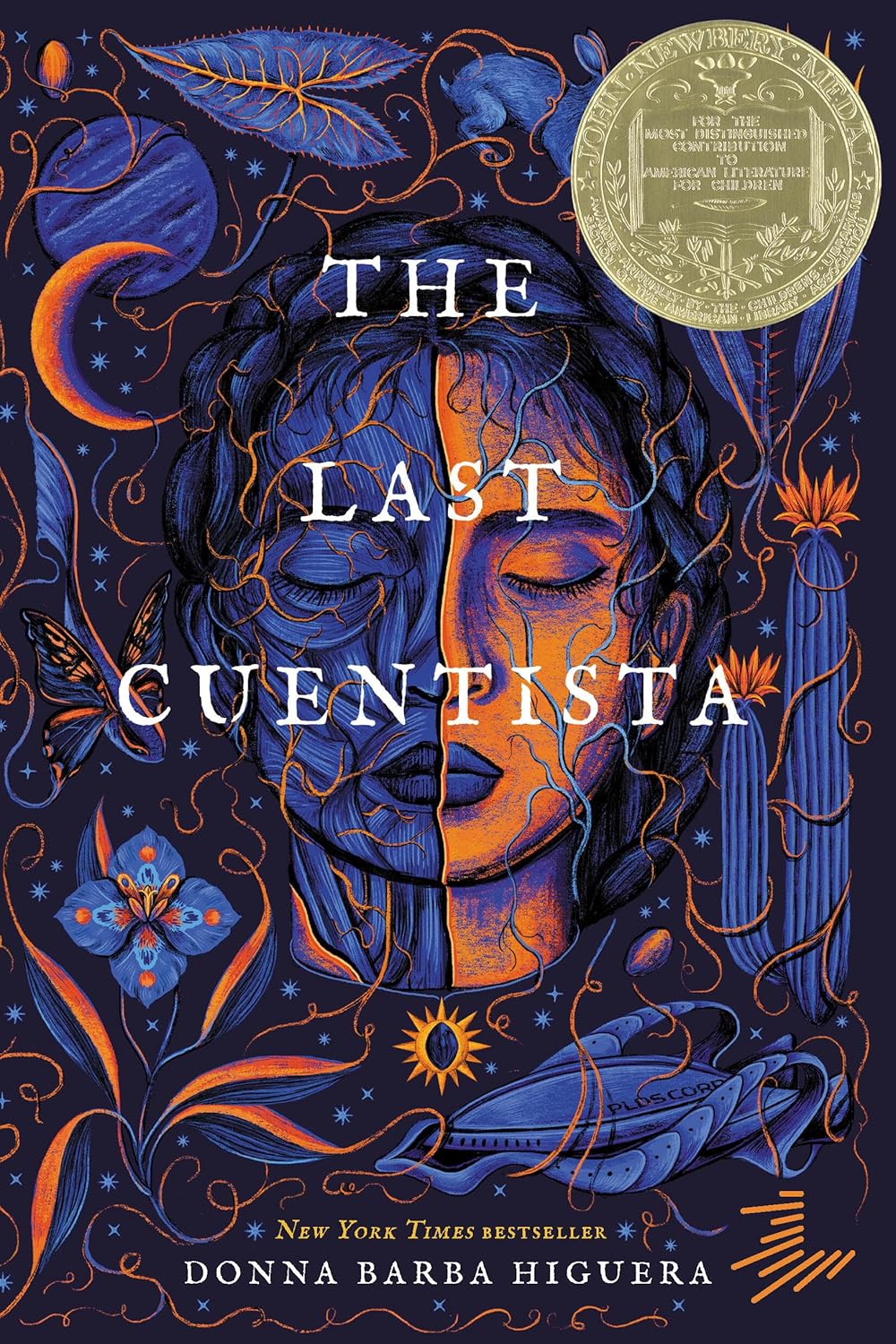
This complete guide to The Last Cuentista by Donna Barba Higuera covers everything parents, teachers, and students need to know — from reading level and recommended age to a full character list, key themes, and similar books. Published in 2021 by Levine Querido, The Last Cuentista is the winner of both the 2022 Newbery Medal and the 2022 Pura Belpré Award. It follows twelve-year-old Petra Peña, a girl who wants to be a storyteller like her grandmother, as she escapes Earth’s destruction by comet only to wake up hundreds of years later on a distant planet where a sinister Collective has erased everyone’s memories, forbidden stories, and eliminated anyone who remembered. Petra — the last one who still knows what it means to be human — must decide what she’s willing to do to keep those stories alive. Whether you’re a parent deciding if it’s right for your child, or a teacher building a unit around it, you’ll find honest, practical guidance here.
For Parents
The Last Cuentista is a dystopian science fiction novel for middle grade readers. Its darkness is real but handled with restraint: the Collective “purges” people it deems insufficiently useful — a form of killing that is never depicted on the page — and brainwashes children to forget their past. Petra’s parents are among those who are killed, off-screen, during the journey. Earth is destroyed by comet (understood rather than shown). There is no profanity and no sexual content. Common Sense Media notes that violence takes place off-scene throughout. Previous Newbery winner Tae Keller described it as veering “into the dark end of middle-grade fiction, with brainwashing, ‘purging,’ and, yes, the destruction of our entire planet — but it doesn’t dwell in the darkness, preferring to give its readers healthy doses of hope, wonder and page-turning action.” Scholastic places it at ages 10–14; we recommend ages 10–13.
For Teachers
The Last Cuentista is a natural anchor for a middle school dystopian fiction unit, offering something rare in the genre: a Latina protagonist, a story rooted in Mexican folklore, and a central argument not just about the dangers of authoritarianism but about the specific power of storytelling as an act of resistance. Teachers who have taught The Giver, The Hunger Games, or The City of Ember will find it an excellent companion or replacement text that brings fresh perspectives to familiar themes. The book also works well in units on folklore, cultural memory, and heritage, and its woven-in Spanish (used naturally, without translation) creates productive discussion opportunities about language and representation. It is widely taught in grades 5–8 and is available in both English and Spanish editions.
The Last Cuentista at a Glance
Find on Amazon →| Author | Donna Barba Higuera |
| Published | 2021 (Levine Querido) |
| Grade Level | 5–7 (our assessment) |
| Recommended Age | 10–13 |
| Flesch-Kincaid Grade | ~5.0 |
| Word Count | Not publicly listed |
| Pages | 336 (hardcover) / 352 (paperback) |
| Chapters | 30 |
| Genre | Science fiction / Dystopian / Middle grade |
| Setting | Earth (2061), a generation ship, and the planet Sagan — hundreds of years in the future |
| Awards | Newbery Medal (2022); Pura Belpré Award (2022); 100th Newbery Medal awarded; Best Books of the Year: TIME, Wall Street Journal, Boston Globe, New York Public Library, and others |
For official Lexile and AR levels, visit Lexile.com or AR BookFinder. ReadingVine provides independent editorial assessments.
What Reading Level Is The Last Cuentista?
The Last Cuentista has a Lexile score of 730L and an ATOS (Accelerated Reader) level of 5.0, worth 11 AR points. Our Flesch-Kincaid calculation is consistent with the ATOS at approximately grade 5. By word and sentence metrics, the book is accessible to a strong reader in grades 4 or 5. Higuera’s prose is clear and propulsive — she writes with the kind of momentum that pulls reluctant readers forward — and the story’s premise (Earth is being destroyed by a comet; one girl will carry humanity’s stories across the stars) hooks readers from the first page. The short chapters also help: 30 chapters over 336 pages averages to about 11 pages each, making natural stopping points easy to find.
The more important calibration is the content and conceptual complexity. The Last Cuentista is a dystopian novel, and its dystopia — a cult-like authoritarian collective that erases people’s memories, eliminates those it deems useless, and forbids stories — requires readers who can hold the logic of authoritarianism in mind and understand why it is frightening. The book’s central argument, that stories are not entertainment but the substance of human identity, is a philosophical claim that rewards readers who can engage with ideas rather than just plot. The Mexican folklore woven throughout — including retellings of La Llorona and other cuentos — requires no prior knowledge but gives additional richness to readers who bring it. SuperSummary places it at grades 6–9; Scholastic at grades 5–9. Our editorial assessment is grades 5–7.
For official Lexile and AR scores, visit Lexile.com or AR BookFinder. ReadingVine’s assessments are independent editorial evaluations.
What Age Is The Last Cuentista Appropriate For?
We recommend The Last Cuentista for readers ages 10–13. Scholastic places it at ages 10–14. The book is notably less graphic than many dystopian novels at this level: violence is implied and off-screen, there is no profanity, and there is no sexual content. What parents and teachers should know going in is the emotional weight rather than any specific scene: Petra’s parents die during the journey (off-page), Earth is destroyed (understood rather than depicted), and the Collective’s practice of “purging” individuals — killing those deemed insufficiently useful — operates as a constant background threat. The book does not dwell in this darkness; it moves through it toward hope and resistance. But it is a serious book about serious things, and it is most powerful with readers old enough to feel the full weight of what is at stake.
The Collective kills (“purges”) colonists who are deemed insufficiently useful to the new society, including some adult characters Petra knows. This is never depicted directly — it happens off-page, and its aftermath is what Petra discovers. Petra’s parents and brother do not survive the journey; their deaths are revealed rather than shown. Earth is destroyed by comet impact, understood as a given from early in the story. The Collective brainwashes children against their will, erasing their memories and rewriting their identities. Characters are threatened with airborne toxins. Some characters are subjected to painful medical procedures. There are gunshots and armed confrontations. There is no profanity and no sexual content. The book also contains extensive Spanish woven naturally into the narrative.
Higuera herself has noted that she wrote the book before the surge of book banning that began around 2022, and that its themes — a powerful institution erasing stories and history to consolidate control — have taken on an eerie and painful timeliness. For readers who are old enough to recognize those parallels, The Last Cuentista offers both a mirror for understanding what is happening in the world and a story about why it is worth fighting. For younger readers who aren’t yet tracking those connections, it works equally well as a gripping science fiction adventure about a girl with an extraordinary gift for storytelling who refuses to let go of who she is.
What Is The Last Cuentista About?
It is 2061. A solar flare has knocked Halley’s Comet off its usual course and set it on a collision path with Earth. Three ships are launched carrying a few thousand scientists and their children — the last of humanity — toward a distant planet called Sagan. The journey will take more than three hundred and fifty years. Among the passengers are twelve-year-old Petra Peña, her parents, and her younger brother Javier. Before leaving, Petra’s grandmother — her abuelita, or Lita — gives her the most important thing she has: the stories. The cuentos. The folklore and fables of their people. “I’m part of you,” Lita tells her. “You’re taking me and my stories to a new planet and hundreds of years into the future.”
Petra is put into stasis for the journey. But her suspended animation device — a “Cog,” originally a P.E.A., or pellet of extended animation — doesn’t work quite right. She drifts in and out of sleep over the centuries, never fully under, never fully gone. When she wakes on the planet Sagan, she discovers that while she slept, a group called the Collective gradually took over the ship. They believed that humanity’s history was a record of sin, violence, and failure, and that the only way to build a better world was to erase it entirely. They purged the adults. They reprogrammed the children. When Petra arrives on Sagan, she is the only person on the planet who remembers Earth, who knows what it felt like to eat an orange or hear a grandmother’s voice or listen to a story about La Llorona on a summer night. She is the last cuentista. And the Collective is watching for anyone who still remembers.
The Last Cuentista Characters
Is The Last Cuentista Banned?
The Last Cuentista has not been banned or formally challenged in any documented way. There is an irony — not lost on Higuera — in the fact that a book about a powerful institution erasing stories and forbidding the telling of history was written before the current wave of book banning began in American schools and libraries. Higuera has said in interviews that she wrote the book in approximately 2015–2021, well before the surge in book challenges that began drawing national attention around 2022. “The fact that it is happening now is really just timely and even more frightening,” she told one interviewer, “because I guess I thought we were beyond all that and it is happening again.”
The book’s themes — a totalitarian society that erases stories, purges cultural memory, and controls the population by controlling what they are allowed to know — have made it a natural text in conversations about censorship and intellectual freedom. It remains widely available in schools and libraries, appears on recommended reading lists nationally, and is one of the most frequently discussed middle grade dystopian novels of the past several years.
The Last Cuentista Themes and Lessons
The novel’s central claim — stated in the title and demonstrated on every page — is that stories are not decoration or entertainment but the actual substance of human identity. Without them, the colonists on Sagan are physically alive but something essential is missing: empathy, context, the capacity to understand why something matters by understanding where it came from. The Collective believes it is building a better world by erasing the past; what it is actually building, Higuera shows, is a world without the capacity to be better, because a world without memory cannot learn from what came before. This is not an abstract argument. It lands in specific moments: Petra telling the story of La Llorona to someone who has never heard a story, and watching their face change as the story reaches them.
The novel also makes a quieter argument about whose stories get erased and why. The Collective’s “Harmony” and “Unanimity” are the language of a particular kind of oppression — the kind that presents itself as neutral and beneficial while systematically eliminating the perspectives of those who dissent or simply remember differently. For teachers, this is rich territory: Higuera wrote the book before the current surge of book banning, and the parallels are not accidental, even if they were not intended. Discussion questions worth exploring: What does the Collective believe about humanity’s past, and why is that belief dangerous? What do the stories Petra carries allow people to do that they couldn’t do without them? Why do you think Higuera chose to interweave Mexican folklore specifically, rather than generic or universal stories? And: is there a story from your own family or culture that you would want to carry to another planet?
How Many Pages and Chapters in The Last Cuentista?
The Last Cuentista is 336 pages in the original hardcover (2021) and 352 pages in the 2024 paperback edition, with 30 chapters. At an ATOS level of 5.0 and with the momentum of its premise driving the story forward, most middle school readers in the 10–13 range move through it quickly — the audiobook runs approximately 8.5 hours, suggesting a total reading time of roughly 6–8 hours at typical middle school reading speeds, or about a week of reading at a chapter a day. The story’s structure divides naturally into three informal parts: the Earth section before departure (shorter, establishing Petra and Lita), the journey and awakening (the transition into the novel’s main action), and the Sagan section (the majority of the book, where the dystopian conflict unfolds). The ending resolves Petra’s immediate situation while leaving the larger story open — a deliberate structural choice, as Higuera has confirmed subsequent books in the series.
Books Similar to The Last Cuentista
About Donna Barba Higuera
Donna Barba Higuera grew up in a tiny desert town in central California surrounded by agricultural and oil fields, of Mexican and Spanish heritage. She has described her favorite childhood activities as calling the library’s dial-a-story service over and over, and sneaking into a restricted pioneer cemetery to weave spooky stories using the crumbling headstones. She spent her whole life blending folklore with experience, and she has said the stories that shaped her — the cuentos, the fables, the folktales — are woven into everything she writes. The Last Cuentista began as a writing prompt, sometime around 2012–2015, to take a traditional fairy tale and turn it into science fiction. Higuera chose “The Princess and the Pea” — underused, she felt, compared to Cinderella and Snow White — and the girl who couldn’t sleep because of a pea under the mattress became a girl whose suspended animation device didn’t quite work, leaving her to drift through centuries between waking and sleep. From that image, the novel grew. Her first book, Lupe Wong Won’t Dance (Levine Querido, 2020), won the Sid Fleischman Award for Humor and a Pura Belpré Honor. The Last Cuentista, her second novel, received the 2022 Newbery Medal and the 2022 Pura Belpré Award. She has said that the Pura Belpré was especially meaningful because it confirmed, from the community whose stories she was telling, that she had gotten the representation right. She lives in the Pacific Northwest.
The Last Cuentista: Frequently Asked Questions
What reading level is The Last Cuentista?
The Last Cuentista has a Lexile score of 730L and an ATOS level of 5.0, worth 11 AR points. Our editorial assessment places it at grades 5–7. The prose is accessible and propulsive, but the book’s dystopian content, its philosophical argument about storytelling and identity, and its woven-in Mexican folklore are best suited to readers in grades 5 and above. Scholastic lists it for grades 5–9 and ages 10–14.
What age is The Last Cuentista appropriate for?
We recommend The Last Cuentista for readers ages 10–13. There is no profanity and no sexual content. The content considerations are: the Collective’s practice of killing (“purging”) people off-page, Petra’s parents dying off-page during the journey, Earth’s destruction (understood rather than depicted), and the brainwashing of children against their will. The book’s darkness is real but handled without graphic depiction. Tae Keller described it as “not dwelling in the darkness” and giving readers “healthy doses of hope, wonder, and page-turning action.”
What does “cuentista” mean?
Cuentista (coo-en-TEES-tah) is a Spanish word meaning storyteller — specifically, one who keeps and tells cuentos (stories, tales). In Mexican and broader Latin American culture, the cuentista is not simply an entertainer but a custodian: someone who preserves the stories, fables, and folklore of a community and passes them forward. Petra’s grandmother is a cuentista, and the novel’s title signals from the first page both what Petra is and what is at stake. When everyone else on Sagan has been made to forget, Petra is the last one who knows the stories — the last cuentista.
Is The Last Cuentista a series?
No. The Last Cuentista is currently a standalone novel, not part of a series. Its ending provides a satisfying resolution to Petra’s story while leaving readers with meaningful questions about the future. Although Donna Barba Higuera published another science fiction novel, Alebrijes (2023), it is a separate story and not a continuation of Petra’s journey.
What Mexican folklore appears in The Last Cuentista?
Several traditional Mexican and Latin American stories are woven into the novel. La Llorona — the Weeping Woman, a figure from Mexican folklore who mourns the loss of her children — appears as one of the cuentos Petra tells on Sagan, and her story functions in the novel as both a piece of preserved cultural memory and a parable about grief, loss, and the danger of forgetting. Other folklore elements appear throughout, woven into Petra’s memories of Lita and into the stories she uses to reach people whose memories have been erased. Higuera grew up with these stories and has said they are the foundation of her imagination as a writer.
How is The Last Cuentista similar to The Giver?
The two books are among the most frequently compared dystopian novels in middle grade fiction. Both feature a society that has erased its past in the belief that doing so will eliminate suffering, and both feature a young protagonist who is given access to what everyone else has lost — memories, stories, history — and must decide what to do with that access. The Giver is set in a near-future Earth community; The Last Cuentista is set on a distant planet centuries from now. The Giver uses a palette of gray and sameness; The Last Cuentista weaves in folklore and color and the specific richness of Mexican cultural tradition. Many teachers use the two books together as a paired text unit.
Why did The Last Cuentista win both the Newbery Medal and the Pura Belpré Award?
The Last Cuentista won both the Newbery Medal and the Pura Belpré Award in the same year. The Newbery Medal is the most prestigious honor in American children’s literature, awarded for the most outstanding contribution to children’s literature in a given year. The Pura Belpré Award, given by the American Library Association, honors the Latino writer whose work best portrays, affirms, and celebrates the Latino cultural experience for children. Winning both simultaneously — and for the same novel — had never happened before. It was also the 100th Newbery Medal awarded, making it one of the most historically significant years in children’s book awards history. The Newbery committee specifically cited the novel’s “rich themes and immersive worldbuilding” in its exploration of storytelling, memory, and the idea that differences are what unite rather than divide us.
Is The Last Cuentista based on a true story or real science?
The novel is fiction, but it is grounded in real elements. Halley’s Comet — the comet that has historically passed Earth roughly every 75 years — is the agent of Earth’s destruction. The planet Sagan is named after Carl Sagan, the real astronomer and science communicator whose work on the search for extraterrestrial life and the importance of scientific thinking to humanity’s future is echoed throughout the novel’s themes. The book’s conception of a generation ship — a vessel traveling across centuries with sleeping passengers — is a well-established premise in science fiction that scientists have seriously discussed as a theoretical possibility for interstellar travel. The folklore woven throughout is drawn from real Mexican and Latin American oral tradition.