
 = Partner Site
The Midwife’s Apprentice Reading Level: A Complete Guide
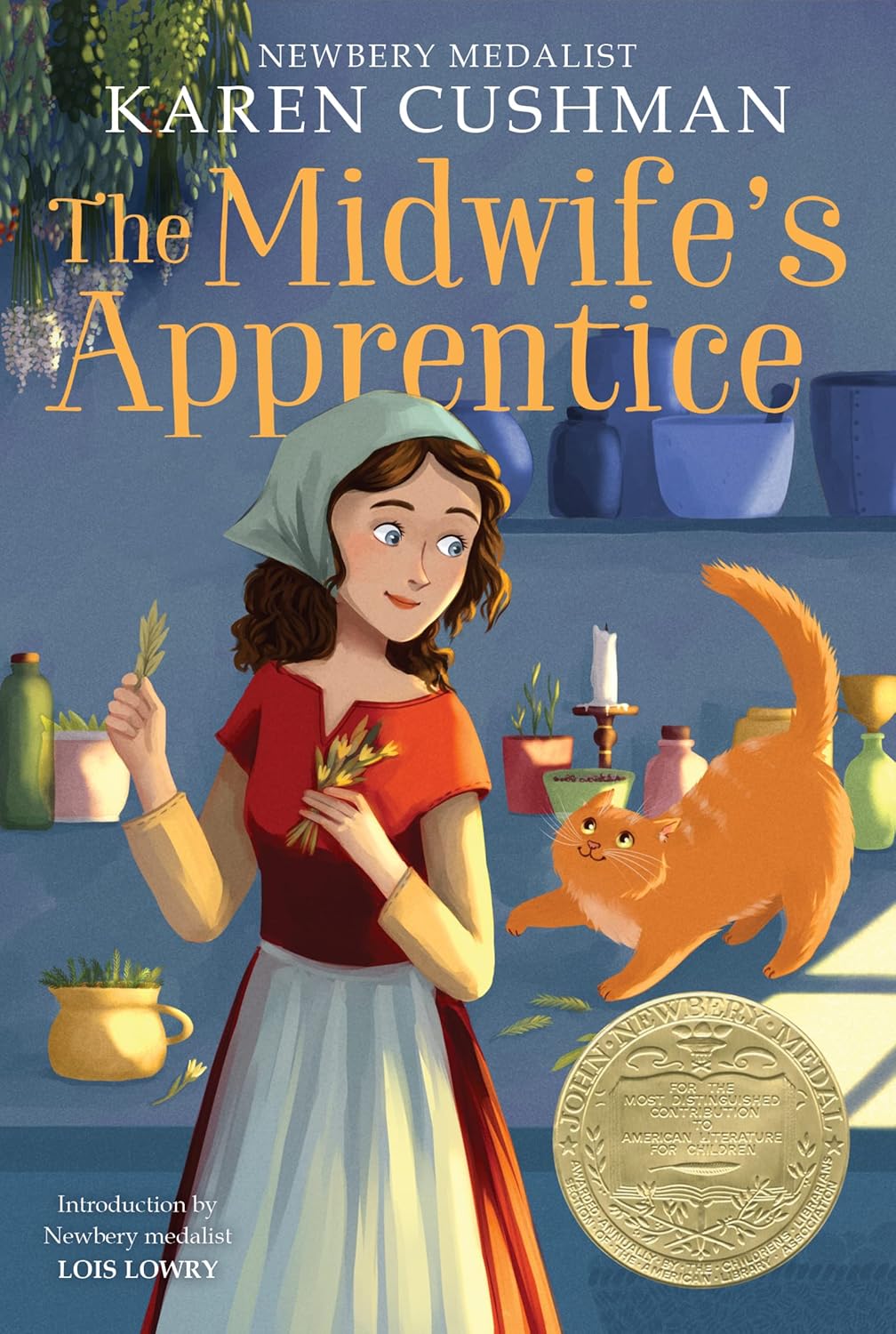
The Midwife’s Apprentice by Karen Cushman is a Newbery Medal-winning novel about a homeless, nameless girl in medieval England who claws her way from a dung heap — literally — to a sense of identity, capability, and belonging. Short, vivid, and written with both humor and historical honesty, it is one of the most distinctive Newbery winners of the 1990s and one of the finest examples of the genre: a novel that makes the medieval past feel immediate, dirty, funny, and deeply human. This complete guide covers the reading level, age appropriateness, themes, characters, and everything parents and teachers need to know about this acclaimed historical novel.
For Parents
The Midwife’s Apprentice is a short, fast-moving novel about a girl with no name, no family, and no sense of her own worth who gradually discovers all three. It deals frankly with the physical realities of medieval life — poverty, bodily functions, childbirth — without being graphic or inappropriate. Best suited for readers ages 10-13, it is an excellent choice for readers who want historical fiction that feels genuinely authentic rather than sanitized, and for readers who are drawn to strong, unconventional female protagonists.
For Teachers
A Newbery Medal winner widely used in grades 5-7, The Midwife’s Apprentice is an outstanding text for teaching historical fiction, character development, and voice. Cushman’s medievally-flavored prose — specific, sensory, and shot through with dry wit — is a superb model for writing in an authentic historical register. The novel’s frank treatment of childbirth and women’s medical knowledge makes it unusual and valuable in a curriculum context, and its themes of identity, perseverance, and self-worth are perennially relevant. It pairs naturally with Crispin: The Cross of Lead and Good Masters! Sweet Ladies! for a medieval unit.
The Midwife’s Apprentice at a Glance
Find on Amazon →| Author | Karen Cushman |
| Published | 1995 |
| Grade Level | 5-7 (our assessment) |
| Recommended Age | 10-13 |
| Flesch-Kincaid Grade | 6.2 |
| Word Count | ~22,000 |
| Pages | 122 (standard paperback) |
| Chapters | 14 |
| Genre | Historical fiction |
| Setting | Rural England, late 13th century |
| Awards | Newbery Medal (1996) |
For official Lexile and AR levels, visit Lexile.com or AR BookFinder. ReadingVine provides independent editorial assessments.
What Reading Level Is The Midwife’s Apprentice?
The Midwife’s Apprentice reads at approximately a 5th-7th grade level by our editorial assessment, with a Flesch-Kincaid grade level of around 6.2. The vocabulary is one source of challenge: Cushman writes in a prose style that evokes the medieval period through diction and rhythm, using words and constructions that feel authentically old without being incomprehensible. Readers who lean into that language find it enormously pleasurable; those who resist unfamiliar vocabulary may struggle.
A second source of challenge is the novel’s subject matter. The Midwife’s Apprentice deals frankly with childbirth — the protagonist is learning to be a midwife, after all — and with the physical realities of medieval life: poverty, illness, animal husbandry, the smells and textures of a world without modern sanitation. None of this is gratuitous, but it asks readers to engage with a physical world quite different from their own. The novel’s dry, unsentimental humor about these realities is one of its greatest pleasures once readers are calibrated to it.
At just 122 pages, the book is short enough to feel manageable even for less confident readers, and the prose rewards reading aloud. It is most commonly assigned in grades 5-7. For official Lexile and Accelerated Reader scores, visit Lexile.com or AR BookFinder.
What Age Is The Midwife’s Apprentice Appropriate For?
We recommend The Midwife’s Apprentice for readers ages 10-13. The novel deals with childbirth directly — it is a book about a midwife’s apprentice, and deliveries are part of the story — as well as with the general physical hardship of medieval peasant life. Cushman handles all of this with matter-of-fact honesty rather than sensationalism, in keeping with the medieval perspective of her narrator.
The novel includes scenes of childbirth depicted with historical frankness — the physical process, complications, and the role of the midwife. These are not graphic in a modern clinical sense but are described with the direct, unsentimental vocabulary of a medieval practitioner. The protagonist begins the novel sleeping in a dung heap for warmth and is treated with cruelty and contempt by villagers. There are references to animal slaughter, poverty, and illness consistent with medieval rural life. A difficult labor scene in which the protagonist must act alone is the novel’s climactic moment. There is no sexual content beyond the context of childbirth and no strong language. Parents who have concerns about age-appropriate discussions of reproduction and the female body should be aware that the novel addresses these directly, within a historical context.
Many teachers and parents find that the historical framing actually makes discussions of childbirth and the female body easier rather than harder — the medieval setting provides distance that allows honest conversation. The novel has been widely used in schools for decades without generating significant controversy, and it is considered both age-appropriate and valuable by the educational community.
What Is The Midwife’s Apprentice About?
The novel opens in a dung heap. A homeless, nameless girl — referred to only as “Dung Beetle” by the villagers who look down on her — has burrowed into a warm heap of manure to survive a winter night. She is perhaps twelve or thirteen, though no one knows for certain, including herself. She has no past she can remember, no family, no name, no sense that she is entitled to any of the ordinary human things: a place to sleep, enough to eat, a name of her own.
She is taken in, grudgingly and entirely for the labor she can provide, by Jane the Midwife — a sharp-tongued, self-interested village woman who delivers babies and guards her knowledge jealously. The girl, who gives herself the name Beetle and later Alyce, begins as a servant: sweeping, cooking, hauling water, sleeping by the fire. But she is observant, curious, and driven by a hunger for knowledge and competence that she barely understands in herself. Slowly, secretly, she begins to watch Jane work, to learn what she knows, to understand the mysteries of birth that the midwife considers her private property.
The novel follows Alyce through her time in the village, her friendship with a boy named Will, her encounters with a traveling scholar, her failures, her flight from the village after a humiliating defeat, and her eventual return — changed, resolved, and finally in possession of something she has been working toward without knowing its name: a sense of herself as a person of worth and capability.
Karen Cushman spent years researching medieval village life and drew on historical sources including midwifery manuals, court records, and accounts of daily life in 13th-century England. The world she creates is specific, smelly, funny, and real — a medieval England of mud, superstition, hard work, and occasional grace, rendered without either romanticization or modern condescension.
The Midwife’s Apprentice Characters
Is The Midwife’s Apprentice Banned?
The Midwife’s Apprentice has occasionally been challenged in school districts due to its frank depictions of childbirth and the physical realities of medieval life, but it does not appear prominently on American Library Association lists of frequently challenged books. The challenges it has received have generally been isolated rather than widespread, and the educational community has broadly and consistently defended the book as age-appropriate and valuable. It is widely shelved and assigned in schools and libraries across the country and is considered a distinguished and important work of historical fiction for young readers.
The Midwife’s Apprentice Themes and Lessons
The central theme of The Midwife’s Apprentice is the discovery and claiming of identity — in the most literal possible sense, since the protagonist begins without a name and must construct one for herself. Alyce’s journey is from nothingness toward personhood: from a creature who expects to be treated as less than human, to a girl who understands that she has a right to her own name, her own knowledge, and her own place in the world. Cushman makes this journey feel genuinely hard-won. Alyce does not simply discover her worth through someone else’s recognition — she earns it through work, observation, failure, and the decision to try again.
Failure and resilience form a closely related theme. The novel’s climactic moment is not a triumph but a failure: Alyce is alone with a laboring woman and cannot deliver the baby successfully. She flees in shame, convinced she is indeed the worthless creature the village has always told her she is. Her return is the novel’s real climax — the moment when she decides that failure is not the end of the story, that knowing what to try is worth something even when you don’t succeed, and that she will go back and try again. This is an unusual and unusually honest lesson for children’s literature: not that you will succeed if you try hard enough, but that trying again after failure is itself the achievement.
The novel is also, implicitly, about the lives of medieval women and girls — the specific limitations and the specific dignities available to them, the knowledge that women like Jane held and transmitted to each other, the way female work and expertise was simultaneously essential to the community and dismissed by it.
Discussion starters for classrooms: Why does Alyce choose her own name rather than accepting the one the villagers gave her? What does she learn from her failure at the difficult birth, and how does it change what she does next? What does Jane teach Alyce that she means to, and what does she teach her by accident? How would Alyce’s life be different if she had been born in a different time or place? What does it mean to know what you don’t know?
How Many Pages and Chapters Are in The Midwife’s Apprentice?
The standard paperback edition of The Midwife’s Apprentice is 122 pages, divided into 14 chapters. The word count is approximately 22,000 words — making it one of the shorter Newbery Medal winners and a book that can be read in a single sitting by a motivated reader. Despite its brevity, it is remarkably dense with historical detail, character, and meaning.
For readers in the target age range of 10-13, expect a reading time of roughly 2-3 hours, or 3-4 days at 30 minutes per session. As a classroom text, the short length makes it practical to read the entire novel within a single week, with time remaining for discussion and related historical activities. It works beautifully as a read-aloud — the prose has a rhythm that carries well when spoken — and it is short enough that teachers can read the entire book aloud to a class in a week of twenty-minute sessions.
Books Similar to The Midwife’s Apprentice
About Karen Cushman
Karen Cushman (born 1941) is an American author who came to children’s writing relatively late — she published her first novel, Catherine, Called Birdy, at the age of fifty-two. That novel, a Newbery Honor book set in medieval England and told in diary form, introduced the historical setting and the strong-willed female protagonist that would become her signature. The Midwife’s Apprentice, her second novel, won the Newbery Medal in 1996. Cushman spent years working in museum education and human development before turning to fiction, and the depth and specificity of her historical research reflects that background. Her subsequent novels include The Ballad of Lucy Whipple, set during the California Gold Rush, and Matilda Bone, another medieval medical story. She has spoken extensively about her belief that historical fiction for children should be honest about the past — including its hardships, its injustices, and its smells — rather than presenting a sanitized, comfortable version of history that does readers no service.
The Midwife’s Apprentice: Frequently Asked Questions
What reading level is The Midwife’s Apprentice?
The Midwife’s Apprentice has a Flesch-Kincaid grade level of approximately 6.2. Our editorial assessment places it at grades 5-7 (ages 10-13). The vocabulary is medieval in flavor and more demanding than the page count alone suggests, but the book is short enough that the challenge is manageable. For official Lexile and AR scores, visit Lexile.com or AR BookFinder.
Why does the main character have so many names?
The protagonist begins the novel with no name at all — she is known only as “Dung Beetle,” a contemptuous nickname given by villagers who view her as less than human. She gives herself the name Beetle, then later, more ambitiously, Alyce. The naming is one of the novel’s central acts of self-creation: each name she chooses is a claim on her own identity, a declaration that she is a person who deserves a name of her own choosing. By the time she calls herself Alyce, she has begun to believe that she is worth something. The progression from no name to a chosen name is the spine of her character arc.
Does The Midwife’s Apprentice contain descriptions of childbirth?
Yes. The protagonist is learning to be a midwife, and assisting in and eventually managing deliveries is central to the story. Cushman describes the process of childbirth in terms appropriate to a medieval practitioner — direct, matter-of-fact, and focused on what the midwife does rather than on graphic physical detail. The most significant birth scene, in which Alyce is alone with a laboring woman and struggles, is the novel’s emotional and dramatic climax. Parents should know this is part of the book, and teachers should be prepared to provide age-appropriate context. In practice, most students ages 10-13 engage with these scenes with interest and seriousness rather than discomfort.
What time period is The Midwife’s Apprentice set in?
The Midwife’s Apprentice is set in rural England in the late 13th century — roughly the 1290s, during the reign of Edward I. This places it in the same broad period as Good Masters! Sweet Ladies! (set in 1255) and just before the era of Crispin: The Cross of Lead (set in 1377). The feudal system is fully intact, the Black Death has not yet arrived, and the medieval village Cushman depicts is a world of extraordinary specificity: particular trades, particular superstitions, particular smells. Cushman drew on historical sources including midwifery manuals and village court records in reconstructing this world.
What grade is The Midwife’s Apprentice typically assigned in?
The Midwife’s Apprentice is most commonly assigned in grades 5, 6, and 7, often as part of a medieval history unit or a unit on historical fiction. Its short length makes it one of the more practical Newbery winners for classroom use — it can be read in its entirety within a single week, leaving time for writing activities, historical research, and discussion. It is frequently paired with Crispin: The Cross of Lead or Good Masters! Sweet Ladies! for a more comprehensive medieval unit.
Why did The Midwife’s Apprentice win the Newbery Medal?
The Midwife’s Apprentice won the Newbery Medal in 1996 for the quality and originality of its writing — specifically for the precision and authenticity of Cushman’s historical prose, the vividness and humanity of her protagonist, and the novel’s refusal to romanticize or sentimentalize the medieval past. The Medal committee recognized a book that treated its young protagonist with complete seriousness and treated its young readers with complete respect, delivering a fully realized historical world without condescension or false comfort.
What is the significance of Alyce’s failure in the novel?
Alyce’s failure at a critical childbirth — when she is alone with a laboring woman and cannot deliver the baby successfully — is the novel’s turning point. She flees the village in shame, convinced that she is incapable and that the villagers were right to think nothing of her. Her eventual decision to return and try again is the novel’s real climax, and it carries the book’s central lesson: failure is not the end of the story. Knowing what you tried, and choosing to try again, is itself a form of courage and worth. This is an unusually honest message for children’s literature, which tends to reward effort with success; Cushman rewards it instead with the dignity of persistence.
Is The Midwife’s Apprentice part of a series?
No. The Midwife’s Apprentice is a standalone novel with a complete, self-contained story. Karen Cushman’s earlier novel Catherine, Called Birdy is also set in medieval England and also features a strong-willed girl protagonist, making it a natural companion read, but the two books are not connected by character or plot. Readers who love The Midwife’s Apprentice should read Catherine, Called Birdy next.