
 = Partner Site
The Report Card Reading Level: A Complete Guide
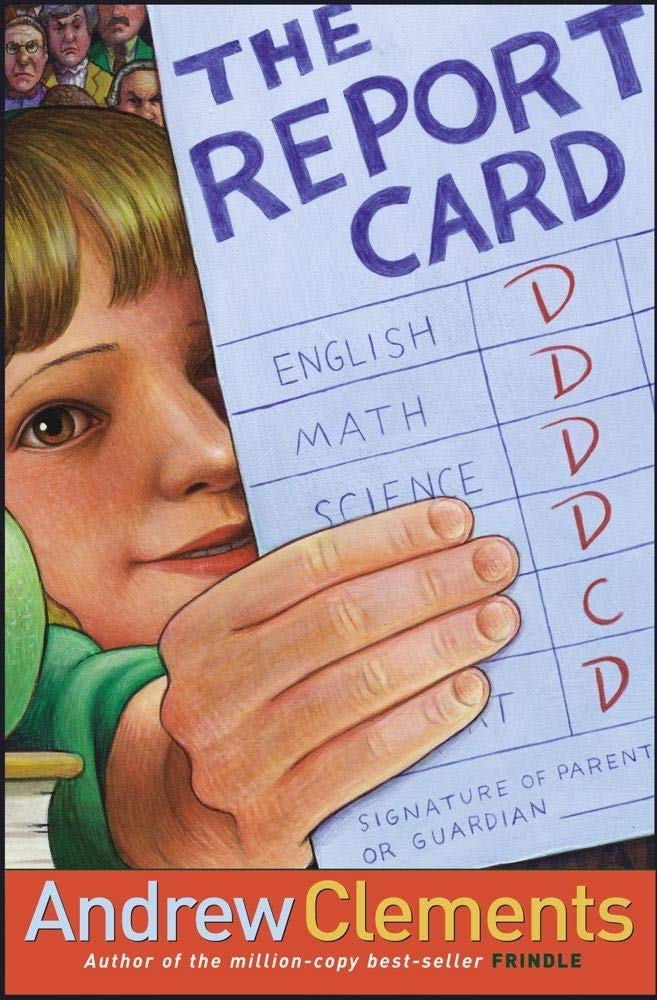
The Report Card, written by Andrew Clements, is a 176-page school novel about Nora Rose Rowley — a fifth-grader who is secretly a genius. She has spent her entire school career hiding this fact, getting average grades, avoiding the gifted program, and just being a normal kid. When her best friend Stephen — who is genuinely average and works hard for every grade he gets — starts to feel worthless because his test scores are low, Nora decides she has had enough. She brings home a terrible report card on purpose. Her point: grades and test scores are an ineffective way to measure intelligence, and they make kids who don’t score well feel like they’re dumb, which they aren’t. The resulting chaos — emergency meetings, a psychologist, an IQ test, a school-wide “Get a Zero” campaign, and the near-suspension of Nora and Stephen — is both funny and genuinely serious about its central argument. Published in 2004 by Atheneum and a natural companion to Clements’s beloved Frindle, it is an effective school-argument novels in middle-grade fiction. This guide covers reading level, age appropriateness, themes, and similar books.
For Parents
A warm, funny school novel about a hidden genius who deliberately flunks fifth grade to prove that grades don’t measure what matters — and the chain of events that follows. Ages 8–12, grades 4–6. No content concerns. An excellent book for children who feel pressure around grades, for children who feel “average,” and for children who are gifted and don’t want to be singled out.
For Teachers
A grades 4–6 classroom standard — one of the most productive available for discussions of testing, grades, different kinds of intelligence, and what school is actually for. Clements taught in public schools for seven years before becoming a writer; the school world in this novel is specific, honest, and recognizable. No bad guys: everyone — teachers, parents, administrators — is doing their best with a system that has real limitations.
The Report Card at a Glance
Find on Amazon →| Author | Andrew Clements (1949–2019) |
| Published | 2004 (Atheneum Books for Young Readers) |
| Grade Level | 4–6 (our assessment) |
| Recommended Age | 8–12 |
| Lexile | 700L |
| ATOS Level | 4.9 |
| Fountas & Pinnell | ~Q |
| Word Count | 31,355 |
| Pages | 176–208 (editions vary) |
| Genre | Realistic fiction / school story |
| Setting | Elementary school, contemporary |
For official Lexile and AR levels, visit Lexile.com or AR BookFinder. ReadingVine provides independent editorial assessments.
What Reading Level Is The Report Card?
Lexile 700L, ATOS 4.9, Fountas & Pinnell ~Q — grades 4–6, interest level grades 4–7. Our assessment: grades 4–6, ages 8–12. Clements writes in a clear, accessible style with large print and short chapters that make the book very readable for the lower end of the recommended age range. At 31,355 words it moves quickly; most readers in the target range complete it in three to five days. For official scores, visit Lexile.com or AR BookFinder.
What Is The Report Card About?
Nora Rose Rowley has been hiding her intelligence since kindergarten. She reads college-level material at home, takes online college courses secretly, and corresponds with research specialists — but at school she gets Bs and Cs, stays out of the gifted program, and is simply a normal kid. She does this on purpose: she doesn’t want to be separated from her friends, she doesn’t want her parents’ expectations crushing her, and she doesn’t want Stephen — her best friend, who tries very hard and genuinely struggles with tests — to feel like he’s “dumb” compared to her.
When Stephen’s test scores come back and he internalizes them as proof that he’s stupid, Nora decides she has had enough of the entire testing system. She deliberately fails her next set of tests and brings home a terrible report card. What she intends as a quiet protest quickly becomes a crisis: emergency parent conferences, a school psychologist, an IQ test that reveals her secret, and eventually a school-wide campaign she and Stephen organize to get the entire class to bring home bad grades. Things escalate. People are nearly suspended. The book does not offer easy answers.
The Report Card Themes and Lessons
The book’s most important and most honest quality — noted by School Library Journal in its review — is that Clements never offers easy answers and never creates villains. The teachers are not failing Nora and Stephen; they are operating within a system that has real limitations. The parents are not bad parents; they want what’s best for their children in the only framework they know. The administrators are not bureaucratic monsters; they are trying to run a school. Everyone is doing their best. The system is the problem, and the system doesn’t have a face.
This makes the book productive for classroom discussion in a specific way: it allows children to be frustrated with something real without directing that frustration at any person. The testing and grading debate is not resolved at the novel’s end — Clements is honest enough not to pretend Nora’s campaign solved anything. But the conversation the book generates is itself the point.
The friendship between Nora and Stephen is the book’s warmest argument: that protecting someone you love from feeling less-than is a form of intelligence that no test measures. Nora’s choice to hide her gifts is not weakness; it is loyalty. Whether it was the right choice — whether hiding yourself to protect someone is ultimately good for either of you — is the book’s most genuinely open question.
Discussion questions: Was Nora right to hide her intelligence? Did it help Stephen, or would it have been better to be honest? What kinds of intelligence does your school measure — and what kinds doesn’t it? If you were designing a way to measure how smart a student is, what would you include?
Books Similar to The Report Card
About Andrew Clements
Andrew Clements (1949–2019) taught in public schools north of Chicago for seven years before becoming a full-time writer — an experience visible in every school novel he wrote. He published more than eighty books for children, including Frindle (1996), The School Story (2001), No Talking (2007), Lunch Money (2005), and Extra Credit (2009), among many others. More than ten million copies of his books have been sold. He received Christopher Awards and an Edgar Award nomination. His school novels are notable for the same quality visible in The Report Card: they argue seriously about education without creating villains, they take children’s observations about the school system seriously as observations, and they trust readers to hold complexity without resolving it artificially. He died in November 2019.
The Report Card: Frequently Asked Questions
What reading level is The Report Card?
Lexile 700L, ATOS 4.9, Fountas & Pinnell ~Q. Our assessment: grades 4–6, ages 8–12. Clear prose, large print, short chapters — accessible for the younger end of the range. For official scores, visit Lexile.com or AR BookFinder.
What is The Report Card about?
Fifth-grader Nora Rose Rowley is a hidden genius who deliberately brings home a terrible report card to prove that grades and test scores are an ineffective way to measure intelligence — especially after watching her best friend Stephen internalize his low scores as proof that he’s dumb. The resulting chaos: psychologists, IQ tests, her secret revealed, and a school-wide “Get a Zero” campaign that nearly gets them suspended.
What is The Report Card’s central argument?
That conventional grades and standardized tests measure a narrow slice of intelligence, create harmful hierarchies among students (making some feel superior and others feel worthless), and miss most of what actually matters about a person’s mind. Clements doesn’t offer easy answers and doesn’t resolve the argument — he opens it and trusts the reader to think about it.
Who is Andrew Clements?
Andrew Clements (1949–2019) was the author of Frindle and more than eighty other books for children, with over ten million copies sold. He taught in public schools for seven years before becoming a full-time writer. His school novels are notable for taking children’s perspectives on the education system seriously and for never creating villains — everyone in his books is doing their best within an imperfect system.