
 = Partner Site
Frindle Reading Level: A Complete Guide
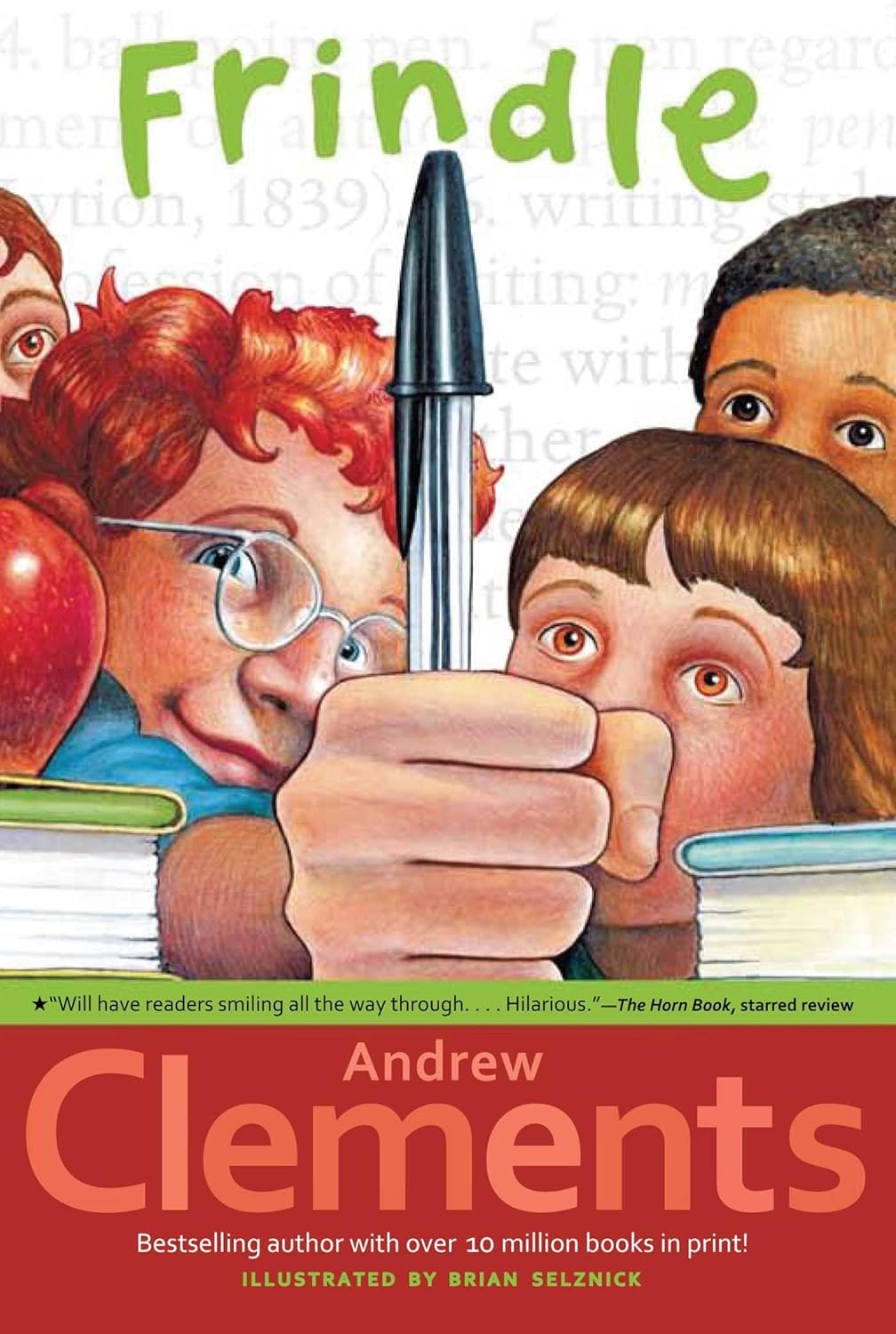
Frindle by Andrew Clements tells the clever story of a fifth grader who invents a new word and starts a revolution in his school and beyond. This guide provides parents and teachers with reading level information, age recommendations, content insights, and discussion questions for this beloved modern classic about creativity, language, and standing up for your ideas.
For Parents
Find the right reading level for your child, understand the book’s themes about creativity and challenging authority respectfully, and get conversation starters to help your child explore questions about how language evolves and the power of ideas.
For Teachers
Access grade-level guidance, reading metrics, character analysis support, and thematic discussion questions perfect for classroom use. This modern classic offers rich opportunities for exploring language, creativity, student-teacher dynamics, and thinking independently.
Frindle at a Glance
Find on Amazon →| Author | Andrew Clements |
| Published | 1996 |
| Grade Level | 3–5 (our assessment) |
| Recommended Age | 8–11 |
| Flesch-Kincaid Grade | 5.1 |
| Word Count | ~15,000 |
| Pages | 105 (standard paperback) |
| Chapters | 15 |
| Genre | Children’s fiction / realistic fiction / school story |
| Setting | Lincoln Elementary School, a contemporary American town |
| Awards | Classic (numerous state reading awards) |
For official Lexile and AR levels, visit Lexile.com or AR BookFinder. ReadingVine provides independent editorial assessments.
What Reading Level Is Frindle?
Frindle is appropriate for grades 3–5, with a Flesch-Kincaid grade level of 5.1. The vocabulary is accessible with occasional challenging words, and the sentence structure is straightforward. The book is relatively short at just over 100 pages, making it an excellent choice for readers transitioning from early chapter books to longer novels. The engaging plot and relatable school setting help carry readers through any unfamiliar vocabulary.
Andrew Clements’s writing style is clear, fast-paced, and humorous. The story is told from a third-person perspective that focuses on Nick’s experiences, thoughts, and motivations. Clements includes realistic school scenarios—classroom interactions, principal’s office visits, parent-teacher conferences—that children immediately recognize. The conflict escalates naturally from a simple word substitution to a full-blown media event, keeping readers engaged throughout.
While strong third graders can handle the reading mechanics, the story resonates most with readers ages 8–11 who have enough school experience to appreciate the dynamics between students and teachers, understand the humor in challenging (but not disrespecting) authority, and recognize the absurdity of adults taking a made-up word so seriously. The book rewards readers who’ve wondered why words mean what they do and who enjoy stories about clever kids outsmarting the system while staying fundamentally good.
What Age Is Frindle Appropriate For?
Frindle is most appropriate for readers ages 8–11. The story deals with mild rebellion against school authority, creativity, and becoming famous, all handled in age-appropriate ways. There’s no graphic content or serious danger—the stakes are whether Nick gets in trouble at school and whether his word catches on, making it emotionally safe while still engaging.
Challenging authority: Nick deliberately defies his teacher Mrs. Granger’s rules by using “frindle” instead of “pen.” While he’s respectful and ultimately learns valuable lessons, he is being disobedient. Parents should consider whether their child will understand the nuance.
Peer pressure and conformity: Nick gets other students to join his rebellion, which could be seen as encouraging group disobedience. However, the book shows consequences and ultimate reconciliation.
Media attention and exploitation: A businessman makes money off Nick’s idea without his permission at first, introducing themes about intellectual property that may require explanation.
Adult misunderstanding: Teachers and administrators overreact to the word “frindle,” which satirizes how adults can make mountains out of molehills. Some children may find this frustrating rather than funny.
What’s NOT in the book: No violence, no profanity (the whole conflict is about using an invented word, not a bad word), no romance, no bullying. The conflict is intellectual and creative rather than physical or cruel. Nick never becomes mean or disrespectful despite breaking rules. The book ultimately validates both Nick’s creativity and Mrs. Granger’s teaching, showing that the conflict helped Nick grow.
What Is Frindle About?
Nick Allen is a bright, creative fifth grader who loves turning things into an opportunity for fun. He’s famous among his classmates for his clever ways of wasting class time—like asking teachers complicated questions to use up the period. When Nick starts fifth grade, he faces Mrs. Granger, a legendary language arts teacher known for being strict, demanding, and passionate about words and the dictionary. Mrs. Granger loves language and expects her students to take it seriously.
One day, hoping to waste time as usual, Nick asks Mrs. Granger who decides what words mean and where they come from. Instead of falling for his time-wasting trick, Mrs. Granger gives him a homework assignment: research the question himself and present the answer. Nick actually does the research and learns that people create words—they’re not handed down by some authority, but rather come into being through usage and acceptance.
This gives Nick an idea. If people create words, he can create one too. He decides to invent a new word for “pen”—he’ll call it a “frindle.” Nick starts his experiment by asking for a frindle at a store, confusing the clerk. Then he gets his best friend to use the word, and soon his whole class is saying “frindle” instead of “pen.” It becomes a game and then a movement among the fifth graders.
Mrs. Granger is not amused. She sees this as Nick challenging her authority and disrupting her classroom. She creates a rule: any student who says “frindle” instead of “pen” has to stay after school and write “I am writing this punishment with a pen” one hundred times. This backfires spectacularly—students proudly accept the punishment, and the word spreads even faster. The conflict escalates as more students use the word specifically to prove they can.
News of the “frindle war” spreads beyond the school. Local newspapers cover the story, then television reporters show up. Nick becomes famous. His parents are worried. The principal is stressed. Mrs. Granger digs in, insisting a pen is a pen. But the word keeps spreading—to other schools, other towns, other states. A businessman starts making and selling “frindles” (pens with the new word printed on them), making money from Nick’s idea.
Eventually, Nick signs an agreement with the businessman to share profits from frindle-related products, with the money held in trust until he turns eighteen. The media attention dies down. Nick goes to middle school and high school. Mrs. Granger retires. The word “frindle” enters common usage—it appears in advertisements, on products, and eventually is accepted into dictionaries as an actual word.
In her letter, Mrs. Granger shows that she understood how language evolves and recognized the creativity behind what Nick started. While she challenged him throughout the process, she ultimately respects what he accomplished and how “frindle” became a real word through use and persistence. Far from being his enemy, she had been helping him succeed by giving him something to push against. She had been proud of him the entire time and had saved newspaper clippings documenting his achievement. Mrs. Granger also reveals she has the very first “frindle” Nick ever asked for—the one from the store—which is now extremely valuable. She gives it to Nick as a gift, along with her respect and admiration.
The book ends with Nick understanding that Mrs. Granger had taught him the greatest lesson of all: that ideas have power, that creativity requires persistence, and that sometimes the people who challenge you the hardest are actually helping you succeed. The word “frindle” lives on, a permanent addition to the English language, proving that one person—even a kid—can change the world.
Frindle Characters
Frindle Themes and Lessons
At its heart, Frindle is about the power of ideas and how one person can change the world. Nick proves that words aren’t carved in stone by some authority—they’re living things created and changed by people. His success shows that you don’t have to be an adult, a scholar, or someone famous to have an impact. If an idea is good and you persist in spreading it, it can catch on and become real. This empowers children to see themselves as capable of creating change rather than just accepting the world as it is.
The book also explores the valuable role of conflict and resistance in achieving goals. Mrs. Granger’s opposition to “frindle” actually makes the word stronger and spread faster. Her final letter reveals that she understood this all along—she gave Nick something to push against because struggle makes success more meaningful and more likely to last. This teaches that obstacles and people who challenge you aren’t necessarily enemies; sometimes they’re actually helping you in ways you don’t recognize until later. The book celebrates both creativity (Nick’s invention) and discipline (Mrs. Granger’s insistence on respecting language), showing that these aren’t opposites but complementary forces.
Discussion questions for families:
- How are new words really created? Can you think of examples of words that were invented recently and became part of the language?
- Was Nick right to defy Mrs. Granger’s rule about not saying “frindle”? How can you challenge rules you disagree with while still being respectful?
- Why did Mrs. Granger oppose the word “frindle” if she actually supported Nick? What does this teach about how opposition can help you succeed?
- If you could invent a new word, what would it be and what would it mean?
How Many Pages and Chapters in Frindle?
Frindle has 105 pages in the standard paperback edition and is divided into 15 chapters. The word count is approximately 15,000 words, making it a quick read perfect for upper elementary students. The chapters are short—averaging just 7 pages each—and each advances the plot significantly, making the book feel fast-paced and engaging.
For independent readers in the target age range (8–11), the book typically takes 2–3 hours to complete, or less than a week of reading 30 minutes per day. Many children read it in one or two sittings because the plot is compelling and the chapters end with hooks that make you want to keep reading. The short length makes it an excellent choice for reluctant readers or for building reading confidence before tackling longer novels.
As a read-aloud, Frindle takes approximately 1.5–2 hours total. The short chapters make it perfect for classroom read-alouds—you can read a chapter in 10–15 minutes, making it easy to fit into a busy schedule. The humor, relatable school setting, and discussion-worthy themes make it engaging for both children and adults. Many teachers use it as a springboard for lessons about language, creativity, and the student-teacher relationship, or as an introduction to Andrew Clements’s other school stories.
Books Similar to Frindle
If your child enjoyed Frindle, here are six similar books that explore themes of creativity, school life, and clever kids:
About Andrew Clements
Andrew Clements (1949–2019) was an American author best known for his school-based novels for children, with Frindle being his most famous and successful work. Published in 1996, Frindle was Clements’s first novel, written after years of working as a teacher, songwriter, and picture book author. The idea came from his own experience as a teacher watching how students invented words and created their own language, combined with his lifelong fascination with how words work. Clements taught in public schools for seven years, and that experience gave him deep insight into student-teacher dynamics, school politics, and the creative ways kids navigate rules and authority. Frindle became an immediate success, winning numerous state reading awards and selling millions of copies. It resonated with both children (who loved Nick’s clever rebellion) and teachers (who appreciated the nuanced portrayal of Mrs. Granger and the ultimate message about respecting education). After Frindle’s success, Clements wrote dozens of other novels, most set in schools and featuring intelligent, creative students facing realistic challenges. His books include The Landry News, The Janitor’s Boy, The Report Card, No Talking, and many others. Common themes in his work include the power of ideas, student agency, challenging assumptions, and the importance of thoughtful, dedicated teachers. Clements believed that children were capable of deep thinking about serious topics, and his books treated them as intelligent readers who could handle nuance and complexity. His clean, accessible writing style, authentic school settings, and respect for both students and teachers made him one of the most popular middle-grade authors of his generation. Frindle remains his masterpiece—a slim, deceptively simple book that has sparked countless classroom discussions about language, creativity, and the power one person has to change the world.
Frindle: Frequently Asked Questions
What does “frindle” mean?
“Frindle” is Nick Allen’s invented word for “pen.” In the book, Nick decides to create a new word to prove that people—not dictionaries or authorities—determine what words mean. He chooses “frindle” because it sounds good and doesn’t mean anything else in English. The word starts as Nick’s experiment but spreads throughout his school, then his town, and eventually across the country until it becomes an actual word that appears in dictionaries. “Frindle” doesn’t have any deeper meaning beyond being a synonym for “pen”—its significance is in what it represents: proof that anyone, even a kid, can create language and make it stick if enough people accept and use the new word. The success of “frindle” demonstrates how language is democratic and constantly evolving.
Is Frindle a real word now?
No, “frindle” is not a real word in actual dictionaries outside the context of Andrew Clements’s book. In the story, “frindle” becomes a real word that gets added to dictionaries, but this is fiction—it hasn’t happened in real life. However, the word is widely recognized by readers of the book, and many teachers and students use it playfully in classrooms after reading Frindle. The book’s success has made “frindle” famous enough that many people know what it means (a pen, in the context of the story), but it hasn’t achieved the kind of widespread adoption that would lead real dictionary editors to add it as an official English word. The book’s point isn’t really about getting “frindle” into actual dictionaries, but rather about teaching how words can become real through usage and acceptance.
Why did Mrs. Granger oppose the word “frindle”?
Mrs. Granger publicly opposed the word “frindle” because she knew that conflict and resistance would make the word stronger and more likely to succeed. In her final letter to Nick, she reveals that she understood from the beginning what he was trying to do—create a real word. She opposed him because she recognized that struggle makes ideas more powerful. If she had supported “frindle” immediately, students might have lost interest or seen it as just a teacher-approved project. By fighting against it, she gave students something to rebel against, making the word spread faster and with more determination. Mrs. Granger was secretly proud of Nick’s creativity all along and had been collecting newspaper clippings about the word’s success. Her opposition was actually a gift—she was teaching Nick that great ideas often require persistence in the face of resistance, and that sometimes your strongest opponents are actually your best teachers.
Is Frindle appropriate for 3rd grade?
Frindle can be appropriate for third graders, especially strong readers or as a class read-aloud. The reading level (5.1 Flesch-Kincaid) is slightly above typical third grade, but the engaging plot, short chapters, and school setting make it accessible to many third graders. The book is only 105 pages with large print, making it less intimidating than longer novels. However, parents and teachers should consider the individual child—the story requires understanding the nuance of challenging authority respectfully versus being disrespectful, which some younger children may struggle with. The best approach for third grade is often reading it as a class with teacher guidance to discuss the themes of creativity, rules, and the student-teacher relationship. For independent reading, strong third graders will enjoy it, while average third graders might do better waiting until fourth grade.
What is the main conflict in Frindle?
The main conflict is between Nick Allen and Mrs. Granger over the word “frindle.” Nick invents a new word for “pen” and gets his classmates to use it, while Mrs. Granger insists students must say “pen” and punishes those who say “frindle.” The conflict escalates as more students use the word to challenge the rule, Mrs. Granger digs in harder, and the media gets involved. However, the deeper conflict is really about ideas: whether language is fixed by authority (dictionaries, teachers) or created by people through usage. Nick’s position is that people make words, so he can make one too. Mrs. Granger appears to believe words should be respected as they are. The conflict turns out to be more complex than it first appears. Mrs. Granger strongly enforces rules and challenges Nick, but later shows respect for his creativity and determination. The story suggests that their conflict helped push Nick’s idea further, even if that wasn’t her stated goal at the beginning. The real conflict was between Nick’s creativity and the obstacles (including Mrs. Granger’s resistance) he had to overcome to make his idea real.
How long does it take to read Frindle?
Frindle takes most independent readers ages 8–11 about 2–3 hours to read. The book is only 105 pages with 15 short chapters, making it one of the quicker middle-grade novels. Many children read it in one or two sittings because the plot is engaging and each chapter ends in a way that makes you want to keep reading. For readers who take 30 minutes per day, it’s typically a three-to-four day book. As a read-aloud in a classroom, it takes about a week to two weeks if you read one chapter per day (chapters are 7 pages on average and take about 10 minutes to read aloud). As a family read-aloud, you could finish it in two or three evenings. The short length makes Frindle an excellent choice for reluctant readers or for building confidence before tackling longer novels.
What is the message of Frindle?
The main message is that ideas have power and one person—even a kid—can make a real difference in the world. Nick proves that you don’t need to be an adult or an authority to create change; if you have a good idea and persist despite obstacles, you can make it real. The book teaches that language belongs to everyone, not just scholars or dictionaries—words are created and changed by ordinary people using them. It also explores how conflict and resistance can actually help ideas succeed rather than destroy them. Mrs. Granger’s opposition makes “frindle” stronger, teaching that people who challenge you might actually be helping you grow. Finally, the book celebrates the relationship between creative students and dedicated teachers, showing that the best teachers don’t just impart knowledge but inspire students to think independently and pursue their own ideas. Frindle empowers children to see themselves as capable of shaping the world around them.
Does Nick get in trouble for saying frindle?
Yes, Nick and other students get in trouble for saying “frindle.” Mrs. Granger creates a rule that any student who says “frindle” instead of “pen” must stay after school and write “I am writing this punishment with a pen” one hundred times. Nick and his classmates accept this punishment, but their willingness to be punished actually makes the word spread faster—it becomes a badge of honor to stay after school for “frindle.” The principal, Mrs. Chatham, supports Mrs. Granger’s rule even though she’s uncomfortable with the escalating situation. Nick’s parents are concerned about him getting in trouble but eventually support him. The media attention and commercial success of “frindle” products complicate things further. However, the punishment and trouble are relatively mild (after-school detention and writing lines), and ultimately Nick faces no serious long-term consequences. The book shows that sometimes doing something creative and important might get you in trouble in the short term but can be worthwhile if you’re respectful and persistent.