
 = Partner Site
The Spiderwick Chronicles: The Field Guide Reading Level: A Complete Guide
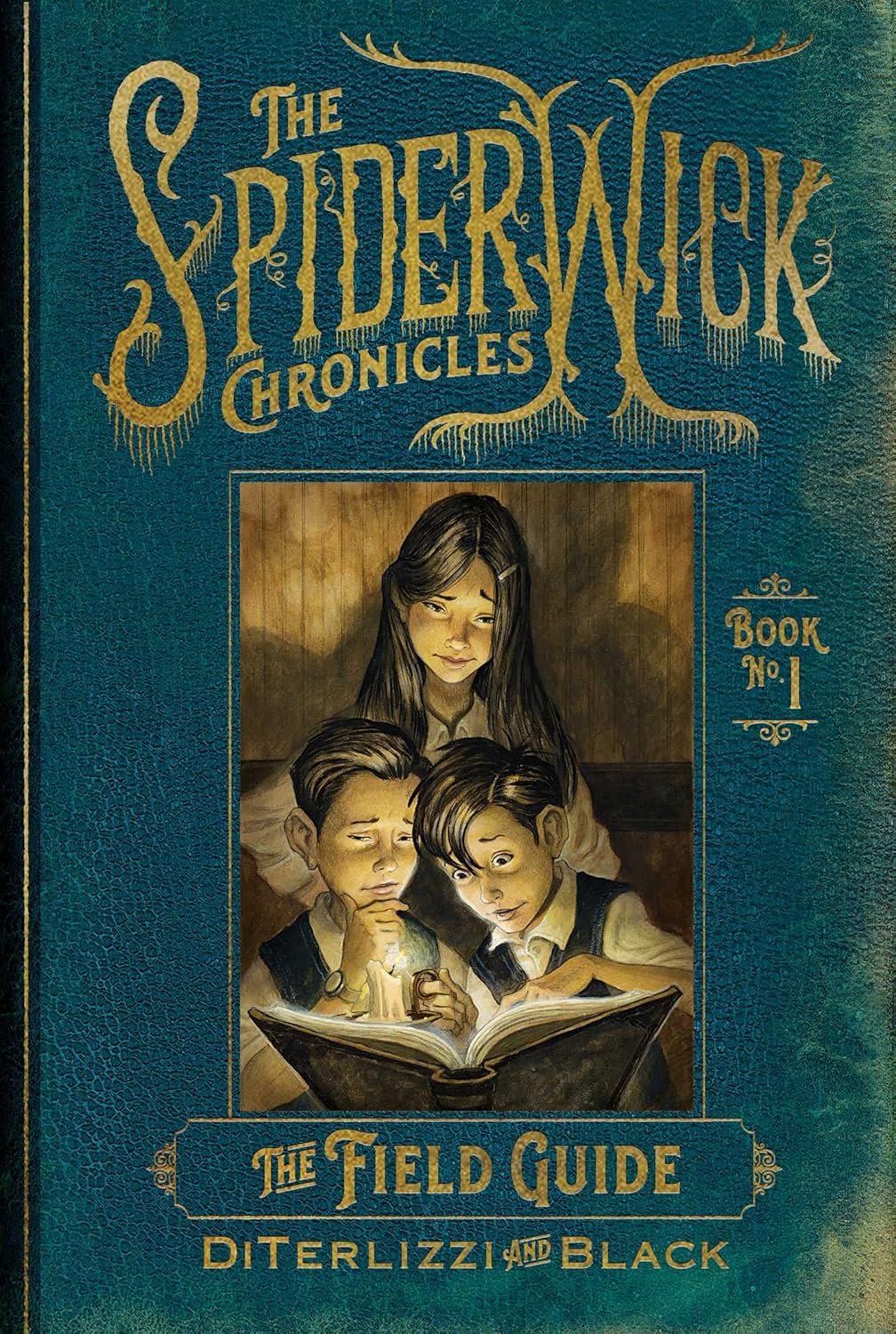
The Spiderwick Chronicles: The Field Guide, written by Holly Black and Tony DiTerlizzi and illustrated by DiTerlizzi, is a 107-page fantasy novel about three siblings — Jared, his twin brother Simon, and their older sister Mallory Grace — who move into their great-great-uncle Arthur Spiderwick’s old mansion and find something extraordinary in the attic: a handmade field guide documenting an entire hidden world of faeries, sprites, brownies, goblins, and other fantastical creatures. Jared opens the book against the warning inside its cover, and the house begins to change around them. The brownie Thimbletack, who has lived in the walls for generations, becomes a boggart — and boggarts are not friendly. First published in 2003 by Simon & Schuster and the first of five books that would together sell 20 million copies, the series was famously “marketed as too dangerous to read” (Kirkus), adapted into a 2008 feature film, and adapted into a streaming series on Roku. Kirkus also called it “handsomely designed, and extravagantly illustrated” and noted that readers who are not yet ready for Harry Potter independently would find these “have just the right amount of menace laced with appealing humor.” DiTerlizzi’s gothic, Edward Gorey–influenced pen-and-ink illustrations appear throughout — framing chapters, depicting creatures from the field guide, and giving the whole thing the feel of a genuine Victorian natural history document made frightening. This complete guide covers the book’s reading level, recommended age, content considerations, key characters, themes, and similar books — designed for parents, teachers, and students.
For Parents
A short, atmospheric fantasy novel about three siblings who discover a secret world of faeries in their great-great-uncle’s old house — and the trouble that follows when they open the book that documents it. Ages 7–12, grades 3–6. Mild scary content: a boggart creeping in the walls, eerie faerie encounters. The first and mildest book in a five-book series that escalates in intensity. An excellent bridge book for readers who love Harry Potter but are not yet ready for the full series.
For Teachers
A grades 3–6 classroom and library staple — one of the most popular fantasy series for the 8–12 age range since its 2003 debut. The short chapter length, fast pacing, and DiTerlizzi’s illustrations make it ideal for reluctant readers and for children transitioning from illustrated chapter books to novels. Each of the five volumes is short enough to assign as independent reading in one week. The companion Arthur Spiderwick’s Field Guide offers genuine world-building extension content.
The Spiderwick Chronicles: The Field Guide at a Glance
Find on Amazon →| Authors | Holly Black and Tony DiTerlizzi |
| Illustrator | Tony DiTerlizzi |
| Published | 2003 (Simon & Schuster Books for Young Readers) |
| Grade Level | 3–6 (our assessment) |
| Recommended Age | 7–12 |
| Lexile | 600L |
| ATOS Level | 4.2 |
| Guided Reading Level | Q–R (series range) |
| Word Count | 9,844 |
| Pages | 107 |
| Genre | Fantasy / middle grade / illustrated novel |
| Series | The Spiderwick Chronicles (5 books); Beyond the Spiderwick Chronicles (3 books) |
For official Lexile and AR levels, visit Lexile.com or AR BookFinder. ReadingVine provides independent editorial assessments.
What Reading Level Is The Spiderwick Chronicles: The Field Guide?
The Field Guide has a Lexile of 600L and an ATOS level of 4.2, with a Guided Reading Level of Q–R across the series. These scores place it squarely at a grades 3–5 independent reading level — consistent with the publisher’s recommendation and with its widespread use in those grades. At 9,844 words and 107 pages, it is one of the shortest novels in this catalog, short enough to be read in one to three sittings by a motivated reader. The ATOS 4.2 reflects Black and DiTerlizzi’s prose style: clear and atmospheric without being particularly complex, driven by scene-setting and character reaction rather than elaborate description.
Kirkus noted in its 2003 review that the series was perfect for readers who are not yet ready to tackle Harry Potter independently — and this comparison holds: the reading demand is meaningfully lower, the length is significantly shorter, and the tone, while atmospheric and genuinely spooky in places, is less emotionally demanding. It is an ideal bridge fantasy for children who are transitioning into longer, more complex fantasy series. For official Lexile and AR scores, visit Lexile.com or AR BookFinder. ReadingVine’s assessments are independent editorial judgments.
What Age Is The Spiderwick Chronicles Appropriate For?
We recommend The Field Guide for readers ages 7–12, grades 3–6. The content is mildly scary in the way that a well-crafted children’s ghost story is mildly scary: the boggart Thimbletack creeps in the walls, moves things, and pulls nasty pranks; there are faerie creatures that are unsettling rather than friendly; and the faerie world in general operates on rules that are neither safe nor entirely comprehensible. None of this is traumatizing or graphic — Common Sense Media rates it appropriate for ages 7 and up — but children who are particularly sensitive to scary or supernatural content may find the wall-creeping boggart sequences uncomfortable.
The series escalates in intensity across the five books: The Field Guide is explicitly the mildest entry, and parents who want to preview the content of later volumes should know they grow progressively more intense through The Wrath of Mulgarath (Book 5). The first book is the right starting point regardless.
What Is The Field Guide About?
The Grace children — Jared, his twin Simon, and their older sister Mallory — have moved with their mother into the old mansion that belonged to their great-great-uncle Arthur Spiderwick, who disappeared years ago. The house is large and strange and full of things their mother cannot explain. Jared, the impulsive one, explores the attic and finds a hidden dumbwaiter. Inside the dumbwaiter is a room that no one else seems to know about. Inside the room is a book: Arthur Spiderwick’s field guide to the fantastical world, a handmade volume documenting dozens of faerie creatures with careful illustrations and detailed notes. A warning inside the cover advises the reader not to read further. Jared reads further.
The house changes. Small things begin to go wrong in ways that feel purposeful — things move, sounds come from inside the walls, Jared’s belongings are disturbed. The brownie Thimbletack, who has lived in the house for generations performing small helpful tasks in exchange for food offerings, has discovered that the field guide is gone and is furious. Brownies who are offended become boggarts, and boggarts are malicious. Jared is blamed for the disturbances — everyone assumes he is causing the problems, which gives the story its most effectively uncomfortable dynamic: Jared knows the truth and cannot prove it to the people who matter.
Jared must convince Simon and Mallory of what he has discovered, protect the field guide from Thimbletack’s increasingly destructive attempts to get it back, and begin to understand the rules of the faerie world — which are different from anything he has known and which will require all three siblings to work together. The book ends with the immediate crisis resolved and the larger mystery of the faerie world only beginning to open.
Tony DiTerlizzi’s Illustrations — Essential to the Experience
The Spiderwick Chronicles would be good without DiTerlizzi’s illustrations. With them, it is something more. DiTerlizzi studied under Brian Froud — whose Faeries (1978) is the visual bible of the faerie revival — and worked extensively as an illustrator for Dungeons & Dragons before turning to children’s books. His illustration style for the Spiderwick series is deliberately Victorian: fine pen-and-ink lines, Edward Gorey–influenced crosshatching, the visual register of a 19th-century natural history plate given to something supernatural. The creatures he depicts for the field guide sections — each drawn as if from life, annotated in the manner of a genuine naturalist’s notes — are the series’ most distinctive visual feature and the ones that children return to most consistently.
The field guide itself, as a physical object, is rendered throughout the series as something genuinely ancient and handmade — worn leather cover, spidery handwriting, watercolor washes — in ways that make the reader feel they have found an actual artifact. This is deliberate: Black and DiTerlizzi published a companion volume, Arthur Spiderwick’s Field Guide to the Fantastical World Around You (2005), designed as the actual in-world field guide, illustrated throughout in the same style. It is one of the most successful world-building companion texts in recent children’s fantasy publishing.
The Spiderwick Chronicles Characters
The Spiderwick Chronicles Themes and Lessons
The series’ central conceit — that a secret world of fantastical creatures exists beside our own, documented by a Victorian naturalist and now suddenly dangerous to those who know about it — belongs to a rich tradition of British faerie literature that runs from Shakespeare through Brian Froud to modern fantasy. Black, who has a deep scholarly knowledge of faerie folklore, grounds the series in actual tradition: brownies who become boggarts, faeries who cannot lie but can deceive, iron as protection, the specific terms of exchange and obligation that govern faerie interactions. The rules feel consistent and genuinely ancient because they are drawn from a genuinely ancient tradition.
The book’s most productively uncomfortable dynamic is Jared’s position of knowing the truth while being unable to prove it. He opened the field guide; the consequences followed. His mother and siblings initially attribute the disturbances to Jared’s own behavior. This is both realistic — impulsive children who have caused problems before are the obvious suspects — and frustrating in exactly the way that children who have been blamed for things they didn’t do will immediately recognize. The frustration is earned and the resolution is satisfying.
Talking with your child: Why do you think Jared opened the field guide even though it said not to? Have you ever done something you were told not to do and had to deal with the consequences? Why do you think brownies turn into boggarts when they are offended — what does that tell us about how to treat the things we live with? What would you do if you found a book that said it was dangerous to read?
The Spiderwick Chronicles Series
The original Spiderwick Chronicles spans five volumes, all published in 2003–2004: The Field Guide (Book 1), The Seeing Stone (Book 2), Lucinda’s Secret (Book 3), The Ironwood Tree (Book 4), and The Wrath of Mulgarath (Book 5). The series was designed to be read in order and to function as a single continuous narrative across the five books; each volume ends with either a cliffhanger or an incomplete resolution that requires the next book. A complete boxed set is available and is the most common gift format for children who are starting the series. The series is available as an audiobook read by Mark Hamill — one of the most acclaimed children’s audiobook performances of the 2000s.
A companion trilogy, Beyond the Spiderwick Chronicles (2007–2009), follows different characters in a Florida setting with a new faerie threat. It connects to the original series but stands more independently. The companion volume Arthur Spiderwick’s Field Guide to the Fantastical World Around You (2005) presents the in-world field guide as a physical object — an illustrated natural history of faerie creatures in the style of a Victorian naturalist’s reference book. It is beautiful and genuinely useful as a companion text.
The Spiderwick Chronicles Film and Streaming Series
A 2008 feature film adaptation condensed all five books into a single story, starring Freddie Highmore (who played both Jared and Simon), Sarah Bolger as Mallory, and Nick Nolte as the voice of Mulgarath. The film is rated PG and runs approximately 95 minutes. It is generally well-regarded as an adaptation, though the compression of five books’ worth of plot requires significant simplification. A streaming series adaptation was produced for Roku, further expanding the story into an episodic format. Families who love the books may enjoy both adaptations as companion texts.
How Long Is The Field Guide?
The Field Guide is 107 pages with 9,844 words — among the shorter novels in this catalog, shorter even than My Father’s Dragon (96 pages, 7,682 words) only by proportion. Most readers ages 7–12 complete it in one to three sittings. The series’ five volumes average approximately 110 pages each, meaning the complete original series runs about 550 pages total — a manageable commitment for readers who are just beginning to tackle series fantasy. The audiobook, narrated by Mark Hamill, is widely praised and has introduced the series to a significant number of listeners.
Books Similar to The Spiderwick Chronicles
About Holly Black and Tony DiTerlizzi
Holly Black was born in 1971 in New Jersey and grew up in a house she has described as “crumbling Victorian” — an upbringing that appears, transmuted, in the Spiderwick mansion itself. She studied at Ramapo College of New Jersey and has since become one of the most prominent fantasy authors in American children’s and young adult publishing. Her other work includes the Faerie Tales series, the Modern Faerie Tales trilogy for older readers, the Magisterium series (with Cassandra Clare), and the Folk of the Air series. She is a deeply knowledgeable scholar of faerie folklore traditions; the rules governing the faerie world in the Spiderwick Chronicles are drawn from genuine British and Irish folk belief rather than invented.
Tony DiTerlizzi was born in 1969 in Florida and grew up drawing constantly. He worked as an artist for Dungeons & Dragons’ creator TSR, Inc., in the early 1990s, developing the visual vocabulary of the fantasy creature illustration tradition before turning to children’s books. His picture book The Spider and the Fly (2002), based on the Mary Howitt poem, won a Caldecott Honor. The Spiderwick Chronicles brought together his Victorian-influenced illustration style and his deep knowledge of fantasy creature design with Holly Black’s folklore scholarship; the combination produced one of the most visually distinctive children’s fantasy series of the 2000s. He lives in western Massachusetts. The Norman Rockwell Museum in Stockbridge, Massachusetts, mounted an exhibition of his work — including his Dungeons & Dragons illustrations and his Spiderwick art — that broke the museum’s attendance records.
The Spiderwick Chronicles: The Field Guide — Frequently Asked Questions
What reading level is The Spiderwick Chronicles: The Field Guide?
Lexile 600L and ATOS 4.2, with Guided Reading Level Q–R across the series. Our assessment: grades 3–6, ages 7–12. At 107 pages and 9,844 words, it is one of the shorter novels in this catalog — readable in one to three sittings. For official Lexile and AR scores, visit Lexile.com or AR BookFinder.
What is The Spiderwick Chronicles: The Field Guide about?
Three siblings — Jared, Simon, and Mallory Grace — move into their great-great-uncle Arthur Spiderwick’s old mansion. Jared finds a handmade field guide in the attic documenting the secret world of faeries, opens it despite the warning inside, and disturbs the house brownie Thimbletack — who transforms into a malicious boggart. The siblings must protect the field guide and manage the consequences of what Jared has set in motion.
Is The Spiderwick Chronicles scary?
The Field Guide is mildly scary in the way of a well-crafted children’s ghost story — the boggart in the walls, eerie faerie encounters, and a generally unsettling atmosphere. Common Sense Media rates it appropriate for ages 7 and up. The series escalates in intensity across the five books; The Field Guide is explicitly the mildest entry. Children who are sensitive to supernatural content may find the wall-creeping boggart sequences uncomfortable but not traumatizing.
How many Spiderwick Chronicles books are there?
Five main books in the original series, all published 2003–2004: The Field Guide, The Seeing Stone, Lucinda’s Secret, The Ironwood Tree, and The Wrath of Mulgarath. A companion trilogy — Beyond the Spiderwick Chronicles — follows different characters in Florida. A companion volume, Arthur Spiderwick’s Field Guide to the Fantastical World Around You (2005), presents the in-world field guide as a Victorian natural history reference book.
Who reads the Spiderwick Chronicles audiobook?
Mark Hamill — widely praised as one of the most acclaimed children’s audiobook performances of the 2000s. The audiobook covers the full original five-book series.
Is there a Spiderwick Chronicles movie?
Yes — a 2008 PG film starring Freddie Highmore (as both Jared and Simon), Sarah Bolger, and Nick Nolte (voice of Mulgarath). The film condenses all five books into one approximately 95-minute story. A streaming series adaptation was subsequently produced for Roku. Both are generally regarded as faithful to the series’ atmosphere if not its plot specifics.