
 = Partner Site
A Separate Peace Reading Level: A Complete Guide
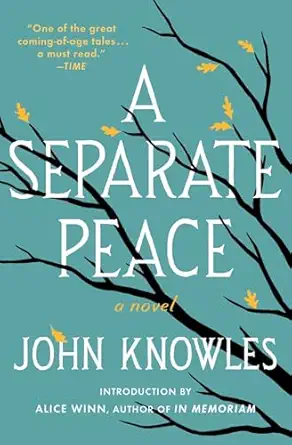
A Separate Peace is a 1959 novel by John Knowles, set at a fictional New England boys’ preparatory school during the early years of World War II. Narrated by Gene Forrester, a man looking back on the summer and school year when he was sixteen and his friendship with the remarkable, charismatic Phineas—”Finny”—was formed, tested, and irreparably altered by a single moment of impulse at the top of a tree. One of the most widely assigned novels in American high school education, it has remained in print and in classrooms for more than sixty years, valued for its precise psychological rendering of adolescent jealousy, its examination of male friendship under pressure, and its use of World War II as both backdrop and metaphor for the internal wars that define coming of age. This guide covers the book’s reading level, age appropriateness, characters, themes, and teaching resources for students, parents, and educators.
For Parents
A Separate Peace is one of the more content-accessible novels in the high school canon. It contains no sexual content, no graphic violence, and only mild language—the challenges it has received over the years have been for profanity. Its emotional content, however, is serious: the novel deals with jealousy, betrayal, guilt, psychological deterioration, and death. The death of a major character is central to the plot and is handled with emotional weight rather than graphic description. It is most commonly assigned in grades 9–10 and is appropriate for readers ages 13 and up.
For Teachers
A Separate Peace is one of the canonical texts for teaching coming-of-age literature, the psychology of jealousy, and the use of an unreliable narrator. Gene Forrester is a first-person narrator who understands himself far less than he believes, and the gap between what he tells readers and what the evidence of his own narration reveals is one of the most productive close-reading opportunities in the ninth or tenth grade curriculum. The novel also pairs naturally with World War II history, with The Catcher in the Rye as a contemporaneous novel about male adolescent alienation, and with Lord of the Flies on the theme of violence beneath the surface of civilized institutions.
A Separate Peace at a Glance
Find on Amazon →| Author | John Knowles |
| Published | 1959 (UK); 1960 (US) |
| Grade Level | 9–10 (our assessment) |
| Recommended Age | 13–16 |
| Flesch-Kincaid Grade | 9.3 |
| Word Count | ~57,000 |
| Pages | ~208 (standard paperback) |
| Chapters | 13 |
| Genre | Coming-of-age fiction / literary fiction |
| Setting | Devon School, New Hampshire (based on Phillips Exeter Academy); 1942–1943 |
| Awards | William Faulkner Foundation Award for Notable First Novel (1961); Rosenthal Award, National Institute of Arts and Letters |
For official Lexile and AR levels, visit Lexile.com or AR BookFinder. ReadingVine provides independent editorial assessments.
What Reading Level Is A Separate Peace?
ReadingVine places A Separate Peace at a grade 9–10 reading level, with a Flesch-Kincaid score of approximately 9.3. Knowles writes in a formal, controlled literary style that reflects Gene’s retrospective narration—he is an adult looking back, and his prose has the deliberateness and precision of a man who has spent fifteen years thinking about what happened. The vocabulary is sophisticated, the sentences are varied and often complex, and the figurative language is dense and purposeful. The novel rewards slow, careful reading rather than quick pace, and the psychological subtlety of Gene’s narration is the primary challenge: readers who process the story only at the surface level—as a story about a boy who shook his friend off a tree—will miss most of what the novel is doing.
The Lexile score (1030L) places it among the more demanding texts regularly assigned at the ninth-grade level, comparable to Lord of the Flies and significantly more demanding in prose complexity than many contemporary YA novels assigned in the same grade. For official Lexile and AR scores, visit Lexile.com or AR BookFinder.
What Age Is A Separate Peace Appropriate For?
ReadingVine recommends A Separate Peace for readers ages 13–16. Its content is considerably less explicit than most other canonical high school novels: there is no sexual content, the language is mild by any contemporary standard, and the physical violence in the novel is limited to a fall from a tree and its consequences. The more significant age consideration is emotional and psychological: the novel is a sustained, unflinching examination of jealousy, betrayal, and guilt, narrated by a young man who may not fully understand—or may actively resist understanding—his own culpability in his best friend’s death. Readers who have not yet encountered the experience of recognizing something in themselves they would rather not see may need more guidance through the novel’s psychological terrain than those who have.
A Separate Peace depicts a character’s death, which occurs as a consequence of an injury sustained in a fall and a subsequent surgical complication. The death is described with emotional weight and is central to the novel’s moral and psychological arc. There is mild language throughout which has been the primary basis for the novel’s challenge history. There is no sexual content and no graphic violence. One character’s psychological deterioration after combat experience is depicted with some intensity in the final section.
What Is A Separate Peace About?
The novel opens with an adult Gene Forrester returning to Devon School—a New Hampshire prep school he attended during World War II—and visiting two places that have haunted him for fifteen years: a marble staircase and a large tree by the river. The main story is told in flashback. The summer of 1942, when Gene was sixteen, was an unusual one at Devon: the older boys had gone to war, and the school ran a relaxed, unofficial summer session in which the boys had an unusual degree of freedom. Gene’s roommate and best friend is Phineas—Finny—a boy of almost supernatural athletic ability, easy confidence, and genuine warmth, who seems entirely without the competitive anxieties that govern everyone else around him. Gene, brilliant and studious, admires and loves Finny with an intensity that gradually curdles into resentment as he convinces himself that Finny is deliberately undermining his academic work to keep Gene from outshining him.
The novel’s central event is spare and devastating. Gene and Finny climb a large tree by the river to jump into the water, a game Finny invented. At the top of the limb, in a moment he does not fully understand and cannot entirely explain even to himself, Gene bends his knees—a slight, almost involuntary movement—and Finny, thrown off balance, falls to the ground and shatters his leg. The fall ends Finny’s athletic career permanently. He will never compete again in any sport, at a moment in his life when sports were his entire identity and purpose. Gene knows what he did. He can never bring himself to say it directly, and the novel turns on the question of whether he will—and whether Finny will hear it if he does.
The second half of the novel follows the winter term, as the war closes in on Devon and the boys face their approaching draft ages. Brinker Hadley, a controlling, legalistic boy who had been planning to enlist heroically, instead retreats from that decision and turns his organizing energies toward a mock “trial” of Gene for Finny’s fall—a scene that forces the truth toward the surface. Finny, who has refused throughout to believe that Gene could have intentionally caused his fall, is finally confronted with evidence he can no longer deny. He tries to leave in distress, falls on the marble stairs, re-breaks his leg, and dies during surgery when bone marrow enters his bloodstream. Gene does not cry at Finny’s funeral, because, he says, it feels like his own—an admission that will take readers the rest of the novel to fully understand.
A Separate Peace Characters
Is A Separate Peace Banned?
A Separate Peace has been challenged in multiple school districts, primarily in the 1980s, at high schools in Pennsylvania, Tennessee, Illinois, and North Carolina. The most common objection was to the novel’s language—specifically mild profanity and similar words that critics described as “unsuitable,” “graphic,” and “offensive.” In some challenges, the novel was also questioned for alleged homoerotic content between Gene and Finny—an interpretation Knowles consistently and explicitly rejected. In a widely quoted response, Knowles stated that if there had been a homoerotic element between the characters, he would have written it into the book, and that he had not because it was simply not there.
None of the challenges resulted in the book’s widespread removal from curricula, and it has remained one of the most consistently assigned novels in American high schools for more than sixty years. The challenges are most productively read as a reflection of the discomfort the novel creates in readers who resist its central psychological argument—that the capacity for betrayal and envy exists even in the most ordinary of boys—rather than as responses to anything objectively objectionable in the text.
A Separate Peace Themes and Lessons
The novel’s central argument is delivered quietly, through Gene’s retrospective narration, but it is one of the most unsettling in American coming-of-age literature: that the real wars are not the ones fought between nations but the ones fought inside ordinary people, between the parts of themselves they recognize and the parts they refuse to see. Gene’s war with Finny is a war he wages largely in his own imagination—a construction of rivalry and threat that exists primarily in Gene’s interpretation of events Finny never intended competitively. When Gene finally understands this, late in the novel, the knowledge does not redeem him; it simply clarifies what he has lost. The book is a tragedy about the cost of self-deception.
Knowles also uses the encroachment of World War II on Devon’s world with great precision. The war is always present as a backdrop—the older boys gone, the younger ones waiting for their draft ages, the school reorganizing around military preparedness. But Devon’s summer session, with its unauthorized freedoms and its sense of time outside ordinary rules, represents a kind of childhood untouched by those external pressures. Finny’s death and the end of that summer mark the same moment: the loss of a world in which Gene could believe that his private feelings were separate from public consequences. Discussion questions: Is Gene responsible for Finny’s death? What evidence in the narration suggests Gene understood what he was doing at the tree? What does it mean that Gene cannot cry at Finny’s funeral because it feels like his own?
How Many Pages and Chapters in A Separate Peace?
A Separate Peace is approximately 208 pages in the standard Simon & Schuster paperback and approximately 57,000 words. The novel has 13 chapters, each moving chronologically through the summer of 1942 and the following winter term, bookended by Gene’s adult return to Devon in the opening pages. At its length, it is shorter than most full novels in the high school canon—comparable to Of Mice and Men in scope, though considerably more expansive in its psychological exploration. An average high school reader will complete it in 4–5 hours. Most teachers assign it over two to three weeks, with close reading of individual chapters—particularly the tree scene in Chapter 4 and the trial scene in Chapter 11—generating the most productive class discussion.
Books Similar to A Separate Peace
About John Knowles
John Knowles was born on September 16, 1926, in Fairmont, West Virginia, the son of a successful coal company executive. He attended Phillips Exeter Academy—the prestigious New Hampshire boarding school that served as the model for Devon—beginning at age fifteen and graduated in 1944. He served briefly in the Army Air Corps Aviation Cadet program before the war ended, then attended Yale, graduating in 1949. After working as a journalist and travel writer and publishing short fiction in magazines, he began writing A Separate Peace in the mid-1950s, following encouragement from his friend Thornton Wilder, who urged Knowles to draw on his own experience for his first novel. The book was published first in Britain in 1959, then in the United States in 1960, where it became a New York Times bestseller and won the William Faulkner Foundation Award for Notable First Novel and the Rosenthal Award of the National Institute of Arts and Letters; it was also a finalist for the National Book Award in 1961. Knowles went on to write several other novels, including Peace Breaks Out (1981), a loose companion to A Separate Peace, and taught writing at Princeton and other universities. He acknowledged that the story drew on his own time at Exeter and relationships there, though he maintained it was fiction rather than autobiography. He died on November 29, 2001, in Fort Lauderdale, Florida.
A Separate Peace: Frequently Asked Questions
What reading level is A Separate Peace?
ReadingVine places A Separate Peace at a grade 9–10 reading level, with a Flesch-Kincaid score of approximately 9.3 and a Lexile of 1030L. Knowles writes in a formal, precise literary style reflecting Gene’s retrospective adult narration, with complex sentence structures and dense figurative language. The primary challenge is not vocabulary but psychological interpretation—reading through Gene’s self-presentation to understand what the novel is actually revealing. Most commonly assigned in grades 9–10.
Did Gene intentionally cause Finny’s fall?
This is the novel’s central interpretive question, and Knowles is deliberately ambiguous—Gene himself never offers a definitive answer. The evidence of Gene’s own narration, however, supports a strong reading that the jouncing of the limb was not accidental: Gene describes it as a deliberate if impulsive act arising from his suppressed resentment of Finny. The fact that he never fully confesses—and that his narration continually deflects and qualifies—is itself part of the novel’s argument about how guilt operates and how the mind protects itself from its own knowledge. The ambiguity is purposeful, inviting readers to weigh the evidence rather than accepting Gene’s framing.
What does the tree symbolize in A Separate Peace?
The tree by the river is the novel’s central symbol of adolescent daring, transition, and the moment at which innocence is permanently lost. Jumping from it is Finny’s invention—an act of courage that brings the summer boys together in shared risk. It is also the site of the novel’s central act of violence and betrayal. When adult Gene returns to the tree in the novel’s opening pages and finds it smaller and less threatening than he remembered, the scene establishes one of the novel’s themes: that the enormous events of adolescence, seen from the distance of adulthood, are both ordinary and irreversible.
Why does Gene say Finny’s funeral felt like his own?
Gene cannot cry at Finny’s funeral because, as he later reflects, Finny was the best part of himself—the embodiment of the ease, confidence, and freedom from envy that Gene most desired and most lacked. To lose Finny is, in the novel’s emotional logic, to lose the version of himself Gene might have been if he had not been the person he is. He also recognizes, with devastating clarity, that he killed that possibility himself. The funeral is his own because the person being buried is not only Finny but the Gene who could have existed in relation to Finny.
Is A Separate Peace based on a true story?
A Separate Peace is fiction, but John Knowles drew directly on his time at Phillips Exeter Academy—the model for Devon School—and his relationships there. He acknowledged the autobiographical roots of the novel but maintained that the specific events and the character of Finny were invented. The novel was written at the encouragement of Thornton Wilder, who advised Knowles to draw on his own experience. Knowles spent time at Exeter during World War II, and the novel’s sense of a protected school world aware of but not yet consumed by the war reflects his actual experience.
What is the significance of the title A Separate Peace?
The title refers to the private, separate peace Gene and Finny achieve within Devon’s walls during the summer session—a world apart from the larger war, where different rules apply and adolescent life can proceed as if the external world does not press in. It is also ironic: the peace Gene finds within himself at the novel’s end—after Finny’s death, after the truth has been forced to the surface—is a peace achieved through loss rather than resolution. The phrase suggests both the protective illusion of Devon’s summer world and the terrible cost of the personal reckoning that ends it.
Why is A Separate Peace frequently challenged or banned?
A Separate Peace has been challenged primarily for mild profanity that were the basis for removal requests in Pennsylvania, Tennessee, Illinois, and North Carolina during the 1980s. It has also been challenged for alleged homoerotic content between Gene and Finny, an interpretation Knowles explicitly and repeatedly rejected. The novel has never been widely banned and has remained continuously in print and widely assigned for more than sixty years.
How many pages and chapters is A Separate Peace?
A Separate Peace is approximately 208 pages and 57,000 words, with 13 chapters. An average high school reader will complete it in 4–5 hours. Most teachers assign it over two to three weeks, with particular attention to the tree scene in Chapter 4 and the trial scene in Chapter 11.