
 = Partner Site
A Single Shard Reading Level: A Complete Guide
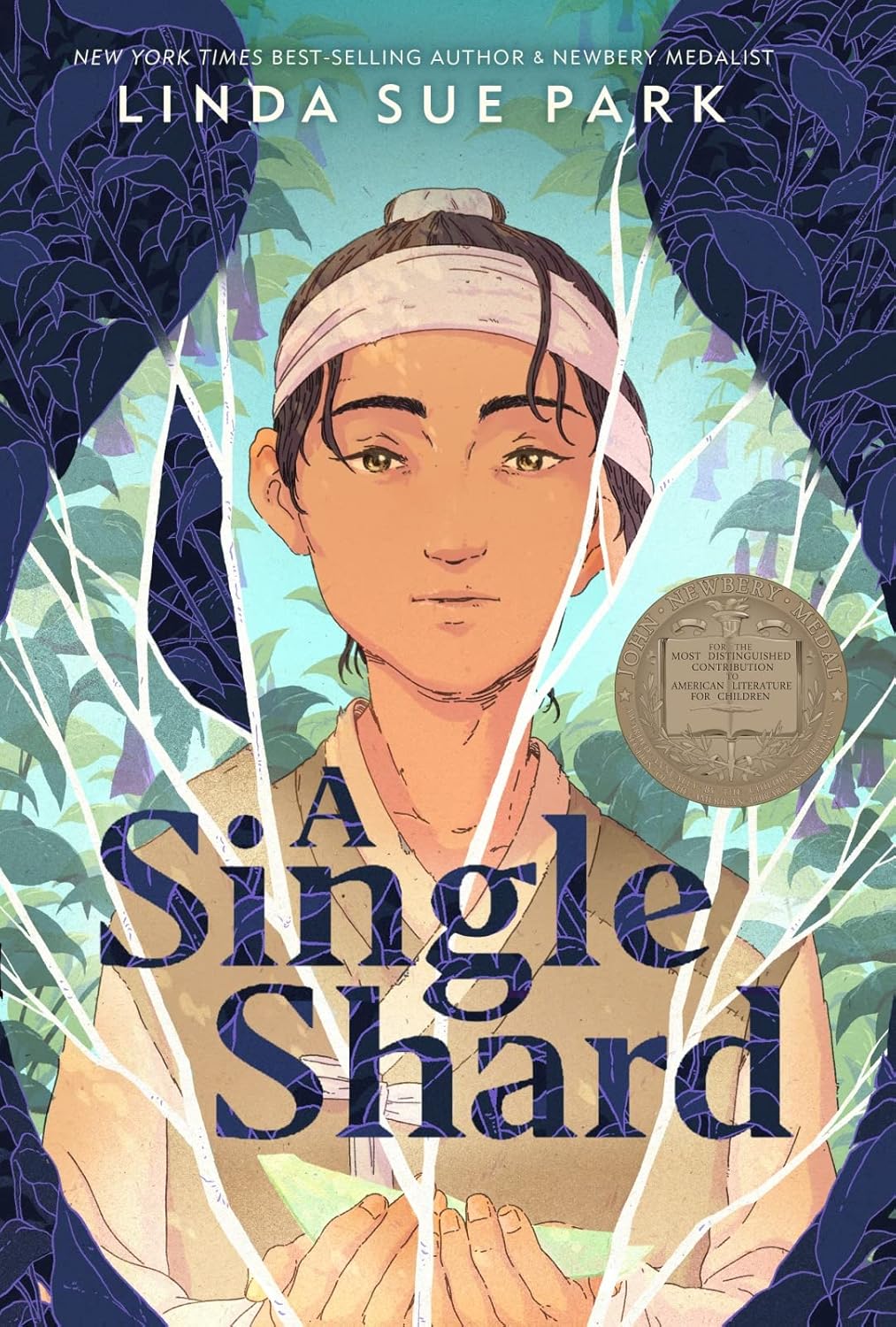
A Single Shard by Linda Sue Park is a Newbery Medal-winning novel set in 12th-century Korea about a homeless orphan boy named Tree-ear who works for a master potter and discovers, through his devotion to the craft, a path to belonging and purpose. Quiet, luminous, and deeply felt, it is a novel about patience, beauty, and what it means to earn your place in the world — one of the most distinctive and internationally minded Newbery winners in the catalog. This complete guide covers the reading level, age appropriateness, themes, characters, and everything parents and teachers need to know about this beautiful and important book.
For Parents
A Single Shard is a quiet, beautifully written novel about a boy with nothing who earns everything through patience and devotion. It is gentle in tone but honest about poverty, loss, and the difficulty of the medieval Korean world it depicts. Best suited for readers ages 9-12, it rewards patient readers who are willing to slow down and inhabit a world very different from their own — and it has a way of making readers care deeply about celadon pottery, which is one of its quiet miracles.
For Teachers
A Newbery Medal winner well suited to grades 4-6, A Single Shard is an outstanding text for teaching historical fiction, character development, and the relationship between craft and identity. The novel’s depiction of 12th-century Korean celadon pottery is meticulously researched and opens rich opportunities for cross-curricular connections to art history, Asian history, and the concept of apprenticeship. It pairs naturally with The Midwife’s Apprentice for a broader unit on medieval apprenticeship narratives across cultures.
A Single Shard at a Glance
Find on Amazon →| Author | Linda Sue Park |
| Published | 2001 |
| Grade Level | 4-6 (our assessment) |
| Recommended Age | 9-12 |
| Flesch-Kincaid Grade | 5.8 |
| Word Count | ~34,000 |
| Pages | 152 (standard hardcover) |
| Chapters | 13 |
| Genre | Historical fiction |
| Setting | Ch’ulp’o village, Korea (Koryo dynasty), 12th century |
| Awards | Newbery Medal (2002) |
For official Lexile and AR levels, visit Lexile.com or AR BookFinder. ReadingVine provides independent editorial assessments.
What Reading Level Is A Single Shard?
A Single Shard reads at approximately a 4th-6th grade level by our editorial assessment, with a Flesch-Kincaid grade level of around 5.8. The prose is clear and measured — Park writes in a style that is unhurried and precise, suited to a story about a craft that demands patience and attention. The vocabulary is accessible, though Korean names and place names, and the specialized terminology of pottery, add a modest layer of unfamiliarity that enriches rather than impedes the reading experience.
The novel’s primary demand is not linguistic but temperamental: it is a slow, quiet book about slow, quiet work, and readers who come to it expecting the pace of contemporary adventure fiction may need to adjust. Tree-ear’s world is one of careful observation, incremental learning, and deferred reward. Readers who can match that pace will find themselves completely absorbed; those who need constant plot movement may find the novel’s middle sections challenging.
The historical setting adds depth: 12th-century Korea under the Koryo dynasty is not a period or place most readers will know, and Park provides enough context within the narrative to orient readers without overwhelming the story. The novel is most commonly recommended for grades 4-6 and is accessible to strong readers in 3rd grade. For official Lexile and Accelerated Reader scores, visit Lexile.com or AR BookFinder.
What Age Is A Single Shard Appropriate For?
We recommend A Single Shard for readers ages 9-12. The novel deals with poverty, homelessness, the death of a beloved mentor, and a devastating loss near the end of the story — all handled with honesty and restraint. It is never frightening, but it is genuinely sad in places.
Tree-ear is a homeless orphan who begins the novel living under a bridge in genuine poverty, and his daily hunger and hardship are depicted without softening. The elderly man who is his guardian and companion, Crane-man, dies in the course of the story — his death is handled gently but honestly, and it carries real emotional weight. Near the end of the novel, Tree-ear suffers a significant loss related to his journey that is devastating in the moment but that he must find the strength to move past. There is no violence beyond a brief encounter with bandits, no strong language, and no sexual content. The emotional difficulty is appropriate to the age range and handled with care throughout.
The book is consistently recommended for ages 9-12 and has been widely used in elementary and middle school classrooms without generating content concerns. Its emotional honesty is one of its great strengths, and the losses it depicts are handled in ways that feel true rather than traumatic.
What Is A Single Shard About?
Tree-ear is a twelve-year-old orphan living under a bridge in the small Korean village of Ch’ulp’o with an elderly crippled man named Crane-man, who has no family of his own and who has become Tree-ear’s guardian, teacher, and dearest companion. They are desperately poor, surviving on whatever food they can find or beg. Tree-ear has no prospects and no plan — until, through an accidental encounter, he comes to the attention of Min, the village’s most gifted and most difficult potter.
Min works in celadon — the distinctive blue-green glazed pottery of the Korean Koryo dynasty, some of the most beautiful ceramic work in human history. Tree-ear becomes obsessed with Min’s work, watching him secretly for hours, marveling at how a lump of clay becomes something of such breathtaking beauty. When he breaks a piece of Min’s work by accident, he offers to work off his debt, and Min accepts. What begins as an obligation slowly becomes something else: a genuine apprenticeship, a growing understanding of what craftsmanship means, and a devotion to Min’s art that Tree-ear barely understands in himself.
When Tree-ear learns that the royal emissary is traveling through the region selecting potters to receive royal commissions — the highest honor and the surest path to security — he understands that everything depends on Min’s work being seen. He volunteers to carry two of Min’s finest vases on a long and dangerous journey to the royal court at Songdo. What happens on that journey, and what Tree-ear carries back from it, forms the novel’s devastating and ultimately hopeful conclusion.
Linda Sue Park, who is Korean American, spent years researching Korean celadon pottery and the social world of the Koryo dynasty. The pottery she describes — the specific techniques of inlaid celadon, the characteristic color that medieval Korean potters achieved and that later craftsmen could not replicate for centuries — is real, and her descriptions of Min at work are among the most beautiful passages in recent children’s historical fiction.
A Single Shard Characters
Is A Single Shard Banned?
A Single Shard has not been banned or challenged and does not appear on any lists of frequently challenged books. It is considered a distinguished, age-appropriate, and important work of children’s historical fiction and has been widely embraced by educators, librarians, and parents since winning the Newbery Medal in 2002. It is commonly shelved and assigned in schools across the country.
A Single Shard Themes and Lessons
The central theme of A Single Shard is the relationship between devotion and identity — what it means to care so much about something beautiful that the caring itself becomes who you are. Tree-ear does not become a potter in the course of the novel; he remains an apprentice’s assistant, a carrier of wood and clay. But his love for the work, his willingness to do anything to be near it and to serve it, defines him more fully than any title would. Park is making a quiet argument about the value of honest devotion — that the person who genuinely loves a thing and serves it faithfully is living with integrity, regardless of what the world calls them.
Crane-man’s philosophy runs through the novel as a second moral thread. His distinction between stealing a handful of food because you are hungry (forgivable, human) and stealing more than you need (a choice to become a thief) is one of the most memorable ethical formulations in recent children’s literature, and Tree-ear applies it throughout the story. Honesty — with Min, with Crane-man, with himself — is Tree-ear’s defining characteristic, and the novel honors it consistently.
Loss is handled with remarkable maturity. The novel asks Tree-ear to lose what he loves most — not once but twice — and to find, in the aftermath of each loss, that something essential remains. This is not a comforting lesson in the conventional sense, but it is a true one, and Park delivers it without false consolation.
Discussion starters for classrooms: What does Crane-man’s philosophy about stealing teach Tree-ear about how to live? Why does Tree-ear love Min’s pottery so much, even before he understands anything about how it is made? How does Tree-ear change over the course of the novel? What does he carry back from his journey that is more important than what he lost? Why do you think the book is called A Single Shard?
How Many Pages and Chapters Are in A Single Shard?
The standard hardcover edition of A Single Shard is 152 pages, divided into 13 chapters. The word count is approximately 34,000 words — placing it among the shorter Newbery Medal winners, short enough to read in two or three comfortable sittings but substantial enough to feel complete and fully realized. The chapters average around twelve pages each, a moderate length that creates natural stopping points without fragmenting the novel’s contemplative pace.
For readers in the target age range of 9-12, expect a reading time of roughly 3-5 hours, or about a week of steady reading at 30 minutes per session. As a classroom text, the novel works well in a two-to-three week unit. It reads beautifully aloud — the prose has a meditative quality that rewards the slower pace of reading aloud — and the pottery descriptions in particular land with more force when spoken. The novel’s short length and measured pace make it well suited for close reading exercises focused on description and sensory language.
Books Similar to A Single Shard
About Linda Sue Park
Linda Sue Park is a Korean American author born in 1960 in Urbana, Illinois, to Korean immigrant parents. She began writing poetry as a child and published her first poem in a children’s magazine at the age of nine. A Single Shard won the Newbery Medal in 2002, the first novel about Korea and the first by a Korean American author to receive the Medal. Park has spoken extensively about her desire to bring Korean history and culture into children’s literature — a tradition she felt was dramatically underrepresented when she was growing up. Her other novels include When My Name Was Keoko, about two Korean siblings living under Japanese occupation during World War II, Keeping Score, and the Archer’s Quest series. She is also the author of the picture book Bee-bim Bop! and has been a tireless advocate for diverse representation in children’s publishing. She lives in upstate New York.
A Single Shard: Frequently Asked Questions
What reading level is A Single Shard?
A Single Shard has a Flesch-Kincaid grade level of approximately 5.8. Our editorial assessment places it at grades 4-6 (ages 9-12). The prose is clear and accessible, though the novel’s quiet, contemplative pace demands a reader with patience. Strong readers in 3rd grade often love it. For official Lexile and AR scores, visit Lexile.com or AR BookFinder.
Why is the main character named Tree-ear?
Tree-ear is named after the tree-ear mushroom — a fungus that grows on dead wood without a parent seed of its own. As Crane-man explains early in the novel, Tree-ear came into the world without parents to plant him, just as the mushroom does, and so the name fits. It is a name given with affection rather than contempt, and it carries the novel’s central metaphor: a thing that grows without the usual origins can still become real, nourishing, and beautiful. By the end of the novel, Tree-ear has earned a different name, and the meaning of that transition is one of the book’s most satisfying moments.
What is celadon pottery and why does it matter in the novel?
Celadon is a type of pottery with a distinctive blue-green glaze, perfected by Korean potters during the Koryo dynasty (918-1392 CE). Korean celadon — particularly the inlaid variety that Min works toward in the novel — is considered one of the great achievements of world ceramic art. The specific color, which medieval Korean potters called “the color of jade” or “the secret color,” was the result of techniques so precise that later craftsmen struggled to replicate it for centuries after the Koryo dynasty fell. Park describes celadon and its making with great accuracy and care, and the beauty of Min’s finest pieces — which Tree-ear has never seen completed, only glimpsed in shards — is the gravitational center of the entire story.
What is the historical setting of A Single Shard?
The novel is set in Korea during the Koryo dynasty, in the 12th century — roughly 1150 CE. The Koryo dynasty ruled Korea from 918 to 1392 and is the origin of the Western name “Korea.” It was a period of significant cultural and artistic achievement, during which Korean celadon pottery reached its peak. The village of Ch’ulp’o, where the novel takes place, is fictional, but it is based on the real coastal villages of Korea’s southwest where celadon pottery was produced. Park’s research into the social structure, daily life, and artistic practices of the period is evident on every page.
What grade is A Single Shard typically assigned in?
A Single Shard is most commonly assigned in grades 4, 5, and 6, often as part of a historical fiction unit or a unit on Asian history and culture. Its short length and quiet intensity make it an excellent choice for close reading work, and its detailed descriptions of celadon pottery make it a natural cross-curricular text for art history. It pairs well with The Midwife’s Apprentice for a unit on medieval apprenticeship across cultures.
Why did A Single Shard win the Newbery Medal?
A Single Shard won the Newbery Medal in 2002 for the quality and distinction of its writing — specifically for the beauty and precision of Park’s prose, the depth and honesty of her characters, the meticulous historical authenticity of the Koryo dynasty setting, and the moral seriousness with which the novel treats its themes of craft, integrity, and loss. The Medal committee also recognized the historical significance of the selection: it was the first Newbery Medal ever awarded to a novel set in Korea and the first to a Korean American author, bringing a culture and tradition previously absent from the Newbery canon into its center.
Why is the book called A Single Shard?
The title refers to a literal shard of celadon pottery — a fragment from one of Min’s finest pieces. Without giving away the ending, a single shard is what Tree-ear is left with after the most devastating moment of his journey, and it becomes the thing that determines his future. But the title also carries a metaphorical weight: a shard is a fragment of something broken, something that was whole and beautiful and is now reduced to a remnant. The novel is, in part, about what a person does with the fragments left after a loss — whether a shard can be enough to build something new from.
Is A Single Shard part of a series?
No. A Single Shard is a standalone novel with a complete, self-contained story. Linda Sue Park’s other novels are not sequels, though readers who love A Single Shard may also enjoy When My Name Was Keoko, her novel about two Korean siblings living under Japanese occupation during World War II, which shares its deep immersion in Korean history and its quiet moral seriousness.