
 = Partner Site
A Thousand Splendid Suns Reading Level: A Complete Guide
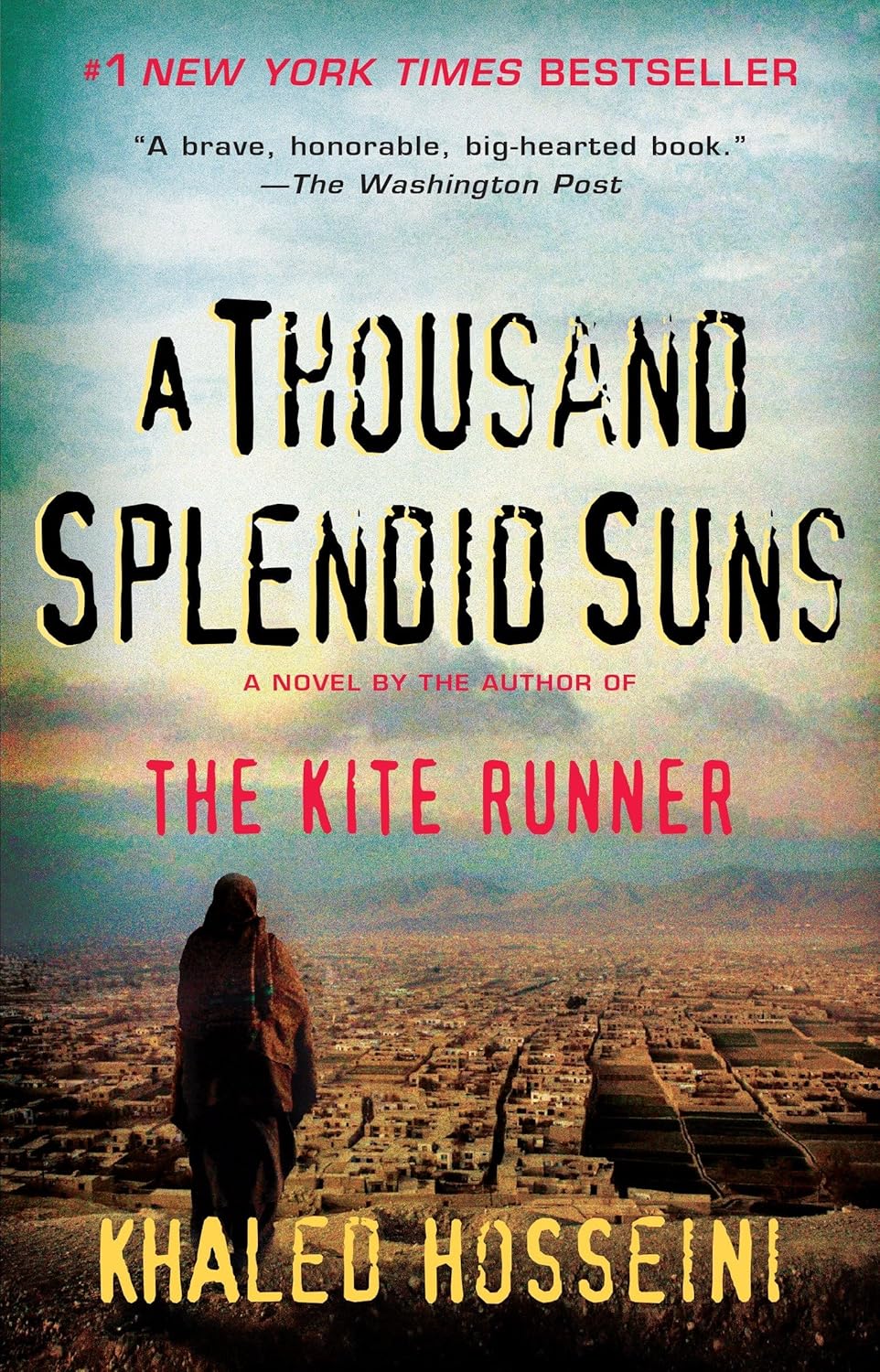
A Thousand Splendid Suns by Khaled Hosseini is a novel about two Afghan women — Mariam and Laila, born a generation apart — whose lives converge when they become wives to the same abusive man in Kabul, and who form a bond of mutual protection and love across nearly thirty years of Afghan history. Published in 2007, it spans the Soviet-Afghan War, the civil war of the early 1990s, the Taliban regime, and its aftermath, telling Afghanistan’s political history through the lives of two women who have almost no power within it. Hosseini has described it as a “mother-daughter story” in contrast to his earlier The Kite Runner, which he called a “father-son story.” This complete guide covers A Thousand Splendid Suns‘s reading level, recommended age, content considerations, characters, themes, and books similar to A Thousand Splendid Suns, designed for parents, teachers, and students.
For Parents
A deeply serious novel about domestic violence, forced marriage, and survival under oppression — the content is difficult and purposeful, not gratuitous. Contains sustained physical and psychological abuse, marital rape, miscarriage caused by violence, and Taliban-era persecution. Appropriate for ages 15 and up; most commonly assigned in grades 10–12.
For Teachers
A rich grades 10–12 text that combines accessible, emotionally immediate prose with a detailed portrait of Afghan history across three decades. Hosseini’s dual narrative structure — alternating between Mariam’s and Laila’s points of view — gives students two fully developed perspectives on the same events and is excellent for teaching focalization and narrative reliability. Pairs naturally with primary sources on the Soviet-Afghan War, the Taliban, and Afghan women’s rights.
A Thousand Splendid Suns at a Glance
Find on Amazon →| Author | Khaled Hosseini |
| Published | 2007 (Riverhead Books) |
| Grade Level | 10–12 (our assessment) |
| Recommended Age | 15+ |
| ATOS Reading Level | 5.4 |
| Lexile | 830L |
| Word Count | 103,556 |
| Pages | 372 (Riverhead paperback) |
| Chapters | 51 (in 4 parts) |
| Genre | Literary fiction / historical fiction |
| Setting | Herat and Kabul, Afghanistan; 1960s–early 2000s |
For official Lexile and AR levels, visit Lexile.com or AR BookFinder. ReadingVine provides independent editorial assessments.
What Reading Level Is A Thousand Splendid Suns?
A Thousand Splendid Suns has an ATOS reading level of 5.4 and a Lexile of 830L. As with Hemingway and Steinbeck in this catalog, these scores substantially underrepresent the novel’s actual demands — Hosseini writes in accessible, emotionally direct prose that keeps sentence complexity low while the subject matter and emotional weight require considerable maturity. A reader who can decode the sentences will not automatically be equipped to process what those sentences describe.
The novel’s primary difficulty is not linguistic but experiential: it asks readers to sustain engagement with sustained domestic violence, forced marriage, the death of children, and the systematic erasure of women’s public existence under the Taliban, across 372 pages and nearly four decades of fictional time. This is material that requires emotional and intellectual maturity rather than advanced vocabulary, which is why our assessment places it at grades 10–12 rather than the grades 7–12 range that some sources list. TeachingBooks grades it 7–12; Booksource’s interest-level rating is grades 9–12 with a “Mature Subject Matter” and “Sexual Assault and Abuse” flag. We side with Booksource’s content flags rather than TeachingBooks’ broader range.
At 103,556 words and 372 pages across 51 chapters in four parts, most classroom readers complete it in three to four weeks. The dual-protagonist structure — Parts 1 and 3 follow Mariam, Parts 2 and 4 follow Laila, with the two lives converging — is easy to follow and gives the novel a natural internal rhythm. For official Lexile and AR scores, visit Lexile.com or AR BookFinder. ReadingVine’s assessments are independent editorial judgments.
What Age Is A Thousand Splendid Suns Appropriate For?
We recommend A Thousand Splendid Suns for readers ages 15 and up. The novel’s content is more serious and more sustained in its difficulty than almost anything else in this catalog. This is not a warning against reading it — the content is handled with care and serves the novel’s larger argument about what women endure and how they survive — but parents and teachers should be fully prepared for what the novel contains before assigning it to younger readers.
Mariam is forced into marriage at fifteen to a man she does not know. The marriage involves marital rape, which is depicted without graphic detail but with complete clarity about what is happening. Rasheed, the husband, subjects both Mariam and Laila to sustained physical abuse throughout the novel — beatings that are described with specificity and that escalate over time. Mariam endures multiple miscarriages, some caused by or accelerated by the physical abuse. Laila’s parents are killed in a rocket attack; she watches their deaths. Under the Taliban regime, Mariam and Laila are subject to systematic erasure from public life: they cannot leave the house without a male guardian, cannot work, cannot seek medical treatment without a husband present. Mariam kills Rasheed to prevent him from killing Laila and accepts execution by the Taliban for it — she is shot in a public execution in the third section of the novel. The novel ends with Laila’s survival and return to a post-Taliban Afghanistan, but the ending is earned rather than comfortable: what was lost cannot be recovered. Teachers assigning this novel to students at the lower end of the recommended age should be prepared to discuss all of these elements before reading begins.
What Is A Thousand Splendid Suns About?
Mariam is the illegitimate daughter of a wealthy man in Herat who visits her weekly but will not acknowledge her publicly. When her mother dies by suicide and Mariam goes to her father’s house hoping to be taken in, his legitimate family sends her away — and arranges for her to marry Rasheed, a shoemaker from Kabul she has never met. She is fifteen. Rasheed is kind at first. When Mariam fails to produce a son — she suffers a series of miscarriages — his cruelty becomes the defining condition of her life. She spends the next decade in increasing isolation, learning to navigate the requirements of survival in an abusive household.
Laila grows up in Kabul in the 1980s during the Soviet-Afghan War. Her father is an educated man who believes in women’s education and encourages her reading; her childhood is marked by the ongoing war but also by genuine friendship, love, and possibility. She loves Tariq, her neighbor and closest friend. When her brothers are killed fighting the mujahideen and Tariq’s family flees to Pakistan, and when a rocket attack kills both her parents, Laila is alone — and then injured, and then dependent on the charity of the household next door. The household belongs to Rasheed and Mariam.
Rasheed, seeing in Laila the possibility of a son, convinces her — through a lie that Tariq has been killed — to marry him. She accepts to protect the child she is already carrying, Tariq’s child, who will be raised as Rasheed’s. Mariam and Laila begin as rivals in the household, Mariam resenting the younger woman who has taken the little security she had. Over years of shared suffering, they become the closest thing either has to family — protective, loyal, willing to sacrifice for each other in ways the novel builds toward from its first pages.
The Taliban’s arrival in Kabul in 1996 tightens every constraint the women have been living under. When Rasheed’s violence reaches a crisis point — he has his hands around Laila’s throat — Mariam kills him with a shovel to save her. She insists Laila escape with the children; she stays to face the Taliban’s justice. She is executed. Laila eventually reaches Pakistan, finds Tariq alive (the lie Rasheed told was entirely fabricated), and spends years in exile before returning to a changed Afghanistan to rebuild a school and make something of what remains.
A Thousand Splendid Suns Characters
Is A Thousand Splendid Suns Banned?
A Thousand Splendid Suns has been challenged in schools and libraries primarily for its depictions of violence and abuse against women. The challenges acknowledge that the content is real but argue that it is too intense for student readers — an argument the novel’s defenders have countered by noting that its purpose is precisely to make that reality visible and comprehensible rather than abstract. In 2025, the novel was removed from the curriculum of a Minnesota high school and became the subject of a public discussion that included Hosseini himself, who spoke about the decision in an interview with the Minnesota Reformer.
The novel has also generated a distinct category of concern from some Muslim and Afghan-American students and educators, who have argued that the novel’s portrait of Taliban-era Afghanistan risks reinforcing stereotypes about Islam and Afghan culture — that a Western readership encountering the Taliban’s practices through a novel may associate those practices with Islam more broadly. This is a substantive educational concern rather than a content objection, and it is worth addressing directly in classrooms: the Taliban regime was widely condemned by Muslim scholars and communities worldwide, and the novel depicts a specific political movement’s perversion of religious authority, not a representation of Islamic practice generally.
A Thousand Splendid Suns Themes and Lessons
The novel’s most persistent argument is about the specific mechanisms by which women are controlled and the specific forms of resistance that remain available when those mechanisms are most total. Mariam and Laila are not passive victims — they calculate, manage, protect each other, find small freedoms within the household’s constraints — but Hosseini is also honest about how limited those freedoms are and at what cost they come. Mariam’s killing of Rasheed is not presented as empowerment in the contemporary sense; it is presented as a desperate act of protection that she knows will cost her life, and she accepts that cost because Laila’s survival matters more to her than her own. This is the novel’s most serious argument: that the love between women, in conditions designed to isolate and subordinate them, becomes the primary mechanism of survival — not as a political position but as a human reality.
The novel’s historical scope — from the final years of Mohammed Daoud Khan’s republic through the Soviet invasion, the mujahideen civil war, the Taliban, and the American invasion — is not background material but the novel’s structural argument. Each political regime changes the specific conditions of Mariam and Laila’s lives, and Hosseini tracks these changes with documentary care. The Taliban’s arrival in 1996 is the novel’s political climax: the decree that women may not leave home without a male guardian, may not work, may not seek education, may not wear anything but the full burqa — these are not background texture but the immediate material conditions that shape every decision both women make in the novel’s second half. Students who read the novel without this historical context miss a significant part of what Hosseini is doing.
The title comes from a 17th-century Persian poem by Saib-e-Tabrizi, which ends with the lines: “One could not count the moons that shimmer on her roofs, / Or the thousand splendid suns that hide behind her walls.” Hosseini uses this poem to describe Kabul — the city as a place of hidden beauty and endurance — but also to describe Mariam and Laila themselves: the suns hidden behind walls, the beauty and resilience that oppression cannot fully suppress.
Discussion questions for classrooms and families: What specific legal and cultural conditions make Rasheed’s abuse possible — and how does the novel track the way political regimes either constrain or enable those conditions? What does Mariam’s decision to stay and face execution, rather than escape with Laila, tell us about how she understands her own life and value? How does Hosseini use the alternating narrative structure — Mariam’s story first, then Laila’s — to shape the reader’s experience of their relationship? What does the title’s reference to “thousand splendid suns” hiding behind Kabul’s walls mean by the novel’s end? How should Western readers approach the novel’s depiction of Islamic extremism without generalizing from the Taliban to Islam as a whole?
How Many Pages and Chapters in A Thousand Splendid Suns?
The Riverhead paperback is 372 pages across 51 chapters organized into four parts. Parts 1 and 3 follow Mariam; Parts 2 and 4 follow Laila. The parts are roughly equal in length, giving the two narratives comparable weight. Word count is 103,556. Most classroom readers complete the novel in three to four weeks. The chapters are short — most run five to eight pages — which makes the novel feel more propulsive than its length suggests and provides natural stopping points for discussion.
Books Similar to A Thousand Splendid Suns
About Khaled Hosseini
Khaled Hosseini was born in 1965 in Kabul, Afghanistan. His father was a diplomat and his mother a teacher of Farsi and history; the family was living in Paris when the Soviet-backed coup of 1978 made return to Afghanistan impossible, and they sought asylum in the United States in 1980. Hosseini grew up in the United States, trained as a physician, and practiced internal medicine for several years before his debut novel The Kite Runner (2003) became an international bestseller and effectively ended his medical career. He has described both novels as attempts to give Western readers a human-scale entry point into an Afghanistan that had largely been visible to them only through news coverage of war and terrorism.
He has said that A Thousand Splendid Suns began with his reaction to the news coverage of the Taliban’s treatment of women in Afghanistan — specifically with his sense that the stories of individual Afghan women were being flattened into a single anonymous image of suffering. He wanted to give two specific women specific lives, and to trace those lives across enough time that readers would understand how Afghanistan’s political history was experienced not abstractly but personally, in the domestic spaces of specific households. Since the novel’s publication, Hosseini has been active in humanitarian work for Afghan refugees through the Khaled Hosseini Foundation. His third novel, And the Mountains Echoed, was published in 2013.
A Thousand Splendid Suns: Frequently Asked Questions
What reading level is A Thousand Splendid Suns?
A Thousand Splendid Suns has an ATOS reading level of 5.4 and a Lexile of 830L. These scores reflect the prose’s accessibility but not the emotional and contextual demands of the content. Our editorial assessment places it at grades 10–12 (ages 15+), consistent with Booksource’s “Mature Subject Matter” and “Sexual Assault and Abuse” flags. For official Lexile and AR scores, visit Lexile.com or AR BookFinder.
What grade is A Thousand Splendid Suns appropriate for?
We recommend grades 10–12, ages 15 and up. The novel contains sustained domestic violence, marital rape, miscarriages caused by abuse, the on-page execution of a central character, and systematic oppression under Taliban rule. The content is handled with care and serves the novel’s larger purposes, but it requires emotional maturity to process.
How many pages are in A Thousand Splendid Suns?
The Riverhead paperback is 372 pages across 51 chapters in four parts. Word count is 103,556. Most classroom readers complete it in three to four weeks. The chapters are short and the prose is propulsive, making the length feel faster than it is.
What is A Thousand Splendid Suns about?
Mariam, an illegitimate teenager from Herat, is forced into marriage with Rasheed, an abusive shoemaker in Kabul. A generation later, Laila — a Kabul girl whose family is destroyed by rocket fire — is maneuvered by circumstance into the same household, the same husband, and eventually the same bond with Mariam. The novel spans nearly forty years of Afghan history and ends with Mariam’s execution for killing Rasheed to save Laila, and Laila’s survival and eventual return to rebuild something from what remains.
What is the relationship between Mariam and Laila?
They begin as rivals within the household — Mariam resents Laila as a younger wife who threatens what little stability she has; Laila is frightened of Mariam’s coldness. Over years of shared suffering under Rasheed, their relationship becomes one of mutual protection and deep love that Hosseini describes as both sisterhood and a mother-daughter bond. It is the novel’s primary relationship, and ultimately the most important one: Mariam’s death makes Laila’s survival possible, and Laila carries Mariam’s memory as the foundation of everything she builds afterward.
Why does Mariam kill Rasheed?
Rasheed has his hands around Laila’s throat and is actively strangling her. Mariam picks up a shovel and hits him until he stops. The killing is not planned; it is a response to an immediate threat to Laila’s life. Mariam’s subsequent decision to stay and face Taliban justice rather than escape with Laila is deliberate: she is the one who has killed Rasheed, she believes her survival is unlikely even in flight, and she insists that Laila — younger, with children, with a possible future — is the one who must live.
Where does the title come from?
From a 17th-century Persian poem by Saib-e-Tabrizi about Kabul: “One could not count the moons that shimmer on her roofs, / Or the thousand splendid suns that hide behind her walls.” Hosseini uses the image to describe Kabul as a city of hidden beauty and endurance — and implicitly to describe Mariam and Laila as the suns hidden behind walls: the beauty, resilience, and worth that the systems surrounding them cannot fully suppress or destroy.
Is A Thousand Splendid Suns based on a true story?
No — it is a work of fiction. However, Hosseini drew on substantial research into Afghan history, the specific practices of the Taliban regime, and the experiences of Afghan women during the periods the novel covers. The political events described — the Soviet-Afghan War, the mujahideen civil war, the Taliban’s rise and fall, the American invasion — are historical facts, and the conditions imposed on women under the Taliban are accurately depicted. The characters are invented; the world they inhabit is real.