
 = Partner Site
Amazing Grace Reading Level: A Complete Guide
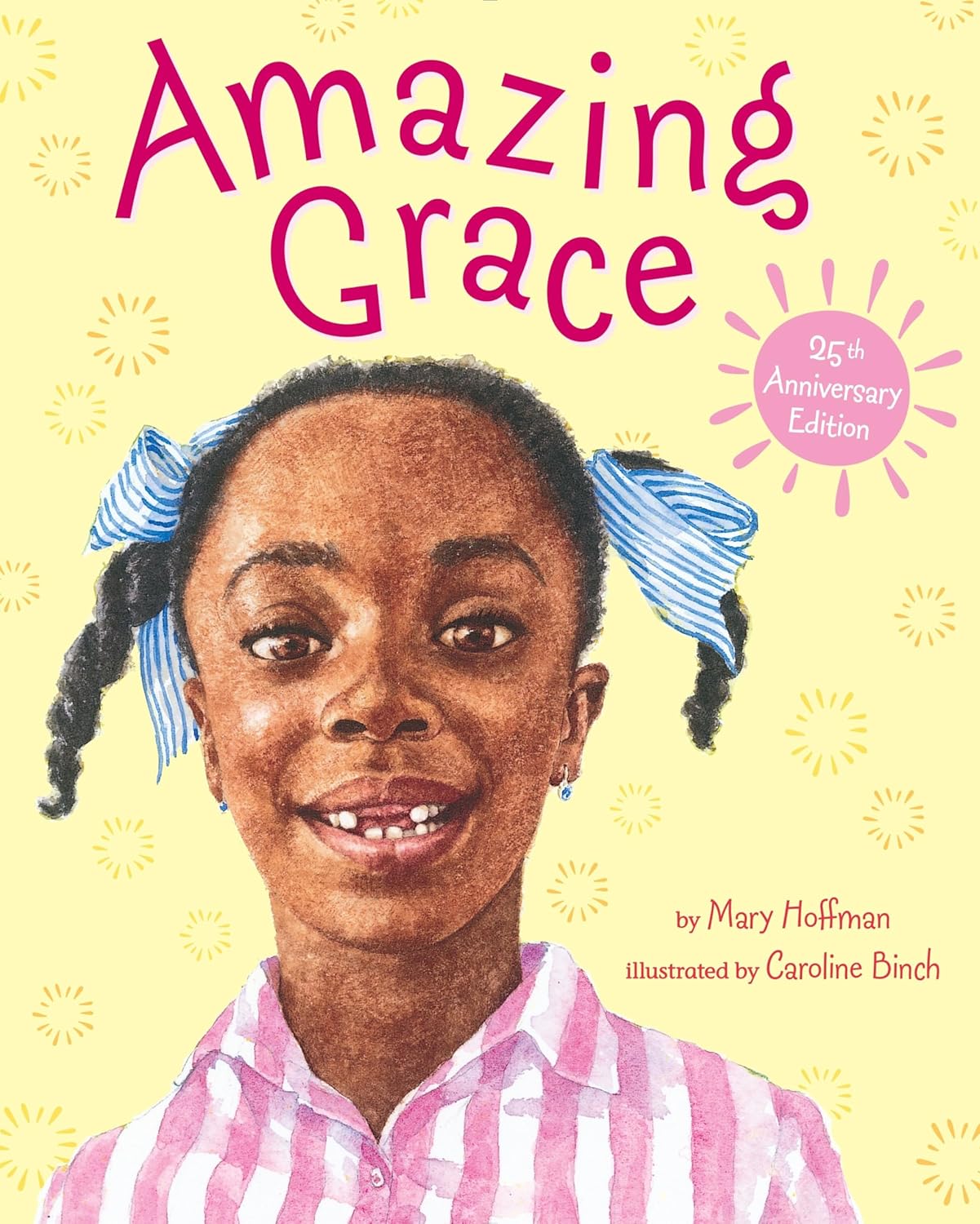
Amazing Grace by Mary Hoffman, illustrated by Caroline Binch, is a beloved and enduring picture book about imagination, self-belief, and the particular damage of being told you cannot do something because of who you are. Published in 1991, it tells the story of Grace — a girl who loves stories, who acts all the best parts herself, who wants desperately to play Peter Pan in her class play — and who is told by her classmates that she cannot because she is Black and a girl. Her grandmother and mother know better. So does Grace, once she is reminded. The book has sold over 1.5 million copies worldwide including its sequels and is widely taught in K–2 classrooms. This guide covers the reading level, recommended age, read-aloud vs. independent reading guidance, themes, and everything parents and teachers need to know about sharing Amazing Grace with young readers.
For Parents
Find out whether Amazing Grace works best as a read-aloud or independent read for your child, what age range it suits, and why this story — about a girl who refuses to accept other people’s limits on her imagination — speaks directly to children who have ever been told they can’t be something because of who they are.
For Teachers
Grade-level data, read-aloud timing, key themes, and discussion questions for a classroom classic on self-belief, racial identity, gender, and the power of representation. Strong for discussions of what it means to be told you “can’t” do something, for the first week of school, and for any unit on identity, imagination, or the stories we tell about ourselves.
Amazing Grace at a Glance
Find on Amazon →| Author | Mary Hoffman |
| Illustrator | Caroline Binch |
| Published | 1991 |
| Grade Level | K–2 (our assessment) |
| Recommended Age | 4–8 |
| Best For | Read-aloud ages 4–8; independent reading ages 5–8 |
| Flesch-Kincaid Grade | 3.2 |
| Word Count | ~700 |
| Pages | 32 |
| Genre | Picture book / realistic fiction / identity |
| Setting | Grace’s home; her classroom; a ballet performance |
| Awards | Kinderboekwinkelprijs (1993) |
For official Lexile and AR levels, visit Lexile.com or AR BookFinder. ReadingVine provides independent editorial assessments.
What Reading Level Is Amazing Grace?
Amazing Grace is a K–2 reading level by our editorial assessment, with a Flesch-Kincaid grade level of approximately 3.2. At around 700 words it is a longer picture book, with prose that is warm and flowing rather than clipped — Hoffman writes in a storyteller’s voice, using varied sentence structure and a generous vocabulary that includes words like audition, rehearsal, and indomitable without defining them, trusting context and illustration to carry meaning. This is slightly more demanding than a simple picture book prose style, and reflects the book’s British origins: Hoffman’s prose has a slightly more formal register than most American picture book writing, which children generally absorb without difficulty but which parents reading aloud should be prepared to pace through.
Caroline Binch’s detailed watercolor illustrations carry a great deal of the story’s emotional content and are essential to the full experience — the early spreads showing Grace acting out various roles in improvised costumes, the deflation on her face when her classmates object, the transformation when she sees the Trinidadian dancer, and the triumph of the audition are all told primarily in Binch’s images. Children who look closely at the illustrations are reading a second, parallel text alongside Hoffman’s prose. For parents who use specific reading level systems: we recommend checking your child’s level on Lexile.com or AR BookFinder for official scores.
Is Amazing Grace a Read-Aloud or Independent Read?
Amazing Grace works beautifully as both a read-aloud for ages 4–8 and an independent read for ages 5–8. As a read-aloud it is an engaging picture book at this level because the story has genuine dramatic stakes — Grace wants something, is told she cannot have it, is hurt by that, and must find the inner resource to prove the doubters wrong — and children who root for Grace feel the audition scene as a genuine triumph. Most adults can read it aloud in about 8–12 minutes.
As a read-aloud, Amazing Grace benefits from a slightly slower pace than simpler picture books — Hoffman’s prose has warmth and rhythm that reward deliberate reading, and the early pages showing Grace’s imaginative play invite children to identify each role before the story names it. The moment when Raj and Natalie tell Grace she cannot be Peter Pan is worth pausing on: it is uncomfortable, and the discomfort is intentional. Children who feel that discomfort, who understand why what was said was wrong before Grace’s grandmother explains it, are doing real ethical reasoning from the text. The grandmother Nana’s response — “You can be anything you want, Grace, if you put your mind to it” — is the book’s emotional pivot, and it lands best when the discomfort that precedes it has been fully felt.
For independent reading, a confident first or second grader can handle the vocabulary and the prose, though some words (audition, rehearsal) may need brief support. The sequential narrative structure is clear and easy to follow, and the emotional logic — want, obstacle, doubt, inspiration, triumph — follows a natural story shape that children track intuitively. Children who read Amazing Grace independently often want to discuss it immediately afterward, which is among the book’s strengths: it is not a book that ends quietly. The audition scene generates conversation.
Before you start, ask your child: “Have you ever really wanted to be something or do something, and someone told you that you couldn’t?” Let them answer, if they want to. Then read Amazing Grace, and when Raj and Natalie say what they say, ask: “Was that okay to say?” Children who have connected their own experience to Grace’s before the objection arrives feel the wrongness of it more vividly, and Grace’s triumph at the audition means more to them. After reading, ask: “What made Grace think she could do it in the end?” The answer — seeing the Trinidadian dancer, understanding that someone who looks like her can play any part — is about representation, and it is worth naming.
What Is Amazing Grace About?
Grace loves stories. She loves them from books, from movies, from her grandmother Nana’s tales of far-off places. Most of all she loves to act them out, always playing the best parts herself: Anansi the Spider, Joan of Arc, Mowgli, the doctor in her family games. So when her teacher announces that the class will perform Peter Pan, Grace’s hand shoots up for the lead.
Two classmates object. Raj says Grace can’t play Peter Pan because she’s a girl. Natalie says she can’t because she’s Black. Grace goes home sad and hurt, and tells Nana and Ma what happened. Nana’s response is decisive: “You can be anything you want to be, Grace, if you put your mind to it.” To show her what she means, Nana takes Grace to see a ballet at the weekend — a production starring a Trinidadian dancer in a role that proves, to Grace’s astonishment and delight, that someone who looks like her can play any part in any story.
At the audition, Grace is magnificent. She is the best Peter Pan the class has ever seen, and the vote is unanimous. At the performance, she flies. The book ends with Grace certain — not just for now, but for always — that she can be anything she wants to be.
Amazing Grace Characters
Amazing Grace Themes and Lessons
The central theme of Amazing Grace is the right to imagine yourself in any role — and the specific harm done when that right is denied by other people’s assumptions about who you are. Raj and Natalie are not villains; they are children who have absorbed assumptions from their world and repeated them without much thought. But the damage those assumptions do to Grace is real and immediate, and the book does not minimize it. Grace goes home sad. The doubt is real. What restores her is not a pep talk but evidence: the Trinidadian dancer who performs a role that “should have” been unavailable to someone who looks like her, and does it magnificently. This is a central thing Amazing Grace says: that telling a child they can be anything is less powerful than showing them someone who already was.
The book is also among the earlier and more direct children’s picture books to address the intersection of race and gender as barriers applied to a child’s imagination. Raj objects because Grace is a girl; Natalie objects because she is Black. Both objections are wrong for the same reason — neither the role nor the story belongs exclusively to any particular kind of person — and both are addressed by the same resolution. This specificity matters: Amazing Grace does not discuss prejudice abstractly. It shows it happening to a specific child in a specific moment, and it shows that child doing something about it.
For teachers, Amazing Grace is a reliable book for opening discussions about representation and possibility with K–2 students. The question it implicitly asks — “Who gets to play what roles in what stories?” — is a pressing question in children’s literature and in childhood itself, and it is asked here in a way that young children can engage with immediately, because Grace’s situation is concrete and recognizable. The book does not require children to understand systemic racism or the history of gender discrimination; it requires them to feel whether it was okay that Raj and Natalie said what they said, and to watch what Grace does in response. That is enough to begin the conversation.
Discussion starters for families: Was it okay for Raj and Natalie to say those things? Why or why not? How did Grace feel when they said it? What changed her mind? What do you want to be when you grow up — and what would you do if someone told you that you couldn’t? Have you ever seen someone who looks like you doing something amazing?
How Long Is Amazing Grace?
Amazing Grace has 32 pages and approximately 700 words. Most adults can read it aloud in about 8–12 minutes. The pacing follows the story’s dramatic structure — the opening pages are expansive and joyful, showing Grace in imaginative play; the middle pages are quieter and more painful; the ballet and audition scenes build back to the book’s triumphant conclusion. Children who are emotionally engaged by the story typically experience it as faster than it is, because they are following Grace rather than counting pages.
A child reading independently at a first- or second-grade level will typically finish in about 10–15 minutes. The prose is slightly more varied and demanding than many picture books at this level, and some children benefit from a read-aloud experience before attempting it independently. The illustrations carry enough of the story that a child who gets stuck on a word can usually work out the meaning from the image on the same spread.
Books Similar to Amazing Grace
If your child loves Amazing Grace, these titles share its themes of identity, self-belief, and the courage to claim your story, or its place in the Identity and Belonging cluster:
About the Author and Illustrator
Mary Hoffman is a British author who has written more than 100 books for children and young adults over a career spanning several decades. She lives in Oxfordshire, England. Amazing Grace, published in 1991, was her first picture book for Frances Lincoln publishers and became her best-known work — it has sold over 1.5 million copies worldwide with its sequels, and has been in print continuously since its first publication. Hoffman has said that Grace came to her as a specific, fully formed character: a girl who plays all the best roles in all the stories she loves, and who should not have to justify that to anyone. The book has been followed by several sequels in the Grace series, including Boundless Grace, which follows Grace to visit her father in Africa, and Grace and Family, all illustrated by Binch. Hoffman’s other work includes picture books, historical fiction, and retellings of mythology and folklore.
Caroline Binch is a British illustrator whose detailed, luminous watercolor paintings are as responsible for Amazing Grace’s impact as Hoffman’s text. Her illustrations are notable for their realism — Grace’s expressions, the costumes, the specific warmth of the family home, the joyful energy of the audition — and for the way they carry the story’s emotional shifts in Grace’s face and body language across the book. Binch won the Smarties Prize for her illustrations for Hue Boy by Rita Phillips Mitchell, and her own authored book Gregory Cool was shortlisted for the Kate Greenaway Medal. For parents and teachers who use Amazing Grace in classrooms, the illustrations repay close attention: Binch embedded numerous details in the early spreads — the specific roles Grace plays, the household objects she uses as props, the warmth and specificity of Nana’s presence — that become richer on repeated readings.
One note on editions: a 25th anniversary edition of Amazing Grace was published in 2016. This edition revised one illustration from the original — replacing an image of Grace playing Hiawatha with an image of her as Aladdin — in response to concerns about the original’s depiction of a Native American character. Both editions remain in print; the original 1991 text and illustrations are preserved in earlier printings. Families and teachers who are aware of this change can seek the edition that best fits their context.
Amazing Grace: Frequently Asked Questions
What reading level is Amazing Grace?
Amazing Grace is a K–2 reading level by our editorial assessment, with a Flesch-Kincaid grade level of approximately 3.2. At around 700 words with flowing prose and some vocabulary that may need support (audition, rehearsal), it works best as a read-aloud for ages 4–8 and as an independent read for ages 5–8. Caroline Binch’s detailed watercolor illustrations carry significant story content alongside the text. For official Lexile and AR levels, visit Lexile.com or AR BookFinder.
What age is Amazing Grace for?
Amazing Grace is appropriate for ages 4–8. As a read-aloud it works from age 4 — younger children respond immediately to Grace’s imaginative play and to the story’s triumphant resolution, even if the specific conversation about race and gender takes on fuller meaning later. As an independent read it suits first and second graders ages 5–8. It is widely recommended for conversations about race, gender, and self-belief at the K–2 level.
What is the message of Amazing Grace?
Amazing Grace’s central message is that you can be anything you want to be — and that neither your race nor your gender is a legitimate reason for anyone to tell you otherwise. More specifically, it argues that seeing someone who looks like you doing something amazing is more powerful than any amount of telling, which is why Nana takes Grace to the ballet rather than simply reassuring her. The book’s enduring classroom use reflects how precisely it names the specific damage of being told “you can’t” by someone who bases that judgment on who you are rather than what you are capable of.
How long does it take to read Amazing Grace aloud?
Most adults can read Amazing Grace aloud in about 8–12 minutes. The pacing follows the story’s dramatic arc — joyful and expansive at the beginning with Grace’s imaginative play, quieter and more painful in the middle when she is told she cannot audition, then building to the triumphant audition and performance at the end. Children who are emotionally invested in Grace’s story experience the book as faster than its word count suggests.
Why does the Trinidadian dancer matter in Amazing Grace?
The Trinidadian dancer is the turning point of Amazing Grace because she provides something more powerful than reassurance: evidence. Nana could tell Grace that she can be anything she wants — and she does — but what changes Grace’s mind completely is seeing, with her own eyes, a Black woman performing a role that the world might have said “was not for her.” The dancer proves by example what no amount of telling can prove: that the story belongs to whoever tells it best, and that Grace can be Peter Pan because someone who looks like Grace already performed a role that others might have thought impossible. This is why representation matters, told directly and usefully.
Are there other books in the Grace series?
Yes — Mary Hoffman and Caroline Binch continued the Grace series with Boundless Grace, in which Grace travels to visit her father in Gambia, West Africa, and confronts new questions about what makes a family. Later Grace books include Grace and Family and others. All continue to follow Grace’s life with the same warmth and specificity as the original. Boundless Grace is widely recommended as a companion to Amazing Grace for classroom use, particularly for discussions of family structure and belonging.